
NEET Time Table for School Students: A Practical, Calm Plan to Balance Classes and Competitive Prep
Balancing regular school hours, homework, and serious NEET preparation can feel like juggling three textbooks, a lab manual, and a stopwatch — all at once. If you’re in school and aiming for NEET, the good news is that this is not only common, it’s totally solvable. A smart timetable isn’t about doing twice as much; it’s about aligning what your school teaches with what NEET demands, adding focused practice, and protecting energy for consistent performance.
Before we get to the weekly grids and sample routines, a few ground truths to keep handy: NEET is tested through multiple-choice questions, it rewards accuracy (positive marks for correct answers and penalty for wrong ones), and the full-length exam is a timed, three-hour experience that requires OMR-sheet discipline and smart time management. Treat school classes as fuel for your NEET engine rather than competition for your time — the overlap between school syllabus and NEET topics is your biggest advantage.
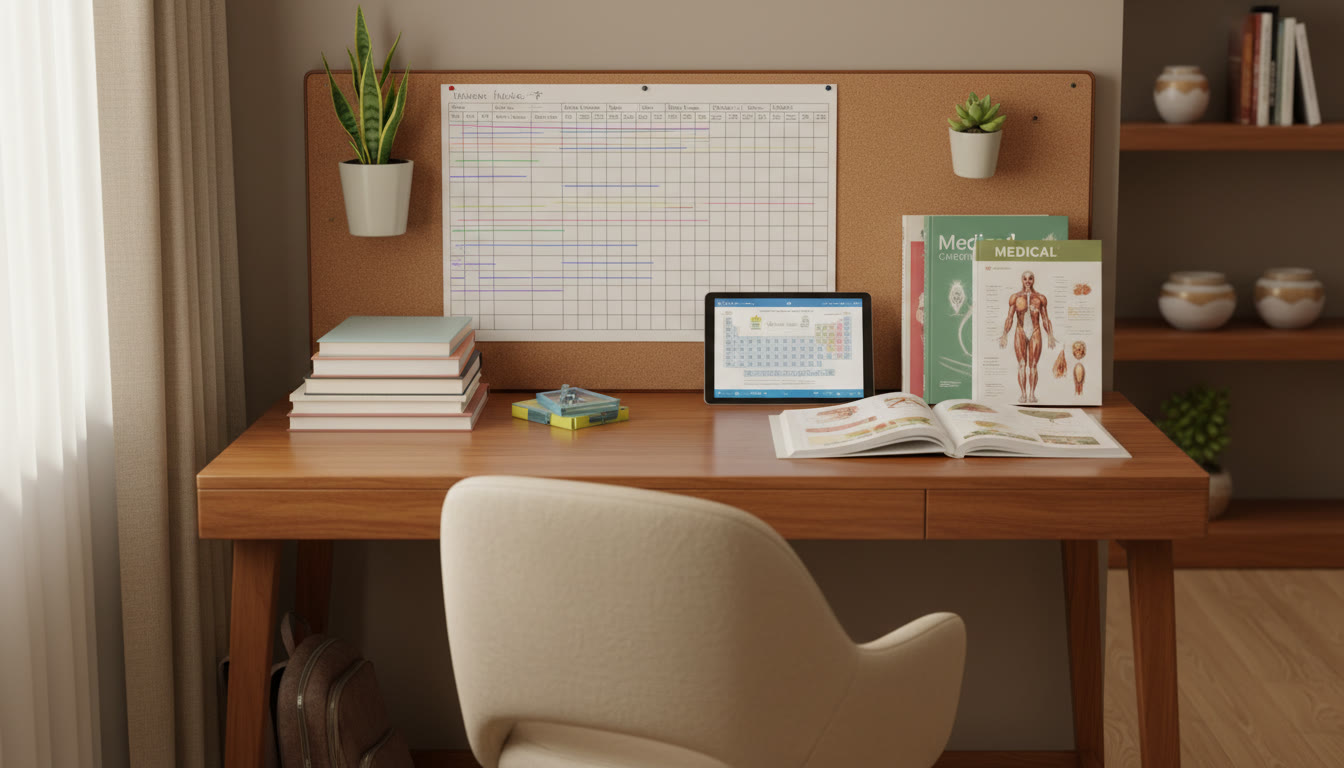
Start with Clear Priorities: What’s Non-Negotiable
When you live in two academic worlds (school and NEET prep), priorities must be ranked. Here’s how to decide what gets first dibs on your time:
- Attendance and core school tasks: Morning classes, labs, and any mandatory school assessments stay top-priority — they build concepts and often mirror the kind of factual recall and procedures asked in entrance tests.
- NEET-focused practice: Daily micro-sessions for MCQs and problem-solving are essential. Short, regular practice wins over long, infrequent cram sessions.
- Rest and recovery: Sleep, short breaks, and decent nutrition cannot be sacrificed without harming retention and test performance.
Why rank this way?
School provides a structured conceptual backbone. NEET tests that backbone in MCQ form under time pressure. When you turn school learning into targeted practice (notes → micro-MCQs → timed mocks), you get the best return on limited time.
Designing a Weekly Timetable That Respects School
A good weekly timetable for a school student does three simple things: it protects school time, creates short daily slots for NEET study around school, and reserves one large block for a full-length mock or extended revision. Here is a balanced sample week you can adapt to your school hours and energy levels.
| Time | Weekday (School Day) | Main NEET Focus | Activity |
|---|---|---|---|
| 5:30–6:30 AM | Wake, light revision | Quick recall (Biology diagrams / Formulas) | 20–30 min active recall + 20 min handwritten notes |
| 7:30 AM–2:30 PM | School hours | School syllabus | Attend classes, note difficult points for evening review |
| 4:00–6:00 PM | After-school | Concept practice (Physics/Math problems or Chemistry reactions) | Focused practice: solved examples, short MCQ sets |
| 7:00–8:00 PM | Evening | School homework → NEET alignment | Convert school homework into test-style practice; tidy notes |
| 9:30–10:30 PM | Night | Light revision / Memory work | Flashcards, diagrams, and 10-minute recap |
This table is a template. If your school ends later, swap the morning micro-session to a short mid-day session or lengthen the evening block while ensuring 7–8 hours of sleep overall.
Daily Micro-Routine: Small Habits, Big Gains
Consistency beats intensity. Break your day into bite-sized, focused blocks that respect cognitive load:
- Morning 30–60 min: Active recall — quick MCQs, formula flash, or a biology diagram redo. The mind is fresh and remembers better.
- After school (45–90 min): Deep focus on the day’s toughest topic — problem solving for physics, reaction writing for chemistry, or long biology passages.
- Evening (30–60 min): Convert school assignments into NEET-style questions and review errors from the day.
- Night (15–30 min): A light recap. Nothing new — just reinforcement to consolidate memory before sleep.
Example micro-session
Pick one concept (e.g., kinematics equation, an organic reaction mechanism, or a plant physiology diagram). Do a 20-minute focused practice: 10 minutes solving or redrawing, 10 minutes doing 8–10 MCQs on it. Close the session with one-line takeaways written in your “idea bank.”
Weekly Focus: How to Allocate Topics
Think of a week as a cycle: learn → practice → test → correct. A simple distribution works well for students who must juggle school:
- 3 days of concept building: Link these with whatever your school taught that week.
- 2 days of problem/MCQ practice: Timed sets of 25–50 MCQs for targeted topics.
- 1 day for full-length or sectional mock: A full 3-hour simulated session every 1–2 weeks, or a sectional timed test weekly.
- 1 day for revision/relief: Light review, doubt clearing, and rest.
| Day | Primary Activity | Goal |
|---|---|---|
| Monday | School + Concept (Physics) | Understand derivations and solve 3 example problems |
| Tuesday | School + Concept (Chemistry) | Balance equations, practice reaction mechanisms |
| Wednesday | School + Concept (Biology) | Diagrams and facts: active recall |
| Thursday | MCQ Practice (Mix) | Timed sets: accuracy & speed |
| Friday | Problem Deep-dive | Work on weak topics identified earlier |
| Saturday | Sectional Mock / Analysis | Complete 1 section under timed conditions |
| Sunday | Full-length Mock / Revision | 3-hour full simulation once bi-weekly or weekly |

Mock Tests and OMR Discipline: Practice Like the Real Day
Mock tests are not just for score-checking; they’re the rehearsal for the real three-hour performance. Key points to practice consistently:
- Practice full-length three-hour mocks under exam-like conditions at least once every one to two weeks. If weekly mocks are too intense, simulate a full mock once every two weeks and do sectional timed tests in alternate weeks.
- Train your OMR discipline: fill answers carefully, avoid bubbling mistakes, and practice using a separate answer sheet to simulate the real flow. Speed without accuracy is wasted effort; the exam penalizes wrong answers, so balance risk-taking with calculation.
- Analyze every test: categorize errors (conceptual, careless, time-management), and record one corrective action per error type.
Mock Test Analysis Template
| Metric | Target | Action If Missed |
|---|---|---|
| Accuracy | > 70% in subject-wise sets | Redo targeted concepts & 30 MCQs next week |
| Time per question | ~72 secs average (for 180 Qs in 3 hours) | Timed drills and sectional practice |
| Unattempted | Minimal on high-scoring sections | Practice educated elimination and time allocation |
Turning School Homework into NEET Fuel
School assignments and labs are not distractions — they are opportunities. Here’s a simple workflow:
- After each class, mark 2–3 points that could be NEET-relevant (a mechanism, a formula, or a conceptual definition).
- Translate homework problems into MCQ practice: convert a long problem into 3–4 quick MCQs by changing details (numbers, conditions, or options).
- Use diagrams from class as quick revision anchors: redraw them once in the evening from memory, then annotate with one-line clinical facts.
Topic-wise Mini-Strategies
Each subject needs a slightly different mindset. Here are concise, practical hacks that fit school life.
Biology
- Prioritize diagrams and line-wise factual recall; active recall works better than re-reading.
- Turn long paragraphs into 4–6 factual MCQs and practice spaced repetition.
Physics
- Focus on understanding derivations and practising numerical problems; make a one-page ‘formula bank’ for quick morning revision.
- Work backward from MCQs: practice until solving a class of problems takes less time than reading the question twice.
Chemistry
- Balance conceptual clarity (why a reaction occurs) with quick recall (reaction conditions, reagents).
- For physical chemistry, turn numerical practice into short timed sets to build speed.
Time Management during Exam Day Practice
Three hours go by quickly. Practice a time-allocation strategy that works for you — many students prefer a layered approach:
- First pass: Answer the easy and confident questions quickly (about 60–80 minutes to capture low-hanging marks).
- Second pass: Attempt medium-difficulty questions, keeping an eye on time (60–70 minutes).
- Final pass: Tackle hard questions with remaining time, avoiding blind guessing because of negative marking.
Simulate this during mocks. If you find yourself stuck on time, practise sectional speed drills: 30 MCQs in 30 minutes, then analyze the mistakes.
When to Ask for Personalised Help
If you regularly hit plateaus — for instance, repeating the same mistake category in tests or unable to improve sectional accuracy — targeted, one-on-one guidance can accelerate progress. For students who want structured personalization, Sparkl‘s personalized tutoring can fit naturally into a school routine by offering tailored study plans, focused doubt sessions, and AI-driven insights that highlight weak-topic clusters and efficient practice schedules.
Sample 8-Week Focus Plan (Phased Intensity)
This plan is adaptable and assumes continuing school commitments. Each two-week block has a clear theme so you can keep momentum without burning out.
| Weeks | Theme | Focus | Weekly Goal |
|---|---|---|---|
| 1–2 | Foundation | Align school syllabus with test topics; build formula bank | Complete 3 concept modules + 2 sectional MCQ sets |
| 3–4 | Application | Problem-solving and reaction practice; timed sectional tests | 4 timed sets + 1 full sectional mock |
| 5–6 | Consolidation | Mixed MCQs, error correction, and conceptual revision | Weekly full mock or two sectional mocks |
| 7–8 | Simulation | Full-length practice under exam timing; OMR discipline | 2–3 full simulations + daily light recall |
Well-being, Sleep, and Sustainable Energy
High performance is not about cutting sleep — it’s about protecting it. Aim for consistent sleep windows, short physical activity, and simple meals that keep cognitive load steady. Use the 50/10 rule during study blocks (50 minutes focused study, 10 minutes break) to keep attention refreshed. Mental resilience improves with predictable routines, not heroic all-nighters.
Adapting for Tests, Holidays, and School Exams
When school exams block study time, reduce the NEET load to micro-revision and MCQ maintenance; after school exams, move into an accelerated but time-limited catch-up plan. On holidays, extend morning sessions for deep practice but avoid overloading the whole day — maintain variety to protect motivation.
Practical Tips That Save Hours
- Keep a small ‘mistake notebook’ and review it weekly — most gains come from correcting repeated errors.
- Make the first 30 minutes of your study time untouchable for your hardest topic (willpower fades later).
- Use short timed sets (10–20 MCQs) to build speed without sacrificing accuracy.
- Turn one school assignment per week into a mock-style challenge to bridge classwork and competitive prep.
Closing Thought
Balancing school and NEET study is fundamentally about alignment: use school classes as structured learning blocks, carve consistent micro-sessions for NEET practice, and simulate the three-hour exam under realistic conditions. Over time, small daily choices — targeted MCQs, disciplined OMR practice, and focused analysis of mistakes — compound into steady improvement. Make your timetable practical, not punitive, and let revision be incremental, measurable, and aligned with both school flow and test demands.















No Comments
Leave a comment Cancel