

How to Build Focused Thinking for JEE
Preparing for JEE is not only about covering a syllabus — it is about training your mind to think clearly and steadily under pressure. Focused thinking is the muscle you develop to read a problem, pick out what matters, run the right reasoning steps, and write the answer precisely within time and negative-marking constraints. This guide is written the way a senior friend would explain it: practical, no-nonsense, and full of immediately usable techniques.
We will move from diagnosis to durable habits, then to targeted practice and exam-day routines. The tone is conversational because focus is something you build slowly, one habit at a time — not by sudden inspiration. Think of this as a map you can return to again and again as you shape a study routine that actually works.

Why focused thinking matters more than hours logged
Two students can study the same number of hours and get very different results. The difference is not magic: it is the quality of attention during those hours. Focused thinking means you approach each study block with a clear goal, a tight method, and a strategy for feedback. For an MCQ-heavy exam with three-hour full-length practice sessions and negative marking, that quality determines whether the time you invest converts into fewer careless errors and faster problem selection on test day.
Quality of focus changes how you learn. With scattered attention you remember fragments; with focused thinking you build connected ideas — derivations, assumptions, edge cases, and typical traps. Focused thinking makes your practice deliberate: each problem becomes data about where your understanding is strong and where it is brittle.
What focused thinking looks like in practice
- Reading a physics problem and immediately outlining the givens, target, and applicable principles before doing algebra.
- Stopping after a wrong answer to classify whether it was a conceptual gap, calculation slip, or time pressure issue.
- Practicing short, intense blocks with a single goal (e.g., ‘I will solve five projectile-motion problems using energy methods’).
- Reviewing wrong answers with the same seriousness as correct ones; turning errors into compact, reusable notes.
Diagnose your attention: a quick self-audit
Before you choose tools or systems, take a short audit. Honest diagnosis helps you pick the smallest change that yields the biggest gain. Spend one study session trying this checklist and record simple numeric answers (0–10 scale).
- Average uninterrupted focus minutes per sitting?
- Number of times you switch tabs or check phone in 60 minutes?
- Proportion of practice problems interrupted mid-solution (yes/no)?
- Mock-test behavior: did you rush, leave many marked-for-review items, or bubble answers poorly?
Score these honestly. If your uninterrupted focus is below 25 minutes, start with attention training. If you make frequent careless marks on answer sheets or in the computer interface, practice OMR/CBT discipline and timed mock tests. The rest of the guide tells you exactly how to convert these audit scores into habits.
Design micro-habits and rituals that prime attention
Big systems fail because they are hard to start. Micro-habits are tiny routines that cut the friction of beginning and direct attention automatically.
- Start ritual (30–90 seconds): clear desk, set one specific learning target, start a 25–50 minute timer, and write the target at the top of the page.
- End ritual (2–5 minutes): write one sentence: what I learned, one mistake I made, next action. This cements learning and points tomorrow’s practice.
- Distraction plan: put phone in another room, use a site blocker for planned windows only, and leave a single notebook for quick distracting thoughts so you can return to them later.
- Focus windows: use 45–50 minute deep sessions for concept building and 20–30 minute sprints for problem sets. Adjust by your attention audit results.
Micro-goal examples that stay specific
- Physics: Derive the time period for a small-angle pendulum and solve 6 problems that use small-angle approximations.
- Chemistry: For one chapter of organic chemistry, write and memorize 10 named reactions, then solve 10 retrosynthesis questions.
- Mathematics: Practice three-level scaffolding — understanding, solving one worked problem aloud, and solving five new problems of the same type.
Practice with purpose: active methods that sharpen thinking
Focused thinking is built by practice that forces you to pull ideas from memory and apply them under constraints. Passive study (re-reading or highlighting) improves familiarity but not retrieval. Replace passivity with active techniques.
- Active recall: after closing a chapter, try to write the key formulas, derivations, and conditions from memory. If you cannot, return to the source and repeat.
- Spaced repetition: review old topics on a schedule so you keep neural connections fresh; increase intervals when recall is stable, shorten when it slips.
- Interleaving: mix problem types within a session so you practice choosing the right method quickly — e.g., alternate between kinematics, optics, and rotational dynamics in one block.
- Deliberate practice: choose problems slightly above comfort level and focus on the tiny techniques that separate success from failure: coordinate choice, simplifying approximations, variable substitutions.
- Feynman technique: explain a topic aloud or in writing as if teaching a friend; if you struggle, you have a learning gap.
An applied example: attacking a concept
Say you want to master electric fields produced by continuous charge distributions. Your focused practice block could be: (1) sketch the geometry and list symmetries (2) write down the integral set-up (3) solve for a simple geometry step-by-step (4) solve three varied problems where symmetry differs (5) summarize edge cases in one paragraph. That compact chain builds both method and intuition.
Mock tests, time management, and exam habits
Mocks are where focused thinking meets reality. Treat each full-length mock as a laboratory experiment: control conditions, record data, analyze, and iterate. Since JEE-style exams are MCQ-oriented and commonly run as three-hour sessions, full-length timed practice is non-negotiable.

| Mock component | Practice focus | Typical target |
|---|---|---|
| First pass (quick scan) | Attempt easy to medium problems, mark time-consuming ones | 40–50% of questions in first pass |
| Second pass (tackle marked) | Attempt medium-hard problems with time limits | 30–40% of questions |
| Final pass (time left) | Careful checking, elimination, and calm calculation | Use remaining time for selective attempts |
After each mock, analyze the test as if you were debugging code. Create categories for errors: conceptual, careless arithmetic, misread question, time mismanagement, or interface/OMR mistakes. Track frequency and address the most common category first.
During the test: MCQ strategies and OMR/CBT discipline
- Read slowly: many mistakes come from misreading a single phrase. Under time pressure, slow thinking in the first 2–3 seconds of each problem saves minutes later.
- Elimination first: cross out impossible options, then decide whether the remaining choices are easy to differentiate.
- Mark-for-review discipline: mark only genuinely uncertain items. Excessive marking wastes time on second passes.
- OMR/CBT discipline: practice ‘bubbling’ or clicking exactly as you would in the real exam. Mistakes in transferring answers, or in navigation, cost points. If you practice on laptops or mock CBT platforms, simulate the interface and time constraints exactly.
- Negative marking approach: if the penalty for a wrong answer makes guessing costly, apply partial-elimination-based guessing only when probability is favorable.
Tools, environment, and digital hygiene
Your environment either steals attention or preserves it. Make small, repeatable changes that cut friction for focus.
- Create a dedicated study corner with minimal decor. Over time the space becomes a cue for focused work.
- Use a single physical notebook for rough work during mocks so you practice neat, exam-like organization and keep track of calculation errors.
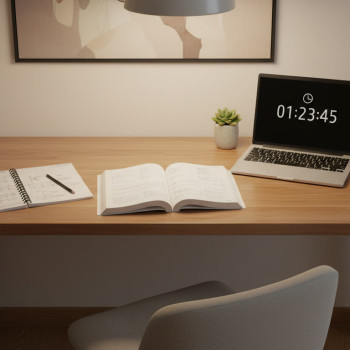
- Limit devices: if a laptop is required for practice, close all unrelated tabs and use a full-screen timer. If you study on paper, keep your phone out of reach.
- Employ blocking tools in scheduled study windows and make those windows sacred — short, intense, and undisturbed.
Health, sleep, and movement: focus is energy management
Attention depends on energy. The brain needs sleep, stable glucose, and movement to sustain deep thinking. Consider these simple rules:
- Aim for consistent sleep cycles; avoid all-nighters before full-length practice. Irregular sleep undermines memory consolidation.
- Eat light, steady meals before long sessions. Heavy, high-sugar meals create energy crashes.
- Take short physical breaks: a five-minute walk or a quick set of stretches every hour resets circulation and attention.
These behaviors aren’t glamorous but they are high-leverage. When your brain is rested, focused thinking is less effortful and more reliable.
Measuring progress and iterating
Focused thinking improves when you measure the right signals. Track a few metrics weekly and act on them.
| Metric | How to measure | What to aim for |
|---|---|---|
| Uninterrupted focus minutes | Use a simple timer and log each session | Gradually increase average focus window by 5–10 minutes every 2 weeks |
| Mock accuracy on attempted questions | Post-mock analysis, exclude unattempted ones | Improve accuracy by 5–10% per month |
| Error categories | Count frequency of conceptual vs careless vs interface errors | Attack the most common error first |
Review your metrics weekly and set a single action for the next week: perhaps more deliberate warm-ups before problem sets, or an enforced phone-free period during mocks. Small, focused adjustments compound rapidly.
When to seek personalized help and how it fits into focused thinking
Many students plateau because they keep practicing the wrong way. Personalized tutoring can break plateaus when it offers structured one-on-one feedback, targeted corrective plans, and tools to monitor progress.
If your diagnostic shows persistent conceptual gaps, recurring careless errors that checklists do not fix, or inconsistent mock performance, targeted support can change the trajectory. For students who want that support, Sparkl‘s tutors provide one-on-one guidance, tailored study plans, and expert feedback that can accelerate the development of focused thinking while preserving your autonomy as a learner. The value of personalized help shows up when it translates your weakest patterns into predictable, correctable actions.
Sample weekly plan: focused practice that scales
This table is an example you can adapt. The idea is to alternate heavy concept days with problem-focused days and to preserve a full-length mock every 7–10 days as your primary feedback loop.
| Day | Primary focus | Session structure |
|---|---|---|
| Monday | Concept deep dive (Physics) | 2×50 min focused study, 30 min active recall, 20 min summary |
| Tuesday | Problem set (Math) | 4×45 min problem sprints, review mistakes |
| Wednesday | Short review + light practice (Chemistry) | 3×30 min mixed questions, spaced repetition |
| Thursday | Mixed problem solving (Interleaved) | 5×40 min, focus on transitions between topics |
| Friday | Weak-topic repair + live tutoring | Targeted corrections, 1-on-1 session if needed |
| Saturday | Full-length mock (3 hours) | Simulate test settings, analyze errors afterward |
| Sunday | Restorative review | Light revision, planning next week |
Micro-checklist to use before every study block
- One short, specific learning target written down.
- Timer set and phone out of reach.
- Materials ready: rough paper, formula sheet, and previous mistakes logged.
- End-of-block review step planned.
Final takeaway
Focused thinking for JEE is not a talent you either have or lack; it is a set of trainable habits. Start with a clear diagnostic, build micro-habits that reduce friction, practice with active methods, and use full-length mocks to check whether your attention strategies work under real constraints. Measure a few simple metrics, iterate weekly, and keep your body and sleep aligned with your cognitive goals. Over time, reliable focus turns problem solving from random effort into a repeatable skill — and that is the most powerful preparation you can do for any rigorous MCQ-based exam.






















No Comments
Leave a comment Cancel