

NEET Score Improvement Tips for Physics
Taking a NEET mock and seeing a score that’s lower than you expected can feel like a punch in the gut. It’s normal — mock tests are designed to expose weak spots so you can repair them. The goal after any mock is not to panic but to convert that raw score into a detailed roadmap for steady improvement.
Remember the exam context as you plan: NEET-style testing is MCQ-based with full-length, timed practice sessions that mirror the actual 3-hour exam pattern. There is negative marking for incorrect answers, so accuracy and OMR discipline matter as much as speed. The Physics portion sits alongside Chemistry and Biology in the same paper, so your preparation needs to be efficient, prioritized, and aligned to the syllabus.

Step 1 — The Calm Analysis: What to Look for Immediately
Separate emotion from data
Don’t rush into blanket revision. Treat the first hour after a mock like triage: breathe, make tea, then open the paper with a cool eye. Your first aim is to collect facts — raw score, time spent per section, number and type of mistakes — not to berate yourself.
Quick checklist for the first read
- How many questions did you attempt? How many were marked wrong?
- Which topic areas contributed most errors? (Mechanics, E&M, Optics, Modern Physics, Thermodynamics, Waves, etc.)
- Were mistakes conceptual, calculation-based, careless reading errors, or OMR/marking mistakes?
- How much time did you spend on lengthy numericals?
Step 2 — Create a Mistake Log and Classify Every Error
Why classification beats raw repetition
Re-doing lots of problems without understanding the pattern of error is like mopping a floor while the tap is still running. A compact mistake log that captures the question number, topic, error type, and corrective action converts confusion into a plan.
How to build a usable mistake log (simple template)
- Column 1: Question reference (mock paper + Q no.)
- Column 2: Topic (e.g., Kinematics — Projectile Motion)
- Column 3: Error type — conceptual / formula / calculation / reading / OMR
- Column 4: Correct solution outline in 2–4 lines
- Column 5: Action — revisit chapter, watch short concept video, do 5 similar problems, add to formula sheet
Use short labels and keep entries concise; the value is reviewability. After three mocks you’ll begin to see patterns — repeated conceptual gaps or a cluster of careless mistakes under time pressure.
Step 3 — Prioritize Repairs: Where to Spend Your Time
High-impact vs low-impact weaknesses
Not all weaknesses cost the same number of marks. Missed conceptual topics that appear often in papers should come first. For example, mastering vector basics, kinematics, and the fundamentals of electricity can clear many mid-level questions. Careless arithmetic errors are a different class — they’re fixable with discipline and targeted practice.
Decision rules for prioritization
- If a topic gave you more than 3 wrong answers in one mock, move it to the top of the weekly plan.
- If mistakes are mostly careless (sign errors, unit problems), add short daily drills that enforce checks: unit checks and sign conventions.
- If you lose time on lengthy numericals, practice faster routes: approximations, smart substitutions, and identifying which questions to skip and return to.
Practical Techniques to Build Physics Strength
1. Make concepts your reference points
Physics is not a list of tricks; it’s a set of principles. When you solve a problem, write down the underlying principle in one line — e.g., conservation of energy, Gauss’s law, Snell’s law. That tiny habit trains you to link new problems to core ideas quickly.
2. Build a living formula sheet
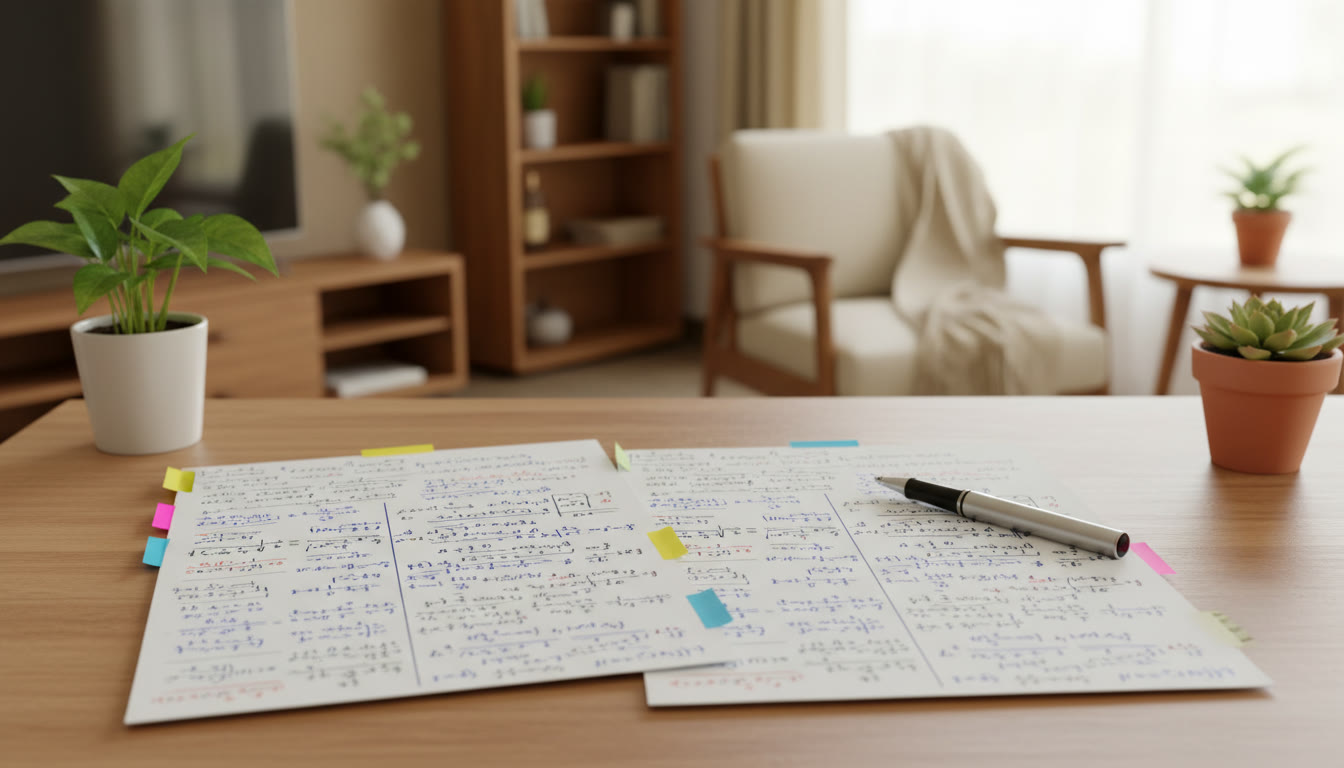
Keep a two-page, handwritten formula sheet that you update weekly. Do not use it in the exam, of course — but the act of organizing formulas and typical problem templates strengthens recall. Add quick reminders for usual approximations (small-angle approximations, limiting cases) and unit checks.
3. Practice numericals the ‘right’ way
Naturally, numericals show up frequently in Physics. Rather than solving a long problem start-to-finish every time, practice phases: identification, set-up, rough estimate, calculation, and check. Learn to estimate answers before full calculation — that reduces silly arithmetic mistakes and helps you judge whether a question is worth the time in a timed mock.
4. Use worked examples to learn the method, not just the answer
When you study a solved problem, reproduce it from memory after five hours; then again after two days. This spaced recall cements the method instead of producing a fragile memory of steps.
Mock Strategy and Time Management
Simulate exam conditions — full stop
Full-length, timed practice is the only accurate simulator of the cognitive load you’ll face. Treat every full mock like a mini-exam: three hours, single sitting, strict OMR discipline. This trains your stamina, pacing, and mental rhythm.
Pacing blueprint inside the 3-hour window
- Do a rapid first pass to solve all straightforward questions (roughly 40–60 minutes).
- Use the second pass for medium-difficulty questions (60–80 minutes).
- Reserve the final portion for long numericals and flagged toughies, and for careful OMR checks (20–40 minutes).
OMR discipline and answer-entry best practices
OMR mistakes are heartbreaking because they are avoidable. Practice filling the OMR sheet carefully in mocks: use the same pen type you plan to use, erase stray marks cleanly if allowed by practice rules, and allocate the last 10–15 minutes to cross-check whether marked answers match the question numbers. In test conditions, a disciplined OMR routine saves marks.
Negative marking — approach it like a probability check
Because incorrect answers attract penalties, guessing without method is costly. Use elimination to convert guesses into calculated decisions. A simple rule: if elimination boosts your chance of being correct above ~50%, a guess can be rational. If you can eliminate one option out of four, your probability is 1/3 which typically does not justify the risk; eliminate more options before guessing.
Structured Weekly Plan: A Practical Table
Below is a sample six-week plan that maps a current mock score range to reasonable targets and weekly focuses. Use it as a template and adapt to your personal pace.
| Current Mock Score (Physics) | Target After 6 Weeks | Weekly Focus Areas | Practice Hours/Week (Physics) |
|---|---|---|---|
| Below 30 | 40–55 | Foundation: basic laws, vectors, kinematics; concept drills; short numericals | 12–15 |
| 30–60 | 55–75 | Mechanics + E&M focus; mistake log corrections; timed problem sets | 14–18 |
| 60–90 | 75–95 | Medium-high difficulty practice; time-based mock pacing; reduce careless errors | 16–20 |
| 90 and above | Maintain / refine to 100+ | High-difficulty concepts, speed work, full exam simulations, avoid slippage | 12–16 (quality over quantity) |
Daily Micro-Routines That Move the Needle
Short, focused sessions beat long, aimless studying
Block your daily Physics time into micro-sessions: 45–60 minutes for a concept deep-dive, 30–45 minutes for problem practice, and 15 minutes for quick revision or flashcards. Consistency compounds rapidly — ten well-directed hours each week produces measurable gains within a few weeks.
Sample daily routine (2–3 hours total for Physics)
- Warm-up: 10–15 minutes of formula review or flashcards.
- Concept session: 45 minutes on one tough topic (e.g., Semiconductors or Rotational Dynamics).
- Practice: 45 minutes solving 6–8 MCQs with timed pressure.
- Review: 20–30 minutes updating mistake log and writing the 2-line solution summary.
When to Seek Personalized Support
Signs you would benefit from one-on-one help
If repeated self-study and mocks leave you stuck on the same conceptual clusters, or if time management-blockers persist despite adjustments, targeted tutoring can accelerate improvement. Personalised guidance shortens the feedback loop: a tutor helps you prioritize, provides tailored problems, and corrects persistent thinking errors quickly.
For students who want focused interventions, Sparkl‘s personalized tutoring approach is often useful — 1-on-1 guidance, tailored study plans, expert tutors who translate weaknesses into practice plans, and AI-driven insights that track progress and adapt practice recommendations.
How to Measure Real Progress — Beyond Raw Mock Scores
Useful improvement metrics
- Accuracy under time pressure: correct answers per hour in timed segments.
- Reduction in careless errors: track the share of errors labeled ‘careless’ each week.
- Topic mastery score: how many topics move from ‘weak’ to ‘comfortable’ in your log.
- Stamina: ability to maintain accuracy in the final hour of a full mock.
Raw marks matter, but these operational metrics tell you whether your study method is working.
Common Pitfalls and How to Avoid Them
- Pitfall: Repeating full mocks without reviewing mistakes. Fix: Always spend 40–60% of your next study session correcting and summarizing mistakes.
- Pitfall: Over-relying on short tricks. Fix: Balance shortcut methods with deep conceptual checks so you can adapt when a question is twisted in the exam.
- Pitfall: Ignoring OMR practice. Fix: Simulate answer-sheet discipline in every full mock and practice marking answers cleanly.
- Pitfall: Trying to cover everything superficially. Fix: Prioritize high-frequency topics and convert low-yield topics into maintenance checks.
Exam-Day Physics Habits (Practical and Calm)
Night before and morning of
Get a solid sleep, do a short 30–45 minute light review of formula sheet in the morning, and avoid last-minute cramming of new topics. Nutrition, hydration, and a calm breathing routine will keep your mind clear for calculation and reading-heavy sections.
During the test
Flag and move on. If a numerical will take too long, mark it and return later. Keep a visible small checklist in your mock notes: (1) answer entry check, (2) unit check for numericals, (3) last-minute OMR sweep. These tiny rituals prevent catastrophic, avoidable losses.
Wrapping Up Your Improvement Cycle
Conversion of a disappointing mock score into lasting improvement depends on disciplined analysis, prioritized practice, and consistent simulation of exam conditions. Focus on pattern recognition in your mistakes, build small but powerful habits (a living formula sheet, daily micro-sessions, and an honest mistake log), and gradually shift practice from learning to speed and reliability under timed pressure.
Personalized interventions, like Sparkl‘s tailored plans and expert guidance, can compress the time it takes to move from a weak topic to reliable marks when you need a focused push. But even without 1-on-1 support, applying the methods above in a structured, consistent way will produce steady gains.
Keep metrics simple, practice intentionally, and treat each mock as a diagnostic tool rather than a final verdict. With targeted repair on the most frequently tested topics, disciplined OMR habits, and a steady mock schedule that mirrors the full-length exam, your Physics score will reflect real, lasting improvement.
This concludes the academic guidance on turning mock-test feedback into a concrete Physics improvement plan for NEET preparation.

























No Comments
Leave a comment Cancel