

Why NCERT Is the Bedrock of JEE Main Chemistry
If you’ve ever opened an NCERT Chemistry book and felt torn between admiration and dread, you’re not alone. Those pages look deceptively simple, and that’s precisely their power. For JEE Main Chemistry, NCERT is not a convenience — it’s a strategic foundation. Read it the right way, and it gives you clarity of concepts, accurate definitions, clean diagrams, and the exact language exam setters often expect.
Think of NCERT as your reliable map: it marks the roads you must know, the shortcuts that are safe, and the traps you should avoid. When your exam strategy needs to align with MCQ-based testing, negative marking, and disciplined full-length mock practice, a firm command of NCERT content makes everything else fall into place.

What NCERT actually gives you (and why it matters)
NCERT is compact, precise, and written in plain language. That sounds simple until you compare it to the confusion that comes from overloading on dozens of reference books. Here’s what NCERT reliably delivers:
- Core definitions and standard terminology that often appear verbatim or conceptually in MCQs.
- Clear, exam-friendly diagrams — especially useful for structural organic chemistry and coordination complexes.
- Concise treatment of physical chemistry fundamentals: units, significant figures, and standard derivations you must understand rather than memorize blindly.
- Inorganic facts presented in neat tables — perfect for quick memorization and recall under exam pressure.
Exam-aligned advantages
JEE Main is an MCQ-based exam that rewards precision. It typically uses negative marking for incorrect responses and expects OMR or computer-based answer discipline during full-length attempts. That means every attempt should be guided by strong fundamentals rather than guesswork. NCERT builds the kind of clarity that reduces careless errors: you’ll recognize standard definitions, spot subtly reworded statements, and eliminate distractors faster.
How to study NCERT effectively for JEE Main Chemistry
Reading NCERT is not the same as studying it. The switch from passive reading to active study is where the results happen.
Step-by-step approach
- First pass — read for understanding: Don’t rush. Understand why things are stated the way they are. Underline only key lines, not whole paragraphs.
- Second pass — annotate: Add short margin notes: important equations, common exceptions, and links between topics (e.g., how electronegativity affects both bonding and reactivity).
- Do every in-text example and exercise: These are compact, high-yield problems. Solve them without peeking at solutions.
- Make summary tables: NCERT gives great structure; reorganize it into one-page sheets for each chapter for quick revision.
- Mental rehearsal: After studying a chapter, close the book and try to verbally explain key ideas — this builds recall for timed MCQ attempts and long-area revision sessions.
Active techniques that beat passive reading
- Create two-column notes: left column for statements/definitions; right column for one-line exam-style examples or common MCQ traps.
- Turn headings and subheadings into quick questions you can test yourself on.
- For reactions, write the mechanism skeleton (no need for full organic-level details) and note the key conditions and exceptions.
Branch-wise NCERT focus: What to prioritize
NCERT covers Physical, Organic, and Inorganic chemistry. Each branch demands a slightly different method of study; the table below lays down a compact roadmap.
| Chemistry Branch | NCERT Strength | Typical JEE Focus | Quick Study Tip |
|---|---|---|---|
| Physical Chemistry | Clear derivations, formulae, practice problems | Application of formulae, unit-awareness, numerical accuracy | Master core derivations and practice timed numericals; focus on units and significant figures. |
| Organic Chemistry | Basic reaction pathways, nomenclature, functional group behavior | Reaction prediction, reagent identification, mechanism-based elimination | Understand reaction logic; make reaction maps and practice with skeletal problems that translate to MCQs. |
| Inorganic Chemistry | Tables, periodic trends, oxidation states, coordination chemistry basics | Direct factual recall, conceptual application, pattern-recognition | Create clean one-page tables and flashcards for quick memory checks. |
Why this branch-wise angle works
Because JEE tests both memory and application. Inorganic rewards precise recall of facts presented in NCERT; organic rewards conceptual links and mechanism intuition; physical rewards problem-solving speed. Tailor your study to each branch so your overall preparation is balanced.
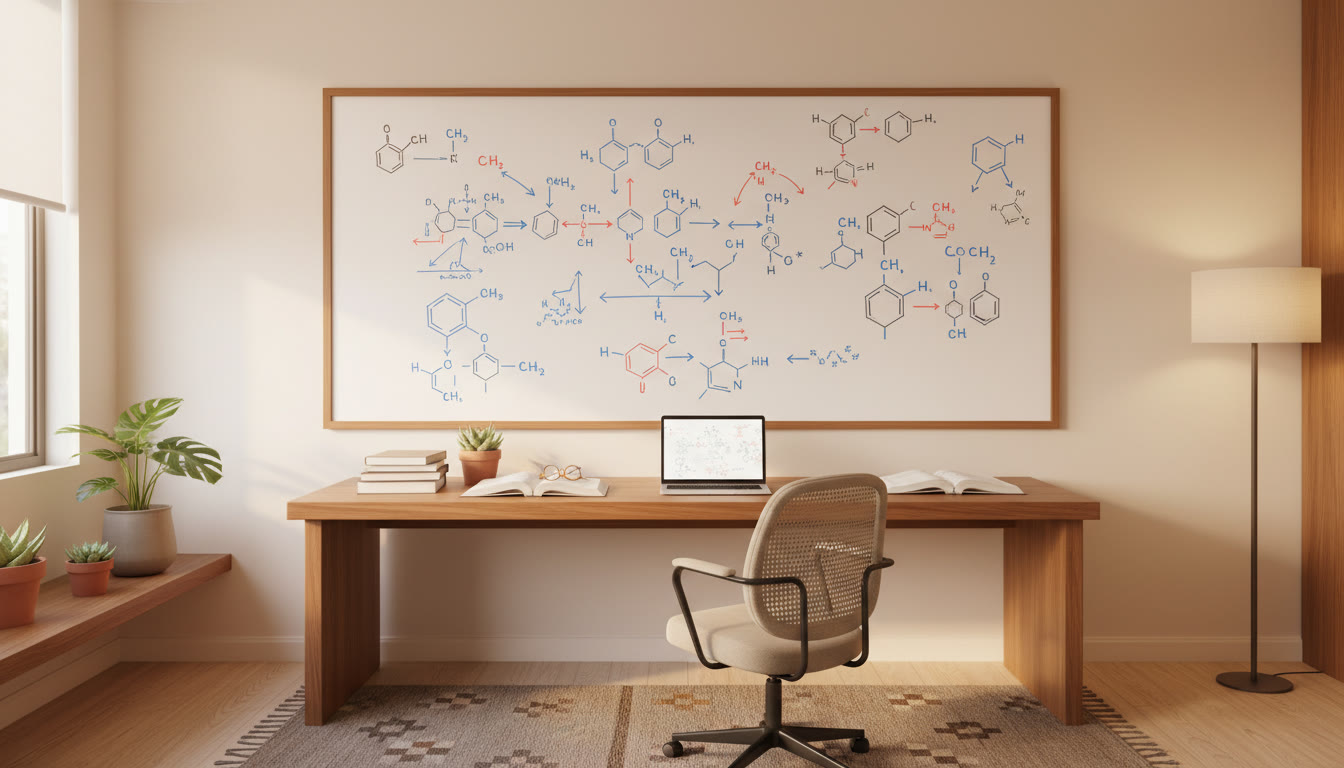
From NCERT examples to MCQ mastery
NCERT examples are often the starting point for tougher MCQ-style questions. The trick is to scale each example by one step: once you solve an NCERT example, ask yourself, “What if the concentration changed? What if the reagent was different? What if this compound had an extra substituent?” That single next-step question is what turns a textbook example into exam-level practice.
Practice routine that maps to exam conditions
- Do regular sectional practice (30–45 minutes per topic) and one full-length chemistry mock that mimics the three-hour pace for complete exam practice.
- Simulate negative marking: treat wrong answers as costly and learn to eliminate options before guessing.
- Respect OMR/CBT discipline during mocks: mark only after confident selection and avoid last-minute mass marking.
When NCERT is enough — and when you should widen the net
NCERT will cover a large part of the conceptual and factual requirements for JEE Main Chemistry. That said, there are times when adding selective practice beyond NCERT is helpful:
- If you’re consistently making mistakes on a topic despite perfect NCERT notes, you need targeted higher-difficulty questions to build depth.
- If time management during numericals is your problem, use additional timed-problem sets to build speed and accuracy.
- If you need alternate explanations for a stubborn concept, seek a short, focused resource — but keep the reading minimal and practice-heavy.
The guiding principle: read NCERT first, practice NCERT thoroughly, then pick selective higher-level problems only to plug specific gaps.
Concrete chapter priorities (how to allocate time)
Every chapter in NCERT has value, but some are higher-yield for JEE Main. Use this approach to prioritize study time:
- High-priority chapters: fundamental topics that appear frequently or form the basis for many MCQs.
- Medium priority: chapters that produce occasional but conceptually important questions.
- Low priority: chapters that are less often tested; keep them on maintenance revision.
Prioritize by spending more mock-practice time on high-yield chapters, and maintain low-yield chapters with quick one-page revisions.
Sample time allocation for a balanced week
- 50% — Physical & numerical practice (thermodynamics, equilibrium, electrochemistry)
- 30% — Organic concepts and reaction practice (GOC, reaction mechanisms, functional groups)
- 20% — Inorganic memory work and periodic trends
Common student mistakes and how NCERT helps avoid them
Students often fall into predictable traps. NCERT helps prevent many of them if used correctly:
- Rote without understanding: NCERT rewards understanding; rewrite facts in your own words to lock them in.
- Ignoring examples: Many students skim the in-text problems. Solve them—these are the seeds of strong MCQ answers.
- Over-reliance on guesswork: Negative marking punishes blind guessing. NCERT builds elimination tactics that reduce risky attempts.
- Skipping revision cycles: NCERT’s compactness makes spaced repetition practical; revisit short summaries frequently.
Sample 8-week NCERT-focused study plan
This is a compact, practice-first plan built around NCERT, designed to fit into a larger preparation schedule during any recent or upcoming entry cycle.
- Weeks 1–2: Physical chemistry fundamentals, units, mole concept, and key numericals from NCERT. Daily problem sets.
- Weeks 3–4: Organic basics — GOC, reaction types, nomenclature, and in-text organic problems. Build reaction maps.
- Weeks 5–6: Inorganic consolidation — make tables, use flashcards, memorize key facts from NCERT and practice recall drills.
- Weeks 7–8: Integrated revision and timed full-length paper simulations (three-hour full attempts), analysis of errors and targeted remediation.
How to use a three-hour full-length mock effectively
- Replicate exam conditions: timing, breaks, and answer-disciplines (OMR/CBT practices).
- Review errors immediately and map them back to NCERT pages; was the error conceptual, careless, or strategic?
- Convert repeated mistakes into a micro-plan—one page per weak topic with NCERT pointers and 5 practice questions.
Memory tools and active revision techniques suited to NCERT
NCERT’s structured language lends itself to powerful memory techniques that are simple and sustainable:
- One-line chapter summaries — a single sheet that contains the chapter’s purpose, the main formulae, and three sample problems.
- Two-minute recall — at the end of each study session, close the book and speak aloud the chapter’s key ideas for two minutes.
- Flashcards for inorganic facts — periodic trends, common oxidation states, and solubility rules.
When personalized help speeds up the NCERT route
NCERT is best used with structure. Some students benefit from guided, focused support that helps convert NCERT understanding into exam performance. Personalized tutoring offers a way to accelerate that translation through one-on-one diagnosis, tailored study plans, expert sense-checks, and data-driven practice. For example, working with Sparkl‘s tutors can help you convert your NCERT notes into concise revision pages, choose the right set of advanced practice questions, and run timed mock simulations that target weak spots.
How targeted guidance can plug gaps
- Spot the exact line in NCERT you misunderstood and reframe it with a short explanation.
- Translate NCERT examples into a personalized practice set tailored to your error patterns.
- Use AI-driven insights or tutor feedback to plan weekly cycles focused on the highest-return topics.
Putting it all together: a final practical checklist
- Finish NCERT chapters thoroughly before moving to advanced practice.
- Solve every in-text example; convert two of them into timed MCQs.
- Create weekly one-page summaries and revise them repeatedly.
- Do full-length three-hour simulations that include strict answer-discipline and negative-marking rules.
- Use selective higher-level problems only to close specific weaknesses, not as a first source of learning.
Closing academic note
NCERT Chemistry is not merely a book to be checked off; it is the conceptual backbone for JEE Main Chemistry. When you study NCERT actively — annotating, solving every example, summarizing, and using timed mock practice with strict answer discipline — you convert clear understanding into reliable exam performance. Keep your practice structured around MCQ-style thinking, respect negative-marking conventions, and prioritize repeated, focused revision; that disciplined, NCERT-centered approach is the most dependable path to steady improvement in Chemistry for the current entry cycle.





















No Comments
Leave a comment Cancel