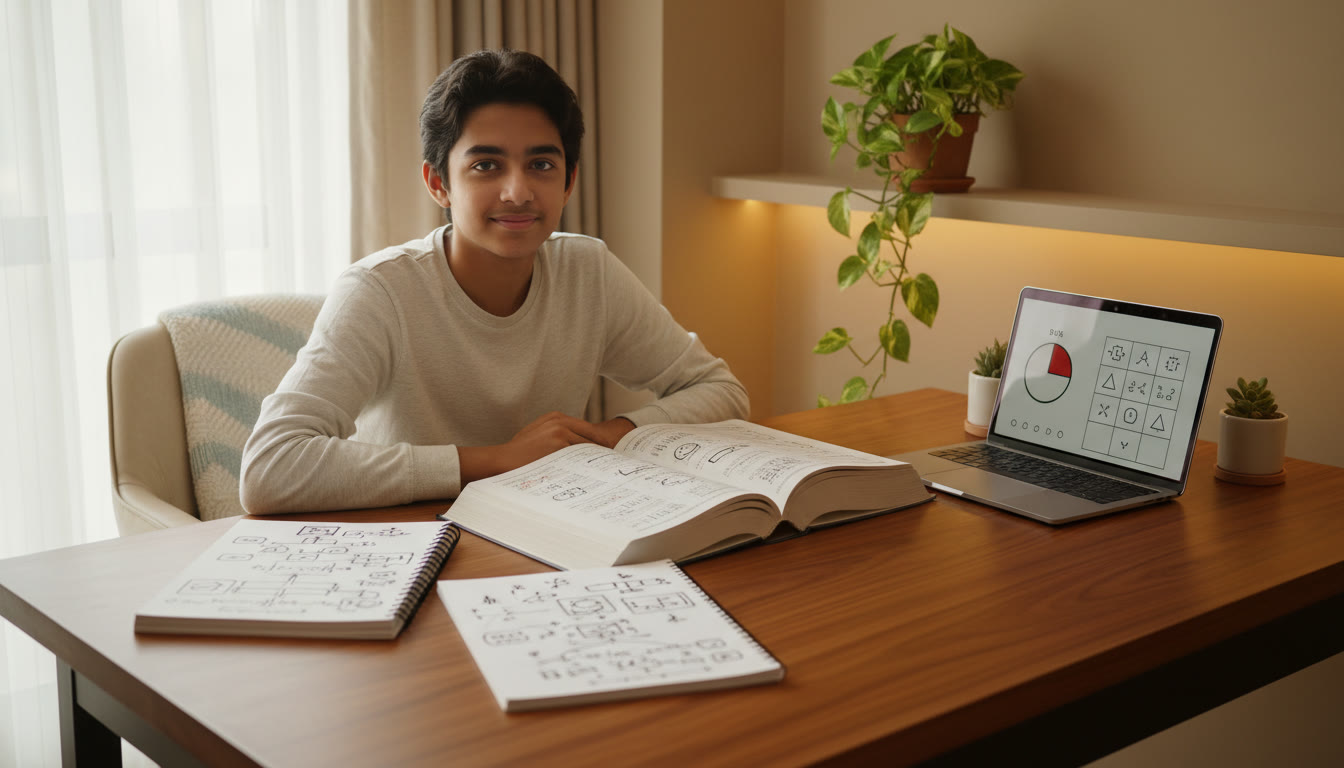

Why an advanced booklist matters (and how toppers think about books)
If you want to move from “comfort with basics” to “cracking high-difficulty MCQs” you need a booklist that does three things at once: tighten fundamentals, widen problem exposure, and sharpen exam instincts. For JEE Main-style exams — a timed, MCQ-first environment with negative marking and a three-hour full-length testing rhythm — the right books act like a training plan on paper. They teach concept, then force application under pressure. The goal is not to own the biggest bookshelf; it is to own the right sequence of resources and use each one with a clear purpose.
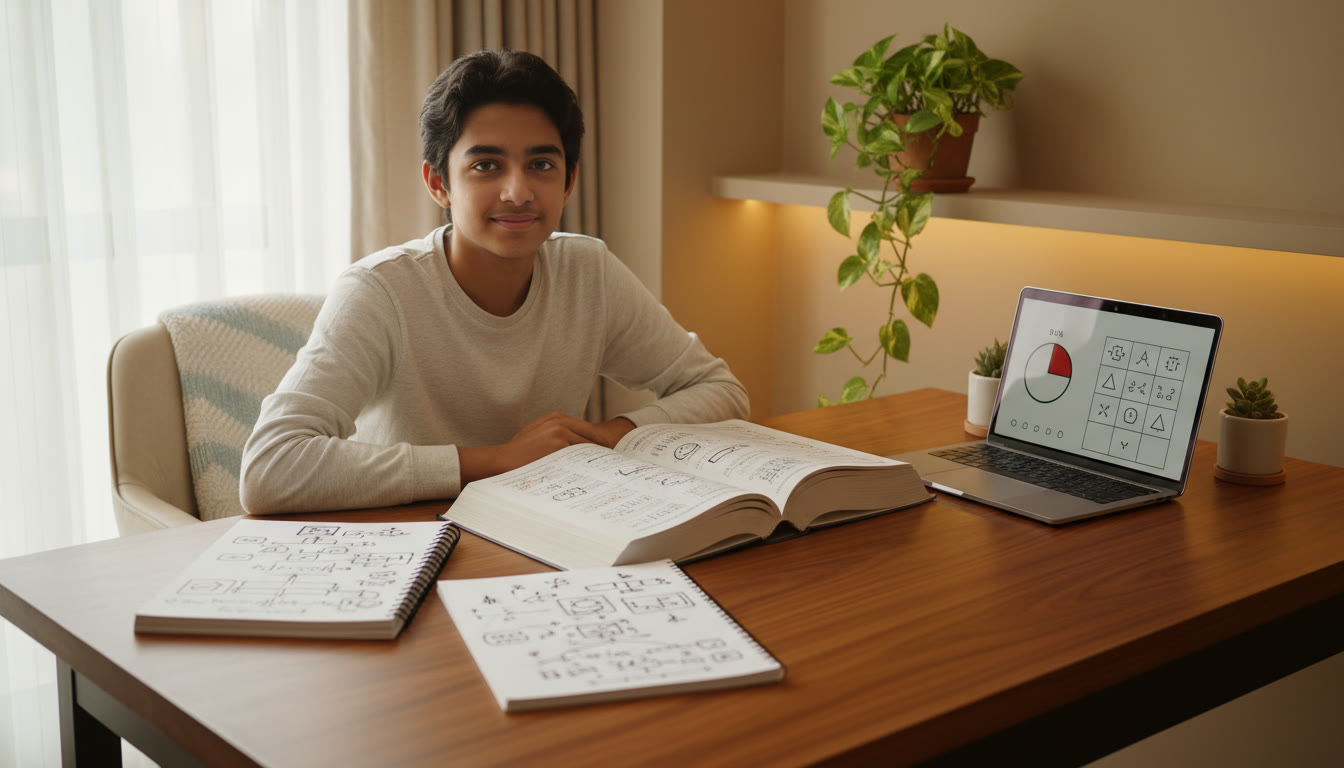
Principles behind this guide
- Start from clarity: advanced books are for deepening, not for first encounters. Build basics from standard board textbooks or foundational concept books before stepping up.
- Practice deliberately: target types of questions — multi-concept integrators, tricky numeric choices, and conceptual traps — not just raw volume.
- Simulate exam conditions: treat many practice sessions as three-hour mock tests to develop stamina, time management, and OMR/CBT discipline.
- Use books with complementary strengths: concept explainers, problem banks, and challenge books. Each has a place in a topper’s cycle.
How to structure your book use: the three-phase approach
Phase 1 — Foundation and fluency (concept + guided practice)
First, make sure basics are absolutely fluent. Read concise explanations and solve guided problems that reinforce every concept in the syllabus. In this phase you build a comfortable command over the mechanics — algebraic manipulations, steady symbolic work in physics derivations, reaction patterns in chemistry and typical calculus techniques.
Phase 2 — Depth and integration (advanced concept books + problem collections)
Once concepts are secure, switch to advanced books that push depth: derivations for physics, mechanism logic for organic chemistry, and harder multi-step problems in mathematics. This is where toppers differentiate themselves: they combine accuracy with speed under pressure. Spend time on problems that force you to connect two or more chapters (for example, kinematics + energy, or calculus + coordinate geometry).
Phase 3 — Consolidation (timed practice, selective revision, error logs)
Finally, integrate your learning into three-hour full-length mock cycles. Use error logs, topic-wise short revision sheets, and timed question blocks (30–60 minutes) to strengthen weak links while preserving strengths. During consolidation avoid broad new topics; focus on polishing application, accuracy, and exam discipline.
Subject-wise advanced booklist and how to use each title
Below is a compact, topper-minded list: selected titles and their role in a preparation pathway. Treat them as tools, not trophies — each entry notes when to use the book and what you will extract from it.
| Subject | Book (Author) | Primary use | When to pick it up |
|---|---|---|---|
| Physics | Concepts of Physics (H. C. Verma) | Clear conceptual explanations + moderate to strong problem sets | After fundamentals; early phase of deepening |
| Physics | Problems in General Physics (I. E. Irodov) | High-difficulty conceptual problems for depth and ingenuity | Phase 2 — for practice once fluency is established |
| Chemistry | Concise Inorganic texts (J. D. Lee style) | Strong conceptual mapping and systematic inorganic revision | Phase 1 and consolidation for inorganic revision |
| Chemistry | Numerical/problem books for Physical Chemistry (P. Bahadur-style) | Tough numericals, multiple-concept physical chemistry problems | Phase 2 — to train accuracy under time pressure |
| Chemistry / Organic | Organic reaction-mechanism texts (Morrison & Boyd-style) | Mechanisms, electron-flow understanding, and synthetic logic | Phase 1 early, with progressive problem practice |
| Mathematics | Problems in Calculus of One Variable (I. A. Maron) | Structured calculus practice and theory for speed | Phase 1 for solid calculus base |
| Mathematics | Coordinate geometry & trigonometry classics (S. L. Loney) | Tricky geometry manipulations and conceptual backbone | Phase 1–2, for technique sharpening |
| Mathematics | Advanced algebra/problem compendia (Hall & Knight / M. L. Khanna style) | High-volume problem solving, Olympiad-level techniques | Phase 2 for toppers needing deeper algebraic tricks |
How to interpret the table
This table is a functional map, not a shopping list. Each title trains a particular muscle — concept, numerical agility, derivation fluency or creative problem solving. Start with the titles that improve weak fundamentals, then layer in the highest-difficulty books once your accuracy and speed are stable.
Practical routines: how toppers schedule and cycle through books
Here are proven daily and weekly habits that convert reading into performance:
- Daily micro-blocks (60–90 minutes) on a focused topic — theory 20–30 minutes, followed by 40–60 minutes of problems from the chosen advanced book.
- Weekly theme: choose one difficult topic per week (e.g., rotational dynamics, redox chemistry, definite integrals) and build a 6-day deep-dive with day 7 as a timed revision test.
- Monthly mock: one full-length three-hour mock under test conditions. Mark answers on your simulation sheet exactly as you would on exam day to practice OMR/CBT discipline and to train the stress response.
- Error log routine: write a short two-line cause for each mistake (concept lapse, careless arithmetic, time-pressure skip), and revisit only those short notes in the next week.
Sample weekly block (compact)
| Day | 60–90 minute morning block | Evening practice (timed) |
|---|---|---|
| Mon | Physics concept + problems (Concepts of Physics) | 30-min problem set from an advanced problem book |
| Tue | Chemistry mechanism reading + examples | Timed numericals: 45 minutes |
| Wed | Mathematics technique + problem cluster | Short mock: 60 minutes |
| Thu | Physics advanced problem practice (Irodov/adv sets) | Review error log 30 minutes |
| Fri | Chemistry numericals + inorganic quick revision | Mixed short mock 90 minutes |
| Sat | Mathematics deep problem-focussed session | Group discussion / explain concepts aloud |
| Sun | Consolidation: review and light revision | Self-evaluation and planning |
Techniques for reading and practicing from advanced books
1. Read with purpose
When you open a tough problem or a longer derivation, always ask: what is the central idea? Spend the first five minutes mapping the structure — knowns, goal, obvious constraints — then attempt. Toppers rarely read passively; they interrogate the text and replicate proofs in their own words.
2. Chunk problems into learnable moves
Advanced problems often combine smaller steps. Train yourself to spot the moves — substitution, approximation, symmetry exploitation, dimensional checks. Make a list of common “moves” and the problems where they worked; that list becomes a fast reference for exam revisions.
3. Rework problems after sleep
Solve a problem, check the solution, then rework the same problem the next day from memory. If you can’t reconstruct it, you haven’t internalized the technique. Repeated retrieval builds a permanent problem-solving habit.
4. Time-driven practice
Work problems under a stopwatch. Set a maximum time for a class of problem: 12–18 minutes for a hard physics problem or 8–12 for an algebraic long-shot. If you exceed your normal time, mark the problem as a practice candidate for break-down and re-practice.
Mock tests: turning book practice into exam performance
Mock tests are not a one-time ritual — they are the laboratory where knowledge is stress-tested. That means replicating the exact discipline: three-hour uninterrupted practice, simulated OMR/CBT marking habits, no mid-test phone checks, and post-test analysis with a ruthless eye on error types.
- Simulate the exam room: silence, timed blocks, and the same question order habits you will use under real conditions.
- After every mock, classify errors: conceptual, careless, tempo, or choice-strategy mistakes. Track frequency and watch for patterns.
- Learn the negative-marking psychology: if negative marking exists in your test cycle, teach yourself to eliminate blind guessing. Build confidence in smart elimination instead of blind attempts.
Using personalized guidance intelligently
A lot of toppers use targeted mentorship to refine book choices and to get a second pair of eyes on weak links. If you try one-on-one guidance, use it to calibrate your book cycle, to design mock-test sequences that suit your learning rhythm, and to extract AI-driven insights where possible for personalized weaknesses. For students seeking such tailored support, Sparkl‘s personalized tutoring and tailored study plans can be used as a complement to your independent practice, offering focused feedback on problem patterns and pacing.
How to choose which advanced book to buy (and when to drop one)
Buy a book only if it solves a clear problem for you: more practice in a weak area, better explanations for a tricky topic, or a curated bank of multi-topic questions. Avoid accumulating unused volumes. A practical rule of thumb:
- Keep at most three active books per subject in Phase 2 — a concept clarifier, a problem bank, and a challenge book. Rotate them as your weaknesses evolve.
- Drop a book when you can consistently solve 80–90% of its problems under timed conditions without external help.
- Prefer books that show partial solution approaches and not just final answers — step-by-step solutions are a learning tool for building reliable techniques.
Dealing with very hard problems: a short roadmap
Tough problems are not walls, they are puzzles with a path. Here’s a repeatable method:
- Restate the problem in your own words and list exactly what is asked.
- Identify immediate invariants or simple bounds — physical limits, parity arguments, monotonicity, or symmetry.
- Break it into smaller sub-questions and try a simple numeric example to see the structure.
- Try standard transforms: substitution, coordinate change, dimensional reduction, or energy methods for physics.
- If stuck, read a hint or the first step in the official solution, then attempt to continue without reading further.
Example (brief and conceptual)
Suppose a problem links rotational dynamics and energy: instead of seeking a full formula immediately, check conservation laws, reduce to a one-dimensional effective coordinate, and look for conserved quantities. Many advanced problems collapse into a simple conserved quantity if you notice the right substitution early.
Common pitfalls toppers avoid
- Over-collecting books without a usage plan — quality beats quantity.
- Ignoring timed practice: conceptual mastery without timed trials rarely converts to exam marks.
- Blind memorization of solutions — work to understand the ‘why’ behind each step.
- Failing to adapt: as mock scores reveal weaknesses, change the book mix rather than repeating the same cycle.
Tying bookwork to exam mechanics: OMR/CBT discipline and negative marking
The real exam tests not just knowledge but exam habits. Whether your mock uses OMR or CBT, practice the ritual: deliberate answer marking, disciplined skipping strategies, and scheduled review of marked-for-review questions. Negative marking penalizes random attempts; train elimination techniques and use probability only when you have at least one elimination. Simulating the exact marking behavior — how you shade an OMR bubble or how you lock answers in a CBT interface — reduces avoidable slips on exam day.
Personalization, analytics, and scaling practice
At the topper level, small gains compound. Use analytics from your mock logs to prioritize: are careless arithmetic slips costing more than conceptual errors? If a large fraction of errors are time-management related, alter practice to include more adaptive timed drills. One-on-one support can accelerate this tailoring. A personalized tutor or platform can help you interpret patterns quickly and suggest book sections or focused problem sets. For students who combine independent work with guided inputs, Sparkl‘s tutors and AI-driven insights are often used to refine pacing and to recommend precise problem clusters to attack recurring weaknesses.
Final checklist before the exam cycle
- Complete at least 8–12 full three-hour mock tests under strict conditions.
- Maintain an error log and ensure repeat mistakes are below 5% of total questions attempted.
- Have one concise revision notebook per subject containing key formulas, reaction maps, and common techniques.
- Practice CBT/OMR discipline until it is automatic; rehearse both marking and the mental decision algorithm for whether to attempt or skip.
- Ensure sleep, nutrition, and short relaxation routines are part of the monthly schedule so your three-hour performance is predictable.
Concluding academic note
A focused advanced booklist is a map — it guides what you study, when, and how intensely. Choose books that solve clearly identified weaknesses, practice under realistic timed conditions with deliberate analysis, and rotate resources as your mastery grows; this is the strategic path that converts deep study into consistent, high-scoring performance in a three-hour MCQ-driven exam with negative marking.





















No Comments
Leave a comment Cancel