
How to Improve Speed in Olympiad Exams: Fast, Focused, and Accurate
Speed isn’t magic — it’s a habit. If you’ve ever finished a mock with unanswered questions, or jumped from one problem to the next hoping something would stick, you know the frustration. Speed in Olympiad-style and JEE-style tests combines quick recognition, smart selection, calm execution and disciplined review. This article gives practical, step-by-step ways to develop that combination: drills you can do in 10–60 minutes, a realistic plan for 3-hour full-length mock practice, and tips for managing negative marking, OMR discipline, and subject-specific shortcuts in Physics, Chemistry, and Biology.

Why speed matters (but accuracy still wins)
Speed does two things: it increases your raw throughput of attempted questions and it reduces anxiety by giving you time to review. But speed without accuracy is self-sabotage — frantic attempts that trade accuracy for speed cost more than they gain when negative marking is present. The goal is smart speed: doing more of the right questions correctly in the same time, and making sure every minute spent has a measurable payoff.
- Fast recognition: identify which questions are immediate attempts versus which need deeper work.
- Smart selection: choose the right order so your high-confidence wins come early.
- Controlled execution: solve quickly without careless slips, especially in MCQs with negative marking.
Understand the exam context: MCQs, 3-hour mocks, negative marking and OMR discipline
Olympiad and JEE-style assessments commonly use MCQ formats and long, timed sessions that mimic the real test environment. A realistic training session is a full 3-hour mock: that builds stamina, concentration, and the right pacing. Key exam realities to keep in mind while training:
- MCQ-based testing: learn elimination tactics and single-line checks that quickly validate or reject options.
- 3-hour full-length mock practice: simulate the whole time window, including planned short mental breaks.
- Negative marking: each wrong attempt can reduce your score; adjust guessing strategy using expected-value thinking.
- OMR discipline: whether your mock uses OMR sheets or CBT-style entry, cultivate habits for careful answer entry and cross-checks.
- Syllabus alignment: focus practice on Physics, Chemistry, and Biology topics (as relevant) so your speed comes from strong conceptual templates.
- No descriptive partial-marking assumptions: MCQs generally don’t give partial credit for steps, so your aim is correct final answers or confident elimination.
Core habits that create speed
1. Build pattern recognition, not just speed
Speed comes from instantly recognizing problem types and which tools to apply. Drill common templates: kinematics identification in one glance, a stoichiometry pattern, or a biology classification clue. Start by categorizing problems you encounter in each week into 6–10 templates and practice those relentlessly until the first step becomes automatic.
2. Use micro-timed drills
Instead of only long tests, add targeted timed drills: 10 minutes of mental math, 15 minutes of conceptual physics, 20 minutes of rapid organic chemistry reactions. These micro-sprints improve the neural pathways that let you move from noticing to solving faster.
- 10-minute arithmetic sprints: fractions, unit conversions, quick approximations.
- 15-minute concept rounds: speed-run 8–12 short conceptual questions.
- 20-minute mixed set: combine quick algebra and short reasoning questions under a clock.
3. Train triage: the three-pass strategy
The simplest, most reliable test tactic is to work in three focused passes:
- Pass 1 (first 30–45 minutes): scan and solve all low-effort, high-confidence questions quickly.
- Pass 2 (middle block): attack moderate-difficulty problems that need one or two steps.
- Pass 3 (final stretch): invest time on the remaining hard problems only if the reward and time allow.
This approach prevents you from spending too long on a single stuck problem early on and preserves energy for review at the end.
Practical timing plan for a 3-hour mock
Below is a sample timing breakdown you can adapt. It balances quick scoring opportunities, focused solving time, and a final review window.
| Phase | Duration (minutes) | Focus | Action |
|---|---|---|---|
| Instructions & Warm-up | 5 | Settle in | Read instructions, glance over sectional layout |
| First pass | 40–50 | Low-hanging fruit | Solve all straightforward MCQs quickly and confidently |
| Second pass | 80–90 | Moderate difficulty | Work systematically on standard problems and apply short derivations |
| Third pass | 30–35 | Hard problems | Attempt only if time-to-solution is reasonable; otherwise mark and move on |
| Final review & OMR check | 15–20 | Review & fix careless errors | Cross-check calculations and ensure answer entry is correct |
How to use this table
Adjust the middle blocks depending on question count and difficulty. If your mock has a subject split, allocate time proportionally to sections you’re weaker in — but keep the first pass aggressive so you bank easy marks early.
Subject-specific speed tactics (Physics, Chemistry, Biology)
Speed techniques differ by subject. Below are practical suggestions you can adopt immediately.
Physics
- Scan for known forms: spot standard kinematic or energy-based patterns in the first line.
- Use quick checks: dimensional analysis and limiting cases are fast ways to validate answers.
- Memorize a small toolkit: common integrals, standard result forms, and typical approximations save minutes.
Chemistry
- For physical chemistry, practice order-of-magnitude estimates and equilibrium sign checks.
- For organic/chemical reactions, memorize classical reaction outcomes and use retrosynthesis for quick elimination.
- Use stoichiometry shortcuts (mole ratios, per-100g normalization) to avoid long arithmetic.
Biology
- Classify fast: many biology MCQs can be answered by correct classification or recognizing keywords in the stem.
- Diagrams and flowcharts: practice drawing tiny mental diagrams to map processes quickly.
- Keyword elimination: genetics and ecology questions often hinge on eliminating violated conditions.
Consistent practice of these subject-specific habits trains you to move from recognition to solution in a fraction of the time it once took.
Managing negative marking using expected value
Negative marking rewards careful choices. A practical way to decide whether to guess is to use an expected-value mindset. If a correct answer gives +R and a wrong answer costs you −P, the break-even probability p* is:
p* = P / (R + P)
So if the scheme were +4 for correct and −1 for wrong, p* = 1 / (4 + 1) = 0.20. That means if random guessing after elimination gives you a better than 20% chance of being right, the expected value is positive. In practice:
- If you can eliminate one option in a four-choice MCQ, your chance rises to 1/3 (> 20%) — guessing becomes statistically favorable.
- If you can’t eliminate any options, guessing randomly is often a negative expectation and should be avoided.
- Use this method quickly: if elimination gives you a clear improvement, mark; otherwise skip and return if time permits.
OMR discipline and careful answer entry
OMR mistakes are low-hanging, heartbreaking losses. Whether you’re practicing on paper or in a CBT mock, cultivate these habits:
- Follow the official marking format exactly — check the test instructions at the start.
- Bubble consistently: many students bubble after each question; others bubble after 10–20 questions. Pick a method that’s fast and comfortable, and practice it.
- Avoid heavy erasures — if the format permits, use the prescribed eraser tool and make each correction clean.
- Reserve a 10–15 minute scanning period at the end for roll-number, section, and bubble-checks.
- In CBT mocks, train to move from rough work to answer entry within the timed window — sloppy clicks cost marks.
Stamina, environment and mental management
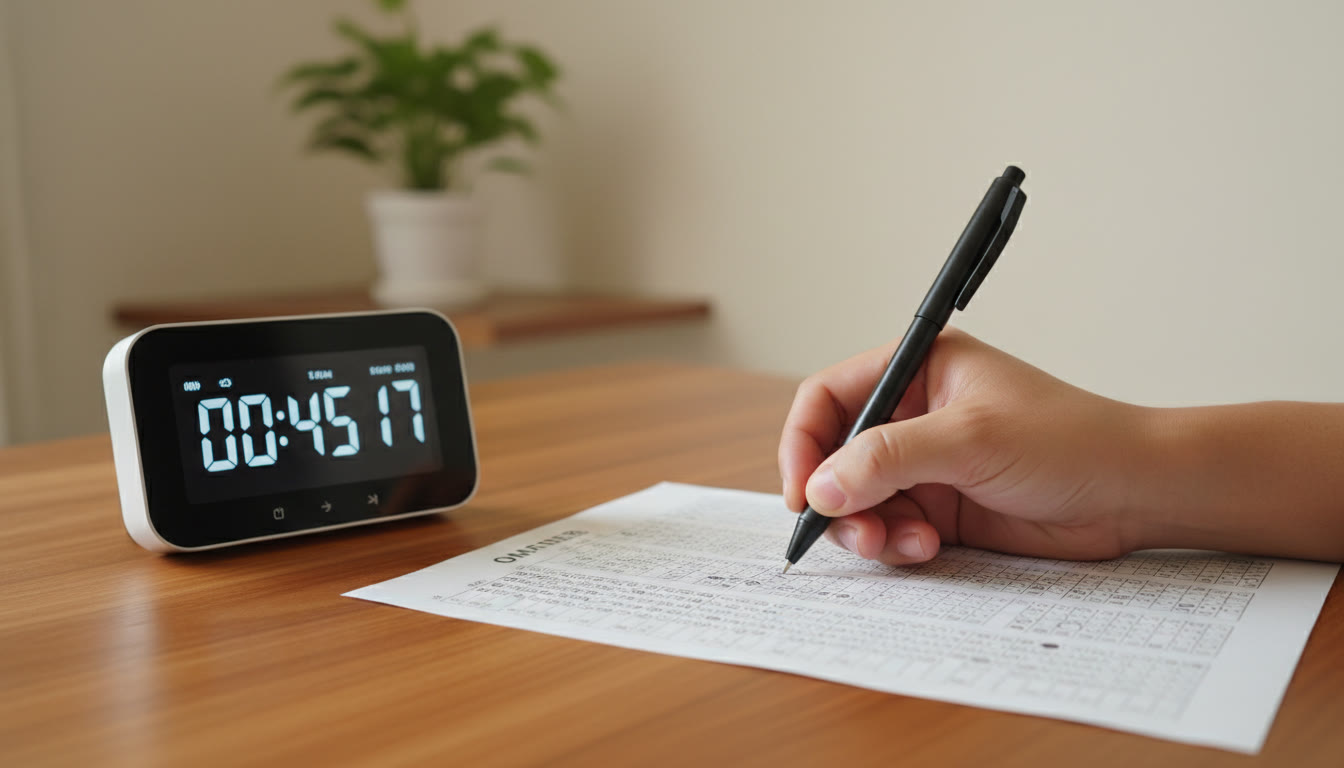
Speed under pressure needs physical and mental endurance. A 3-hour session is demanding; you must train for it.
- Do full 3-hour mocks in realistic conditions: a quiet space, timed strictly, with only allowed materials.
- Practice mental resets: a 30-second breathing routine between sections sharpens focus more than scrolling your phone.
- Nutrition & sleep: moderate caffeine and a balanced meal help, but avoid sudden sugar spikes before the test.
- Simulate distractions occasionally so small interruptions don’t derail your rhythm during the real test.
Sample weekly practice plan (compact and speed-focused)
Here’s an example week that balances skill building, micro-drills, and a full mock. Adjust the durations to suit your current study load.
| Day | Morning | Afternoon | Evening |
|---|---|---|---|
| Monday | 20-min mental math + 40-min Physics template practice | 40-min Chemistry reaction drills | Review mistakes (30 min) |
| Tuesday | 15-min quick bio classification drills | 60-min mixed timed set (30 Qs in 45 min) | Light revision (30 min) |
| Wednesday | 30-min formula flashcards | 1-hour problem set: speed focus on weak topic | Relaxed review and planning (20 min) |
| Thursday | Micro-drills (20 min) | Full mock (3 hours) | Immediate review: note top 10 mistakes |
| Friday | Recovery + light revision (45 min) | Targeted error correction (60 min) | Flashcards & quick recall (20 min) |
| Saturday | Mock-style speed rounds (90 min) | Topic deep-dive (60 min) | Group discussion / doubt clearing (optional) |
| Sunday | Rest + active recall (30 min) | Planning and weak-area mapping (40 min) | Light practice, prepare for next week |
Trackable metrics to measure real speed gains
Speed gains must be measurable. Track the following weekly and watch trends rather than one-off days.
- Average time per question (overall and by subject).
- First-pass attempts and first-pass accuracy (how many questions you solved quickly and how many were correct).
- Attempt rate per hour and net score improvement across mocks.
- Error categories (conceptual, careless, calculation, OMR-entry).
Set realistic targets: for first-pass accuracy, aim for 90%+ on easy questions and incrementally push moderate-question accuracy upward. Use a simple spreadsheet to log times and categories — over weeks, speed increases will show as reduced time per correct answer and fewer avoidable mistakes.
Common speed traps and quick fixes
- Trap: Starting with the hardest question. Fix: Start with the first-pass rule — bank easy marks fast.
- Trap: Guessing wildly under pressure. Fix: Apply the expected-value rule or skip and return if time allows.
- Trap: Poor OMR habits. Fix: Decide on a consistent bubbling routine and practice it every mock.
- Trap: Spending time verifying every step. Fix: Learn fast checks — dimensional analysis, units, sign checks — and use them as confidence gates.
How one-on-one guidance accelerates speed development
Personalized tutoring speeds improvement because it targets your specific bottlenecks. A tutor can:
- Identify wasted steps in your approach and replace them with leaner templates.
- Prescribe precise micro-drills that attack your weakest pattern-recognition areas.
- Provide timed mock feedback and corrective drills oriented toward the real 3-hour pressure window.
For example, Sparkl‘s personalized tutoring focuses on 1-on-1 guidance, tailored study plans, expert tutors, and AI-driven insights that track the tiny habits that add up to major time savings. When speed is the bottleneck, a coach can remove redundant steps in your workflow and help you rehearse faster alternatives until they become automatic.
Final checklist before a timed mock
- Clear workspace and a working timer.
- Materials ready: rough sheets, permitted calculators or formula sheets (if allowed), and any required identification.
- Plan exactly when you will take short breaths and when you will do an OMR check.
- Warm-up with a 10-minute mental math and a rapid-fire set to prime your recognition skills.
Conclusion
Improving speed in Olympiad and JEE-style mock exams is a layered process: strengthen recognition patterns, practice disciplined triage, simulate full 3-hour mocks, and use micro-drills to build automaticity. Pair these practices with careful OMR discipline, a clear negative-marking strategy using expected-value thinking, and subject-specific templates for Physics, Chemistry, and Biology. Over weeks, track simple metrics — average time per correct answer, first-pass accuracy, and error categories — and iterate the plan. The result is not frantic haste but steady, reliable speed built on accuracy and calm decision-making.


















No Comments
Leave a comment Cancel