
How often should you take mock tests for JEE Main?
Ask any serious JEE aspirant and you’ll hear the same short answer people wish was a little simpler: it depends. It depends on where you are in your preparation, how consistent your revision is, what your accuracy and speed look like, and how well you convert practice into learning. But “it depends” isn’t enough when exam day is breathing down your neck — you need a clear, practical plan you can test, tweak, and trust.
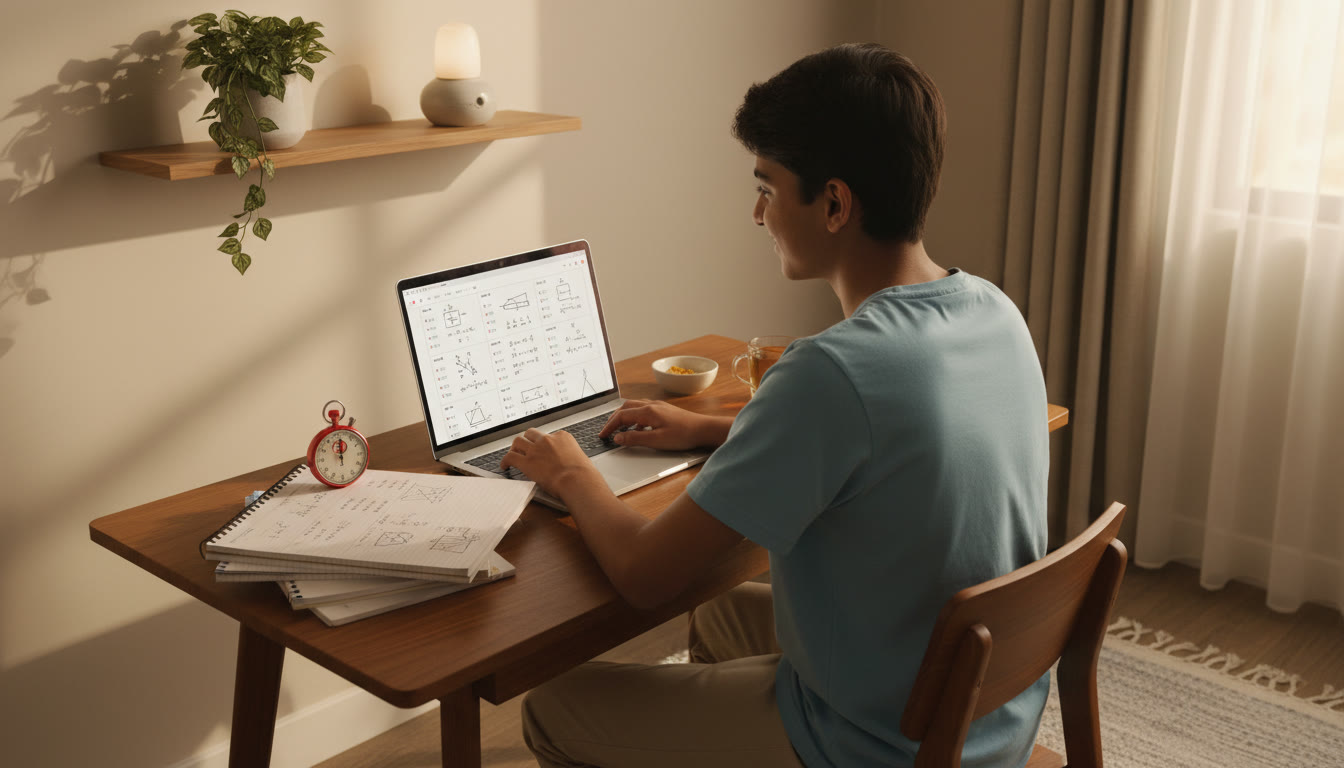
This article breaks down the reasoning, offers stage-wise mock frequencies, and gives a simple analysis routine you can repeat after every mock. Everything here assumes the realities of the JEE-style environment: MCQ-heavy testing, a full-length 3-hour simulated practice for realistic stamina building, negative marking that penalizes careless guessing, and strict answer-marking discipline. We also treat diagrams, derivations, and notes as learning tools — not as substitute answers in an MCQ arena. The examples and templates are evergreen: suitable for the current cycle and adaptable as the exam evolves.
Why mocks are the backbone of JEE preparation
Mock tests are more than checkpoints. Think of them as laboratory sessions for your exam skillset. In a classroom you learn concepts; in a mock you test whether the concepts can be applied under pressure, with time ticking and penalties for mistakes.
- Simulation of exam conditions — time pressure, pacing, and mental fatigue.
- Real feedback loop — specific error types, question selection habits, and timing leaks become visible.
- Strategy rehearsal — question selection order, time allocation across Physics, Chemistry, and Mathematics, and guesswork control under negative marking.
- Stamina and stress management — practicing full 3-hour sessions builds focus, not just knowledge.
Core principles that decide the right frequency
Before you count mocks, set principles. These will guide how often you sit down for a full-length 3-hour run and how many shorter sectional or topic mocks you schedule.
- Quality beats quantity: A poorly analyzed mock is wasted time. One well-reviewed mock a week can be more valuable than three ignored ones.
- Gradual overload: Increase frequency as you approach the exam — but only if analysis keeps pace.
- Diversify practice: Combine full-length simulations with sectional tests and topic-targeted drills.
- Consistency and recovery: Build a rhythm that includes rest; learning consolidates in recovery, not constant overload.
- Actionable reviews: Every mock must end with a concrete study map for the next week: topics to revise, problems to redo, and techniques to practice.
Stage-wise mock frequency: a practical table you can follow
Below is a simple, adaptable template. Treat each row as a mode you can slide into depending on how close you are to the final push and how well you handle analysis.
| Preparation Stage | Full-length mocks (3-hour) per week | Sectional / Topic mocks per week | Primary focus |
|---|---|---|---|
| Foundation phase (building concepts) | 0–1 | 2–4 (shorter, focused) | Concept clarity, error patterns, fundamentals |
| Consolidation phase (applying concepts) | 1–2 | 2–3 | Speed, selective accuracy, sectional weakness |
| Simulated peak phase (exam-style repetition) | 2–4 | 1–2 | Full exam stamina, timing strategy, error reduction |
| Final taper / revision (last short window) | 0–2 (short/full as recovery demands) | 2–4 (short focused mocks, quick revisions) | Conserve mental energy, targeted corrections, confidence |
Notes on the table: the numbers are flexible. If your accuracy is low, prioritize quality and analysis over packing in more full-lengths. If you can complete a full review within 24–48 hours, you can afford higher mock frequency. If reviews drag on for a week, dial the number down until you can fully digest mistakes.
How to structure a 3-hour full-length mock (time allocation)
A 180-minute exam leaves no room for improvisation. A useful starting allocation is to imagine equal base time for three subjects, then adjust based on your strengths. The point is to have a pre-decided plan and stick to it in the mock.
- Baseline split: ~60 minutes per subject as a default starting point.
- Adjusted split: If Math is your strength or the paper skews heavy, consider 70–80 minutes for Math, and slightly less for your other two subjects; if Chemistry is quick for you, speed through it and bank time.
- Buffer time: Reserve the last 10–15 minutes for quick re-checks and to handle OMR/answer-marking discipline — even in computer-based practice, use this time to verify flagged questions.
During the mock: rules to simulate exam-day rigor
True preparation is practiced under constraints. Make these rules non-negotiable for your mock sessions.
- Use a single, uninterrupted three-hour window for full-length mocks.
- Turn off phone notifications and eliminate distractions; treat the room like an exam hall.
- Use a timer visible to you and follow the time-split you decided beforehand.
- Respect negative marking: practice conservative guessing. If you don’t know elimination techniques, pause and mark for review rather than blind-guessing.
- Practice OMR-style discipline even if the test is on a screen: practice careful marking and answer transfer routines to avoid careless loss of marks.
After the mock: a ruthless 3-step analysis routine
The test doesn’t end when you submit. The real work starts in the analysis. Use a consistent template so you can compare progress across mocks.
- Step 1 — Score + Time audit (first 30–45 minutes): Record raw score, negative marks count, time taken per section, and number of attempted vs unattempted questions.
- Step 2 — Error taxonomy (next 60–90 minutes): For every wrong or skipped question, tag it: careless error, concept gap, application gap, time-limited, or silly arithmetic. Put time estimate for fix.
- Step 3 — Action map (final 30–60 minutes): Make a short, prioritized list for the next week: 3 topics to revise deeply, 10 problems to re-solve, techniques to practice (e.g., elimination, approximation, unit-check), and a timeline for re-testing those topics.
| Checklist Item | Why it matters | Time to spend |
|---|---|---|
| Raw score and rank estimate | Gives a performance snapshot and trend | 10–15 minutes |
| Error categorization | Helps find root causes and common traps | 30–90 minutes |
| Topic rework plan | Ensures targeted correction and avoids repeat errors | 20–40 minutes |
Sectional mocks and topic drills: how they complement full-lengths
Full-lengths train endurance and strategy; sectional mocks train precision and depth. Both are necessary. When a subject shows repeated weak areas (say, a cluster of mechanics or organic chemistry reactions), switch to focused timed drills for that topic and retest within a few days.
- Use sectional mocks to attack specific weaknesses, not as a way to avoid full-lengths.
- Short timed drills (30–60 minutes) help build technique for question types you regularly miss.
- Alternate subject focus across the week to avoid burnout and promote spaced repetition.
Managing fatigue, mood and diminishing returns
More mocks won’t always produce better results. The trick is to watch the shape of your improvement curve.
- If scores plateau and review quality drops, reduce mock frequency and improve quality of analysis.
- If stress spikes and sleep suffers, introduce recovery days: light revision, concept recaps, or a single short mock rather than multiple full-lengths.
- Physical activity, consistent sleep, and good nutrition make every mock more effective — these are non-negotiable performance multipliers.
When to seek personalized adjustments
Most students benefit from outside perspective when their mock strategy stops producing progress. An expert coach or a tutor can help you calibrate which mocks to take, and how to interpret statistical patterns in your tests.
For instance, Sparkl’s personalized tutoring can help tailor a mock schedule that matches your learning curve, offering 1-on-1 guidance, tailored study plans, and targeted feedback — including AI-driven insights about recurring weak spots. If you’re unsure whether to increase mocks or focus on conceptual repair, a short diagnostic conversation can save weeks of wasted effort.
Small examples to illustrate progressive planning
Example A — A student in the consolidation phase: begins with one full-length per week plus three sectional tests. After two weeks of clean analysis and steady improvement in accuracy, she moves to two full-lengths weekly while keeping targeted sectional practice.
Example B — A student near the final push: he switches to three full-lengths a week, each under strict timing, and uses the day after each mock for deep analysis. He keeps daylight recovery and one short, restorative revision day to avoid burnout.
Practical do’s and don’ts for every mock
- Do treat the simulated environment seriously: wear exam-appropriate clothing, sit at a desk, and time breaks.
- Don’t skip analysis — a mock without review is just a practice illusion.
- Do practice careful marking — in CBT and when transferring answers on any sheet, maintain the habit of double-checking your answer indices to avoid silly loss of marks.
- Don’t make the mock a content-hunt; it’s a performance measure. Note down content gaps but prioritize applications and corrections.
Troubleshooting common problems
Problem: You score well in sectional practice but poorly in full-lengths. Likely cause: stamina and pacing. Fix: Gradually increase the length of mixed-section practice and simulate exam-day continuous focus.
Problem: You attempt many questions but get penalized by negative marks. Likely cause: poor elimination technique or over-guessing. Fix: Train decision rules for guessing, practice elimination, and adopt a disciplined threshold for blind guessing.
Problem: You keep repeating the same mistakes. Likely cause: superficial review. Fix: Use error taxonomy and force a re-solve of the same problems after 48–72 hours; revise related concepts until the error class disappears.
Using data smartly — tracking progress beyond raw scores
Record more than score. Track accuracy per topic, average time per question type, negative marks/share of attempted questions, and trendlines across 6–8 mocks. Visualize progress weekly. If the trend shows improving accuracy with reduced time, you’re on the right path; if not, focus on technique and content clarity for the slowest topics.
How to integrate mock practice with day-to-day study
Mocks should punctuate study blocks, not replace them. A typical micro-week might look like this:
- Mon–Wed: Topic study and practice problems (3–4 hours/day)
- Thu: Short sectional mock + analysis
- Fri: Targeted revision and problem redo
- Sat: Full-length 3-hour mock
- Sun: Deep analysis and lighter review — fix the top 2–3 recurring errors
Shift the pattern earlier or later depending on your schedule and the proximity of the final exam. The essential bit is rhythm: study → simulate → analyze → act.
Closing tips: mindset, small wins, and steady improvement
Mocks are a mirror. They reflect both preparation and habits: careful reading, answer marking discipline, structured problem approach, and calm under pressure. Celebrate small wins — improved accuracy on a tricky topic, cutting average time on a problem type, or resisting the urge to guess without elimination. Those are the metrics that compound into a strong mock score.
When you’re uncertain about how to scale your plan or how to translate mock insights into a weekly routine, consider targeted, expert-led adjustments. A tailored approach — one that blends disciplined mock frequency with personalized repair strategies and regular retraining of weak techniques — shortens the road to your goal and reduces wasted effort.
Conclusion
The best frequency of mock tests is not a single number but a moving plan: start with fewer, well-analyzed mocks during concept-building; increase to more frequent, strictly simulated full-lengths as you consolidate; watch for diminishing returns and fatigue; and taper in the short window before the final exam. Anchor every mock in a disciplined review routine — that is the real engine behind steady, reliable improvement.






















No Comments
Leave a comment Cancel