
JEE Main PYQ Daily Practice Plan: Why a focused daily routine wins
If you’ve ever opened a past JEE paper and felt equal parts thrilled and intimidated, you’re not alone. Previous-year questions (PYQs) are the single most honest mirror of the exam — they tell you what’s important, how questions are phrased, and where time is most likely to be eaten. The trick is not simply to do PYQs, but to do them the right way: with timing, with analysis, and with a plan that fits how your learning improves over days and weeks.
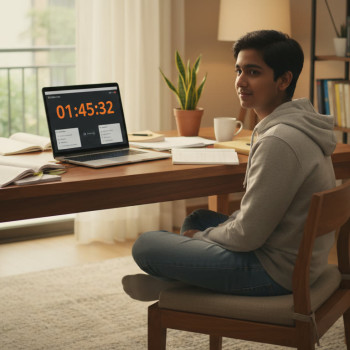
![Photo Idea : [Student focused at a desk, solving a timed JEE-style paper with a stopwatch and notebook beside a laptop]](https://asset.sparkl.me/pb/blogs-image/img/c89a351bd59f44a18138f808d29e3aa0.jpg)
Think of PYQs as a training ground where you practice the full rhythm of the exam — reading, deciding, eliminating, and writing down answers under the same pressure you’ll face in a real 3-hour test. This guide gives you a practical, day-by-day approach to using PYQs to build accuracy, speed, and exam intelligence while keeping revision smart and sustainable.
What to keep in mind before you start
- JEE-style tests are predominantly objective: MCQs and objective numeric-type items require a clear answer, and in many mock setups there is negative marking — so guessing without strategy reduces your score expectancy.
- Mock tests should simulate a full 3-hour session whenever possible to train stamina, time allocation and decision speed.
- Whether your practice is on paper OMR or computer-based mock platforms, maintain strict answer discipline: mark and review exactly as you would in the exam environment.
- PYQs are not just for final revision — they are excellent for learning concepts in context, discovering recurring patterns, and practicing elimination when answers look close.
Core principles of a strong PYQ daily practice plan
1. Small, focused bursts beat random marathon sessions
Instead of doing ten disconnected PYQs in one sitting, break practice into focused segments: a timed 60–90 minute mini-test, then a 30–45 minute analysis block. This improves retention and helps you see patterns in mistakes quickly.
2. Emphasize analysis — not just attempts
Completing a question has low value unless you can explain why the right option is right and why the wrong options are wrong. Keep a two-column note: “Mistake Type” (concept gap, calculation slip, reading error) and “Fix” (formula to revise, shortcut to learn, habit to change).
3. Balance breadth and depth
Use PYQs to cover all major topics across Physics, Chemistry, and Mathematics (PCM). Rotate topics so your weak areas see repeated attention, but don’t ignore the high-weightage chapters that recur across cycles.
4. Simulate exam conditions regularly
Do a full 3-hour mock at least once per week in a concentrated preparation phase. This conditions your body and mind for the real test length and helps calibrate realistic accuracy and speed targets.
Daily practice blueprint — structure of a productive day
Below is a compact 14-day sample rotation you can adapt to your calendar. Each day combines timed PYQ practice, targeted revision, and a focused analysis session. This cadence helps you steadily shift from quantity (covering many PYQs) to quality (deep analysis and consolidation).
| Day | Activity | Duration | Focus | Post-practice Task |
|---|---|---|---|---|
| 1 | Sectional PYQ set: Physics (Electrostatics-style) | 90 min | Concept mapping + timing | Root-cause analysis for 8 errors |
| 2 | Sectional PYQ set: Mathematics (Calculus) | 90 min | Problem classification | Formula flashcards creation |
| 3 | Sectional PYQ set: Chemistry (Physical) | 90 min | Equation practice + approximations | Short recap notes (1 page) |
| 4 | Mini full-test (30–40 Qs across PCM) | 120 min | Timing & sequencing | List of 10 weak concepts |
| 5 | Targeted revision: weak list | 60 min | Concept drill | Attempt 5 PYQs on each corrected concept |
| 6 | Full-length PYQ mock (past-year paper) | 3 hours | Exam simulation | Detailed analysis next session |
| 7 | Restorative review & light practice | 60 min | Retention & mnemonics | Self-test on flashcards |
| 8 | Sectional PYQ set: Physics (Mechanics) | 90 min | Vector problems + diagram practice | Sketch a cheat-sheet of formulas |
| 9 | Sectional PYQ set: Mathematics (Algebra) | 90 min | Equation solving speed | 10 quick-recall drills |
| 10 | Sectional PYQ set: Chemistry (Organic) | 90 min | Reaction mechanism recall | Mechanism summary page |
| 11 | Mini full-test (30–40 Qs) | 120 min | Attempt patterns | Compare with Day 4 sequence |
| 12 | Targeted revision: persistent weak topics | 60 min | Intensive drill | 5 PYQs per topic |
| 13 | Full-length PYQ mock (past-year) | 3 hours | Stamina & scoring | Detailed error log update |
| 14 | Reflection & spaced review | 60–90 min | Memory consolidation | Plan next 14-day cycle |
How to interpret and personalize the table
Use this rotation as a scaffold. If a topic is especially weak (for example, integration techniques or organic mechanisms), replace one of the sectional days with an extra targeted revision day. If you are short on time, convert a 3-hour full mock into two 90-minute focused mocks prioritizing your weakest subjects.
Time allocation inside a 3-hour PYQ mock — suggested split
| Segment | Minutes | What to do |
|---|---|---|
| First pass | 60–75 | Answer easy-to-moderate questions quickly; mark tough ones for review. |
| Second pass | 60 | Tackle moderate-hard questions and use elimination for MCQs. |
| Third pass | 30–45 | Attempt the remaining hard questions; re-check arithmetic and sign errors. |
| Final review | 10–15 | Ensure no OMR/online-entry mistakes; re-evaluate risky guesses under negative marking. |
Practical tips for time management
- Do the lowest-hanging fruit first: 20–30 clear marks in the first hour build confidence and reduce pressure.
- Keep a two-state approach for tough questions: “Try and solve” if you can do it in 3–6 minutes, otherwise mark and move on.
- Remember negative marking: switch to intelligent elimination if you can rule out at least one option — this raises expected value for some guesses.
- Final 10–15 minutes are for answering skipped questions only if you have reasonable paths to solutions; avoid panicked random guessing.
Post-mock analysis — the heart of improvement
Doing a mock without analysis is like running laps without checking your lap times. Here’s a reproducible checklist to make each attempt educational.
Post-mock analysis checklist
- Record raw score, attempted questions, accuracy percentage, and time spent per section.
- For each wrong answer, label the mistake: Conceptual gap / Silly mistake / Calculation / Misreading / Time pressure.
- Re-solve each missed question without looking at the solution; then compare approaches and note a quicker route if available.
- Create a one-line correction for each mistake (e.g., “missed minus sign in kinematics; re-scan equations before finalizing”).
- Update your mistake log with the date, topic, mistake type, and corrective action.
- Set a micro-drill for the week: 5–10 PYQs specifically chosen from the mistake log topics.
Building a durable mistake log and spaced repetition
A mistake log is your best friend. Keep it simple: Date | Topic | Question ref | Why wrong | How to fix. Review that log weekly and schedule tiny active-recall sessions: flashcards for formulas, one-minute concept explanations aloud, short re-attempts of the same PYQs after 7–10 days.
Example categories for your mistake log
- Formula lapse (e.g., forgetting sign or factor)
- Concept confusion (e.g., mixing up conditions for equilibrium)
- Computation slip (e.g., arithmetic error)
- Strategy error (e.g., choosing a long method when a short trick exists)
- Time management (e.g., spending 20 minutes on a single question)
Using PYQs by topic and difficulty — a practical recipe
Sort PYQs into three buckets: easy, medium, and hard. Start each topic with a handful of easy PYQs to build pattern recognition, then move to medium ones to practice application, and finally tackle hard items to expand problem-solving depth. Over time, shift the proportion toward medium+hard as accuracy improves.
How many PYQs per day?
- Sectional day: 12–15 PYQs focused on one subject with strict timing.
- Mini full-test day: 30–45 PYQs across subjects to practice sequencing and transitions.
- Full mock day: one complete past-paper simulation under strict exam rules.
Mental and physical preparation — small things that add up
Three hours of intense cognitive work is tiring. Build test stamina gradually by lengthening your practice blocks over weeks. On mock days, follow the same pre-test routine: a light carbohydrate-rich snack, 30–60 minutes of low-intensity warm-up (easy formula recall), and a short breathing exercise before you begin. During the mock, stand up for 30 seconds at natural breaks and hydrate in small sips.
Pre-test checklist
- Charged laptop (for CBT) or clean OMR sheets/mock booklet.
- Timer or stopwatch visible but non-distracting.
- Quiet, uninterrupted environment.
- Water and a small snack for breaks.
![Photo Idea : [Close-up of a tidy mistake log notebook, with dated entries and short corrective notes beside a pen]](https://asset.sparkl.me/pb/blogs-image/img/0555fc11c0184c00bce39bdad8a788a6.jpg)
When to bring in personalized help
Some plateaus respond well to outside guidance: when your accuracy stalls despite volume, or when weak topics resist self-revision. Personalized tutoring can shorten that plateau by delivering targeted feedback, adapting study plans to your mistake patterns, and providing real-time problem-solving strategies. If you try one-on-one help, look for tutors who focus on exam-style thinking, not just lecturing.
If you want a blend of tailored study plans, expert-driven corrections, and periodic 1-on-1 guidance, Sparkl‘s approach can fit naturally into the daily PYQ rhythm: short diagnostics to identify weak threads, personalized drills that mirror your mistake log, and AI-driven insights that highlight recurring error patterns.
Weekly and monthly progression — shifting priorities
In early phases, prioritize coverage and rapid analysis. As you approach a target exam window, shift to more full-length mocks and targeted revision for the most frequently-tested topics. Track two metrics over time: accuracy on attempted questions and time per question. Improvements in both reflect real progress; if time decreases but accuracy drops, slow down and rebuild precision before speeding up again.
Sample metric-tracking grid (weekly)
- Week score average (full-mock): Aim for slow, steady growth.
- Attempt-to-accuracy ratio: Keep attempts sensible; accuracy gains matter more than raw attempts.
- Mistake categories frequency: Watch for trends — if computation slips spike, schedule computation drills.
Quick example — how one day might look for you
Morning: 60 minutes — quick revision of formulas and flashcards. Late morning: 90 minutes — Physics PYQs (timed). Afternoon: 30 minutes — targeted correction of mistakes from the morning session. Evening: 120 minutes — solve a mixed 30-question mini-test and spend 45 minutes on analysis and mistake-log updates. This pattern balances practice, correction, and consolidation.
Common pitfalls and how to avoid them
- Overdoing mocks without analysis — always pair attempt with at least a lightweight post-mortem.
- Ignoring easy PYQs — they build momentum and are high-yield for scoring.
- Random guessing without strategy — use elimination and probability thinking under negative marking.
- Chasing shortcuts only — shortcuts are valuable, but understanding foundations prevents surprises on novel PYQs.
Final academic takeaway
Consistent, reflective practice with previous-year questions rewires your exam instincts: you learn to recognize patterns, make faster decisions, and reduce avoidable errors. A balanced daily plan blends timed attempts, careful analysis, and targeted revision. Track your mistakes, use spaced repetition to lock in concepts, and simulate exam conditions regularly to build stamina and composure. Over time, this disciplined cycle — attempt, analyze, fix, and rehearse — converts scattered effort into predictable, measurable improvement.


















No Comments
Leave a comment Cancel