
CBSE Exam Strategy for Weak Students: A Calm, Practical Study Plan
If you feel behind or overwhelmed by the CBSE syllabus, know this first: feeling weak in a subject is not a fixed label — it’s a starting point. The difference between being “weak” and “improving” is a structured plan, honest diagnostics, and consistent, focused practice. This guide is written for students who want a real, usable roadmap — not motivation slogans — to move from shaky confidence to steady performance.
This plan focuses on what actually matters in the current cycle: aligning study with the CBSE syllabus and marking approach, creating manageable short-term wins, practicing full-length tests under realistic conditions, and fixing the small but high-impact habits that cause most marks to be lost. Throughout the article you’ll find examples, a couple of ready-to-use templates, and practical ways to measure progress so every day feels constructive.
Start with a gentle, honest diagnostic
Don’t jump straight into cramming. Begin with a single diagnostic that is kind but informative — a test that shows you where the gaps are so you can prioritize. The test does not need to be perfect; it needs to be revealing.
- Pick one paper or set of questions that covers the full syllabus in brief — include easy, medium, and hard items across units.
- Time it roughly like an exam (or a shortened version): the goal is to see pacing as well as content gaps.
- Mark your results honestly: separate careless errors, time issues, and concept gaps.
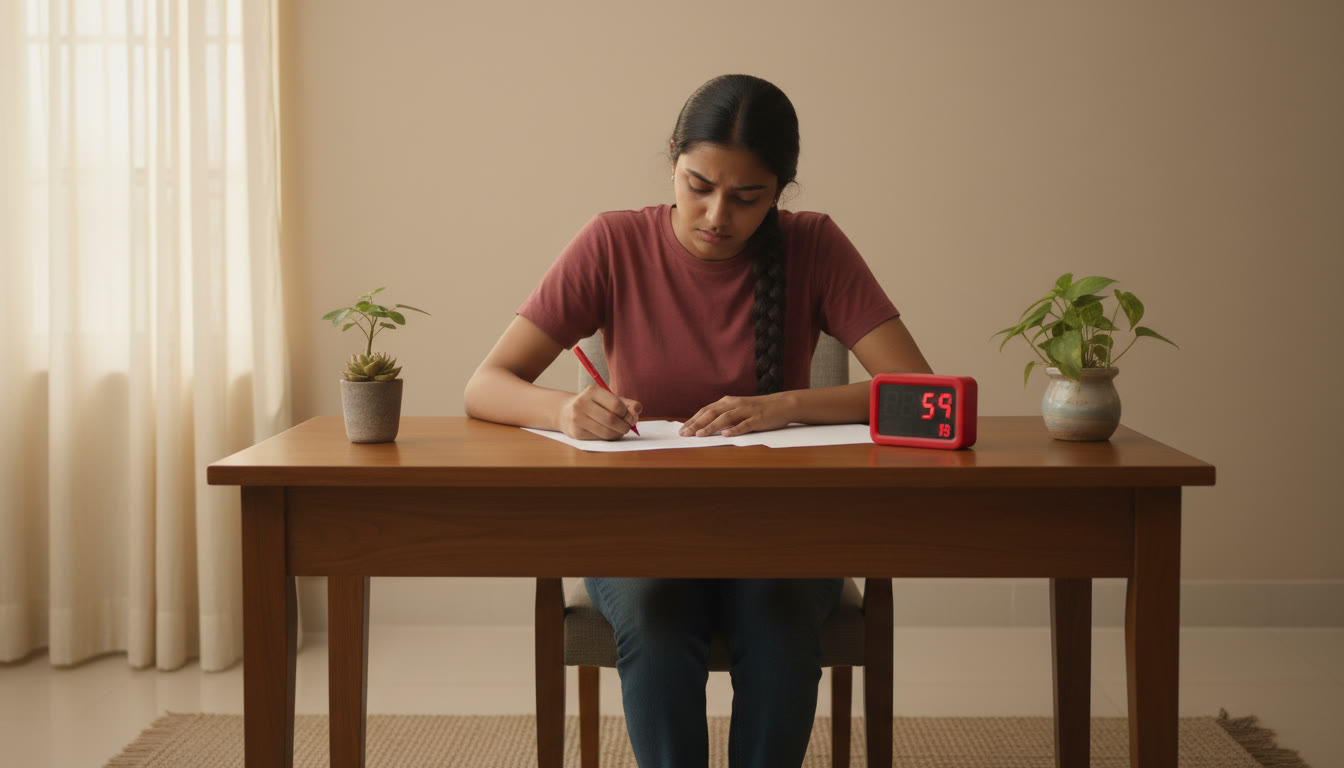
From that diagnostic you should be able to answer three questions: Which chapters cause the most mistakes? Are you losing marks because of careless errors or because you don’t know the material? Can you complete the paper in time? The answers shape everything that follows.
Build a weekly plan with micro-goals
Weak students improve fastest when they work with short, focused cycles. A weekly rhythm keeps momentum without burning out. Use a simple template: two concept-days, two practice-days, one revision-day, one mock or timed-practice day, and one rest or light-review day.
Quick weekly plan template
| Day | Focus | Time Block | Target |
|---|---|---|---|
| Monday | Concept learning (weak chapter 1) | 2 × 45 mins | Understand core ideas & solve 5 guided examples |
| Tuesday | Practice problems (related to chapter 1) | 2 × 45 mins | Attempt 10 questions, mark errors |
| Wednesday | Concept learning (weak chapter 2) | 2 × 45 mins | Make a 1-page summary and formula box |
| Thursday | Practice + revision | 2 × 45 mins | Timed practice + review mistakes |
| Friday | Topic revision (both chapters) | 2 × 45 mins | Active recall test of items you learned |
| Saturday | Full-length or sectional mock | 3 hrs / 1–2 hrs | Simulate exam; mark and note 3 recurring errors |
| Sunday | Light review & reset | 30–60 mins | Organize notes, plan next week |
That table is a template — scale the time blocks to match your day. The key idea is repetition with variety: learn, practice, revise, test, and rest. Keep every target measurable (e.g., solve 10 questions, review 15 flashcards).
Micro-goals and quick wins
- Set a daily “minimum” (e.g., 30 minutes of focused work on the weakest topic). Completing the minimum is a win.
- Celebrate small improvements: finishing a timed section 10% faster or reducing calculation errors.
- Keep a one-line progress diary — what went well, what needs change — five times a week.
Subject-specific micro-strategies
CBSE subjects have patterns. Weak students benefit most by adopting the high-leverage actions that apply to their subject.
Mathematics
- Classify problems: list types (algebraic manipulation, coordinate geometry, calculus variants). Practice the prototype for each type until the method becomes routine.
- Learn standard steps for full marks — show working clearly and write intermediate steps when required by marking scheme.
- Prioritize problem-solving speed by timing smaller sets (e.g., 5 problems in 30 minutes) before doing full tests.
Science (Physics, Chemistry, Biology)
- Physics: focus on concepts, free-body diagrams, units, and numerical practice. For derivations, practice writing clean, stepwise answers that match how marks are awarded.
- Chemistry: establish reaction patterns, basic equations, and problem templates (stoichiometry, thermochemistry). Memorize only what is high-yield; understand the rest.
- Biology: use diagrams and flowcharts — diagrams are tools to explain, not decoration. Write concise, labeled answers aligned with typical mark allocation.
Social Sciences and Languages
- For Social Sciences, create timelines and cause-effect maps. Practice answer-writing: define terms, give examples, and connect to the question’s demand words (describe, analyze, evaluate).
- For Languages, focus on formats (letter, essay), grammar accuracy, and reading comprehension strategies. Practice past prompts under timed conditions.
Across subjects, treat diagrams and derivations as learning tools. They help you internalize structure and often convert a fuzzy understanding into a precise answer during exams.
Understand the paper pattern and marking mindset
Instead of guessing what is “important,” study the format: sections, internal choices, and the visible marking clues inside questions (sub-parts and allocated marks). That knowledge lets you allocate time intelligently and write answers tailored to how marks are awarded.
- Always note how many marks a question is worth. If a question is 4 marks, plan to write two clear points and a short example or calculation step for each mark.
- For long answers, use numbered points or small paragraphs — clarity keeps your answer visible to the examiner and reduces lost marks for poor presentation.
- Practice answer framing: start with a one-line thesis or formula, then expand with steps or supportive points.
How to learn from marking schemes
After each mock or practice paper, compare your answer to the ideal marking approach. Note where you lost marks — often the loss is for missing a single word, a missing unit, or a skipped step. Create a “loss log” with the 3 most frequent mistakes and tackle them systematically.
Full-length mocks: frequency, focus, and feedback
Mistakes in real exams are rarely novel; they are common patterns that repeat when students are under time pressure. Full-length mocks reveal those patterns. If you are weak, schedule more targeted mocks rather than only repeating the same old paper over and over.
| Mock Type | When to Use | Duration | Primary Goal |
|---|---|---|---|
| Sectional timed practice | Early weeks | 30–90 minutes | Improve accuracy and time on weak sections |
| Topic-wise mini mock | After focused learning | 60–120 minutes | Check concept retention and common errors |
| Full-length mock (realistic) | Later weeks / before exam | Full exam duration | Simulate exam stamina and strategy |
After each mock do three things: mark strictly, write a short improvement plan (3 actions), and re-practice the exact questions you got wrong until the method becomes automatic. This is where gains compound: every error corrected removes the risk of repeating it under pressure.
How to analyze a mock
- Time analysis: which sections took too long? Where did you pause?
- Error analysis: careless mistakes, conceptual mistakes, language or presentation errors.
- Strategy analysis: did you jump to hard questions first? Did you leave easy marks for later?
Revision techniques that stick
Revision should be active, not passive. Reading notes is less effective than testing yourself and explaining concepts aloud.
- Spaced repetition: review a topic after 1 day, 3 days, 7 days, then 2–3 weeks. Each pass should be shorter and more active.
- Active recall: close notes and write down everything you remember about a topic. Check and correct gaps immediately.
- One-page summaries: condense a chapter into one page with formulas, key definitions, and a 3-step method for common problems.
- Peer-teaching: explain a topic to a friend or family member — if you can teach it clearly, you know it.
Time management: daily and exam-day tactics
Time is often the real enemy for students who struggle. A few practical rules help:
- Use the two-pass approach in exams: quick pass for all easy questions, then second pass for medium and hard ones.
- Allocate a fixed time per mark (as a guideline) and stick to it — this prevents over-investing time in a single question.
- Leave 10–15 minutes at the end for revision and correction — small corrections often recover lost marks.
Exam-room answer presentation
Answer neatness and structure matter. For numerical problems, show steps. For theoretical answers, use numbered points or short paragraphs. Where a question asks for explanation, connect cause and effect and give one example if space allows. Never assume partial marking — present every point clearly as if you are earning the marks for each line.
Handling anxiety and building exam stamina
Weak students can become anxious, and anxiety reduces accuracy. Practical habits reduce anxiety long before exam day:
- Simulate exam conditions in practice so the real exam feels familiar.
- Develop a simple pre-exam routine: light revision for 30 minutes, breathing exercises, and a checklist (pens, admit card, watch) — the checklist avoids last-minute panic.
- Sleep, hydration, and a calm meal matter more than one extra hour of late-night studying. Your brain consolidates knowledge during sleep.
When to ask for help — and how to get the most from it
Targeted help speeds recovery. If you’re stuck on the same errors despite practice, personalized guidance can point out misconceptions and shortcut patterns that make a difference.
If you choose a tutor or guided program, look for the following: 1-on-1 guidance that focuses on your specific weak topics; a tailored study plan that fits your pace; and ongoing feedback with measurable checkpoints. For students who want structured, personalized support, Sparkl offers 1-on-1 guidance, tailored study plans, expert tutors, and AI-driven insights that help track progress and prioritize weaknesses. Many students find that a small, regular investment in focused tuition accelerates the improvement curve.
When referring to resources, use targeted help for the moments you are stuck. For example: if a particular chapter in mathematics consistently costs you marks, dedicate a short block with an expert who can demonstrate the core method and then supervise practice for a fixed number of sessions. Repeat until the method is reliable.
For possessive mention: Sparkl’s approach mixes human tutors with diagnostics that show the exact topics to prioritize, which saves wasted study time and keeps revision tightly aligned with marking priorities.
Common pitfalls and how to avoid them
- Over-broad studying: Trying to study everything superficially. Fix: narrow to high-impact chapters and correct the top 3 recurring mistakes each week.
- Ignoring exam technique: Know how many marks each sub-part needs; practice answer length and presentation to match that.
- Skipping full-length practice: Without simulated exams you won’t develop pace and stamina.
- Neglecting revision: Repeated exposure is how weak topics become reliable — use spaced reviews on a schedule.
- Letting failures define you: A poor mock is information, not identity. Each mistake fixed adds up.
Sample 8-week recovery plan (compact)
| Week | Main Focus | Practice | Outcome |
|---|---|---|---|
| 1 | Diagnostic + plan; learn 2 weakest chapters | Sectional practice | Clear list of top 6 weaknesses |
| 2 | Deep practice on chapter 1 | Targeted problems + mini mock | Method reliable on typical problems |
| 3 | Deep practice on chapter 2 | Timed questions + revision | Reduced careless errors |
| 4 | Consolidate three medium chapters | Sectional mocks | Improved accuracy and speed |
| 5 | Full-length mock; analyze | Full mock + error log | Refined exam strategy |
| 6 | Polish weak points; one-on-one sessions | Practice + tutor feedback | Key gaps closed |
| 7 | Finalize revision notes & formula sheets | Active recall schedule | High retention of essentials |
| 8 | Simulate exam week and rest plan | Two full mocks + light review | Exam-ready pace and calm |
Adapt the schedule length to suit your starting point. The point of the plan is consistency: small, frequent wins build reliable performance faster than erratic bursts of study.
Final academic note
Improvement for CBSE exams is the product of accurate diagnosis, focused short cycles, disciplined practice with full-length simulations, and clear alignment with the syllabus and marking expectations. Keep measuring errors, refining methods, and prioritizing the highest-impact tasks; steady recovery follows from persistent, structured effort.



















No Comments
Leave a comment Cancel