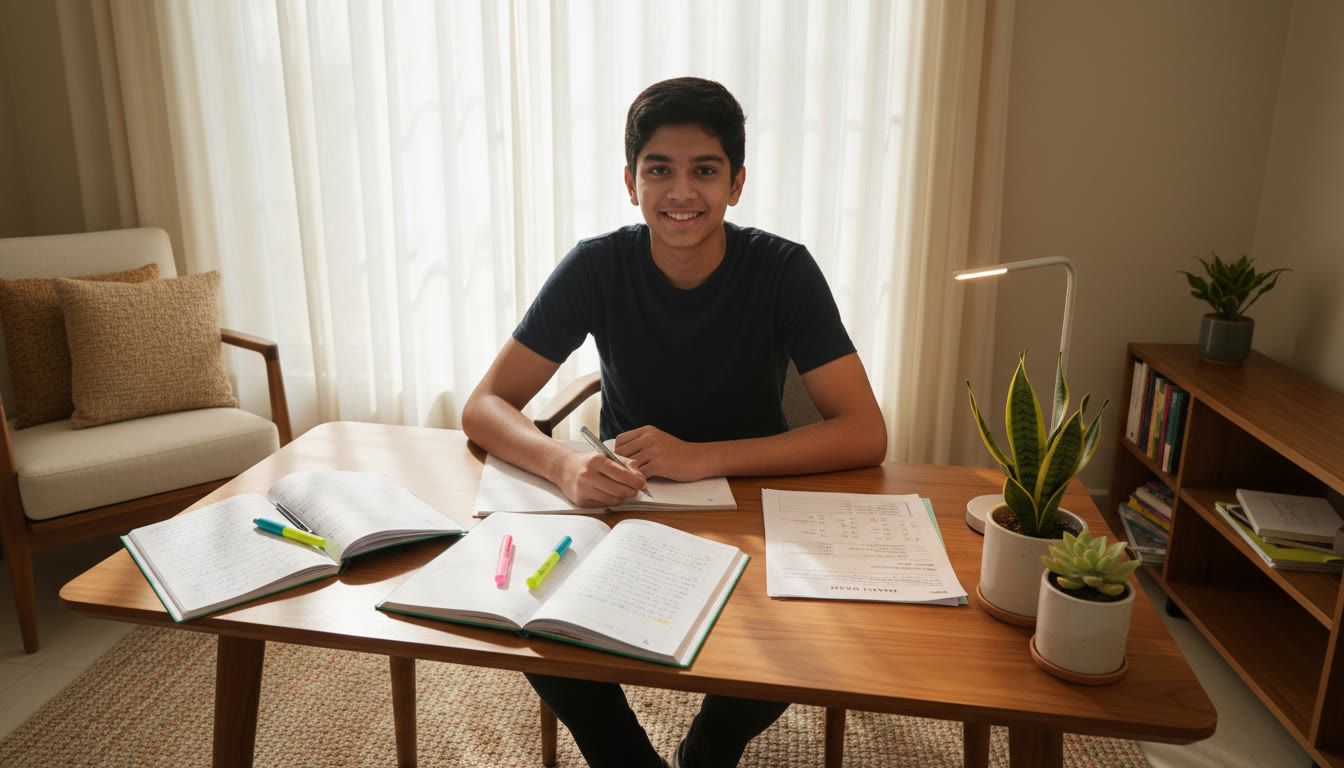

Why a Board-Wise Strategy Changes Everything
Board exams are not just about what you know — they are about how you show it on the day that counts. For CBSE students aiming for top marks, the difference between a good score and a great score often comes down to a few things: clear alignment with the syllabus, consistent full-length mock practice, understanding the marking mindset, and deliberate revision habits. This blog will walk you through a calm, practical, and human plan for turning preparation into performance.
Start with the right mindset
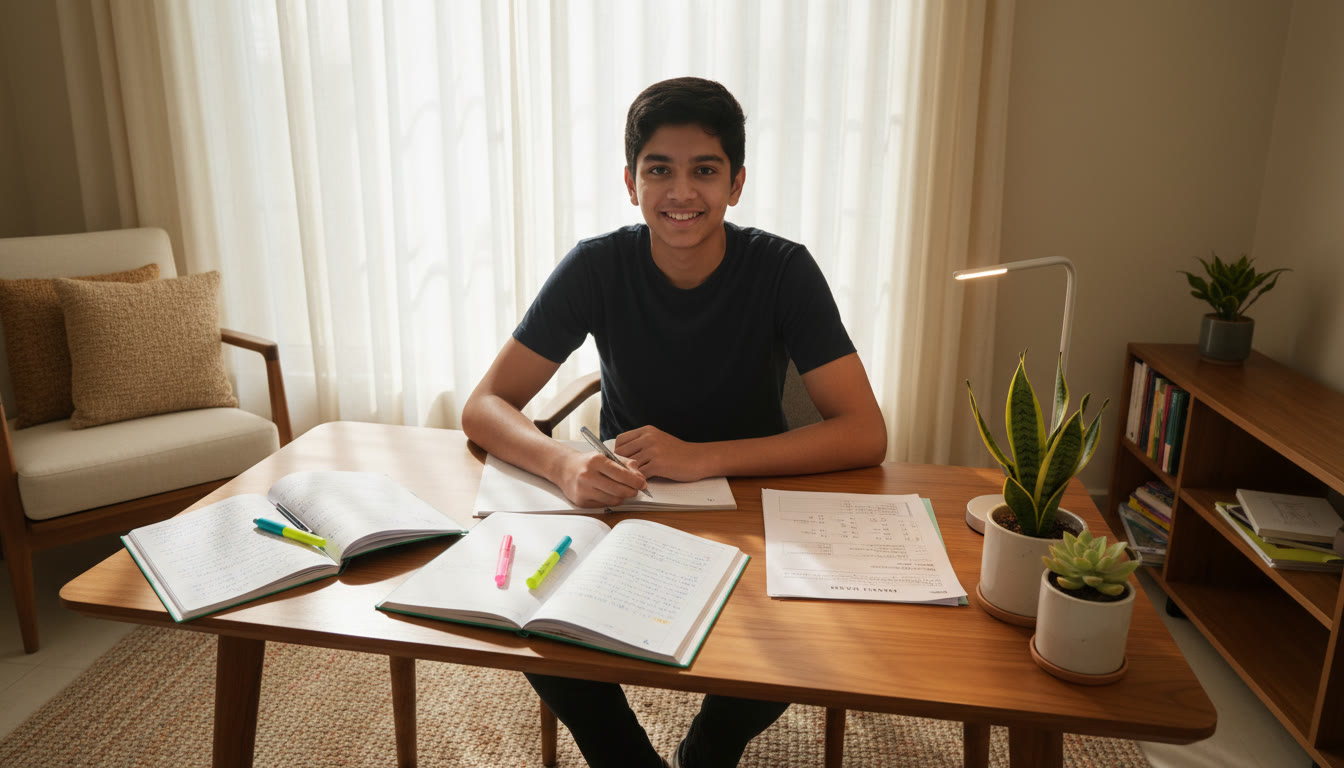
Confidence is a habit you build, not a trait you’re born with. Replace panic with process: map what you must learn, break it into manageable chunks, and treat every mock test as feedback rather than a verdict. That shift — from fearing exams to treating them as structured opportunities to demonstrate learning — is the single most stabilizing move you can make.
Understand the CBSE Blueprint: Syllabus, Weightage and Question Style
Know the boundaries so you can be creative within them
CBSE exams prize clarity and alignment. That means:
- Stick to the official syllabus topics — they are your roadmap.
- Pay attention to the types of questions commonly asked: short-answer, long-answer, value-based, case-based, and application-based items.
- Understand the marking approach: answers with clear structure, correct keywords, and logical steps generally score well.
Rather than memorizing whole chapters, learn to map every chapter to likely question types and practice accordingly.
Make a simple syllabus map
Create a one-page map for each subject listing: (a) Must-know concepts, (b) Practice problems, (c) Application tasks, and (d) Diagram/derivation practice. Review that map weekly and update it after every mock test so it reflects real weaknesses.
Daily Habits That Build Reliable Scores
Small, steady practice beats last-minute marathons
Consistency matters more than session length. Aim for focused study blocks of 40–60 minutes followed by a short break. Blend active recall (testing yourself) and spaced repetition (revisiting material at increasing intervals). Over time, this approach consolidates memory and sharpens exam recall.
- Morning: Concept review (30–45 mins) when your mind is fresh.
- Afternoon: Problem practice or application tasks (45–60 mins).
- Evening: Quick revision and light reading, focusing on weak spots (20–30 mins).
Use a weekly rhythm
Block subjects across the week so no subject is neglected. Keep one day for consolidation and pure revision, and one shorter day for rest and light review to avoid burnout.
Sample Weekly Study Plan
This simple sample helps you visualise how focused hours translate into progress. Adjust hours and days to match your school timetable and energy levels.
| Day | Primary Focus | Goal | Active Practice |
|---|---|---|---|
| Monday | Mathematics (core concepts + problem set) | Complete 2 concept lessons + 10 practice problems | Timed problem solving (45 mins) |
| Tuesday | Science (theory + diagrams/derivations) | Revise 2 chapters + draw 3 diagrams | Write 2 long-answer responses |
| Wednesday | Language (writing & comprehension) | Practice essay + 2 unseen passages | Timed writing (30 mins) |
| Thursday | Social Sciences (history & maps) | Map practice + 10 short answers | Answer structuring drill |
| Friday | Revision mix (weak areas) | Targeted practice on mistakes from mocks | Flashcards + quick tests |
| Saturday | Full-length practice or sectional mock | Simulate exam conditions | Full-length timed test |
| Sunday | Consolidation & rest | Light revision & planning for week | Reflection and notes update |
Full-Length Mocks: Your Most Honest Feedback
Run them, review them, and learn deliberately
A full-length mock done under exam conditions is the closest rehearsal you can give yourself. Aim to do sectional tests frequently and full-length mocks periodically. But the secret is in the review: do not move on until you have a clear, written plan for how to fix each mistake.
- Simulate timing, seating, and materials to build resilience.
- After the test, mark it as a teacher would: be honest and strict.
- Create a two-column error log: Mistake type (concept, careless, time) and corrective action.
How to use data from mocks
Full-length practice surfaces time leaks and weak question types. Use performance patterns to reallocate study time: if long-answer numericals consistently take too long, add more timed practice on those. If language sections lose marks to unclear presentation, practice structuring answers with short opening lines, bullet points, and endings.
Smart Answering: Presentation, Structure, and Time Use
Start with the paper strategy
When the question paper is handed out, take the reading time seriously. Plan a time allocation map for the paper, noting which questions to tackle first and which to reserve for later. Always leave a brief window at the end for quick proofreading and small improvements.
Write answers that graders can read quickly
Neatness, clear headings, labeled diagrams, and stepwise numerical work help examiners award marks faster. A few practical tips:
- Under each answer, start with a one-line thesis or the key result; then expand with logic or steps.
- For problem-solving, show the main steps and write units. Even when the final answer is correct, clear intermediate steps reduce the chance of mark loss.
- For language or social science answers, use short paragraphs or numbered points to make the structure obvious.
Subject-Wise Tactics That Often Make the Difference
Mathematics
Practice remains king in maths. Focus on mastering foundational techniques, then apply them in increasingly complex contexts. Timed problem sets and error analysis are essential. Memorise core formulas but prioritise understanding when and why they apply.
Sciences (Physics, Chemistry, Biology)
For conceptual sciences, balance theory with application. Diagrams and equations should be practiced until you can reproduce them cleanly from memory. For experimental/chemical procedures, focus on core principles and typical reasoning steps rather than rote steps alone.
Languages
Read widely and practice writing under time constraints. For comprehension, train on unseen passages and summarisation. For writing sections, keep a toolbox of opening lines, linking phrases, and a checklist to ensure completeness: context, example, and conclusion.
Social Science
Chronology and cause-effect relationships matter. Build timelines and mind-maps for history, and practise map-skills and evidence-backed answers for geography and civics. Use short summaries for each topic and practice converting those into structured answers.
Note-Making and Active Revision
Build notes that the exam rewards
Notes are study tools, not exam answers. Create concise, layered notes: flashcards for quick recall, a one-page summary for each chapter, and a three-to-five-page deep summary for high-weight topics. Update notes after each mock test to reflect what actually appears in exams.
Revision cadence: spaced and mixed
Rotate topics rather than studying one subject in isolation for long stretches. Mixing subjects in a single study session improves retrieval cues and helps you switch modes quickly, which mirrors actual exam demands.
Tracking Progress: Simple, Useful Metrics
Track a handful of metrics that translate directly into mark improvement: score trends on full mocks, accuracy on high-value question types, and time spent per question on average. Keep a compact dashboard (even a notebook) and review it weekly. If you have access to personalised tutoring, the tutor should help interpret these metrics and set specific micro-goals.
Final 30-Day Plan — What to Prioritize
The last month before boards is about consolidation, not new chapters. A helpful frame is checklist-based: revise, practise, polish, and rest. Here’s a compact checklist you can adapt:
| Week | Primary Aim | Daily Focus | Key Activity |
|---|---|---|---|
| Week 1 | Complete rapid revision of all chapters | 2–3 chapters/day | Short timed quizzes + flashcard review |
| Week 2 | Targeted practice on weak areas | Problem-solving + long answers | Sectional timed tests |
| Week 3 | Full-length mocks and analysis | 1 mock every 3–4 days | Detailed error logs and correction plan |
| Week 4 | Polish presentation and rest | Light revision, short practice | Relaxation techniques + sleep routine |
How Personalised Support Helps — The Right Kind of Tutoring
Some students benefit from one-on-one guidance that focuses on their unique gaps and keeps them accountable. When personalised help is aimed at building independent skills — better technique, smarter time use, clearer answers — it complements school learning rather than replacing it. If you choose a tutor or a platform, seek options that offer tailored study plans, expert tutors, and data-based feedback so practice is targeted and efficient. For students who opt for guided support, Sparkl‘s approach to 1-on-1 guidance and AI-driven insights can make practice time more efficient by highlighting the highest-impact improvements.
Exam-Day Habits and the Quiet Rules of Success
Three practical exam-day rules
- Arrive early with a clean, calm routine: stationery, admit card, and a light snack.
- Read the paper thoroughly during reading time and make a quick plan mapping time to marks.
- Answer clearly and concisely — quality beats quantity when time is limited.
Manage stress without losing time
Use breathing exercises before you begin, and if you feel stuck on a question, move on and return later. Small, steady practice on relaxation during mocks helps these strategies become automatic on exam day.
How to Keep Improving — The Feedback Loop
Improvement is a loop: practice → evaluate → correct → practice. Maintain an error log that captures what went wrong, why it happened, and a precise plan to prevent it next time. Over weeks, this habit reduces repeated mistakes and clarifies the highest-return study actions.
Where tailored guidance adds value
When a coach or platform helps you convert your error log into a personalised schedule and gives targeted practice on stubborn weaknesses, progress accelerates. For example, guided one-on-one sessions can focus on exam presentation or timed problem-solving drills until those skills become second nature. Platforms that combine human tutors with analytics can make that cycle faster by turning raw mock results into precise action items. If you explore that route, remember to prioritise clarity, small measurable goals, and accountability.

Common Pitfalls and How to Avoid Them
- Over-reliance on revision notes without active testing — fix: test first, then consult notes to correct mistakes.
- Skipping full-length practice — fix: schedule at least one full-length mock every 7–10 days during consolidation.
- Studying in long unfocused marathons — fix: switch to shorter, concentrated blocks with breaks.
- Neglecting time management — fix: practice timed sections and record average time per question.
Putting It All Together: A Realistic Roadmap
Follow these steps in order and adapt them to your pace:
- Map the syllabus and flag high-value topics.
- Create a weekly rhythm that balances learning, practice, and full mocks.
- Use active recall and spaced repetition to lock concepts in memory.
- Do full-length mocks under realistic conditions; treat results as diagnostic tools.
- Maintain an error log and convert it into targeted practice sessions.
- Polish presentation and time allocation strategies before the final stretch.
Closing Academic Note
Scoring top marks in CBSE exams is a product of deliberate practice: aligning study to the syllabus, practising under exam conditions, understanding how answers are evaluated, and refining weaknesses with targeted drills. Build routines that prioritise clarity, time-aware practice, and gradual consolidation. Thoughtful habits and disciplined review not only improve scores but also deepen understanding — and that educational growth is the lasting outcome of any board preparation.























No Comments
Leave a comment Cancel