
How to Think Without Memorizing Formulas: A JEE Student’s Playbook
There’s a quiet freedom that opens up once a formula stops being something you ‘must remember’ and becomes something you ‘can build’. For JEE aspirants, that shift — from rote recall to generative thinking — is the difference between guessing a symbol under pressure and calmly reconstructing an expression from first principles.
This guide is the practical, human-side playbook for making that shift. No preachy slogans, no magic shortcuts — just step-by-step habits, lightweight drills, and exam-smart tactics that work inside the MCQ-driven, time-pressured environment you face in the physics, chemistry, and mathematics portions of JEE-style tests.

Why memorizing feels safe — and why it isn’t
Memorizing formulas can feel like a short route: if you have a long list of formulas in your head, you think you’re ready. The problem shows up under three conditions that are common in competitive exams:
- Questions are contextual: they repackage familiar relationships into new frames.
- Time pressure forces you to adapt if a direct formula doesn’t fit the format.
- Negative marking punishes random guessing and rewards reliable reasoning.
So the safer path is to make formulas secondary: first understand, then derive quickly, then apply. That way, even if you forget the exact coefficient or sign, your reasoning will point you in the right direction.
Core exam realities to design your practice around
When you practice thinking instead of memorizing, align that training with the test realities you’ll face:
- MCQ-based format: questions expect crisp answers; steps often matter for arriving at the option set.
- Full-length mock rhythm: practice under a three-hour, exam-like environment to build stamina and timing.
- Negative marking: accuracy matters. Strategic elimination and reasoned answers beat blind recall.
- Answer marking discipline: whether you simulate OMR bubble-filling for paper mocks or the digital marking flow for computer-based tests, cultivate clean, error-free answer recording habits.
- Syllabus focus: your routine should be driven by Physics, Chemistry, and Mathematics fundamentals; practice deriving expressions from those fundamentals rather than memorizing lists.
- No partial-credit assumptions: for MCQs, partial steps don’t earn points — your job is to reach the right option consistently.
Three mental shifts that change everything
Adopt these shifts and the rest becomes tactical:
- From static memory to dynamic derivation: Treat formulas as end-products of reasoning, not static facts. If you can sketch the short derivation, you’re safe.
- From formula recall to unit and limit checks: Units, limiting cases, and symmetry give fast sanity checks that catch sign or coefficient errors before you bubble an answer.
- From isolated equations to concept networks: Build maps that link a formula to the concept it represents, typical derivations, and two quick applications.
Concrete tactics: a daily toolkit
These are simple techniques you can use in 10–30 minute blocks. Over a month they compound into real skill.
- Derive in one minute: Pick a familiar formula and reproduce a stripped-down derivation in 60–90 seconds. Focus on logical steps, not algebraic detail. Do this daily for different topics.
- Dimension and limit checks: Before trusting an answer, check units and two limiting cases (zero and infinity where applicable). If a velocity formula gives meters per second, you’ve avoided a common error.
- Simplify to skeletons: Store skeleton versions of formulas — the structure and dependencies — instead of full coefficients. For example, remember that the range of projectile motion scales as velocity squared divided by gravity and depends on an angular function, then reconstruct the exact coefficient if needed.
- Pattern-bank of transforms: Maintain a short list of algebraic transforms you use to derive formulas: small-angle approximations, completing the square, using conservation laws, or energy–work relationships. These are tools, not facts to memorize.
- Quick reverse-engineer: Look at options in an MCQ and work backward. If one choice produces consistent units and reasonable limits, it often saves time compared with deriving from scratch.
Practice drills you can do immediately
Consistency beats intensity. These drills are meant to be repeated and timed — they train thinking speed.
- 10-minute derivation drills: Open a random chapter, pick a formula, and explain it out loud in 10 minutes. If you can narrate the why and how, you’re learning the idea, not a string of symbols.
- 15-minute unit checks: Given a short list of expressions, mark which ones are dimensionally consistent. This builds an automatic filter that catches nonsense answers quickly.
- 30-minute MCQ recast: Take 5 MCQs and write, in one line each, the physical principle you’d use. This links questions to concepts rather than isolated formulas.
Sample quick derivation — how to reconstruct, not memorize
Take a typical physics scenario: you need the horizontal range of a projectile launched at speed u and angle θ. If you don’t remember the exact formula, think like this:
- Break into components: horizontal velocity u_x = u cos θ, vertical velocity u_y = u sin θ.
- Find time of flight from vertical motion: total vertical displacement is zero for level ground, so use upward and downward symmetry or solve vertical motion equations to get time ∝ u_y/g.
- Range = horizontal speed × total time. So range ∝ u cos θ × (u sin θ / g). Combine to see a u²/g factor and a trig factor sinθ cosθ, which you know combines into (1/2) sin 2θ if needed.
That line of thought gives you the structure u²/g × trig function. If you need the constant out front, your steps already produce it. You didn’t need to recall the formula — you reconstructed it from concepts.
Table: Short drills, purpose, and time
| Skill | Drill | Daily Time | Why it helps |
|---|---|---|---|
| Derivation fluency | 60–90s rebuild of a known formula | 15 mins | Turns recall into reconstructive habit |
| Dimension sense | Check 10 expressions for unit consistency | 10 mins | Catches algebraic and sign errors fast |
| MCQ elimination | Practice back-solving from options | 20 mins | Improves accuracy under negative marking |
| Special cases | Test formula at extremes (0, ∞, symmetry) | 10 mins | Exposes hidden assumptions |
| Mock simulation | Full 3-hour exam simulation | 180 mins (weekly) | Builds stamina, timing, and answer-recording discipline |
Mock tests and OMR/computer discipline
Full-length mocks are where thinking beats memory. Treat them as rehearsals for both your mind and your environment: practice the timing, the mark distribution, and the answer-recording routine. A reliable mock routine looks like this:
- First pass — rapid scan: answer the low-hanging fruit quickly to secure marks and confidence.
- Second pass — focused solving: work on the medium-difficulty items using the derivation and dimension checks you’ve practiced.
- Last pass — targeted attempts and reviews: reassess flagged questions, eliminate options, and avoid risky guesses because of negative marking.
Whether your mock uses paper-based OMR or a computer interface, guard the answer-recording step. A small marking error can erase the benefit of a well-reasoned solution. Build a personal checklist you follow after every question: quick units check, sanity limit, and confirm the bubbled answer matches your working.
How to tackle the mental blocks
When you freeze mid-problem, these micro-strategies help restore flow:
- Re-state the problem in one sentence: For example, “Find the time it takes for the bead to return to the origin given initial upward speed u.” This focuses the core variable relationships.
- Ask two guiding questions: Which conservation law or definition applies? What are natural limiting cases?
- Sketch a tiny diagram: A one-line sketch often reveals symmetry or a cancellation you missed.
Notes, diagrams, and derivations: learning tools, not answer scripts
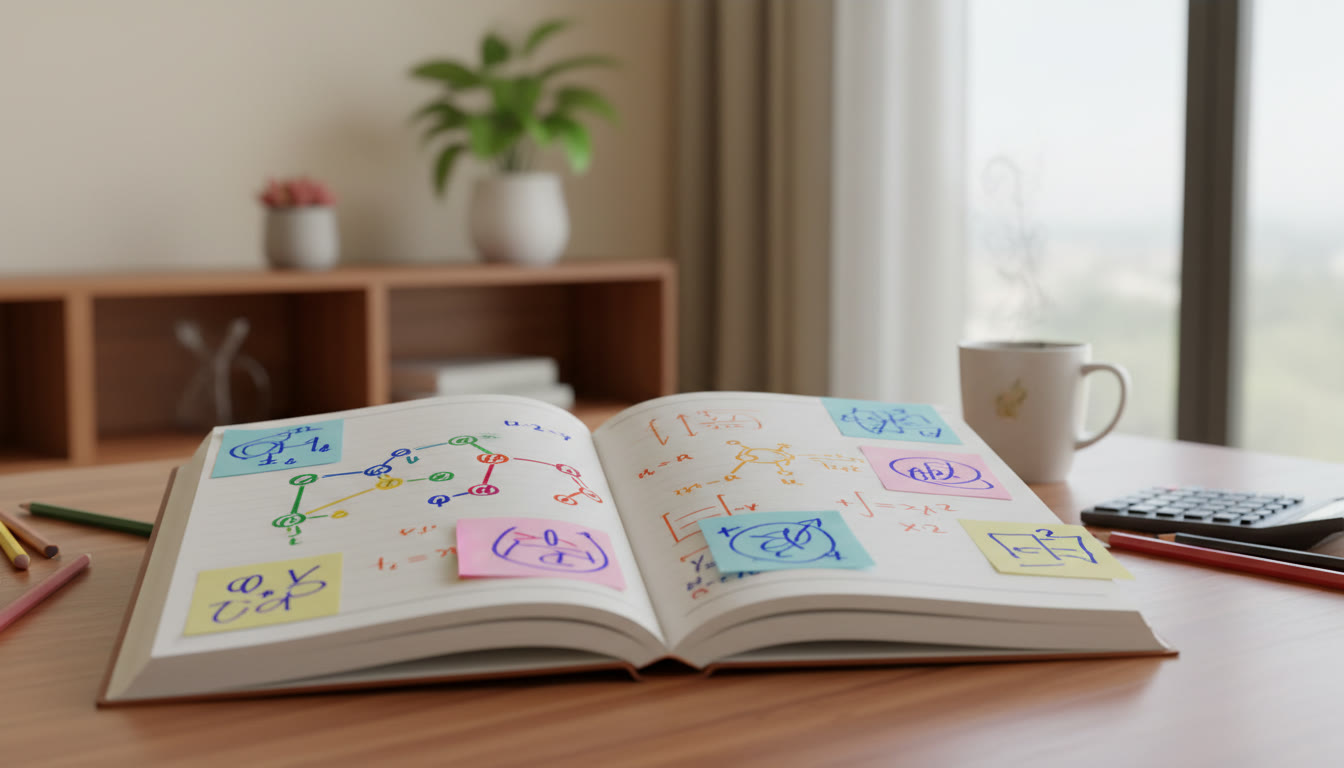
Your notes should be living — short derivation flows, diagrams annotated with meaning, and a ‘why’ sentence for each major formula. Treat diagrams and derivations as tools to rebuild answers, not as decorative memory aids. When you practice this way, a 10-line notebook page becomes a compact empowerment kit you can reproduce mentally during exams.
When memories fail: techniques for last-minute reconstruction
Last-minute panics are often about confidence, not competence. Use these safe tricks if you can’t recall an exact expression:
- Units-first: Force the expression to match units. That alone can fix multiplicative factors or reveal missing variables.
- Dimensionless ratios: Sometimes the result is a ratio; express the unknown as a factor times a known ratio of variables.
- Small-limit expansions: If angle or velocity can be small, approximate and see the structure; that points to the full form.
Daily plan that builds thought-architecture
Here’s a compact daily plan that respects school hours, coaching hours, and personal rhythms. You can adapt the durations; consistency matters more than exact minutes.
- Warm-up (20–30 mins): Quick derivation drills and unit checks for one topic.
- Focused study (60–90 mins): Work on problem sets that force derivation rather than plug-and-chug.
- Application (30–45 mins): Mixed MCQs targeting the day’s concept; practice elimination under time limits.
- Reflection (10–15 mins): Annotate one or two mistakes — why you made them and which quick check would have prevented them.
How guided personalization can accelerate thinking
Thinking is a meta-skill: you grow it faster when practice is tailored. If you choose guided help, look for mentorship that focuses on the thinking process — rebuilding formulas, recognizing patterns, and diagnosing conceptual gaps — rather than simply giving lists to memorize. For students who prefer structured personalization, Sparkl‘s 1-on-1 guidance, tailored study plans, and AI-driven insights can help translate these techniques into a repeatable study path.
A sample week: turning tactics into habit
Below is a simple cycle you can repeat weekly. Rotate topics so you keep exposure across physics, chemistry, and mathematics.
- Day 1–2: Foundations and derivations — pick 2 core formulas per subject.
- Day 3–4: MCQ application — mixed problem sets with elimination practice.
- Day 5: Targeted mocks — 60–90 minute sectional test focusing on speed and reconstruction.
- Day 6: Full-week review and weak-point repair; use sketches and one-minute derivations.
- Day 7: Rest, light reading, and conceptual consolidation.
Common pitfalls and how to avoid them
- Over-relying on memorized lists: If your first reaction to a new problem is to flip through a mental list, pause and ask which principle applies.
- Skipping limit checks: You’ll miss nonsensical results. Habitually check extreme cases.
- Practicing only easy questions: Thinking grows through mildly uncomfortable problems. Include medium-difficulty puzzles regularly.
- Ignoring answer-recording practice: A correct process can be undone by a careless bubble. Practice clean marking routines every mock.
Final practical checklist before exam day
- Review skeleton derivations for 10–15 core formulas per subject (structure, not verbatim coefficients).
- Run three 60–90 second derivation drills for weak topics.
- Do a short mock under timed conditions focusing on clean answer recording.
- Pack a tiny sanity kit: a one-page sheet of core units and typical limits (for last-minute mental checks).
Conclusion
Thinking without memorizing is not an abstract ideal; it’s a practice habit you can train. Build a routine of short derivations, unit and limit checks, and mock-test rehearsals that mimic the timed, negatively marked MCQ environment. Over weeks, your mind learns to reconstruct formulas reliably; they stop being fragile facts and become natural tools you wield confidently in an exam setting.

















No Comments
Leave a comment Cancel