

CBSE Sample Paper Revision Strategy: Turn Practice into Exam-Ready Performance
If you’re sitting down with a stack of CBSE sample papers and wondering how to turn them into real score gains, you’re in the right place. Sample papers aren’t just extra homework — they are a rehearsal of the exam day, a mirror that shows you exactly where your preparation is solid and where it’s fragile. This guide walks you through a clear, student-friendly strategy to use sample papers wisely: diagnose, practice, polish, and perform.

Why sample papers matter (and how to avoid common mistakes)
Sample papers reflect the latest updates to question styles, distribution, and marking emphasis. When used correctly they do three things: simulate time pressure, reveal syllabus gaps, and sharpen exam technique. A common mistake is treating them like one-off quizzes — students take a paper, get a score, then move on. Real learning happens when you analyze mistakes, correct misconceptions, and repeat targeted practice.
Remember two simple rules before you start: always check that the paper aligns with your current syllabus and marking format, and treat the official marking guidance as the authoritative way to allocate marks when self-assessing. Do not assume partial marks automatically — award them only where the marking instructions or model answers indicate.
Quick checklist before you begin
- Confirm syllabus alignment and paper format (sections, marks, duration).
- Read the marking instructions or model answer notes that accompany sample papers.
- Decide whether to simulate exam conditions (strict timing, no notes) or to practice sections for technique.
- Set a realistic schedule: full-length mock tests should be spaced to allow meaningful review between attempts.
A step-by-step revision roadmap using sample papers
Think of your revision in phases. Each phase has a clear purpose: find weaknesses, fix them, build stamina, and polish presentation. You don’t have to finish the whole syllabus before you begin — well-chosen sample papers will help you focus revision more effectively than blind topic-by-topic studying.
Phase 1 — Diagnostic and focused patch-up
Start by taking one full sample paper under timed conditions early in your revision cycle. Treat this as a diagnostic, not a score to brag about. Your goal is to map weak topics, time-sink questions, and question-types that consistently trouble you.
- Time the paper strictly and mark it using the official marking guidance.
- Create an error log: for every mistake, note topic, question type, reason (concept gap, careless error, time pressure), and corrective action.
- Turn the error log into a micro-plan: for each recurring weakness, list 2–3 focused practice exercises (short questions, concept notes, targeted revision).
Phase 2 — Targeted practice: quality over quantity
After diagnosis, spend concentrated sessions on high-impact topics. Use sample paper sections as drills: do the short-answer section for 20–30 minutes, then take immediate corrective notes. The principle is deliberate repetition — practice a specific question type until you can do it accurately within the time limit.
- Break down long questions into steps and practice individual steps until each is automatic.
- For subjects with derivations or diagrams, rehearse the exact sequence of steps the evaluator expects; labeling and units matter.
- Keep a list of common command words (define, explain, justify, evaluate) and practice the specific writing approach each one demands.
Phase 3 — Full-length mocks and exam simulation
Once your topic-level confidence improves, schedule regular full-length mock tests. These build stamina and reveal how you manage time across sections. After each mock, spend 2–3 times the test duration reviewing it: mark carefully, write a short reflection, and plan concrete improvements before the next mock.
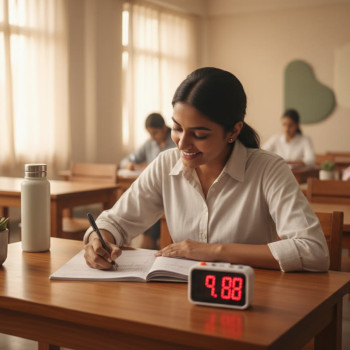
- Simulate exam conditions: same start time, strict timing, no notes, and write answers standing up or seated exactly as you will on exam day if that helps you focus.
- Check presentation: date/roll no., numbering, underlining headings and final answers where recommended — clarity saves marks.
- Use the rating scale: Content accuracy, Method/Steps, Presentation/Clarity; aim to improve each metric per test.
Suggested 8-week sample paper schedule (adapt to your timeline)
| Weeks | Main focus | Sample paper task | Daily time (approx.) | Outcome |
|---|---|---|---|---|
| 1 | Diagnostic + planning | One full timed paper; create error log | 1–2 hours | Clear list of weak topics |
| 2–3 | Targeted repairs | Sectional practice from sample papers (short/SA) | 2–3 hours | Improved accuracy on weak topics |
| 4–5 | Application & time skills | Mixed timed sections and half-paper attempts | 2–3 hours | Steady time management |
| 6 | Full-length mock 1 | Full timed mock + deep review | 3–4 hours (test + review) | Stamina and marking practice |
| 7 | Fine-tuning | Target weak sections; two short timed papers | 2–3 hours | Cleaner answers, fewer careless errors |
| 8 | Full-length mock 2 & polish | Full timed mock + final review | 3–4 hours | Exam-ready confidence |
How to mark, reflect, and convert mistakes into strengths
Marking is where learning multiplies. Don’t rush marking; do it with the same seriousness as taking the paper. Follow the marking guidance to the letter: allocate marks per step, tick off required elements, and award partial credit only where the key allows. When you mark, write short corrective notes in the margin and add a plan: what practice will fix this error, and when will you do it?
A practical self-marking rubric
- Accuracy: Is the final answer correct and supported by working? (Full marks if yes.)
- Method: Are intermediate steps logically shown and necessary formulas used? (Assign step marks as per key.)
- Presentation: Are units, circuits, diagrams, and labels present and clear?
- Clarity: Can a second reader follow your reasoning in under a minute?
After marking, write a one-paragraph reflection: what cost you the most marks (concept, careless, time) and one measurable action for the next mock. Over time this habit turns small, repeated improvements into large score gains.
Subject-specific tactics for sample-paper practice
Mathematics and numerical subjects
For math, structure and steps matter. Use sample papers to practise the sequence of work an examiner expects: state formula, substitute, simplify, box the final answer with units. If a solution requires multiple steps, label them: (i), (ii), (iii). When you make a calculation mistake, rewrite the step cleanly and redo those steps only — this trains you to isolate error sources quickly.
Science and derivation-heavy subjects
Derivations and experiment descriptions are best practiced as mini-essays. Sample papers often require a neat mix of theory and application. Write short, bullet-style plans for long answers before drafting the full answer: list key principles, equations, and the final conclusion. Diagrams should be labelled and proportional — a clear diagram with labeled parts is quicker to grade and often safer than a sloppy one. Treat diagrams as tools to explain, not decoration.

Languages and long-answer subjects
For languages, sample papers are a practice ground for clarity and structure. Practice planning answers in two to three lines, then write. For extended-response subjects, practise introductions and conclusions separately, then stitch them together. Keep an answer template for common question types (argumentative, descriptive, analytical) and adapt it quickly during the exam.
Time-management: tricks that actually work
Time management is less about rigid minute-by-minute plans and more about recognizing question classes and prioritizing. Start with a quick scan: mark the easiest questions you can answer in full and collect those marks first. Allocate a buffer for long or high-mark questions. If you get stuck on a question, note its number, move on, and return if time permits.
Sample time split technique
- First 5–10 minutes: read paper, underline command words, assign question priorities.
- Next 60–70% of time: answer medium and easy questions to secure base marks.
- Final 20–25%: tackle long or high-value questions and revise answers where necessary.
Common pitfalls and how to avoid them
- Don’t treat every sample paper as exactly the exam — use them to practice skills and patterns, not predict exact questions.
- Avoid rote answers that ignore the question’s command words; tailor every response to what is asked.
- Don’t overcorrect: if you spend too long polishing handwriting or decoration, you may lose marks for incomplete answers.
- Don’t assume partial marks unless the marking key suggests so — be precise and show working for credit.
How technology and guided feedback can speed progress
Smart feedback shortens the learning loop. Targeted tutoring, one-on-one feedback on marked sample papers, and AI-driven insights into common error patterns can help you prioritise the right practice. If you choose guided support, look for help that focuses on the four pillars above: correct diagnosis, deliberate practice, reinforced mock testing, and careful marking.
For tailored feedback that connects your mock performance to a personalised study plan, Sparkl‘s blend of 1-on-1 guidance, tailored study plans, expert tutors, and AI-driven insights is designed to close the gap between practice and performance naturally within your schedule.
Quick checklist for exam day built from sample-paper habits
- During reading time, mark the questions you will answer first and highlight command words.
- Write legibly and number answers clearly; examiners award clarity.
- Show all necessary steps for calculation and derivation questions; partial credit is given only where steps are visible and correct.
- Keep time-checks every 20–30 minutes and stick to your planned buffer for long questions.
Measuring progress: how to know the strategy is working
Progress shows in three ways: higher accuracy on repeated question types, reduced time per question category, and fewer careless errors on review. Track your scores and, more importantly, track the nature of errors. If your error mix shifts from conceptual to careless, you’re getting closer to exam-ready performance.
Simple progress metrics
- Accuracy rate on repeated question types (aim to increase by measurable percent each cycle).
- Time-per-question category (reduce by realistic chunks without losing accuracy).
- Number of new topics appearing in your error log (this should decrease over time).
Final academic note
Sample papers are practice and feedback loops turned into study tools: use them to discover gaps, practice deliberately, and polish exam technique under realistic conditions. Combine timed practice with careful marking, focused correction, and repeated full-length mocks until the format, timing, and marking expectations feel familiar and manageable. Consistent, reflective practice built around sample papers is the most dependable route from preparation to performance.
























No Comments
Leave a comment Cancel