

Why Micro-Goals Beat Marathon Sessions
When students hear “study for the SAT,” many picture marathon sessions: hours hunched over practice tests, coffee cups piling up, and motivation slowly leaking away. But steady, focused progress doesn’t come from sheer volume alone. It comes from small, deliberate moves—micro-goals—that are specific, short, and achievable. Think of them as the daily breadcrumbs that lead to the test-day smorgasbord of confidence and competence.
What is a micro-goal?
A micro-goal is a tiny, measurable action you can complete in a short block of time—often 10 to 45 minutes. Instead of saying, “Study math for two hours,” a micro-goal might be, “Finish and review five algebraic manipulation problems, focusing on factoring and sign errors.” The point is clarity and completion. You finish it, you get a hit of success, and you move on.
Why micro-goals work: the science and the psychology
Micro-goals align with how our attention, memory, and motivation actually function. A few reasons they’re effective:
- Short attention spans win: Your brain can concentrate intensely for short bursts. Micro-goals fit that pattern.
- Frequent wins boost motivation: Completing a small task releases dopamine, reinforcing the habit loop.
- Lower friction, higher consistency: Small goals reduce the mental barrier to starting.
- Better feedback cycles: Short, repeated practice lets you spot patterns—like recurring algebra mistakes—so you can adapt quickly.
Micro-goals vs. macro-goals
Macro-goals are essential—aiming for a target SAT score, a college list, or a timeline is necessary. But micro-goals are the daily machinery that powers you toward those macro targets. The macro tells you where to go; micro-goals tell you how to take the next step.
How to craft useful SAT micro-goals
Good micro-goals share certain features. Below is a practical checklist to evaluate whether your micro-goal will actually help:
- Specific: Define the skill or type of problem (e.g., “interpret two reading passage arguments”).
- Measurable: Include a number, a time limit, or an accuracy target.
- Short-term: Achievable in one focused session (10–45 minutes).
- Actionable: Focus on actions you control—practice, explain, correct—not outcomes like “get a 700”.
- Reflective: Include follow-up: review mistakes, note patterns, or jot a brief reflection.
The SMART micro-goal formula (a tiny tweak)
SMART goals are popular: Specific, Measurable, Achievable, Relevant, Time-bound. For micro-goals, trim that into a compact habit-friendly version:
- Specific skill or question type
- Minimum number or time (e.g., 10 problems or 25 minutes)
- Action (practice, review, explain)
- Reflect (write one line about the error pattern)
- Today (complete it in this session)
Examples of micro-goals by section
Concrete examples make this less abstract. Below are micro-goal examples tailored to different SAT sections, each designed to fit a short study block.
Reading
- Read one 250–300 word passage and identify the main idea in one sentence (20–25 minutes).
- Practice five inference questions, explain why the wrong choices are wrong (15–20 minutes).
- Summarize how the author builds an argument in one paragraph; highlight rhetorical devices (25 minutes).
Writing and Language
- Edit a passage for grammar: correct seven sentences focusing on verb tense and subject-verb agreement (20 minutes).
- Practice transitions: rewrite three awkward sentences to improve flow, and record the change (15 minutes).
Math (No Calculator)
- Solve eight algebraic manipulation problems; note which steps caused errors (30 minutes).
- Practice two geometry proofs: write out diagrams and label reasoning steps (20 minutes).
Math (Calculator)
- Complete six real-world word problems, and underline the key facts before solving (25 minutes).
- Drill on functions: graph three functions and explain differences in behavior (20 minutes).
Sample weekly micro-goal schedule (table)
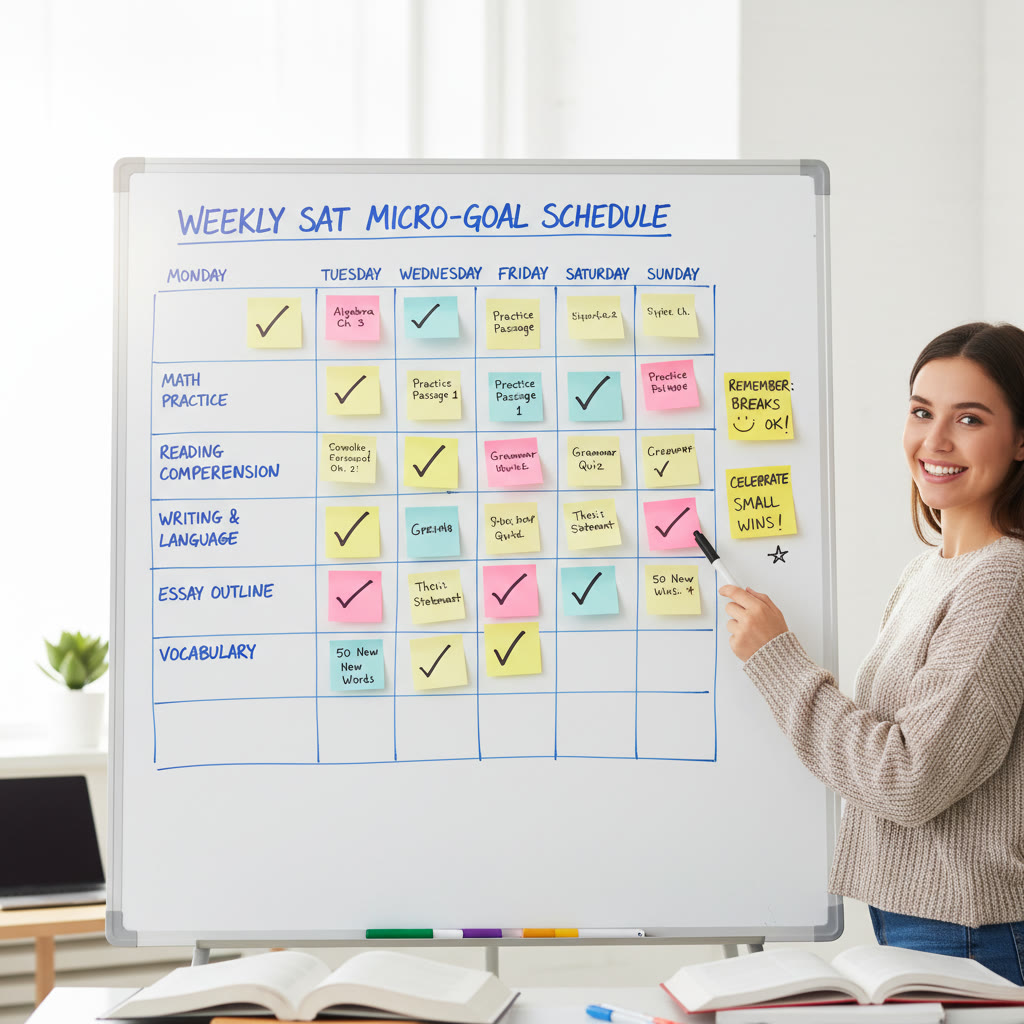
This simple table demonstrates how micro-goals stack across a week to build momentum without burnout.
| Day | Micro-Goal (30–45 min) | Quick Reflection (5 min) |
|---|---|---|
| Monday | Finish and review 10 algebra problems (focus: sign errors) | Note 1 recurring mistake |
| Tuesday | Read one passage + 6 questions (focus: author’s tone) | Summarize tone in 1 sentence |
| Wednesday | Write corrections for a Writing section passage (7 edits) | Record the rule you used |
| Thursday | Timed 25-min math set: 12 mixed questions | Identify time sinks |
| Friday | Practice 10 vocabulary-in-context items + definitions | Use 2 words in a sentence |
| Saturday | Full practice section (Reading or Math) under timed conditions | Score and compare to baseline |
| Sunday | Review errors from the week and make 3 targeted micro-goals for next week | Plan next week |
Tracking progress without obsession
Tracking is vital, but it can turn counterproductive if you over-obsess. Use a lightweight system:
- A simple habit tracker (paper or app) that marks completed micro-goals.
- One-line reflections: after each session, write 1–2 sentences about what went well and what to repeat.
- A weekly review: adjust the next week’s micro-goals based on mistakes and comfort zones.
Over time, the data—how often you complete certain micro-goals and the mistakes that persist—helps you refine study priorities. If you miss a micro-goal, treat it as data, not drama. Ask why: Was the goal unclear? Were you tired? Did you underestimate time?
How to combine micro-goals with practice tests
Full-length practice tests remain essential. Think of them as diagnostic and endurance metrics, while micro-goals are the targeted therapy between tests. Schedule practice tests every 2–3 weeks early on, then more frequently as test day approaches. After a practice test, break down your errors into micro-goals. Instead of “study all reading,” set a micro-goal like, “Fix misinterpretation of paired passages—practice three paired passages and summarize argument structures.”
Recovery sessions
After a difficult practice test, avoid the temptation to binge-study for hours. A recovery micro-goal—one focused, short task—will restore momentum and reduce anxiety. Example: “Spend 25 minutes reviewing only the first 10 questions of the Reading section and annotate each incorrect answer with the reason it was wrong.”
Tools and techniques to make micro-goals stick
Little rituals and smart tools help. Here are practical techniques you can implement immediately.
- Pomodoro-style sessions: 25 minutes focused work + 5 minute break. One micro-goal per Pomodoro is a natural fit.
- Active recall: After finishing a micro-goal, close your notes and explain the concept out loud for 60 seconds.
- Spaced repetition: Use flashcards for vocabulary and error-types; schedule review micro-goals every few days.
- Error bank: Keep a running list of mistake types and pick a micro-goal to attack the top two each week.
- Accountability: Pair your micro-goal with a short check-in—tell a friend, teacher, or tutor what you’ll do and when you’ll report back.
Examples of micro-goals that target common weak spots
Every student’s weaknesses are different, but here’s how to convert common issues into micro-goals.
- Slow on passage reading: Micro-goal: “Read and annotate one passage with timers—split 15 minutes for reading and 10 for questions.”
- Careless arithmetic errors: Micro-goal: “Practice 10 calculation problems using a method that forces rechecking (write intermediate steps).”
- Grammar rules blur together: Micro-goal: “Make a one-page cheat-sheet for comma rules and correct 8 sentences using them.”
- Multiple-choice traps: Micro-goal: “Review 6 questions where more than one answer seems plausible and write why each wrong choice is tempting.”
When to scale a micro-goal into a macro-goal
Micro-goals are for honing skills—when a micro-goal consistently becomes easy and you no longer see improvement, it’s time to scale. Combine several related micro-goals into an extended study block or weekly challenge. For instance, consecutive mastery of algebra micro-goals could culminate in a timed, mixed problem set or a mini-test section to simulate pressure and endurance.
Signs to scale up
- Completion without struggle and steady accuracy over three sessions.
- Transfer of skill to mixed questions (e.g., getting similar algebra problems right in mixed sets).
- Increased confidence and reduced need for hints or extra review.
Personalization: make micro-goals yours
No single template fits everyone. Your life, school schedule, and learning style determine the ideal micro-goals. Some students prefer micro-goals focused on speed; others prioritise accuracy. Sparkl’s personalized tutoring can be helpful here—tutors offer 1-on-1 guidance to identify weak spots and design tailored study plans. Expert tutors can translate diagnostic results into bite-sized micro-goals and use AI-driven insights to highlight which practice will move the needle fastest. Importantly, personalization keeps micro-goals realistic and motivating.
Real-world examples: two student case studies
These short, anonymized case studies show micro-goals in action.
Case 1: Maya, the busy junior
Maya balances school, soccer, and a part-time job. She had three hours per week for SAT prep. Instead of two long sessions, she used six 30-minute micro-goals across the week: two reading blocks, two math blocks, one writing block, and one review block. Each micro-goal was specific—like “10 algebra problems this Tuesday: focus on quadratic manipulation.” After six weeks, her accuracy on algebra increased 12 percentage points, and she reported feeling less stressed on practice sections.
Case 2: Daniel, the detail-oriented senior
Daniel tended to obsess over every question and ran out of time. He set micro-goals that practiced time awareness: “Complete five reading questions in 12 minutes and mark out-of-time ones.” He also used an error bank micro-goal each Sunday to consolidate persistent mistakes. Over two months, his pacing improved enough to attempt an extra 4–6 questions per section on practice tests.
What to do when a micro-goal fails
Failure is not a character flaw—it’s information. When you don’t meet a micro-goal, ask three questions:
- Was the goal unclear or too big?
- Were external factors (sleep, distractions) the real blockers?
- Did the content expose a deeper gap?
Adjust accordingly. If the goal was too big, halve it. If you’re tired, shift to a lighter task like vocabulary review. If the content reveals a gap, make the next micro-goal explicitly about learning that foundational skill.
Finishing strong: test week micro-goals
In the final week before test day, micro-goals should emphasize readiness, not cramming. Focus on clarity, pacing, and recovery:
- Two days before: complete one timed practice section, then review mistakes gently—no heavy study.
- Night before: a 20-minute light micro-goal—review formulas and simple flashcards, then relax.
- Morning of test: a calming micro-goal—breathing for 5 minutes and one quick vocabulary warm-up.
Final checklist to design your first week of micro-goals
- Identify one weakness per section (Reading, Writing, Math no-calculator, Math calculator).
- Create 5–7 micro-goals for the week—each 20–40 minutes.
- Schedule them in a calendar and commit a check-in time.
- Record a one-line reflection after each session.
- At week’s end, review errors and revise next week’s micro-goals accordingly.

Parting advice: consistency over heroics
Big gains rarely come from last-minute heroics. They come from repeated, well-chosen micro-goals that build skill, speed, and confidence. Celebrate the small wins. Adjust when you need to. Use simple tracking. And when you want help turning diagnostic results into tailored micro-goals, consider seeking targeted support—Sparkl’s personalized tutoring offers 1-on-1 guidance, tailored study plans, expert tutors, and AI-driven insights that can turn your practice into measurable improvement. The right support can help you set smarter micro-goals and keep you moving forward.
Start today: pick one micro-goal you can complete in 25 minutes. Do it. Reflect for two minutes. Then schedule your next one. Those small steps add up faster than you think—and they make the SAT less of a mountain and more of a series of manageable climbs.



















No Comments
Leave a comment Cancel