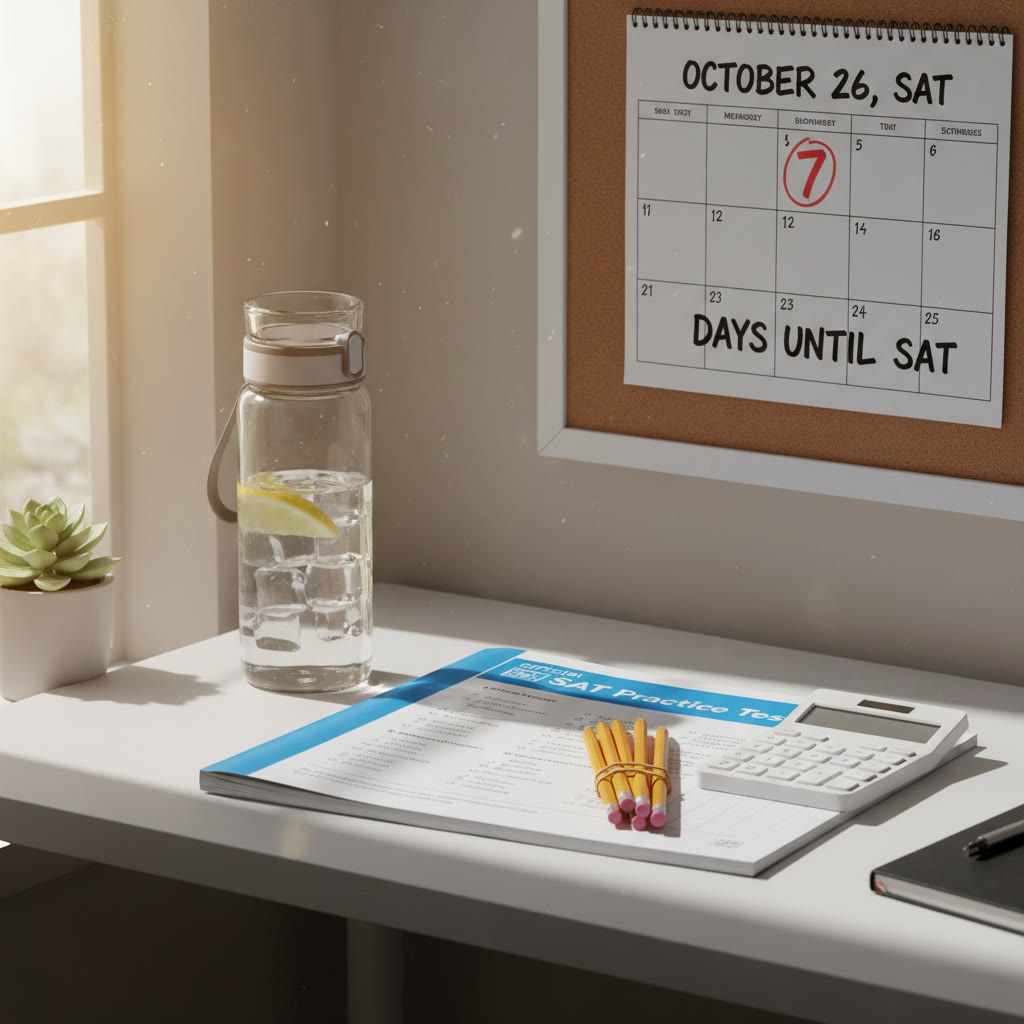

How to Prepare for the SAT in the Last 7 Days
Okay — deep breath. If you’re seven days away from the SAT, you’re in the “do the high-impact things” zone, not the “learn everything anew” zone. This isn’t the time for broad, aimless studying; it’s the time for focused practice, smoothing out weak spots, and building test-day routines that keep you calm and effective. Imagine tuning a race car before a race: you don’t rebuild the engine — you adjust the suspension, check the tires, and make sure the driver knows the course.
Quick reality check: what really moves the needle
When time is tight, prioritize activities that reliably improve score and reduce mistakes. These include:
- Full-length practice tests under realistic timing — to build timing, stamina, and pacing.
- Targeted review of consistently missed question types — the “repeat offenders” that cost you points.
- Refining test-day logistics and mindset — how you enter the room affects performance as much as what you studied.
Anything that doesn’t directly address these three areas can wait. No, cramming a new math topic from scratch is unlikely to help; practicing the most common question types and learning when to skip is.
Understand scoring and timing
The SAT is scored from 400–1600, combining Evidence-Based Reading and Writing (EBRW) and Math. Remember: raw correct answers are the key. There’s no penalty for guessing on unanswered questions, so answering every question is essential even if you must guess. Know the time limits for each section and test yourself under those constraints.
Check logistics now
- Verify the test center address, reporting time, and parking or transit options.
- Confirm permitted calculators and backup batteries; know your ID and admission ticket rules.
- Look at the weather forecast and plan clothes in layers — being comfortable matters.
Seven-day action plan (high-level)
| Day | Main Focus | Practice Time | Why it matters |
|---|---|---|---|
| Day 7 | Full-length official practice test | 3–4 hours + review | Baseline, pacing, and stamina check |
| Day 6 | Deep review of test mistakes | 2–3 hours | Fix repeat errors and patterns |
| Day 5 | Targeted practice: Math problem types | 2 hours | Shore up high-yield topics |
| Day 4 | Targeted practice: Reading and Writing | 2 hours | Speed, passage strategy, grammar shortcuts |
| Day 3 | Mixed timed sections and pacing drills | 2–3 hours | Simulate pressure in short bursts |
| Day 2 | Light review and logistics | 1–2 hours | Reduce anxiety and finalize plan |
| Day 1 | Rest, gentle review, early sleep | 30–60 minutes | Optimized mind and body for test day |
Detailed day-by-day plan
Day 7 — Full-length practice test (do it like the real thing)
Today is your simulated race. Use an official College Board exam if possible. Treat it like test day: start at the same time you’d start the actual test, use only permitted materials, take the scheduled breaks, and follow the time limits exactly.
- Before you begin: set up a quiet space, disable phone notifications, and have water and snacks for the break.
- During the test: practice consistent timing. If you fall behind, note where you lose time so you can address pacing later.
- After the test: record raw scores and note which sections and question types gave you trouble.
Don’t rush the review. Spend as much time reviewing as you spent taking the test. The furthest learning gains come from understanding why an answer is wrong and what small rule or trap caused it.
Day 6 — Deep review: find the patterns
Today is detective work. Collect every missed question from Day 7 and ask:
- Is this a content gap (something I didn’t know) or a careless error?
- Does the mistake repeat across passages or problem types?
- Could a time-management choice have caused it?
Create a short list of 5–10 “repeat offenders” and focus all Day 5–4 work on those. This is also a good time to write down quick rules or shortcuts for recurring grammar errors or math steps.
Day 5 — Targeted math work
Math is often a high-leverage area in the last week. Don’t try to learn calculus — focus on:
- Algebra fundamentals: linear equations, systems, manipulating expressions.
- Problem-solving and data analysis: ratios, percentages, interpreting graphs.
- Heart of Geometry and a few key trigonometry basics that show up.
Work in short, intense bursts: 25–40 minutes focused practice, 5–10 minute break. When you solve a problem, force yourself to explain the quick reason you chose each step (either aloud or in a sentence). Explaining helps cement smart shortcuts and reveals hidden misunderstandings.
Day 4 — Reading and Writing focus
Spend the day on passage strategy, timing, and grammar rules. Key habits:
- For Reading: annotate quickly — underline the author’s main point, tone, and structure. Answer line-reference questions by going back to the passage and locating exact text; don’t guess from memory.
- For Writing & Language: memorize a short list of the most common grammar fixes — subject-verb agreement, verb tense consistency, modifier placement, parallel structure, and punctuation for lists/clauses.
- Practice eliminating obviously wrong choices fast. On multiple-choice, narrowing to two and then choosing is a winning habit.
Day 3 — Short timed sections, pacing drills
Today you rebuild rhythm. Do two or three shortened sections (for example, one math calculator section, one reading passage, one writing section) under strict timing. The goal is to practice transitions between question types and to get comfortable finishing sections with a modest reserve for review.
- Time each question roughly: on average, keep an eye on seconds-per-question so you don’t drift.
- Practice strategic skipping: mark hard questions quickly and come back only if time permits.
Day 2 — Light review, practice mental routines
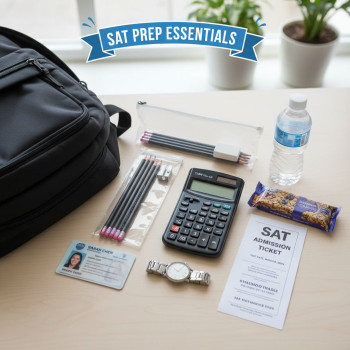
Now is the time to calm down and consolidate. Skim your list of repeat offenders and run through a couple of light timed sections — but avoid heavy, frustrating work. Put together your test-day bag: ID, admission ticket, approved calculator, pencils, snacks. Lay out clothes and plan your travel.
Day 1 — Rest, routine, and confidence
Do minimal studying. Maybe a 30–60 minute gentle review of flashcards or grammar rules. Focus on sleep, a calming evening routine, and an early bedtime. Your brain needs consolidation; last-minute cramming often reduces performance.
Practice tests and timing strategies
Full practice tests are the single most powerful activity in the last week. They tell you how your energy holds up for 3.5 hours, where your pacing breaks down, and which question types silently cost you points. But how you review the test after taking it matters just as much.
- Review by question type, not just by question. If you missed three inference questions on Reading, practice a targeted set of inference questions.
- Time-block your review sessions: 20–30 minutes per trouble area, then move on. Repetition beats marathon re-reading.
- Simulate pressure with short bursts (e.g., one passage with 25% less time) to train for the moments when you fall behind.
One practical pacing trick: if a question is taking more than 1.5x the average time, mark it to return to. This prevents one sticky question from stealing the pace for an entire section.
Topic-focused quick refresh: what to review now
Math — efficient priorities
Focus on: algebra manipulations, linear and quadratic equations, functions, interpreting data, systems, and geometry essentials. Memorize formulas you frequently forget (distance, slope, area/volume basics) rather than trying to derive them under time pressure.
- Practice translating word problems to equations quickly.
- Use a calculator for complex arithmetic but not for algebraic reasoning — practice doing the algebraic setup on scratch paper.
- If a problem requires long case work and careful algebra, consider skipping and returning if time allows — often those are low yield for last-week effort.
Reading — speed and evidence
The biggest gains in Reading come from two habits: reading for structure and using evidence in the passage. Don’t try to memorize details — learn to map the passage quickly.
- Identify the main point and the author’s attitude in the first and last paragraph.
- Answer inference questions only using passage evidence; avoid outside knowledge unless the passage directly suggests it.
- Practice a few passages under timed conditions and track how long you spend before the first question — aim to read actively in 2–3 minutes for a long passage.
Writing & Language — rules and structure
Grammar questions have patterns. If you can narrow mistakes down to standard grammar rules, you’ll cut time and improve accuracy.
- Common rules to review: subject-verb agreement, pronoun clarity, modifier placement, verb tense consistency, punctuation for clauses.
- Phrase improvement questions often reward concision and clarity — prefer the concise correct choice when uncertain.
- Practice quickly spotting where the sentence’s subject and main verb are; errors often hide in long introductory phrases.
Test-day logistics, checklist, and mindset
On test day, logistics should be automatic so you can focus entirely on questions. Lay everything out the night before.
- Essentials: admission ticket, valid photo ID, approved calculator with fresh batteries, 2-3 sharpened No.2 pencils and eraser, a watch (if allowed) or mental timer, snacks for the break, and a bottle of water.
- Dress in layers. Test centers can be unexpectedly cold or warm.
- Eat a balanced breakfast with protein and complex carbs to keep energy steady.
Mental checklist before walking into the room:
- Remind yourself: I’ve practiced under pressure.
- If anxiety rises, use a 4-4-4 breathing trick: inhale for four counts, hold four, exhale four — repeat twice to reset.
- Have a simple anchor phrase: “One question at a time,” or “Pace, then accuracy.”
How to use tutoring and tools wisely in the last week
If you have access to personalized help, use it strategically. A focused 1-on-1 session can be a huge advantage in the last seven days because tutors can diagnose patterns quickly and give tailored practice. For example, Sparkl’s personalized tutoring can help by providing one-on-one guidance, tailored study plans, expert tutors, and AI-driven insights that highlight which question types are costing you points and which habits to change immediately.
Good ways to use tutoring now:
- One focused session to review your practice test mistakes and create a short correction plan.
- Targeted drills on patterns highlighted in your errors — not broad lessons, but quick, high-impact fixes.
- Feedback on timing strategies and a mock test with real-time pacing coaching.
Remember: the point of tutoring this close to test day is surgical intervention, not starting new curricula. If your tutoring provides AI-driven insights that flag recurring issues, use those to structure Day 5–3 practice blocks.
Common last-week pitfalls and how to avoid them
- Over-cramming: burning out on the final night. Avoid marathon study sessions the night before; sleep matters more than one extra hour of review.
- Neglecting full tests: doing only untimed practice can leave you unprepared for pacing. Always include at least one full timed test in the last week.
- Ignoring logistics: forgetting your ID or calculator battery can ruin a good day. Pack the night before.
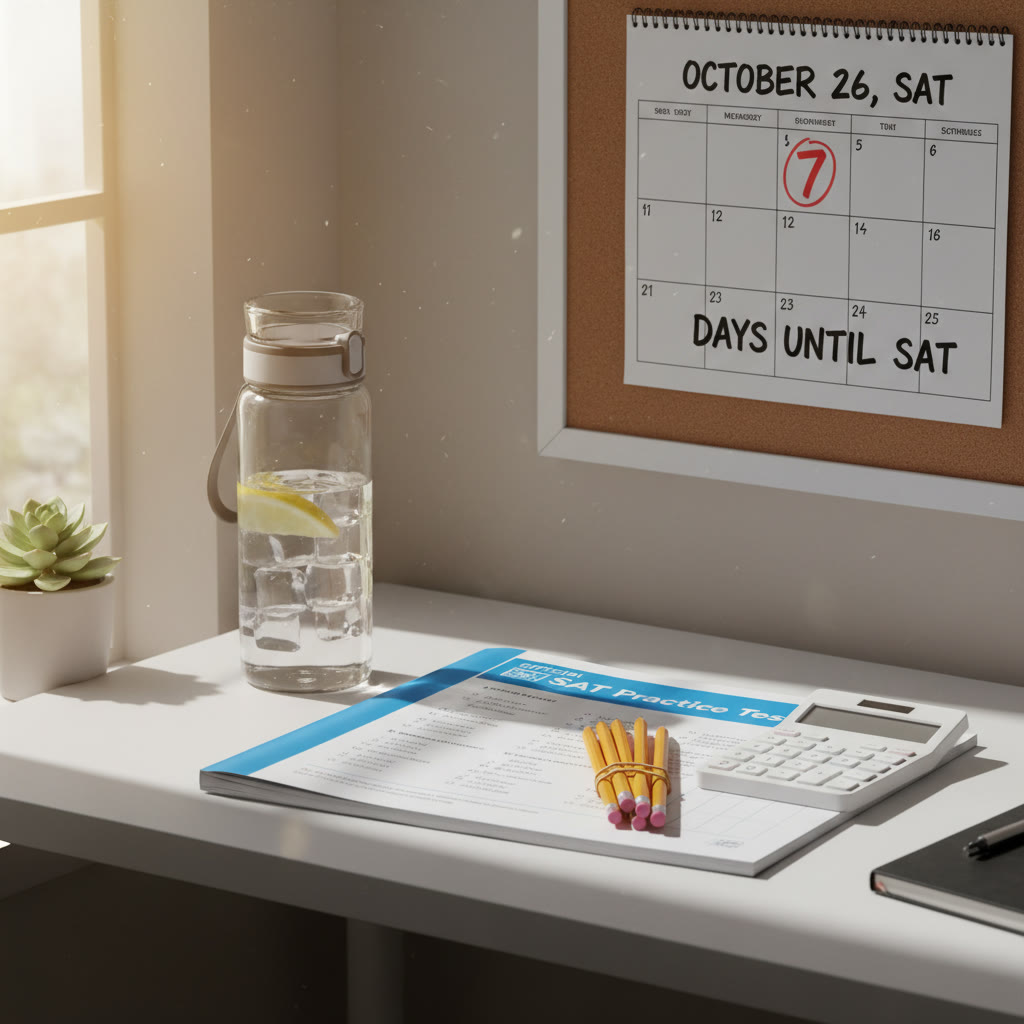
Practical mini-drills to use in pockets of time
You’ll have odd pockets of 10–30 minutes. Use them wisely with micro-drills:
- Five sentence corrections: quickly pick grammar errors using a cheat-sheet of common rules.
- One Reading passage summary: read a short paragraph and write the main idea in one sentence — this sharpens distillation skills.
- Three math problems: choose one algebra, one data interpretation, one geometry problem — time yourself to keep pace.
Nutrition, sleep, and small rituals that help
Don’t underestimate physical factors. Sleep consolidates memory, and the right foods keep your energy even during a long test.
- Sleep: aim for 7–9 hours. If you can’t get that, prioritize consistent wake time the week of the test.
- Food: a breakfast with protein (eggs, yogurt, nut butter) and slow carbs (oatmeal, whole-grain toast). Avoid sugary cereals that cause a mid-test crash.
- Hydration: drink water throughout the week. Bring water for the break if allowed.
- Small ritual: a five-minute breathing routine or brief walk before the test can lower cortisol and sharpen focus.
Scoring expectations and realistic gains
In seven days, dramatic increases are rare, but focused work can produce meaningful improvements — especially if you fix careless errors and pacing. Typical last-week gains for students who study strategically can be 20–80 points, depending on starting point and how effectively they use practice tests and targeted review. The trick is to concentrate on repeat mistakes; plugging those holes compounds quickly.
Final checklist for the night before and morning of
- Night before: lay out clothes, pack test materials (ID, ticket, calculator, pencils), set multiple alarms, and go to bed early.
- Morning of: eat a steady breakfast, leave early to avoid stress, do a two-minute breathing exercise before you enter, and treat the test like any other long day of work — pace, hydrate, and use your breaks.

Final pep talk
Seven days is short, but it’s enough to make smart changes. Focus on practice tests, targeted review of recurring errors, and a calm test-day routine. Use your time like a laser: simulate real conditions, correct patterns, and practice pacing. If you have access to personalized support like Sparkl’s tutoring, put that resource to use for quick diagnostic sessions or pacing feedback — targeted guidance can turn confusion into clarity fast.
At the end of the day, the test is one milestone, not the whole story. Do the practical work now, sleep, walk into the room with a plan, and take it one question at a time. You’ve got this.



















No Comments
Leave a comment Cancel