

How to Warm Up Effectively on SAT Test Morning
Test morning feels like the opening scene of a movie: lights on, heart racing, and the whole plot of months of prep narrowing down to a few hours. But here’s a quiet truth many students miss — how you warm up on the morning of the SAT matters almost as much as the weeks you spent studying. A smart warm-up clears the cobwebs, steadies nerves, and turns you from a nervous runner into a focused sprinter who knows when to breathe and when to push.
Why a Warm-Up Works: The Simple Science
Before we get to specific drills, let’s be practical about why this helps. Your brain needs a few gentle cues to shift from “waking up” to “problem solving.” Brief, targeted practice does three things:
- It raises alertness without overstimulating you — a short spike of focused effort beats frantic cramming.
- It reminds your brain of strategy patterns you practiced during prep (like process of elimination or backsolving), making those habits automatic.
- It calms anxiety by replacing “what if I forget?” with immediate, small wins: you solved a problem, you answered a paragraph, you corrected a sentence.
These effects are consistent with what cognitive science tells us about priming and arousal: a brief, well-structured warm-up puts you in the optimal performance zone without depleting energy reserves.
Before the Morning: The Night Prior Checklist
A great warm-up begins the night before. Do these simple things to make your morning calm and focused:
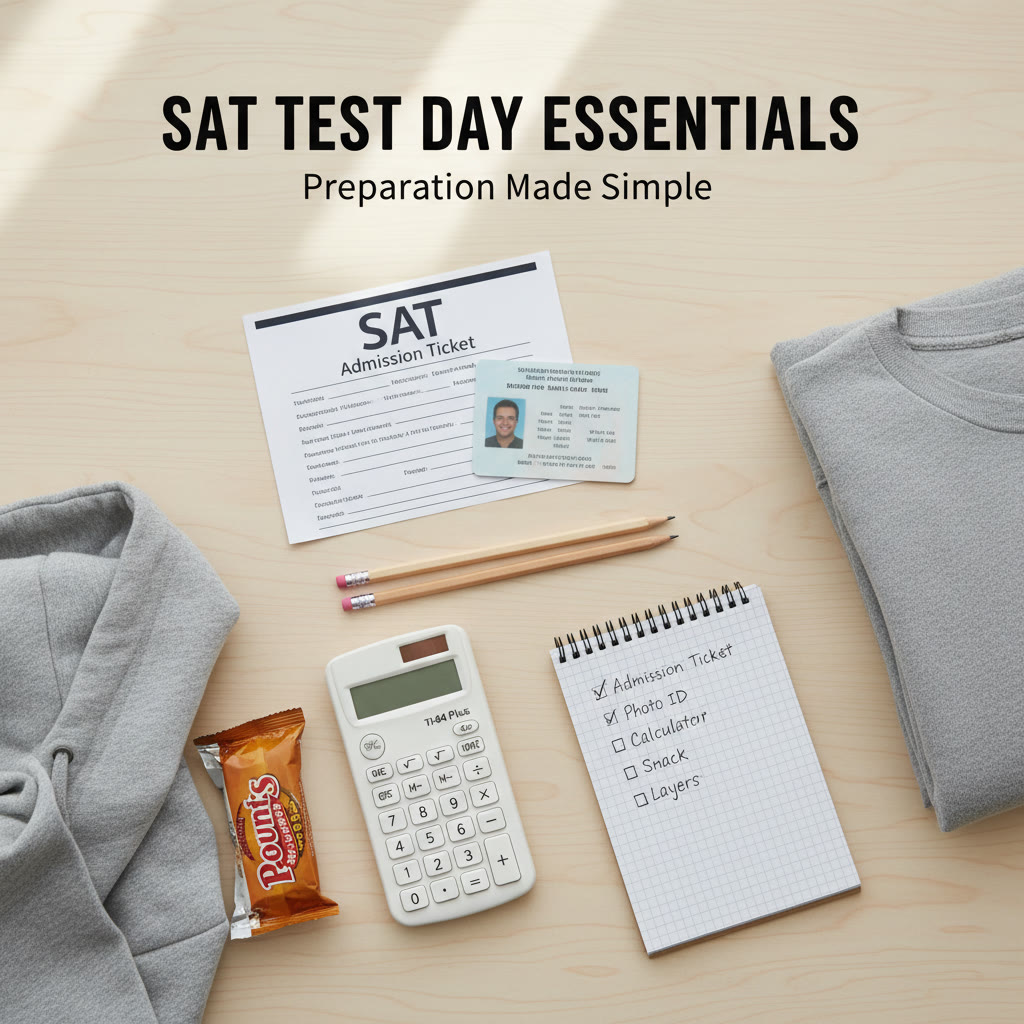
- Pack your bag: admission ticket, acceptable photo ID, two sharpened pencils, an approved calculator with fresh batteries, a small snack, and a bottle of water. Double-check everything before bed.
- Lay out comfortable clothes. Dress in layers so you can adapt to room temperature without fuss.
- Put your phone away and set a backup alarm. Avoid last-minute cramming; instead, skim one sheet of high-yield notes if that soothes you.
- Get a full night of sleep. Even one hour less can make timing and attention worse.
Test-Morning Timeline: What to Do and When
Below is a practical timeline you can adapt to your testing time. Use it as a template and personalize the timing based on when you need to arrive at the test center.
| Time Before Test | Activity | Duration |
|---|---|---|
| 90–120 minutes | Wake, hydrate, eat a balanced breakfast, dress, and double-check your items | 30–45 minutes |
| 60 minutes | Light mental warm-up: very short practice for each section; practice breathing | 15–20 minutes |
| 30 minutes | Final logistics: restroom, last sip of water, put away notes; power walk to raise circulation | 10–15 minutes |
| 10–15 minutes | Seat arrival: sit quietly, breathe, visualize the first five questions calmly | 5–10 minutes |
| During 10-minute break | Snack lightly, stretch, breathe, and reset; avoid studying new content | 10 minutes |
What to Eat and Drink
Your brain needs steady fuel. Aim for a breakfast that combines slow-release carbohydrates and protein to avoid a sugar crash. Examples:
- Oatmeal with banana and a spoonful of peanut butter
- Whole-grain toast with eggs and a small apple
- Greek yogurt with berries and granola
Bring a compact, non-messy snack for the break: a granola bar, a piece of fruit, or a small packet of nuts. Sip water steadily, but not excessively — too much water can make you uncomfortable during the test.
Concrete Warm-Up Exercises (Section-by-Section)
Now the fun part: the warm-up itself. These are not full practice sessions — they are short, focused drills to prime the exact skills you will use.
1) Reading Warm-Up (10 minutes)
Goal: shift from casual reading to active, question-driven reading.
- Scan one passage (350–450 words) and read actively for main idea and author attitude. Don’t do every question — pick 3: one global main-idea, one inference, and one detail question.
- Practice time: 7–8 minutes to read and answer those 3 questions; 1–2 minutes to review why the right answers fit.
Example mini-exercise: read a short opinion paragraph and ask yourself, “What is the author’s stance? Which line most supports that stance?” This retrains your brain to search for viewpoint and structure rather than skimming for surface facts.
2) Writing and Language Warm-Up (5–7 minutes)
Goal: activate grammar instincts and structural editing habits.
- Do five sentence correction problems. Focus on concision, verb tense, pronoun clarity, and parallel structure.
- Timing: 5–7 minutes total. Don’t overthink; capture the first rule that fits.
Sample quick problem: Choose the sentence that best corrects: “Running late, the bus left before the student arrived / Because the student arrived late, the bus left before them.” Pick the grammatically correct and clear option. Brief drills like this sharpen your editorial ear.
3) Math No-Calculator Warm-Up (6–8 minutes)
Goal: wake up number sense and problem setup skills.
- Solve five problems that emphasize arithmetic, algebra basics, fractions, ratios, and simple geometry — all without a calculator.
- Keep paper scratch as if you were in the test: write clearly, estimate when possible, and use mental math shortcuts (like factoring before multiplying).
Quick example: compute 7/8 of 64 in your head: 64/8=8, 8*7=56. That immediate fluency reduces time spent on basic steps later.
4) Math Calculator Warm-Up (6–8 minutes)
Goal: reboot your multi-step problem strategy and calculator checks.
- Solve three multi-step problems that require a calculator for convenience: quadratic formula check, systems of equations elimination, or a geometry area/volume computation.
- Tip: practice one quick calculator habit — after a multi-key entry, glance over the digits to avoid an input error.
5) Two-Minute Calm and Strategy Review (2–3 minutes)
Before the first question, spend two minutes on mental alignment. Close your eyes (briefly), breathe deeply three to five times, and run through a short checklist:
- I will read the questions first when appropriate.
- I will eliminate wrong answers fast and trust my instincts on close calls.
- I will allocate time and move on when stuck, marking the question to return to later.
These grounding steps are tiny rituals that protect your focus when the pressure rises.
Example 20-Minute Morning Warm-Up Routine
Here is a compact routine you can use if you have limited time before the test:
- 7 minutes: Read one passage and answer 3 reading questions.
- 5 minutes: Do five writing and language sentence corrections.
- 8 minutes: Do five no-calculator math problems and two calculator problems.
- 2 minutes: Quick breath-work and run checklist.
What to Avoid: Common Warm-Up Mistakes
Not all action is helpful. Avoid these pitfalls:
- Cramming new content. The test morning is for activation, not learning novel formulas or rules.
- Spending too long on one section. You want breadth, not depth.
- Energy-sapping activities like sugary breakfasts that spike and crash your focus.
- Negative self-talk. If you find yourself spiraling, switch to a calming strategy: deep breaths, positive visualization, or the two-minute checklist above.
Using the Break Wisely
There’s usually a 10-minute break mid-test. It’s tempting to cram, but the break is a reset. Do this instead:
- Eat a light snack and hydrate.
- Stretch your neck, shoulders, and legs to re-oxygenate the brain.
- Breathe and briefly visualize success on the next section.
- Avoid crackling through notes or trying to learn new content. That raises anxiety and wastes precious reset time.
Practical Examples and Micro-Exercises
Here are a few short items you can carry in a pocket sheet or memorize for quick use. They’re designed to be completed in two minutes and repeated if you have a longer warm-up window.
- Two-minute reading: Read the first paragraph of a non-fiction article and write one-sentence summary and the author’s tone.
- Two-minute grammar: Correct five short sentences searching specifically for subject-verb agreement errors.
- Two-minute math: Do five quick mental arithmetic questions that mix fractions, percent, and basic algebra manipulations.
Personalized Support: How Sparkl’s Personalized Tutoring Fits In
Some students thrive by having a tested morning routine tailored to their personal patterns. That’s where targeted coaching helps. With Sparkl’s personalized tutoring and benefits, students can get 1-on-1 guidance to build a warm-up plan that matches their strengths and anxiety triggers. Expert tutors can model a morning routine, craft a short packet of warm-up drills specific to your weak spots, and use AI-driven insights to track which drills predict a stronger morning performance. If you’ve been wondering how much practice to do the morning of the test or exactly which micro-exercises suit you, tailored study plans and real-time feedback from a tutor can be the difference between an OK morning and a confident one.
Real-World Context: Stories from Test Takers
Students often think more practice is always better. In reality, I worked with a student who doubled down on cramming the night before and woke up foggy. After switching to a calm warm-up routine — a brisk 20-minute checklist, a predictable breakfast, and a two-minute breathing practice — she reported feeling steady instead of scattered. Another student used a short math warm-up to reset his number sense and found he gained back three minutes per math section just by avoiding fiddly arithmetic errors. These small, concrete shifts produced measurable score improvements because they reduced careless mistakes and poor time management, which are common score killers.
Final Mindset: Questions to Ask Yourself
As you practice warm-ups in the final weeks, ask yourself these questions after each mock test morning:
- Did this warm-up change how focused I was at question one?
- Did my heart rate drop after the breathing exercise?
- Which micro-exercises reliably produced confidence or improved accuracy?
- Is my snack and hydration plan preventing mid-test energy dips?
Use your answers to tweak the routine. The best warm-up is the one you can replicate calmly and consistently on test day.
Parting Advice: Keep It Personal and Simple
On test morning, the goal is to arrive at the first question centered, warmed up, and confident enough to trust your training. Keep your warm-up simple, repeat it in practice tests, and refine it so the routine itself becomes reassuring. If you want help designing a warm-up that fits your rhythm — with specific drills, reassurance, and a plan you can run on autopilot — consider reaching out to a personalized tutor. Small, well-chosen moves on test morning create a big payoff in calm focus and fewer careless errors.

Take one last breath. You have trained for this, and your warm-up is the final courteous handshake between preparation and performance. Walk into the room with a plan, a practiced routine, and the quiet confidence that comes from habit. You’ve got this.






















No Comments
Leave a comment Cancel