

Why Writing Skills Matter More Than You Think
When students think about the SAT, many picture math equations and dense reading passages. But strong writing skills quietly power a big piece of the score—and they do more than help you answer grammar questions. Writing skills sharpen clarity of thought, improve reading comprehension, and make you faster at spotting errors and argument flaws. In short: better writers usually become better SAT test-takers.
This isn’t just about the old optional essay (which national administrations discontinued)—it’s about the Writing & Language section, which sits inside the Evidence-Based Reading and Writing (EBRW) score. That 200–800 half of the SAT depends heavily on editing, rhetorical reasoning, and grammar. But beyond that, strong writing habits make the Reading section easier, and they carry over to college essays, interviews, and disciplined study habits.
Where Writing Shows Up on the SAT
Understanding the test’s structure helps you see where to focus your writing practice. The SAT is split into two main score sections: Evidence-Based Reading and Writing (EBRW) and Math. EBRW combines both the Reading and the Writing & Language sections.
| Section | Questions | Time | How Writing Helps |
|---|---|---|---|
| Reading | 52 | 65 minutes | Critical reading, understanding tone, identifying evidence—skills strengthened by writing practice |
| Writing & Language | 44 | 35 minutes | Grammar, concise expression, organization, and rhetorical editing—direct writing skills |
| Math | 58 | 80 minutes | Clarity in reading word problems and communicating steps—indirect writing benefit |
Notice how the Writing & Language section is a concentrated dose of editing and rhetorical decision-making. But the payoff from writing practice spills into Reading because editing trains you to find the sentence-level logic that supports passage-level arguments.
Quick fact
Even a handful of errors avoided in the Writing & Language section—especially those that commonly trip up students—can translate into a meaningful bump in your EBRW score.
Core Writing Skills That Move the Score Needle
Work on these areas and you’ll see improvement across multiple parts of the SAT.
- Grammar and usage: Subject-verb agreement, pronoun clarity, verb tense consistency, and commonly misused words.
- Punctuation: Commas, semicolons, colons, dashes, and apostrophes—used to signal meaning and structure.
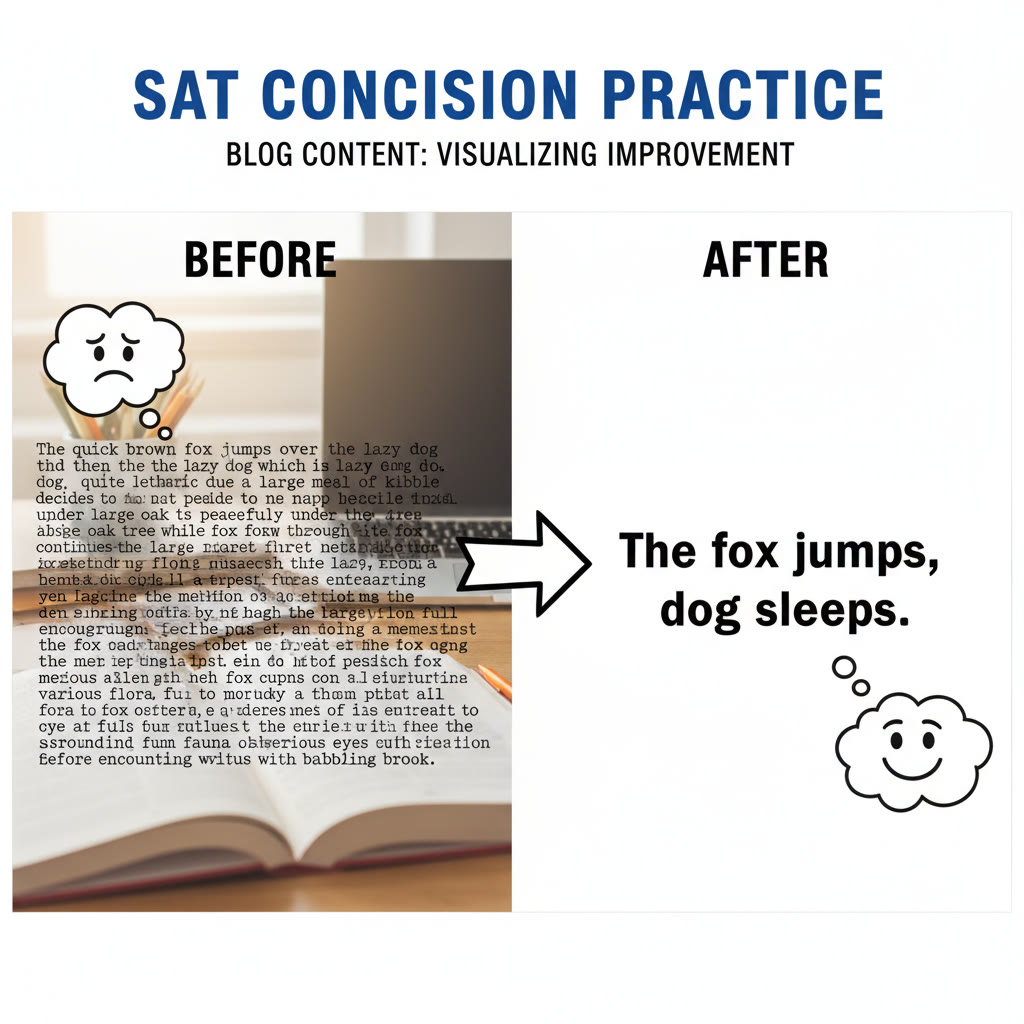
- Concision and redundancy: Choosing precise words and removing unnecessary phrases helps in editing questions.
- Rhetorical skills: Organization, paragraph transitions, tone, and purpose—these come up in passage-wide questions.
- Evidence and support: Interpreting how sentences support claims in a passage prepares you for questions that ask which sentence best supports a conclusion.
Examples that make the rules stick
Example 1 — Subject-verb agreement
Incorrect: The list of books are on the table.
Correct: The list of books is on the table.
Tip: Identify the true subject. “List” is singular even though “books” is plural.
Example 2 — Misplaced modifier
Incorrect: Walking to school, the rain drenched Sarah.
Correct: While Sarah was walking to school, the rain drenched her.
Tip: Make sure the modifier clearly and logically refers to the subject that performs the action.
How Writing Practice Boosts Reading Performance
At first glance, writing and reading feel like two distinct skills. But consider this: editing a sentence trains you to notice structure, emphasis, and clue words—techniques that make dense reading passages less intimidating.
- When you practice tightening sentences, you learn to find main ideas faster.
- When you identify tone shifts while editing, you become more sensitive to passage-level purpose and attitude.
- Parsing complex sentences in editing drills helps you untangle long sentences in the Reading section.
Mini comparison: A reader vs. an editor
The reader searches for the main idea. The editor dismantles how that idea is expressed. Good editors are precise readers—so practicing editing accelerates comprehension.
High-Yield Grammar and Rhetorical Rules (with practice)
These are the rules that show up often on the Writing & Language section. Practice them until they feel automatic.
- Parallelism: Make list items share the same grammatical form. Example: “She likes hiking, swimming, and to bike” → “She likes hiking, swimming, and biking.”
- Pronoun clarity: Ensure pronouns clearly refer to one noun. Example: “When Jordan met Alex, he was nervous” is ambiguous—who was nervous?
- Verb tense consistency: Maintain the same time frame unless there’s a reason to change it.
- Comma usage: Use commas to set off clauses, items in a series, and transitional phrases—avoid comma splices.
- Semicolon vs. comma + conjunction: Use a semicolon to join closely related independent clauses without a conjunction; use a comma and conjunction when you want a softer connection.
Practice drill
Pick one: “Because he wanted to study, the library was chosen by Mark.” Is this correct? What revision would you make?
Answer and explanation: It’s passive and awkward—”Because he wanted to study, Mark chose the library.” Active voice and clearer subject placement make the sentence stronger.
Strategies for Tackling the Writing & Language Section
Turn grammar knowledge into actionable tactics for test day:
- Read the underlined portion in context—sometimes the right answer affects neighboring sentences.
- Anticipate before you view choices—try to imagine the correction yourself quickly; it reduces trap choices.
- Watch for extreme choices—answers that add irrelevant details or change meaning are often wrong.
- Keep the author’s tone—don’t select a grammatically correct choice that clashes with the passage’s voice or purpose.
- If two choices seem right, prefer the more concise one—SAT favors economy of expression when both are grammatically correct.
Sample question and explanation
Passage sentence: “The committee members, who had met every Tuesday, is ready to vote.”
- Error: Subject-verb agreement. “Members” is plural, so the verb should be plural.
- Correction: “The committee members, who had met every Tuesday, are ready to vote.”
- Why this matters: You must identify the real subject and ignore nonessential clauses like “who had met every Tuesday.”
Time Management: Writing Quickly and Carefully
The Writing & Language section is fast paced: 44 questions in 35 minutes. That averages to about 48 seconds per question. You won’t have time to agonize over every choice, so train your eye to spot common traps.
| Focus | Target time | What to practice |
|---|---|---|
| Single-sentence edits | 30–40 seconds | Grammar drills and quick identification of error types |
| Paragraph-level/organization questions | 50–70 seconds | Practice transitions, logical placement, and tone matching |
| Evidence/support questions | 40–60 seconds | Learn to connect specific lines to broader claims quickly |
Practical tip: If a question is taking more than 90 seconds, mark it, move on, and return if time permits. You get no penalty for guessing, so answer everything you can confidently handle first.
Sample Weekly Practice Plan (8 Weeks)
Consistent, focused practice beats random study. Here’s a concise plan that balances grammar, editing, and reading.
| Week | 30–60 minute sessions (4–5 per week) |
|---|---|
| 1–2 | Begin with diagnostics. Target common grammar rules: subject-verb, pronouns, and verb tense. Do short timed drills. |
| 3–4 | Add punctuation and concision practice. Start passage-level organization questions. One full timed Writing & Language section per week. |
| 5–6 | Increase mixed practice: combine Reading and Writing drills. Focus on rhythm: 2 timed sections per week plus review. |
| 7–8 | Simulate test conditions once a week. Review error patterns, and work targeted mini-lessons on weaknesses. |
Why a plan works
Repetition builds pattern recognition. When you see similar grammar traps during practice, you create mental shortcuts you can rely on during the test.
How Personalized Tutoring Supercharges Progress
Studying alone is possible, but personalized guidance accelerates improvement. Tutors can identify the precise error patterns you miss and design practice that targets those gaps.
Sparkl’s personalized tutoring offers 1-on-1 guidance, tailored study plans, expert tutors, and AI-driven insights to pinpoint weak spots and measure progress. With a tutor, you get immediate feedback on mistakes, which means fewer repeated errors and faster gains.
What targeted tutoring can change
- Reduce the time spent on each question through practiced strategies and error recognition.
- Eliminate recurring mistakes: tutors help convert knowledge into habits.
- Provide accountability and adaptive pacing—tutors tailor sessions to your curve of learning.
Practice Examples: Realistic Questions with Explanations
Working through realistic problems is the fastest way to learn. Try these mini-questions and explain your answers aloud or in writing; teaching consolidates understanding.
Question 1
Choose the best version of the underlined portion:
“Because the experiment was not completed properly, the data are unreliable and the conclusion is suspect.”
- Why this is likely correct: Parallel structure and clarity—no change necessary.
- Trap choices often add unnecessary words or change verb tense inappropriately.
Question 2
Which sentence best replaces the underlined sentence to improve the passage’s clarity?
Underlined: “The committee discussed the proposal for two hours, and it passed unanimously after several changes were made by them.”
Improved: “After two hours of discussion and several revisions, the committee passed the proposal unanimously.”
Explanation: This revision removes passive phrasing, clarifies the timeline, and keeps the subject consistent.
From Mistakes to Mastery: Tracking Your Progress
Keep a short error log. After each practice session, write down 4–6 mistakes you made and the rule you violated. After two weeks, you should see patterns—those patterns tell you where to spend focused time.
- Column 1: Error type (e.g., subject-verb).
- Column 2: Example sentence you missed.
- Column 3: Correct rule/explanation.
- Column 4: Action step (e.g., “Do 50 subject-verb drills this week”).
How to Build a Rapid Editing Habit
Editing is a muscle; build it with short, frequent exercises.
- Spend 10 minutes each day doing 5 sentence-edit questions. Focus on speed and precision.
- Translate passive to active voice and note the change in clarity.
- Read a paragraph aloud and ask: does every sentence add value? Cross out redundancies.
Mini challenge
Take a short passage and reduce it by 20% without losing meaning. That exercise trains concision and helps you pick the more economical choices on the test.
Test-Day Mindset and Small Habits That Help
On test day, stress can make you second-guess basic rules. Reinforce confidence with rituals:
- Warm up with a few grammar drills before you start the test—this primes your editing muscle.
- When unsure, pick the concise, clear option that preserves meaning.
- Use process of elimination quickly—remove answers that change meaning or add irrelevant detail.
- Trust practiced rules. Your training is designed to get you past that moment of doubt.
Final Checklist Before Your Test
- I can explain why common errors are wrong (subject-verb, pronoun clarity, modifiers).
- I have a routine for pacing the Writing & Language section.
- I practice mixed Reading + Writing sections to train switching contexts.
- I keep an error log and revisit frequent mistakes weekly.
- I’ve done at least one full, timed practice test under realistic conditions in the last two weeks.
Parting Thought: Writing Is a Lifelong Advantage
Improving your writing skills is more than SAT prep—it’s a tool that benefits college essays, classwork, and future communication. Small, consistent improvements produce steady score gains and real-world confidence. If you pair intentional practice with targeted help—like Sparkl’s personalized tutoring that includes 1-on-1 guidance, tailored study plans, expert tutors, and AI-driven insights—you amplify your progress and build habits that stick.
Remember: test scores reflect habits, not luck. Train your editing eye, strengthen your rhetorical sense, and treat each practice question as a tiny experiment in clarity. When your writing improves, your SAT performance will follow.






















No Comments
Leave a comment Cancel