
Why words matter: confidence is built in conversation
There’s more to test-day readiness than bubble sheets and timed sections. For many students, what happens in the hours before the Digital SAT — the words they hear, the questions they ask themselves, and the tone of the people around them — makes a huge difference. This article gives you ready-to-use, natural scripts for students and parents to build calm, focus, and confidence before the test. It’s practical, human, and designed for real families balancing schedules, nerves, and big dreams.

How to use these scripts
These scripts are short conversational templates — not scripts to memorize word-for-word. Use them as a starting point and adapt to your student’s personality. Some students prefer playful encouragement; others want quiet, factual reminders. Try the following steps:
- Pick one “tone” that fits your student (encouraging, pragmatic, playful, calm).
- Say it naturally. Short, sincere comments are better than long speeches.
- Reinforce actions, not outcomes: praise the routine (sleep, practice, focus), not the score.
- Practice the scripts aloud in the week before the test so they feel familiar and not scripted.
Before the week of the Digital SAT: foundation scripts (build habits, not pressure)
Use these lines during study weeks leading up to test day. They lay groundwork for confidence by reinforcing control and competence.
For parents: the steady coach
“You’ve been consistent with practice — that’s what counts. I can see how you use your time well.”
“What part of practice felt most useful this week? Let’s keep doing more of that.”
“If you want, we can make a short checklist for the morning of the test so you don’t have to think about small stuff then.”
For students: self-talk for focus
“Okay — I practiced the question types that gave me trouble. I’ve improved. I’ve got a plan.”
“This test is a chance to show what I’ve learned, not a single moment that defines everything.”
48–72 hours out: scripts to lower arousal and keep perspective
As test day approaches, the goal is to reduce last-minute panic and cement simple routines. This is about shifting attention from “score anxiety” to execution.
For parents: reassure and normalize
“It’s normal to feel nervous. That usually means you care — and caring is useful energy. Let’s convert that into small, useful steps.”
“Two more practices won’t change months of work. This weekend, focus on rest and a short, calm review.”
For students: grounding phrases to use when worry spikes
Use these quietly before bed or while getting ready:
- “Breathe. Remember the plan.”
- “One step at a time — reading, then math, then review.”
- “I handled hard problems before. I can handle this.”
The night before: scripts for rest, not last-minute cram
The best action the night before is often to put the books away and build a calm, predictable routine. Words now should encourage sleep and steady nerves.
For parents: practical calm
“Let’s get everything ready for the morning: charger, photo ID, snacks. Then we’ll shut down the phones and do a relaxing activity.”
“You did what you could today. Sleep is the strategy now.”
For students: self-script to promote sleep
“I did a meaningful amount of work. A good night’s sleep helps more than a late study session.”
Morning of the test: short scripts for peak calm and competence
This is the critical window. Keep phrases short, supportive, and action-oriented. Avoid performance pressure and long lectures.
For parents: the checklist + calm coach
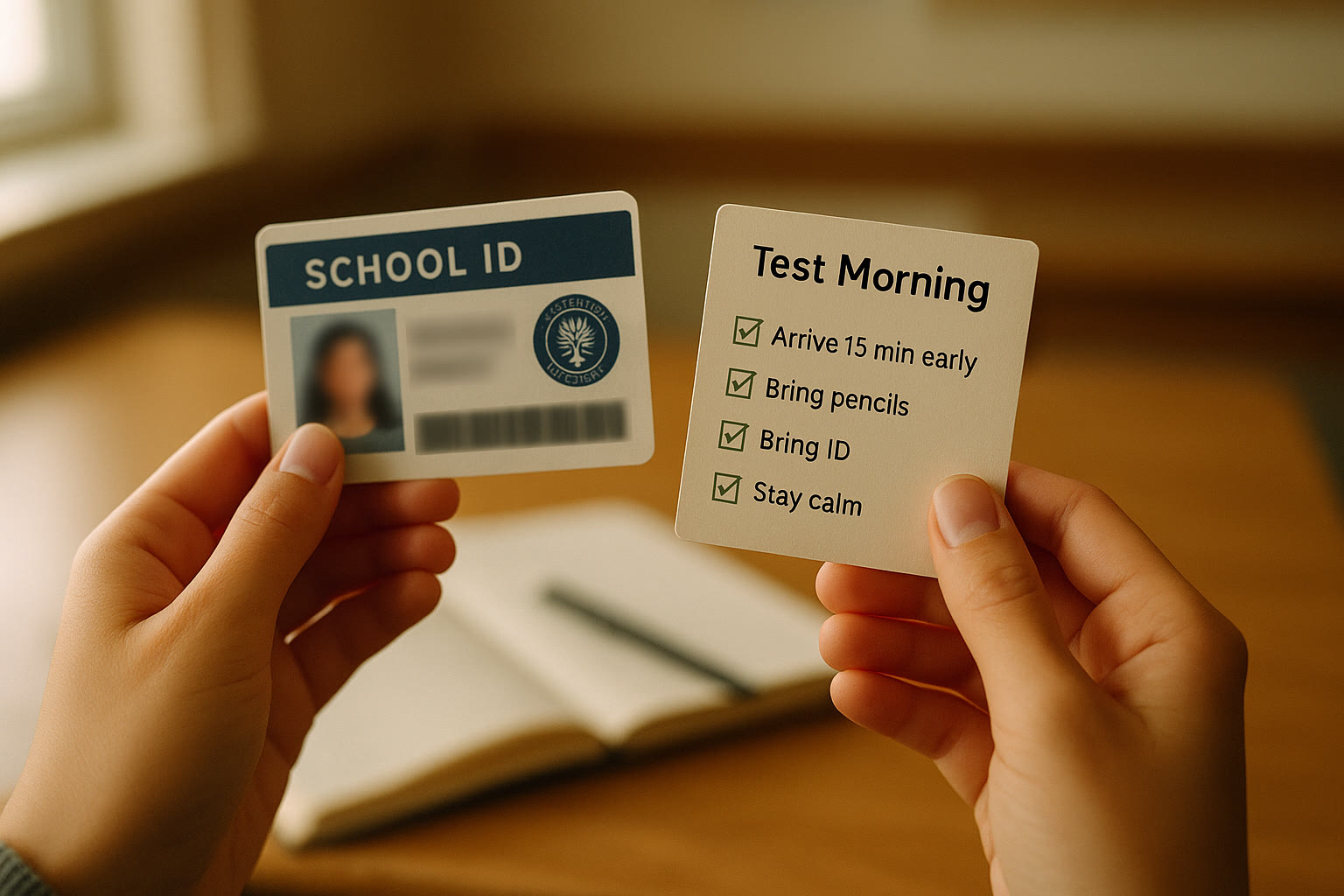
“Here’s your checklist: device charged, ID, snacks, jacket. You’re set. I’ll be at the car in five minutes.”
“You’ve prepared — now do the thing you do every morning that helps you focus. Ten deep breaths, and you’re ready.”
For students: power lines to use before walking in
“I’m ready. I’ll pace myself and do my best.”
“If something feels off on a question, I’ll mark it and move on. I’ll come back with a calm mind.”
In the testing room: scripts for focus and recovery
Inside the exam, the most powerful scripts are short reminders and permission to use effective strategies. These can be silent self-talk cues.
Student in-test scripts (silent self-talk)
- “Scan, plan, solve — move on.” (for reading passages)
- “If it’s messy, mark and skip; I’ll return.” (for tricky math problems)
- “Two deep breaths, then read the whole question.”
What to say when you hit a rough patch
It’s normal to land on a question that feels impossible. Try: “I’ve handled hard questions before; this one’s next in line.” Then follow with a small behavior: move on, mark, or re-read the setup.
After the test: scripts for healthy appraisal
Students and parents often rush to debrief. The first response matters for morale and future motivation.
For parents: containment and curiosity
“How do you feel? Tell me one thing that went well.”
“We’ll look at this the right way — with time and data. For now, let’s celebrate the effort.”
For students: constructive reflection
“I did what I prepared to do. I’ll note patterns to guide future study.”
Scripts: role-play examples you can practice
Here are short, realistic role-plays parents and students can read aloud. Practicing them makes the phrases feel natural when nerves show up.
Scenario 1 — Morning nerves
Parent: “Hey, quick checklist — phone off, charger, ID, snacks. You want the playlist or quiet?”
Student: “Quiet today, please.”
Parent: “Got it. Ten minutes before we leave, we’ll do three deep breaths together. You’ve prepared for this.”
Scenario 2 — During the week of the test
Student: “I’m worried I didn’t finish my practice test.”
Parent: “You finished every full section in practice and improved on timing. Tonight, do a short review and then relax. One more late-night practice won’t help like rest will.”
Scenario 3 — Post-test debrief
Student: “Some questions felt weird. I think I messed up the formula one.”
Parent: “Tell me one part that felt good. Then we can make a plan — if you want to keep working, we’ll target that type of problem.”
Short scripts for teachers, tutors, and mentors
Educators who coach students through the Digital SAT can use language that empowers autonomy and reduces catastrophizing.
- “What strategy did you use here? Let’s name it — then we can practice it.”
- “This was a stretch problem. It’s a perfect learning opportunity, not a failure.”
- “Try the 5-minute restart: breathe, re-read, outline, answer.”
Quick checklist table: what to say versus what to avoid
| When | Say | Avoid |
|---|---|---|
| Night before | “Rest is part of preparation.” | “You should study all night if you want a good score.” |
| Morning of | “You’ve prepared; follow your plan.” | “This test decides everything.” |
| During test | “Mark and move on; come back later.” | “You must get every question right.” |
| After test | “What part felt best? What do you want to work on?” | “Tell me your score now — we’ll make plans based on that.” |
Practical language features that actually help
Certain linguistic moves are consistently helpful when building calm: they redirect attention to behavior (what to do), normalize emotion (it’s okay to feel this way), and emphasize controllable steps. Here are examples and why they work.
Behavior-focused phrases
Examples: “Let’s make a checklist,” “Take three breaths and re-read,” “Skip and return.” Why they work: They give immediate actions, which feels empowering and reduces rumination.
Normalization and permission
Examples: “It’s OK to be nervous,” “Most people feel this before a test.” Why they work: Normalizing reduces shame and the sense of being alone in anxiety.
Small wins and micro-praise
Examples: “You kept your timing on that section,” “You used the strategy we practiced.” Why they work: Praise focused on process reinforces repeatable behaviors rather than fixed outcomes.
Sample 10-minute pre-test routine (script + actions)
Use the routine below the morning of the exam. Practice it until it becomes automatic.
- Minute 10: Walk to the test center entrance calmly; hold your checklist card.
- Minute 9: Stand, take three slow deep breaths together (if with a parent), and say: “I’ve prepared; I’ll follow the plan.”
- Minute 8–5: Quick visual review of checklist: ID, charger, snacks, pencil/charger equivalent for Digital SAT rules.
- Minute 4–1: Sit quietly, do a brief positive visualization: one question you can answer confidently. Repeat: “Plan, focus, move on.”
When to bring in extra help: a natural place for personalized tutoring
Sometimes, confidence gaps are tied to real knowledge gaps or timing issues. If repeated practice leaves a student anxious about the same types of questions, targeted help can make a measurable difference. Personalized tutoring — for example, one-on-one guidance that builds tailored study plans, tracks progress with clear milestones, and uses expert tutors to decode problem patterns — often helps students convert anxiety into strategy.
Sparkl’s personalized tutoring is an example of this approach: one-on-one guidance, tailored study plans, and expert tutors can provide focused practice and AI-driven insights to identify patterns and build confidence. When the words in the scripts above align with concrete progress from personalized practice, the combination is powerful.
Practice sessions that include confidence-building scripts
Incorporate these short scripts into mock test days. Simulate the environment and use the role-play lines in the moments you would on the real day: morning, during breaks, and the first questions. Practicing the language reduces cognitive load on test day because the student doesn’t have to invent words in the moment — they can act on a rehearsal.
Common pitfalls and how to avoid them
Here are a few traps families fall into and how to steer around them.
- Over-coaching: too many instructions increase stress. Keep comments short and focused on one or two actions.
- Score fixation: avoid immediate talk about outcomes. Delay detailed debriefs until emotions settle.
- Negative comparisons: comments that compare to peers erode intrinsic motivation. Focus on the student’s own progress.
Customizing language for personality
Different students respond to different tones. Here are quick templates to adapt the scripts above:
- For the analytical student: use step-by-step language and timelines (“First section: 65 minutes; goal: pass and flag two questions max.”).
- For the anxious student: focus on calm and short phrases (“Three breaths, then read.”).
- For the high-pressure perfectionist: emphasize process and permission to err (“Mistakes are data; we’ll use them.”).
Real-world examples: short conversations that changed the tone
Example 1: A sophomore told his mom he was panicking the night before. She stopped the long lecture and said, “Show me one problem you’re proud of from the week.” They talked about it for five minutes, and he slept better. The next morning he used the same proud-problem memory to boost confidence walking into the center.
Example 2: A student consistently froze on multi-step math problems. His tutor paused and taught a “three-line restart” script to use during the test: re-state the question, outline the steps, execute one step. The student practiced the script until it felt automatic, and the freeze moments decreased dramatically.
Putting it all together: a sample script pack for the week
Use this compact set across the last seven days before the Digital SAT. Pick the tone and repeat the lines when appropriate.
- 7 days out: “We’ll make a short schedule with rest built in.”
- 3 days out: “Keep your routine. Small, focused practice only.”
- Night before: “Pack your bag — rest is the plan now.”
- Morning of: “Checklist, three breaths, follow your plan.”
- During test: “Scan, plan, solve — mark and move on.”
- After test: “Tell me one win. Then we’ll look at the rest later.”
Final thoughts: the language of steady progress
Confidence doesn’t appear from nowhere; it grows from repeated experiences of manageable challenge, clear feedback, and supportive language. The scripts in this article are a toolkit — small, repeatable conversational habits that make high-pressure moments feel smaller and more manageable. When these words are paired with concrete practice, tailored study plans, and focused help where needed (for example, through personalized tutoring and AI-informed review like the kind Sparkl offers), students move into the Digital SAT room not as fragile candidates but as prepared, practiced, and calm test-takers.
Use the scripts, adapt the tone, and practice them out loud. The more familiar the lines, the less power panic has. In short: prepare the mind like you prepare the test — with a plan, repetition, and a calm, steady voice guiding the way.
Parting sentence
On test day, let the words you choose be simple, steady, and true — because the right phrase at the right moment can change everything.
























No Comments
Leave a comment Cancel