
Why your sleep matters more than an extra late-night practice test
If you’re anything like most students prepping for the Digital SAT, the temptation to keep grinding after dinner is real. One more practice section. One more essay-style passage to untangle. But there’s a sneaky trade-off: every hour you skimp on quality sleep chips away at memory consolidation, focus, mood, and reaction time. In short—your brain does some of its best SAT prep while you sleep. That makes sleep not an optional luxury, but a strategic study partner.
The surprising science (short version)
When you sleep, your brain organizes the day’s learning, strengthens neural connections, and prunes what’s not needed. That’s how a new vocabulary word or a tricky algebraic trick turns from “I saw it once” into “I can use it.” Pulling an all-nighter might let you review more questions, but it weakens the very skills you’ll need under test pressure: sustained attention, working memory, and the ability to think clearly.
First rule: plan so prep supports sleep, not competes with it
Start with the obvious: set a test-prep schedule that protects sleep blocks. That means deciding—before stress sets in—what a realistic study week looks like. When you plan ahead, late-night crisis studying becomes rare. Here’s how to build a schedule that keeps your brain rested and growing.
Step-by-step weekly schedule framework
- Choose a consistent wake time and bedtime, even on weekends. Consistency helps your circadian rhythm lock in alertness during study blocks.
- Use shorter, sharper study sessions: 45–60 minutes focused, followed by a 10–15 minute break.
- Place your most demanding work (full practice sections, timed problem sets) earlier in the day when your cognitive energy is highest.
- Reserve evenings for lighter tasks—review flashcards, watch strategy videos, or read explanations—then start winding down 60–90 minutes before bed.
- Build in one full-length practice test at most every 1–2 weeks; schedule it on a day when you can recover with good sleep afterward.
Example weekly block (student-friendly)
| Day | Morning | Afternoon | Evening | Target Sleep Window |
|---|---|---|---|---|
| Monday | 60 min math practice | Class/assignments | 30 min vocab review, wind down | 11:00 pm – 7:00 am |
| Tuesday | Timed reading section (60 min) | Club/activities | Light review, stretches | 11:00 pm – 7:00 am |
| Wednesday | Practice quiz + review | School | One small timed practice (if energy allows) | 11:00 pm – 7:00 am |
| Thursday | Math-targeted drills | Homework | Relaxing activity + prep for Friday | 11:00 pm – 7:00 am |
| Friday | Full-length practice test (biweekly) | Review test | Early night—recover | 10:30 pm – 7:30 am |
| Saturday | Tutor session / targeted practice | Free time or light review | Social time, relaxed bedtime | 11:30 pm – 7:30 am |
| Sunday | Review weak spots | Plan week ahead | Wind down, set goals | 10:30 pm – 7:00 am |
This is a template—adjust it to your school day and energy rhythm. The key principle is protecting 7–9 hours of good-quality sleep most nights.
Practical night-before-test strategies (so you’re sharp, not exhausted)
It’s tempting to cram the night before your SAT, but evidence and experience agree: late-night cramming kills performance. Use the evening before the test to do consolidation, not acquisition.
What to do the evening before
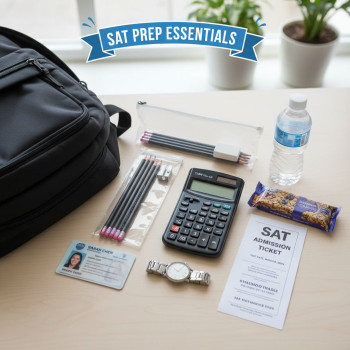
- Pack your things early—chargers, permitted ID, comfortable clothes, snacks—and check Bluebook or your test app setup if you’re testing digitally.
- Do a light, confidence-building review (20–30 minutes) of high-yield concepts you already know: formulas, punctuation rules, common strategies.
- Avoid new content. Learning new material before bed increases anxiety and reduces sleep quality.
- Start a wind-down routine 60–90 minutes before bed: dim lights, avoid screens or switch to night modes, and try light reading (non-SAT) or breathing exercises.
On sleep timing for test day
Avoid shifting your schedule dramatically just for test day. If the SAT is in the morning, slowly nudge your bedtime earlier in the week rather than forcing an early bedtime the night before. That preserves deep sleep cycles and morning alertness.
Build study routines that protect sleep quality
Good sleep hygiene and smart study habits go hand in hand. Here are habits students can adopt that help both learning and rest.
Daily study habits that support better sleep
- Limit caffeine after midday. Swap late-afternoon energy drinks for water or herbal tea.
- Exercise regularly—30 minutes of moderate activity improves sleep onset and depth.
- Keep study space tidy and reserved for studying; make your bed a sleep-only zone to strengthen the bed-sleep association.
- Use active recall and spaced repetition rather than endless rereading. These methods are more efficient and leave more time for sleep.
- If you nap, keep it short (20–30 minutes) and early in the day to avoid disrupting night sleep.
Study smarter: tactics that save time and protect sleep
- Do mixed practice: alternate math and reading sections in a single session to build flexibility without extending total hours.
- Review your mistake log weekly. Focusing on recurring errors is far more efficient than redoing whole sections.
- Use timed sections to build stamina instead of lengthening study sessions.
- Try one high-focus session per day rather than several half-hearted ones. Depth beats scattered time.
Technology tips: use devices without sabotaging sleep
Your phone and laptop are essential tools for Digital SAT prep, but they can be sleep’s worst enemies. Here’s how to make tech work for you.
Evening tech rules
- Switch devices to night mode at least 60 minutes before bed to reduce blue light exposure.
- Use website blockers to keep practice strict—block distracting sites during study windows to reduce the urge for late-night scrolling.
- Consider using official Bluebook practice in the morning or early evening so the interface feels familiar without interfering with sleep onset.
When stress steals sleep: quick tactics to calm down
It’s normal to feel anxious before a big test. But when worry interrupts sleep, performance suffers. Try these short, effective strategies when anxiety spikes.
5-minute anxiety-reset routine
- Breathe: 4 seconds in, 6 seconds out for five cycles to slow heart rate.
- Write it down: list the three most important tasks for tomorrow—then close the notebook.
- Body scan: tense and relax muscles from toes to head to release tension.
- Recall a success: mentally replay a time you overcame a tough test or project to boost confidence.
How tutoring can help your sleep (yes—really)
One-on-one guidance can reduce the fog of uncertainty that causes late-night cramming. Personalized tutoring helps you focus on what actually moves your score—so you spend less wasted time and sleep more.
What effective tutoring should do for your schedule
- Provide a tailored study plan that fits your daily routine and protects night-time rest.
- Target your weak points with efficient drills so you don’t feel the need to keep reviewing everything late into the night.
- Offer flexible session times—morning or early evening slots often work best for preserving sleep windows.
For example, Sparkl’s personalized tutoring offers 1-on-1 guidance and tailored study plans that coordinate with students’ school lives. Their expert tutors and AI-driven insights can pinpoint exactly which skills to focus on, which reduces overall study hours and takes late-night guesswork out of prepping.
Tracking progress without losing sleep
Measurement keeps motivation high and prevents unnecessary extra study. But too much data-checking late at night becomes a stress loop. Here’s how to track effectively.
Simple weekly tracker
| Metric | Why it matters | When to review |
|---|---|---|
| Practice test score | Shows overall readiness | Once every 1–2 weeks (daytime) |
| Timed section accuracy | Spotlights pacing vs. content gaps | After timed sessions (not at night) |
| Top 3 recurring errors | Targets study efforts | Weekly review |
| Average sleep hours | Directly affects performance | Daily log (quick check each morning) |
Put the data review in a daytime slot—your brain’s more rational then, and you’ll avoid spiraling before bed.
Real-world examples: students who fixed sleep, not scores
Here are two short, composite examples based on common student paths—nothing dramatic, just real-life shifts that help.
Case 1: Jamal—from late-night crammer to targeted learner
Problem: Jamal stayed up until midnight redoing practice sections because he felt he “hadn’t done enough.” Result: fuzzy memory and slow reaction times on practice tests.
Solution: He worked with a tutor to identify three recurring error types and replaced nightly redoing with three focused 45-minute sessions earlier in the day. He set a hard 11:00 pm bedtime and used a quick pre-bed review only twice a week. Outcome: his practice test scores stabilized and his morning focus improved.
Case 2: Mia—sleepy mornings to steady energy
Problem: Mia napped after school for two hours, then studied late into the night. She felt exhausted during morning practice and lost motivation.
Solution: She shortened naps to 20 minutes early in the afternoon, moved a study session to before school when she’s naturally alert, and committed to a consistent 10:30 pm bedtime. Outcome: Mia’s retention improved and timed-section accuracy rose because she could focus better during practice.
Test-day sleep checklist
- Get a full night’s rest the two nights before the test—sleep debt is cumulative.
- Wake up at your normal time; avoid sleeping in an hour or two extra.
- Eat a balanced breakfast: protein + slow carbs (oatmeal, eggs, fruit) for steady energy.
- Do a brief warm-up: 15–20 minutes of light practice or review of formulas and strategies.
- Stay hydrated but avoid excessive sugar or caffeine right before the test.
When sleep problems are deeper: what to do
Some students face persistent insomnia, anxiety, or medical issues that make sleep difficult. If you’re experiencing chronic sleep disruption, talk to a trusted adult—parent, school counselor, or healthcare professional. Addressing underlying issues will benefit test performance and overall well-being far more than extra late-night study.
Resources you can try
- School counselor: they can offer schedule advice and support, and may suggest workload adjustments during intense prep periods.
- Medical professional: persistent sleep issues or anxiety may need professional treatment.
- Structured programs: personalized tutoring that coordinates with your life can trim unnecessary study time and reduce stress. Tutors can help make each session more effective so you protect sleep without sacrificing progress.
Putting it all together: a 4-week sleep-friendly SAT plan
This short plan assumes you’re 4 weeks from test day and want to maximize learning while preserving sleep.
Week-by-week outline
- Week 1: Baseline—take a timed practice test early in the week (daytime). Identify top 3 weaknesses. Set consistent sleep schedule and commit to it.
- Week 2: Target—work with a tutor or focused study sessions on top weaknesses. Use two high-focus sessions per day (45–60 minutes) and avoid evening heavy work. Maintain sleep schedule.
- Week 3: Simulation—take one full-length practice test under test-like conditions; review mistakes the next day. Adjust study plan based on weak patterns. Prioritize sleep especially in the two nights before test simulation.
- Week 4: Taper—reduce total study hours, focus on clarity and confidence, and hold firmly to wind-down routines. Early nights are the priority; no new material this week.
Final thoughts: sleep is part of your strategy
Prepping for the Digital SAT isn’t just about how many hours you study—it’s about how you study and how you recover. Treat sleep as a study resource: schedule it, protect it, and use it to make your learning stick. Small changes—shifting tough work to mornings, fixing bedtime routines, and using focused tutoring to cut wasted time—add up to better performance and a healthier lead-up to test day.
If you feel stuck building a plan that fits your life, consider personalized tutoring that respects your schedule. A tutor who understands pacing, targeted practice, and recovery can save you time and preserve your nights—so you show up on test day rested, confident, and ready.
Take a breath, pick one change, and try it tonight
Don’t aim for perfection. Pick one sleep-friendly habit to add this week—shift one study session earlier, set a consistent bedtime, or start a five-minute wind-down routine. Tiny steps compound. Over a few weeks you’ll notice sharper focus, better memory, and fewer late-night panics. That’s the kind of prep that wins tests and keeps you sane.
Good luck—sleep well, study smart, and walk into test day ready to show what you know.





















No Comments
Leave a comment Cancel