
Why Scientific Literacy Matters on the Digital SAT
Picture this: a passage about bees, climate, or a quirky lab experiment arrives on your screen. You feel a little flutter—part curiosity, part anxiety. That moment is exactly why scientific literacy matters for the SAT Reading section. The test doesn’t expect you to be a scientist, but it does reward the ability to read scientific texts with calm, clarity, and critical thinking.
Scientific literacy on the SAT means being able to:
- Understand main ideas and supporting details in scientific writing.
- Interpret data and charts presented within or alongside passages.
- Evaluate hypotheses, evidence, and the structure of scientific arguments.
- Distinguish between what the author claims, what the data shows, and what can be inferred.
These are not exotic skills. They’re everyday thinking skills that scientists use, and that the SAT tests in many of its passages. Becoming comfortable with them will boost your accuracy, speed, and confidence.
What the SAT Reading Section Looks for in Science Passages
Science passages on the SAT often present an idea, data, a short experiment, or a historical account of discovery. The exam might also give a passage that mixes science with social or ethical implications. In every case, the test-makers want to see how well you:
- Identify the primary purpose of a passage (e.g., explain, argue, inform, compare).
- Track the flow of an argument—claims, evidence, qualifiers, and counterpoints.
- Analyze graphs, tables, and experimental descriptions.
- Make evidence-based inferences rather than unsupported leaps.
In short: the SAT expects you to think like an intelligent, skeptical reader. Scientific literacy is simply practice at doing that within the context of technical language and empirical reasoning.
Core Elements of Scientific Literacy You Can Practice
1. Grasping Structure and Purpose
Scientific writing has a rhythm: background, question, methods or explanation, results, and implications. If you can label those segments quickly, you’ll know where to look for the answer when a question asks about evidence versus conclusion.
2. Reading Data and Visuals
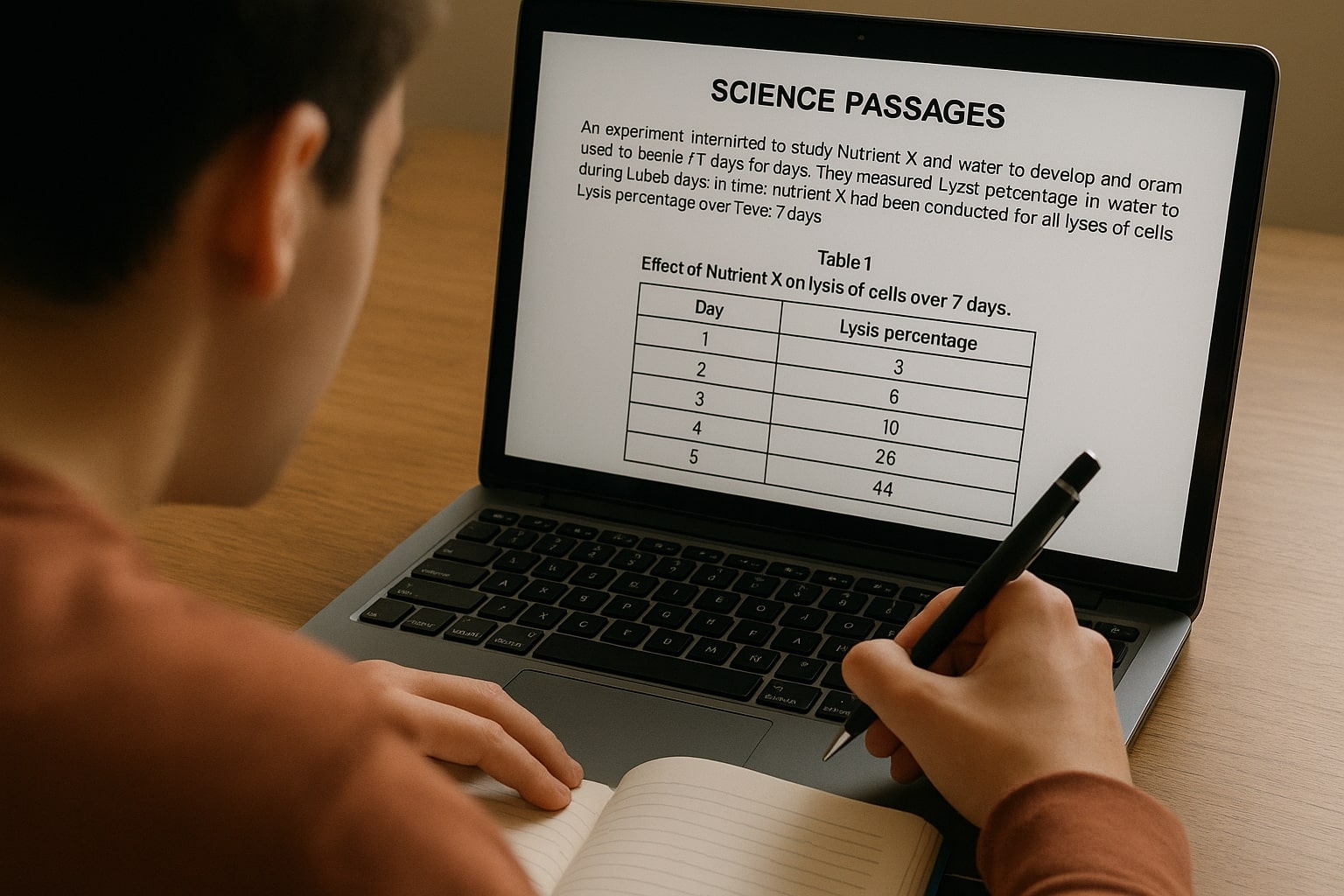
Tables, simple charts, and experimental descriptions are fair game. Train yourself to read the axes, notice units, and compare trends before reading the questions. Often the test asks something like, “Which result best supports the author’s claim?” — and the data is the key.
3. Distinguishing Claim from Evidence
An author’s claim is not necessarily proven within the passage. The SAT will test whether you can tell if the author is making an assertion, citing evidence, or offering speculation. Phrases like “suggests,” “may,” or “the data suggest” are subtle signals that the author is cautious, not conclusive.
4. Making Controlled Inferences
Inference questions ask you to go slightly beyond the text, but only using logically supported steps. Think of it like a ladder—every rung must be connected to textual support. Avoid wild leaps that seem plausible but aren’t grounded in the passage.
5. Translating Jargon to Plain Meaning
Scientific passages often include unfamiliar terms. You don’t need to memorize vocabulary; instead, practice using context clues and structural hints to figure out what a term does in the passage. Often a definition, example, or contrast will appear in the same paragraph.
Examples and Mini-Exercises to Build Skill
Short, focused practice sessions beat clumsy marathon reading. Here are small exercises you can use repeatedly.
Exercise 1: One-Sentence Main Idea
Read a short scientific paragraph (5–8 sentences). Close your eyes and summarize the main idea in one plain sentence. If you can’t, reread. This trains you to filter out details and find core meaning.
Exercise 2: Evidence Hunt
After reading a paragraph, list the top two pieces of evidence the author uses to support the main claim. Then ask: does the evidence directly support the claim or is it suggestive? This improves your precision on evidence-based questions.
Exercise 3: Data Quick-Scan
When you encounter a table or chart, give yourself 30 seconds to summarize what the visual shows in plain English. Identify trends, outliers, and what’s measured. This habit reduces panic when visuals appear on test day.
How Scientific Literacy Helps Across Question Types
Let’s match literacy skills to common SAT question types:
- Primary purpose questions: structure and purpose skills.
- Detail questions: careful scanning and evidence-hunting skills.
- Inference questions: controlled inference and logic skills.
- Data questions: chart/table reading and numeric sense.
- Author’s attitude/point-of-view: language tone and qualifiers.
Seeing this mapping helps you approach questions predictably. Instead of guessing, you’ll know which toolkit to pull out.
Sample Passage Walkthrough (Compact)
Imagine a passage describing an urban rooftop garden experiment where researchers test three soil mixes to measure plant growth over six weeks. The passage gives a brief methods paragraph, a table of average plant heights, and a concluding paragraph that notes unexpected variability.
Step-by-step approach
- First, identify the structure: background, methods, results table, conclusion.
- Scan the table before deep-reading the conclusion—note which mix led to the tallest average height and whether variation was high.
- When a question asks which claim is best supported by the data, choose the option that matches both the mean differences and the variability described in the table.
- If a question asks about the researchers’ recommendation, check whether the conclusion matches the data or is speculative—words like “may” indicate cautious recommendation.
This process—structure → data quick-scan → evidence check—keeps you anchored and reduces second-guessing.
Smart Study Plan: 8 Weeks to Stronger Scientific Literacy
Consistency is everything. Here’s a practical 8-week plan that blends reading practice, strategy, and review. Aim for 4–6 focused sessions per week, 30–60 minutes each.
| Weeks | Focus | Activities | Goals |
|---|---|---|---|
| 1–2 | Foundations | Read short science articles; practice one-sentence summaries; begin data quick-scan drills. | Build comfort with structure and plain summaries. |
| 3–4 | Evidence & Inference | Do targeted practice on evidence-based and inference questions; annotate passages for claim vs. evidence. | Improve accuracy on evidence questions and avoid unsupported inferences. |
| 5–6 | Data & Visuals | Practice interpreting tables/charts; time-limited drills on data-related questions; compare multiple-choice distractors. | Speed and confidence with charts, units, and variability concepts. |
| 7 | Full Passage Integration | Do mixed sets of science passages under timed conditions; review mistakes thoroughly. | Simulate test conditions and hone endurance. |
| 8 | Polish & Strategy | Light practice focusing on weaknesses; solidify timing strategy; mental prep and rest routines. | Enter test day calm, confident, and prepared. |
Daily Mini-Checklist for Practice Sessions
Keep each short session purposeful. Use this checklist to stay sharp:
- Warm-up: One-sentence summary of a paragraph (2–3 minutes).
- Drill: 3–4 targeted questions (evidence, inference, or data) (10–20 minutes).
- Review: Explain mistakes out loud and note why the correct answer fits (10 minutes).
- Reflection: Write one short action to improve next time (2 minutes).
Time Management: How Scientific Literacy Saves Seconds
Good scientific reading saves time because it reduces re-reading. When you can quickly label a paragraph’s role and spot the evidence, you avoid hunting for answers. A few habits that shave seconds:
- Scan visuals first for data questions.
- Underline or mark the sentence that makes the main claim.
- Circle qualifiers (may, suggests, likely) to judge certainty.
- Read questions before line references to know what to look for.
Seconds add up. Saving 10–20 seconds per question leaves more time for harder items later in the section.
Common Pitfalls and How to Avoid Them
Pitfall: Confusing correlation with causation
Many science passages describe relationships between variables. The SAT will test whether you can tell if an author claims causation or merely reports correlation. If the passage lacks an experimental design with controls, be skeptical of causal language.
Pitfall: Overreading the passage
It’s tempting to expand beyond what the author says. If an inference requires outside knowledge, it’s likely wrong. Anchor every inference in explicit textual support.
Pitfall: Misreading visuals
Watch for axis labels, units, and whether the table uses averages or medians. Question options often exploit sloppy reading of these details.
Pitfall: Letting jargon intimidate you
Break terms down using context: definitions, contrasts, or examples usually appear nearby. Translate the sentence into everyday language before answering.
How to Use Practice Material Effectively
Quality beats quantity. Use deliberately chosen passages that emphasize science content and reflect SAT style. Here’s how to extract the most from practice:
- Do timed sections occasionally, but focus mostly on targeted drills where you examine each wrong answer.
- When you miss a question, write a 1–2 sentence diagnosis: was it a reading error, a data misread, or an inference mistake?
- Track recurring errors—if you consistently misread charts, devote a week to visual drills.
- Explain correct answers aloud to a friend or a tutor—teaching is a powerful way to learn.

When Personalized Help Makes a Big Difference
Most students make the fastest gains when they combine smart independent practice with targeted guidance. That’s where a personalized tutor can be transformative. A good tutor helps you:
- Discover blind spots—patterns of error you might not notice on your own.
- Build a tailored study plan that focuses on your unique weakness areas rather than a one-size-fits-all schedule.
- Practice with feedback: immediate corrections and explanations accelerate learning.
For example, Sparkl’s personalized tutoring blends one-on-one guidance, tailored study plans, and expert tutors who can pinpoint whether you struggle more with data interpretation or with inference questions. Combined with AI-driven insights that track progress, this kind of support can cut months off your learning curve—especially when time is tight.
Real-World Reading That Builds Scientific Literacy
Beyond test prep, read short, accessible science writing. Aim for variety: ecology, human biology, tech innovations, and historical accounts of scientific discoveries. Here are practical sources of short reading practice you can do anywhere:
- Popular science summaries or news articles—read one per day and practice summarizing.
- Research summaries or plain-language sections of scientific reports—note claims and evidence.
- Science podcast transcripts—read and then listen to the episode to check comprehension.
The goal is not to learn technical detail, but to practice the mental habits that the SAT rewards: identifying claims, evaluating evidence, and understanding how data supports an argument.
Scoring Strategy: When to Guess and When to Move On
On the SAT Reading section, there’s no penalty for guessing, so answer every question. But be strategic: if a question looks like a time sink, mark your best answer quickly (eliminating obviously wrong choices) and move on. Return only if time remains. The stronger your scientific literacy, the fewer ‘time sink’ questions you’ll face.
Putting It All Together: A Practice Session Example
Here’s a 45-minute practice session you can follow. It integrates reading, data practice, and reflection:
- Warm-up (5 minutes): Read a short science paragraph and write a one-sentence summary.
- Targeted drill (20 minutes): Complete 6 science-passage questions (mix of evidence, inference, and data).
- Review (15 minutes): For each question you missed, write why the correct answer fits and why your choice was wrong.
- Reflection (5 minutes): Note one action for improvement tomorrow (e.g., “read charts first”).
Measuring Progress: Simple Metrics that Matter
Track a few indicators weekly:
- Accuracy on science passages (percentage correct).
- Average time per question on science passages.
- Types of errors (misread data, weak inference, vocabulary misread).
Small, consistent improvements in these metrics are more meaningful than occasional high scores on untimed practice. If you work with a personalized tutor—like the expert tutors available at Sparkl—you can get clear feedback on these metrics and an evolving study plan that addresses persistent gaps.
Mindset: Curiosity Beats Cramming
Science reading rewards curiosity. When you approach a passage as a mini-mystery—what question are the authors trying to answer and what clues do they offer—you’re more engaged and better able to recall details. This curiosity-driven approach also reduces anxiety because it invites exploration instead of perfectionism.
Final Checklist for Test Day
Keep this short checklist in your pocket the week before the test:
- Practice one full Reading module under timed conditions (if possible) 5–7 days before test day.
- Do at least two short data-interpretation drills in the 48 hours before the test.
- Sleep well and eat a balanced meal before the test—cognitive stamina matters.
- Use your practiced quick-scan: glance at visuals first, mark the main claim, and answer evidence questions by referencing that claim.
- Remember to trust your strategies—avoid re-reading endlessly and keep time in mind.
Closing Thoughts: Scientific Literacy as a Life Skill
Scientific literacy does more than improve SAT scores. It teaches you how to weigh evidence, read critically, and think clearly—skills that help in college classes, informed civic decisions, and everyday claims you encounter online or in conversation. The SAT simply packages a few of these habits into a timed challenge.
If you want targeted, efficient growth—especially in the weeks leading up to the test—consider combining independent practice with personalized help. Sparkl’s 1-on-1 tutors, tailored study plans, and AI-informed progress tracking can help you sharpen the exact skills the SAT rewards: reading for meaning, interpreting evidence, and making careful inferences. With steady practice, curiosity, and the right support, scientific passages will stop being a source of stress and start becoming a place to show off your critical thinking.
Start small. Read widely. Ask: “What is the evidence?” and “How sure is the author?” Practice those two questions often enough, and your reading will become faster, smarter, and more confident—exactly the edge you want on the Digital SAT.





















No Comments
Leave a comment Cancel