

Why Confidence Grows After Every SAT Practice Test
There’s a particular kind of calm that comes after you finish a full SAT practice test. It’s not always about a perfect score — often it’s about that quiet, steady feeling that you can handle whatever the exam throws at you. If you’ve ever finished a practice test and thought, “Okay, I can do this,” you’ve already felt the confidence-building power of practice. In this post we’ll explore why that happens, what’s actually changing in your brain and test skills, and how to turn short-term reassurance into lasting exam-day confidence.
The three ways practice tests build confidence
At a high level, confidence after practice tests grows because of three things working together: familiarity, feedback, and strategy refinement. Each full-length practice test is a mini-experiment — it tells you what works, what doesn’t, and where to focus next. Let’s unpack each of those.
1. Familiarity: the unknown gets smaller
Unknowns breed anxiety. The SAT’s format, timing, adaptive behavior, and question phrasing can feel unpredictable when you’re new to the test. Every practice test removes a bit of that unpredictability:
- You learn the rhythm of sections and how long 35–45 minutes really feels when you’re concentrating.
- You get used to the look and feel of passages, graphs, and question stems so your brain stops wasting energy on novelty and can focus on solving problems.
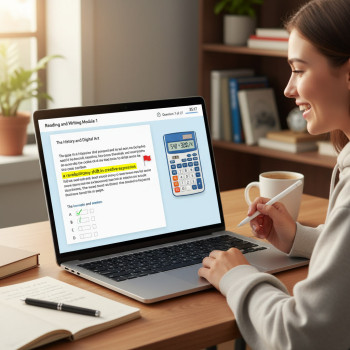
- You discover which interface tools (if practicing digitally on Bluebook or an official platform) you prefer — flagging, highlighting, back-and-forth navigation — so test day feels like one more session, not a brand-new experience.


2. Feedback: mistakes become opportunities
A practice test gives you facts: which types of questions you missed, when your timing falters, and whether careless errors are a pattern. That feedback loop is powerful because it converts anxiety into a concrete plan: you can’t fix what you can’t see. Once you can name your trouble spots — weak algebraic manipulation, pacing during long reading passages, or misreading conditional statements — you can practice deliberately.
3. Strategy refinement: less guesswork, more choices
Confidence also grows when you discover a reliable strategy that suits your brain. Practice tests are the laboratory where you can try different approaches: reading the questions first, outlining reading passages, using estimation in math, or deciding which questions to skip and return to. Over time your chosen strategy becomes automatic, and automaticity is the quiet engine of confidence.
What really changes in your mind after a practice test
Understanding the psychological and cognitive shifts helps make confidence intentional, not accidental.
Shift 1 — reduced cognitive load
When you first approach SAT material, your brain is juggling format, content, and strategy. That’s a lot of mental weight. After repeated practice, familiarity reduces the cognitive load: format and routine become background processes, leaving more working memory for reasoning and comprehension.
Shift 2 — growth mindset in action
Each practice test shows that skills can improve with effort. When students build a routine of testing, reviewing, and adjusting, they begin to see errors as a path to growth rather than proof of fixed limitations. That mindset shift improves resilience — a cornerstone of lasting confidence.
Shift 3 — pattern recognition and “fast intuition”
Practice trains your brain to recognize problem types and likely traps more quickly. Over time you develop a fast, accurate intuition for whether an answer makes sense, which shortens decision time and boosts confidence in your choices.
How to get the most confidence from each practice test
A practice test is only as helpful as the follow-through. Here’s a practical routine to extract maximum confidence-building value:
Before the test: simulate the real thing
- Choose a quiet spot and a realistic device setup (if you’re taking the Digital SAT, practice on a device similar to what you’ll use on test day, or use the College Board’s Bluebook preview).
- Set a timer and eliminate distractions. Treat it like test day: wear headphones if you’ll wear them during the real test, set a drink nearby, and use the same tools you plan to use later.
- Decide on one strategy to test: reading questions first, time checkpoints, or a math-checkback routine. Change only one thing at a time so you can measure impact.
During the test: collect confidence data
Don’t just score the test — record your confidence level on each question (a simple 1–5 will do) and note why you felt that way. This is the “Confidence Check Activity” in action: it lets you compare confidence to accuracy and discover blind spots (for example, high confidence + wrong answer often signals careless mistakes; low confidence + right answer shows you need more trust in your instincts).
After the test: review with a plan
Spend more time reviewing wrong answers than celebrating correct ones. For each mistake, ask:
- Was the error content-based (I don’t know the rule) or process-based (I misread, miscalculated, or ran out of time)?
- What is the smallest practice task that would guard against this error happening again?
Then build that task into your next study block — short, targeted practice beats long, aimless studying.
Concrete examples: turning tests into confidence
Let’s make this tangible with a few realistic student scenarios and step-by-step fixes.
Example 1 — The anxious reader
Anna consistently loses time on Reading & Writing because long passages feel overwhelming. After two practice tests she notices a pattern: she’s rereading whole paragraphs and getting stuck on details.
- Action: She tries the “question-first” strategy on one practice test — read the questions first, then skim the passage for answers. She records confidence and timing.
- Result: Her pacing improves and she feels calmer because she’s looking for targets, not reading everything. Confidence rises when she sees that targeted skimming yields correct answers more often.
Example 2 — The rushed math student
Marcus gets many math questions right but loses points to careless arithmetic errors under pressure.
- Action: After each practice test he adds a two-minute “quick check” at the end of the math section to re-evaluate arithmetic and units on the hardest questions.
- Result: A few avoidable mistakes disappear, and his accuracy improves even when the raw number of attempted questions stays the same. That small win builds trust in his pacing and reduces panic on future tests.
Example 3 — The overconfident guesser
Priya often feels sure but misses a surprising number of Reading questions. Her confidence ratings were high for many wrong answers.
- Action: She starts the Confidence Check Activity — marking her certainty for each answer. During review she learns that certain phrasing patterns trip her up, so she practices question stems and trap options.
- Result: Her confidence becomes calibrated: she learns to pause on certain cues and double-check, which prevents repeat errors and increases reliable confidence.
Study plan template: practice-test-focused 8-week cycle
Here’s a compact 8-week cycle centered on regular practice tests. It’s flexible — adjust timing to fit your schedule and target test date.
| Week | Main Activity | Goal | Time per day |
|---|---|---|---|
| 1 | Baseline full practice test (bluebook or official PDF) | Identify strengths, weaknesses, and confidence patterns | 2–3 hrs (test day) + 30–45 min review |
| 2 | Targeted skill work (grammar, algebra, passage strategies) | Close 1–2 obvious gaps | 45–90 min |
| 3 | Timed half-sections + one full practice test | Try new strategies; collect confidence data | 1–2 hrs |
| 4 | Deliberate practice on weakest skill | Turn a weakness into a manageable task | 45–90 min |
| 5 | Full practice test + review with confidence audit | Measure improvement and recalibrate plan | 2–3 hrs + 45–60 min review |
| 6 | Mixed practice + timed strategy drills | Sharpen timing and stamina | 1–2 hrs |
| 7 | Full test under near-test-day conditions | Practice day-of routines and stress-management | 2–3 hrs + light review |
| 8 | Final light review + one short practice test | Conserve energy and trust your preparation | 30–60 min |
Common pitfalls — and how to avoid them
Practice tests can backfire if used incorrectly. Here are frequent mistakes and their fixes.
Pitfall: Taking tests without review
Why it hurts: You’ll repeat the same errors and wonder why your score won’t budge.
Fix: Spend at least half the time of the test reviewing. Use the Confidence Check Activity and write one clear action item for each type of mistake.
Pitfall: Changing too many strategies at once
Why it hurts: You won’t know what actually helped.
Fix: Test one new variable per practice test. Keep a short log: date, strategy change, score impact, confidence change.
Pitfall: Over-testing without variety
Why it hurts: You can burn out or plateau if every test is the same type of practice.
Fix: Mix full practice tests with focused drills, timed sections, and calm “skill-only” days.
How tutoring accelerates the confidence curve (a natural fit)
One reason many students see faster confidence gains is targeted guidance. A good tutor or coaching program helps you turn practice-test feedback into a precise plan. That doesn’t mean hand-holding — it means faster troubleshooting.
What tailored tutoring brings to the table
- Immediate, focused feedback on why errors happen (not just that they happened).
- Custom practice material that zeroes in on your specific traps and timing issues.
- Short accountability loops so your next practice test isn’t a solo experiment — it’s an informed trial.
If you’re exploring tutoring options, Sparkl’s personalized tutoring model — 1-on-1 guidance, tailored study plans, expert tutors, and AI-driven insights — can fit naturally into a practice-test-based routine. Sparkl’s approach helps students convert each practice test into a targeted action plan, shortening the time between tests and measurable improvement.
Stress management: small rituals that protect confidence
Confidence is fragile on test day. Small, repeatable rituals preserve the gains you built during practice.
- Pre-test breathing routine: 4-4-8 breathing for two minutes before you start a section.
- Micro-checkpoints: set a simple timing checkpoint for the first few questions to prevent early panic.
- Positive cue: a short phrase like “One question at a time” that you repeat quietly when you feel overwhelmed.
- Recovery micro-habit: if you miss a question, jot a one-word note (e.g., “rushed”) and move on. Don’t let a single error cascade into a panic spiral.

Measuring confidence without getting trapped by scores
Scores matter, but they aren’t the only signal. Track these non-score indicators to see real improvements in confidence:
- Average confidence rating per section (from your confidence audit).
- Change in number of careless errors.
- Ability to execute a chosen strategy consistently (e.g., reading questions first) across tests.
- Emotional response: feeling calmer entering a test or less likely to catastrophize a single mistake.
Final thoughts: practice is practice, but practice tests are transformation
Taking an SAT practice test is not just a way to estimate a score — it’s an act of rehearsal that trains your mind, your timing, and your emotional responses. Each test shrinks the unknown, gives you clear data, and allows you to try strategies in a low-stakes setting. That’s why confidence often grows incrementally with each practice test: you’re literally rewiring how you approach problems and how you handle pressure.
If you want to accelerate that process, integrate deliberate review, keep a confidence log, and consider targeted support. Personalized tutoring — like Sparkl’s 1-on-1 sessions, tailored study plans, and AI-driven insights — can make the cycle of test → review → targeted practice → test more efficient and less stressful. Above all, remember that confidence is built, not bought: every practice test is a small, measurable step toward feeling calm and capable on the day that matters.
Keep your next step simple
Schedule a timed practice test this weekend. Treat it like a rehearsal: simulate the day, collect your confidence ratings, and spend the same amount of time reviewing you spent testing. Then pick one tiny practice goal for the next week. Small wins compound faster than marathon sessions. Good luck — you’ve got this.















No Comments
Leave a comment Cancel