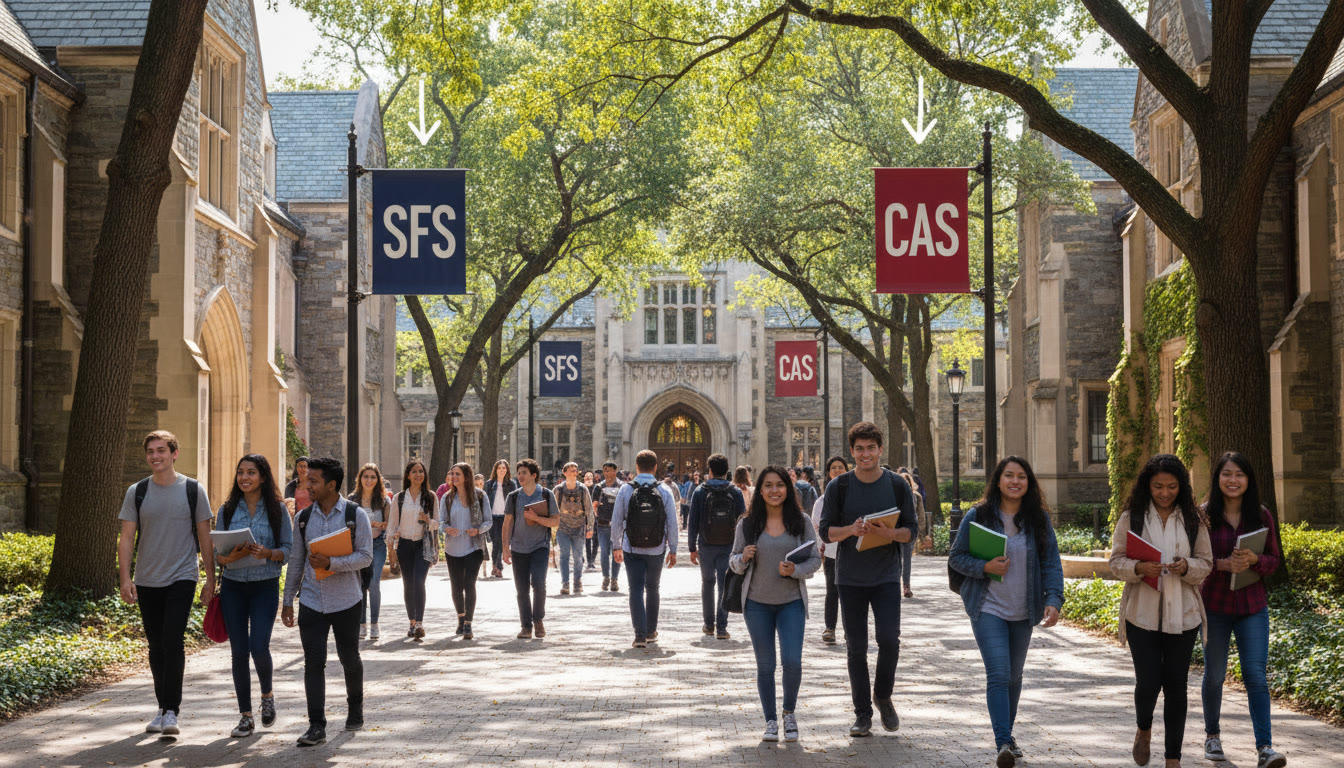

Why This Choice Matters: SFS vs CAS — More Than Just a Name
When you’re standing at the crossroads of college choice — and for many students, that crossroads includes Georgetown — the difference between the School of Foreign Service (SFS) and the College of Arts & Sciences (CAS) can feel both exciting and a little bewildering. On paper, SFS evokes diplomacy, global affairs, languages, and policy. CAS offers breadth across the humanities, sciences, and social sciences with academic flexibility. But how does your AP Language & Culture work fit into the picture? How do AP scores, demonstrated language proficiency, and the courses you choose in high school influence both admission and later success once you’re on campus?
Quick Snapshot: What SFS and CAS Emphasize
Think of SFS as purpose-driven specialization: students often enter with strong interest in international relations, economics, languages, and regional studies. CAS is the classic liberal arts college experience where you can explore widely, double-major, and pivot academically.
- School of Foreign Service (SFS): Career-oriented toward diplomacy, international policy, development, security, and languages.
- College of Arts & Sciences (CAS): Broad intellectual foundation; supports majors from physics to philosophy and everything in between.
Admission to either school is competitive; your AP record and how you present it—through your transcript, essays, recommendation letters, and demonstrated interests—can help admissions officers understand your readiness and fit.
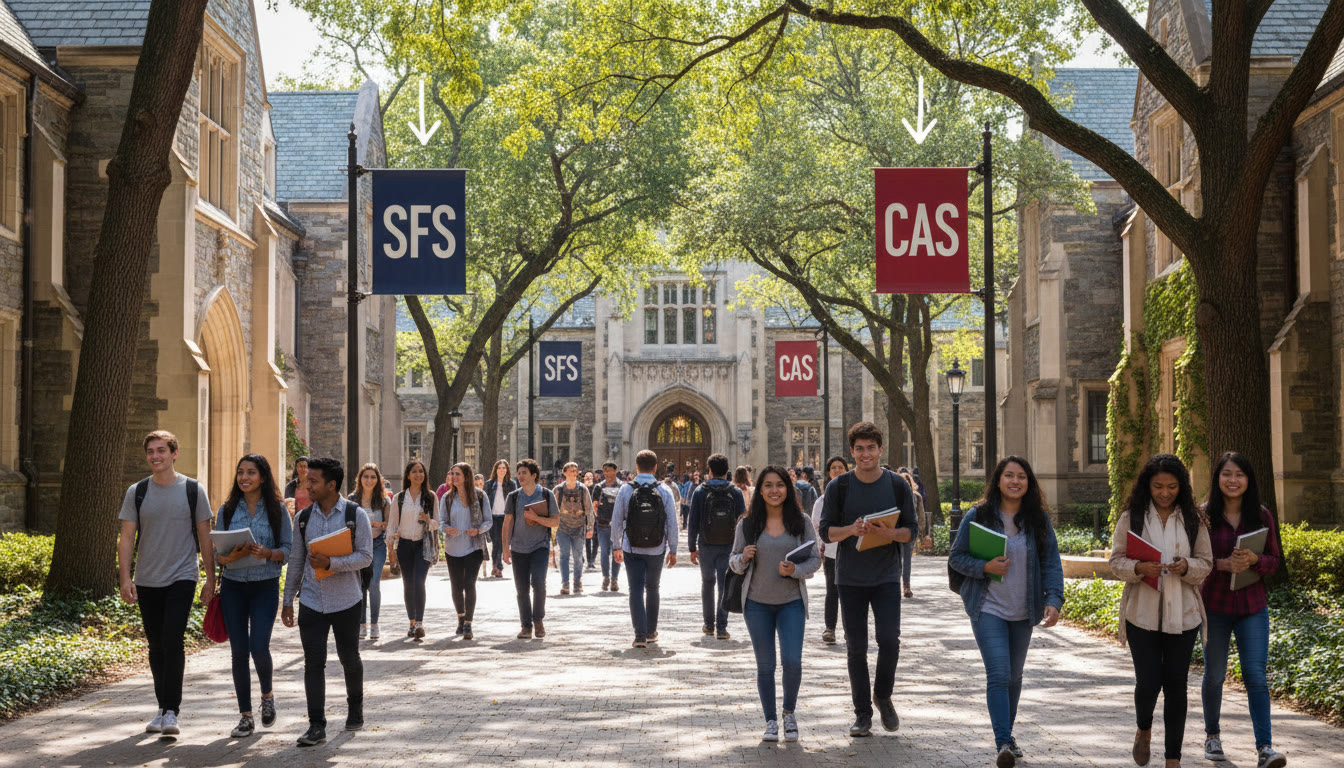
How AP Language & Culture Exams Matter to Georgetown
AP Language & Culture exams (Spanish, French, Chinese, German, Italian, etc.) are direct evidence of your language study and readiness for college-level foreign language work. For both SFS and CAS, strong AP performance in languages signals several things:
- Academic preparedness for rigorous coursework.
- Persistence and depth in studying another culture and language—an increasingly prized skill in a globalized admissions landscape.
- Potential for placement or credit that can let you start at an advanced language level in college or free up your schedule for other majors/minors.
Admissions officers don’t treat AP scores as the only evidence, but they are a crisp, comparable data point across thousands of applicants. High scores on AP Language & Culture exams pair exceptionally well with SFS applicants who demonstrate global or policy-minded engagement; they also serve CAS applicants who want the freedom to study advanced literature, linguistics, or area studies without starting from scratch.
AP Exams: Credit, Placement, and the Long-Term Academic Advantage
Most universities, including Georgetown, use AP scores in two practical ways: credit (college course credit) and placement (allowing you to enroll directly in higher-level courses). Even when the institution doesn’t award credit for every high score, strong AP results can place you into advanced sequences faster—especially in language departments.
Why does that matter?
- Being placed into an advanced language course in your first year allows you to pursue higher-level seminars, study abroad opportunities, or a double major without losing momentum.
- SFS students who arrive with advanced language skills can engage earlier in region-specific coursework relevant to diplomacy and international affairs.
- CAS students can pair advanced language study with majors like History, Sociology, or Political Science for interdisciplinary depth.
Practical Strategies: Using AP Language & Culture to Strengthen Your Application
Here’s a practical roadmap you can follow in junior and senior year to make your AP language work count.
1. Plan Early — Sequence Your Courses with Intent
If you’re leaning SFS, layer your interests: AP Language & Culture + AP Human Geography or AP Comparative Government amplify your profile. If CAS is your swing school, mix language APs with AP Literature, AP World History, or AP Biology to show intellectual range.
2. Aim for Depth Over Quantity
Two strong APs in related areas are better than six shallow APs. Admissions committees notice consistency and sustained interest. If language is your passion, take the highest level available in high school, and consider complementary extracurriculars (language clubs, community tutoring, cultural festivals).
3. Use Your Writing — Not Just Scores — to Tell Your Story
Your college essays and short answers are where scores meet soul. Talk about a text you analyzed in AP Language & Culture, an exchange program, a conversation you had with a native speaker, or how learning a language altered how you think. Concrete examples matter.
4. Prepare Strategically for the Exam
- Practice the AP exam’s three modes: interpersonal, interpretive, and presentational communication. Those are real-world skills.
- Use College Board resources—AP Classroom videos, topic questions, and past score distributions—to know what earns a 4 or 5.
- Simulate exams under timed conditions. Combine practice with targeted review: grammar drills, listening practice, and cultural reading.
When to Mention AP Credit on Your Application (and How)
There’s no need to overplay a single AP score, but be intentional. If a high AP Language & Culture score changed your course sequence or made possible a project, include that in a short activity description or essay. If you used AP credit to take a college-level course in high school or at a local college, mention the specific course and what you learned.
Sample Activity Blurb
“Advanced Spanish (AP Spanish Language and Culture) — 5 on exam; placed into upper-level university Spanish I during senior year, enabling independent research on migration narratives in modern Latin American literature.”
How SFS and CAS View Language Skills Differently — And Where They Overlap
Both schools value language competence, but they sometimes use it differently:
| Aspect | SFS Perspective | CAS Perspective |
|---|---|---|
| Purpose | Language as a tool for diplomacy, policy, and regional expertise. | Language for scholarship, interpretation, literature, and cultural insight. |
| Course trajectory | Often integrated into international relations and area studies sequences. | Can be paired with humanities and sciences; greater flexibility to minor or double major. |
| Study abroad / immersion | Highly encouraged; language proficiency often aligns with internships/fieldwork abroad. | Also encouraged; may be pursued for research, literary study, or language pedagogy. |
| Admissions Signal | AP language + international experience = strong SFS fit. | AP language + multidisciplinary coursework = strong CAS fit. |
The takeaway: language APs are a shared asset. How you frame them — as a tool for public diplomacy or as a gateway to comparative literature — shapes the narrative around your fit for SFS or CAS.

Concrete Prep Checklist for AP Language & Culture Success
Use this checklist during your junior and senior years to keep your progress measurable and meaningful.
- Junior Year Spring: Enroll in highest-level high school language available. Begin AP Classroom resources and AP Daily review videos.
- Summer Before Senior Year: Read short stories, news articles, and listen to podcasts in the target language; practice speaking with native speakers or tutors.
- Senior Year Fall–Winter: Complete full-length timed practice exams; review weak skill areas (listening, grammar, persuasive speaking).
- Senior Year Spring (pre-exam): Polish presentational tasks and real-world speaking scenarios. Simulate AP exam constraints.
- After Scores: Assess placement options for college. Consider whether to accept credit or begin at a higher placement level.
How Personalized Tutoring Can Make a Difference
Some students thrive with self-study. Others need targeted feedback—especially on speaking and writing. Personalized 1-on-1 tutoring can give you real-time corrections, tailored study plans, and exam-specific strategies. When tutoring is aligned with AP rubrics and real exam tasks, you get more than content review: you get a plan built around your aspirational college major and the narrative you want to present to admissions. Sparkl’s personalized tutoring, for example, offers tailored study plans and expert tutors who can help simulate speaking sections and refine written responses—resources that fit naturally into a focused senior-year strategy.
Real-World Examples: How AP Language Choices Played Out
Here are short, composite examples (inspired by actual student trajectories) to help you imagine different paths.
- Marisol — SFS Applicant: Took AP Spanish Language and Culture (score 5), AP Human Geography, and volunteered at a local immigration center. In her essays she connected language with a desire to work on migration policy. Result: strong SFS fit due to aligned coursework, AP signal, and extracurricular impact.
- Ethan — CAS Applicant: Took AP French Language and Culture (score 4) and AP Literature (score 5). Used AP credit to take an independent college seminar on Francophone literature. Result: Admission to CAS with opportunities for interdisciplinary study in literature and linguistics.
- Aisha — Undecided, Later Specialized: Took AP Chinese Language and Culture and AP Calculus. Started CAS, then leveraged language skills to transfer into an international economics program within the university. This shows flexibility: APs can open doors even when initial school choice differs.
What to Do If Your School Doesn’t Offer AP Language
Not every high school offers every AP language course. You still have options.
- Self-study using AP Classroom materials and take the exam at an authorized testing site.
- Enroll in community college language courses and report them on your application with transcripts.
- Join language tandems, online language exchanges, or local cultural associations to build conversational fluency and experiences you can describe in essays.
Documenting Non-AP Language Work
If your language learning happened through community programs, heritage learning, or immersion, be explicit. Include a short description in the activities section and, if available, provide teacher or mentor recommendations that highlight proficiency and cultural engagement.
Placement Decisions: To Accept AP Credit or Not?
When you get your AP score, colleges may give you choices: accept credit (which may count toward a degree requirement) or accept placement (start at a higher course level without credit). Consider these factors:
- Will accepting AP credit reduce opportunities for major-specific introductory courses you actually want to take?
- Will placement into a higher course better position you for honors seminars, study abroad, or early research?
- How many total credits do you want to enter with? Do you plan to graduate early, study abroad, or double major?
Talk to academic advisors at Georgetown (or any target school) before making final decisions — placement can shape your first-year experience.
Putting It All Together: Application Timeline and Messaging
Admissions is storytelling. Your scores and courses are chapters; your activities and essays are the voice. Here’s a timeline to help you tell a coherent story that connects AP Language & Culture work to your choice of SFS or CAS.
| When | Action | Why It Helps |
|---|---|---|
| Junior Year Spring | Choose and commit to highest available language level; start AP resources. | Shows sustained commitment; leaves time to build a strong record. |
| Summer | Engage in immersion, reading lists, or tutoring focused on AP exam skills. | Improves fluency; supplies material for essays and interviews. |
| Senior Year Fall | Frame your application essays around language experiences and academic goals. | Aligns your narrative with either SFS (global policy) or CAS (scholarship/exploration). |
| Senior Year Spring (post-AP) | Decide on AP credit vs placement; consult advisors. | Ensures the first-year schedule supports long-term academic plans. |
Final Notes: Be Strategic, But Be Authentic
Top colleges like Georgetown are trying to understand the person behind the transcript. AP scores and AP Language & Culture work are powerful tools because they’re objective and comparable, but they’re not standalone. The strongest applications tie objective achievements to curiosity, context, and impact: why you studied that language, what you did with it, how it changed the questions you want to ask of the world.
If you’re balancing test prep, coursework, extracurriculars, and essays, consider targeted support where it matters most. Personalized tutoring that focuses on your weak spots, mimics AP exam tasks, and helps you articulate your story can be a force multiplier. Services like Sparkl that offer 1-on-1 guidance, tailored study plans, expert tutors, and AI-driven insights can help you optimize study time and craft application narratives that resonate — when used thoughtfully and in service of your authentic interests.
Parting Advice for Students and Parents
Remember: whether you end up in SFS or CAS, language study opens doors — to internships, study abroad, interdisciplinary majors, and careers you might not yet imagine. Choose courses and experiences that excite you genuinely. Use AP exams as milestones to measure growth, not as the only destination. And finally, keep perspective: college is for learning, not just for credentialing. The most persuasive applications show a learner’s trajectory over time — and language study is one of the clearest ways to demonstrate it.
Best of luck — and if you want help turning your AP Language & Culture preparation into real momentum for Georgetown or any top college, consider focused, personalized guidance that matches your goals and schedule. A little strategic support can turn hard work into compelling evidence of your readiness and fit.





























No Comments
Leave a comment Cancel