

Why Time-Blocking Is the Secret Superpower for AP Students
Balancing Advanced Placement courses with clubs, practices, and a social life can feel like juggling while riding a unicycle. The good news? You don’t need superhuman willpower — you need a plan. Time-blocking turns vague intentions (“I’ll study later”) into a real schedule that respects your energy, your commitments, and the rhythms of your week.
This post is written for you: the student who wants strong AP scores but also wants to keep playing soccer, leading the debate team, or just sleeping more than five hours a night. Expect practical templates, a realistic sample week, tips for staying flexible when life intervenes, and a few gentle reminders to protect your mental health. Oh — and where it fits naturally, we’ll touch on how Sparkl’s personalized tutoring can support the strategy with 1-on-1 guidance and AI-driven study insights.
Start with Why and What: Your Priorities and AP Targets
Before you open a calendar app, answer two simple questions: Why are these APs important to you? What score do you realistically want (or need)? Your answer will shape how aggressive your time blocks should be.
- Why: Are you aiming to earn college credit, strengthen an application, or build mastery in a subject you love?
- Target Score: A 5 requires different prep intensity than a 3. Be honest and factor in your current baseline (practice test scores, past grades).
- Non-negotiables: Practices, meetings, family time, and sleep. These anchor your calendar and protect your wellbeing.
Write these down — put them on the top of your planner or phone notes. They become the north star for your time-blocking decisions.
How Time-Blocking Works — The Simple Mechanics
Time-blocking is the practice of assigning specific activities to designated chunks of time. Unlike to-do lists, which are open-ended, a block has a start, an end, and a clearly defined purpose.
Core principles
- Chunk your day: Use blocks of 25–90 minutes depending on focus needed.
- Theme your blocks: Label blocks by task type (AP Math Practice, Club Prep, Rest/Recovery).
- Protect high-value time: Schedule your hardest work when you have the most focus (often mornings or right after a light rest).
- Buffer time: Add 10–20 minute buffers between blocks for transitions — especially important when moving from school to practice or meetings.
- Weekly structure: Plan blocks for the whole week but keep some unscheduled time for life surprises.
Designing Your Week: A Practical Template
Below is a balanced, realistic weekly template for a student taking two AP courses, in two school clubs, and playing a sport. Adjust durations, number of sessions, and intensity to match your personal goals and energy.
| Time | Mon | Tue | Wed | Thu | Fri | Sat | Sun |
|---|---|---|---|---|---|---|---|
| 6:30–7:30 AM | Light Review (AP Chem flashcards) | Gym/Stretch | Light Review (APUSH timeline) | Gym/Stretch | Sleep In / Recovery | Practice Test Block (timed) | Review Test Answers |
| After School 4:00–6:00 PM | Soccer Practice | Club Meeting + Prep | Homework Block (focused) | Soccer Practice | Lab / Long Project Work | Optional Club Event | Family Time / Rest |
| 7:00–8:30 PM | AP Math Practice (problem set) | AP Lang Essay Practice | Free / Catch-up | AP Math Review + Sparkl Tutor Check-in | Light Review + Social Time | Active Recall Session | Plan Week Ahead |
This is a sample — and a compact one. Notice the rhythm: short morning reviews for memory consolidation, longer evening study blocks for deeper work, and a weekend practice test to simulate exam conditions. Integrate club and sport slots as immovable commitments and build academics around them.
Two Rules That Keep Time-Blocking Real (and Sustainable)
Rule 1: The 80/20 Focus
Not all study is equal. Identify the 20% of topics that produce 80% of score improvement and prioritize them in your blocks. For an AP Calculus student, that might be derivatives, integrals, and limits; for APUSH, it could be analyzing primary sources and writing DBQs under timed conditions.
Rule 2: Energy, Not Just Time
You might be able to study four hours straight, but are those four hours productive? Match task difficulty to your energy levels. Use high-energy times for hard practice (problem-solving, timed essays) and low-energy times for lighter tasks (flashcards, reading summaries, organizing notes).
How to Mix Clubs and Sports Without Burning Out
Clubs and sports are not interruptions — they’re anchors that shape your schedule. The trick is to use them to your advantage rather than treating them as obstacles.
- Use travel or warm-up time: Short audio reviews or mental rehearsals during warm-ups or car rides are surprisingly effective.
- Block around practices: If practice ends at 6 p.m., schedule a 20–30 minute buffer for transitions, then a 45–60 minute focused study session. Respect recovery time.
- Leverage club projects: Turn club presentations or projects into opportunities to practice AP communication skills — for example, crafting arguments for AP Lang or synthesizing data for AP Environmental Science.
- Plan rest days: Athletes need rest for both body and brain. Use one lighter academic day after intense competitions or long club events.

Concrete Tools and Routines That Actually Work
Pomodoro With Purpose
Pomodoro (25 minutes focus + 5 minute break) is flexible: combine two Pomodoros for a deeper 50-minute block when you need more continuity. Use the short breaks to hydrate, change your environment, or do quick mobility stretches after practice.
Weekly Review Sunday
Spend 30–60 minutes each Sunday to:
- Assess what worked and what didn’t.
- Move unfinished study blocks into the coming week.
- Set one measurable goal per AP (e.g., complete four timed FRQs or master three new problem types).
Active Recall and Spaced Repetition
Active recall (self-testing) beats passive rereading. Pair it with spaced repetition across your study blocks. Even 10 minutes of flashcard review morning and evening strengthens memory more than a single two-hour cram session.
When You Need Extra Help: How Personalized Tutoring Fits
Sometimes the bottleneck is not time but direction: you study a lot but don’t know which problems to prioritize or how to fix recurring mistakes. That’s where targeted help shines.
Sparkl’s personalized tutoring can fit into time-blocking naturally — short, focused 1-on-1 sessions after a timed practice or before a big test. Tutors can create tailored study plans and provide AI-driven insights that show which question types bleed your score and which topics will give the biggest gains. Use tutoring sessions as weekly calibration: a 45-minute Sparkl check-in can redesign your blocks for maximum efficiency.
Sample Two-Week Sprint Before an AP Exam
The final two weeks before an exam are about sharpening, not relearning. Here’s a realistic sprint that balances practice tests, targeted review, and recovery.
- Day 1: Full-length practice exam (timed). Immediate 30-minute high-level review of missed questions.
- Days 2–5: Targeted blocks — focus on the three most-missed topics. Use active recall and practice problems.
- Day 6: Mixed-question simulation (half exam). Work on pacing and essay structure for 30–45 minutes afterward.
- Day 7: Light day — flashcards, sleep early.
- Repeat week 2 with intensity slightly reduced and sleep prioritized the last two nights before the exam.
During this sprint, keep club obligations light if possible. If you can’t reduce them, reduce the length of study blocks and increase focus — quality over quantity.
Tips for Staying Flexible: Handling the Unexpected
No plan survives the season perfectly. Games change, a club trip appears, or a friend needs support. Flexibility keeps your system resilient.
- Swap don’t cancel: If you miss a study block, swap it with a buffer slot later in the week instead of skipping it entirely.
- Micro-study: Use 10–15 minute pockets (locker time, bus rides) for flashcards or single-problem practice.
- Reassess goals: If your workload spikes, temporarily lower the number of practice exams and focus on key question types.
- Communicate with teammates and club leaders: Sharing exam dates can lead to mutual support — your team might shift a practice time for an athlete with a major test.
Sample Daily Plan: Realistic and Human
This is a single-day example for a student who has soccer practice and a club meeting:
- 6:30–7:00 AM — Morning flashcards (AP Bio) — low-effort, high-memory.
- 8:00 AM–3:00 PM — School (use free periods for 20–30 minute targeted review).
- 4:00–6:00 PM — Soccer practice (physical recovery after).
- 6:30–7:00 PM — Transition / dinner / light unwind.
- 7:00–8:00 PM — Focused AP Math block (one topic/problem set, Pomodoro style).
- 8:10–8:30 PM — Active recall: summarize the evening’s mistakes.
- 9:00–9:30 PM — Relax and bedtime routine (electronics off 30 minutes before sleep).
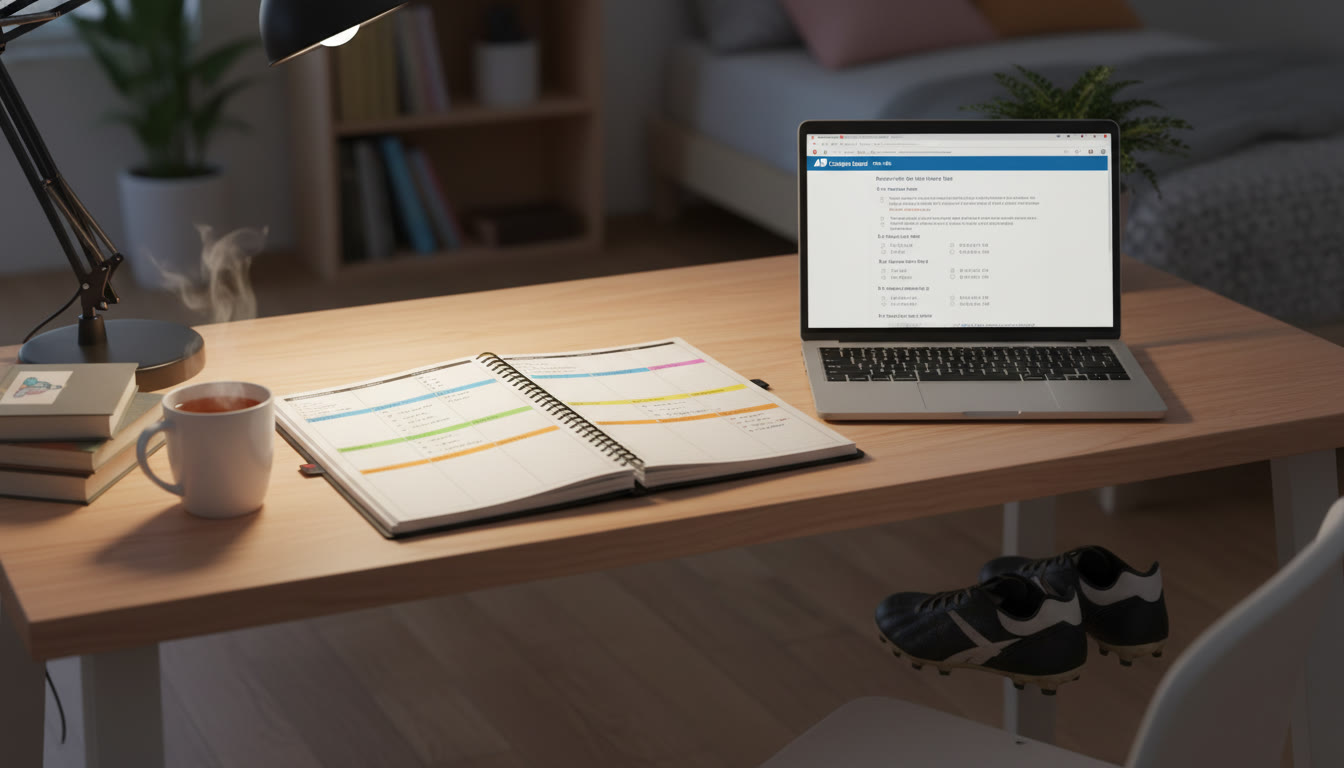
Notice the built-in transition time after sports and the compact, high-quality study block in the evening.
Measuring Progress: What to Track and How
Tracking doesn’t have to be obsessive. Pick three metrics and check them weekly:
- Practice test score (or percentile by section).
- Timed question accuracy (percentage correct on FRQs or MCQ subsets).
- Consistency (how many scheduled blocks you completed).
Use these metrics to tweak your blocks. If practice test scores plateau, change tactics: switch a repetition-heavy block to a tutor-led session or spend a block analyzing past mistakes rather than doing new problems.
Common Time-Blocking Pitfalls and How to Avoid Them
- Over-scheduling: Less is often more. Leave breathing room for recovery and creativity.
- Perfectionism: If a block doesn’t go perfectly, move on. The next block is where progress is made.
- Ignoring energy: Forcing yourself to grind when exhausted is inefficient. Learn your rhythms and honor them.
- Lack of review: New learning sticks only with review. Space repetition into your plan.
A Quick Checklist to Set Up Your Time-Blocking System Tonight
- Write down your AP goals and non-negotiables.
- Block immovable commitments (school, practices, meetings).
- Place 3–5 study blocks per AP per week (mix of practice and review).
- Reserve a weekly two-hour slot for a practice test or simulation.
- Schedule one short tutoring check-in with a Sparkl tutor or similar if you want targeted feedback.
- Plan one full rest day or half-days after big competitions.
Final Notes: Keep It Human
Time-blocking is not a straitjacket; it’s a compassionate structure that protects what matters. If your schedule helps you do your best on APs while still enjoying your clubs, sports, friends, and sleep, then it’s working. If it doesn’t, iterate. Small, steady improvements trump sporadic heroic efforts.
When you need tailored strategies — whether that’s identifying the 20% of content that’ll boost your score, practicing essays with feedback, or designing a study plan that fits around a hectic sports season — consider adding occasional 1-on-1 sessions with a tutor. Those sessions can be brief, strategic, and aligned exactly to the blocks you’ve already carved out from your week.
Go forward with curiosity
Time-blocking takes a few weeks to feel natural. Start small, celebrate the wins (even the tiny ones), and remember: APs are important, but they’re one part of a larger life that includes growth, teammates, and afternoons that are just for you. You’ve got this.
If you’d like, I can create a personalized two-week time-blocked plan based on your AP subjects, practice-test baseline, club schedule, and sport commitments — tell me your APs and weekly calendar and I’ll draft it.




























No Comments
Leave a comment Cancel