

Why Family Calendar Sync Matters for AP Students
AP season isn’t just about flashcards and review books. It’s about choreography — how school assignments, family commitments, weekend jobs, sports, and social life all move together without tripping over exam week. When a family calendar is properly synced, stress drops, confidence rises, and students find the mental bandwidth to study smarter rather than harder.
This guide is for students, parents, and guardians who want a practical, human approach to aligning AP prep with family life. It’s peppered with real-world examples, quick templates you can copy into any calendar app, and small rituals that create big payoff. We’ll also note where Sparkl’s personalized tutoring can fit naturally into a balanced plan — because the right support is a game-changer.

Start With Values, Not Timetables
Calendars feel technical, but syncing starts with a conversation. Before you create time blocks and notifications, ask three simple questions as a family:
- What are the non-negotiables? (e.g., religious services, family dinners, games, work shifts)
- Which AP goals matter most this term? (e.g., score goal for a particular AP, portfolio deadlines)
- How will we handle interruptions? (e.g., sudden family travel, illness, or a job interview)
Answering values first prevents the calendar from becoming a rigid prison. Instead, it becomes a living plan that respects priorities and preserves sanity.
Build a Practical Shared Calendar: Tools and Structure
Pick one primary calendar and two secondary helpers. The simplest tech stack usually wins because consistency beats complexity.
- Primary: A shared family calendar (Google Calendar, Apple Calendar, or any family-sharing app) for events, exam dates, and commitments.
- Secondary (student-specific): A personal study calendar in the same app for focused blocks, practice tests, and Pomodoro sessions.
- Reference: A physical wall calendar or planner in a common area for quick visual reference — useful for younger siblings or when tech fails.
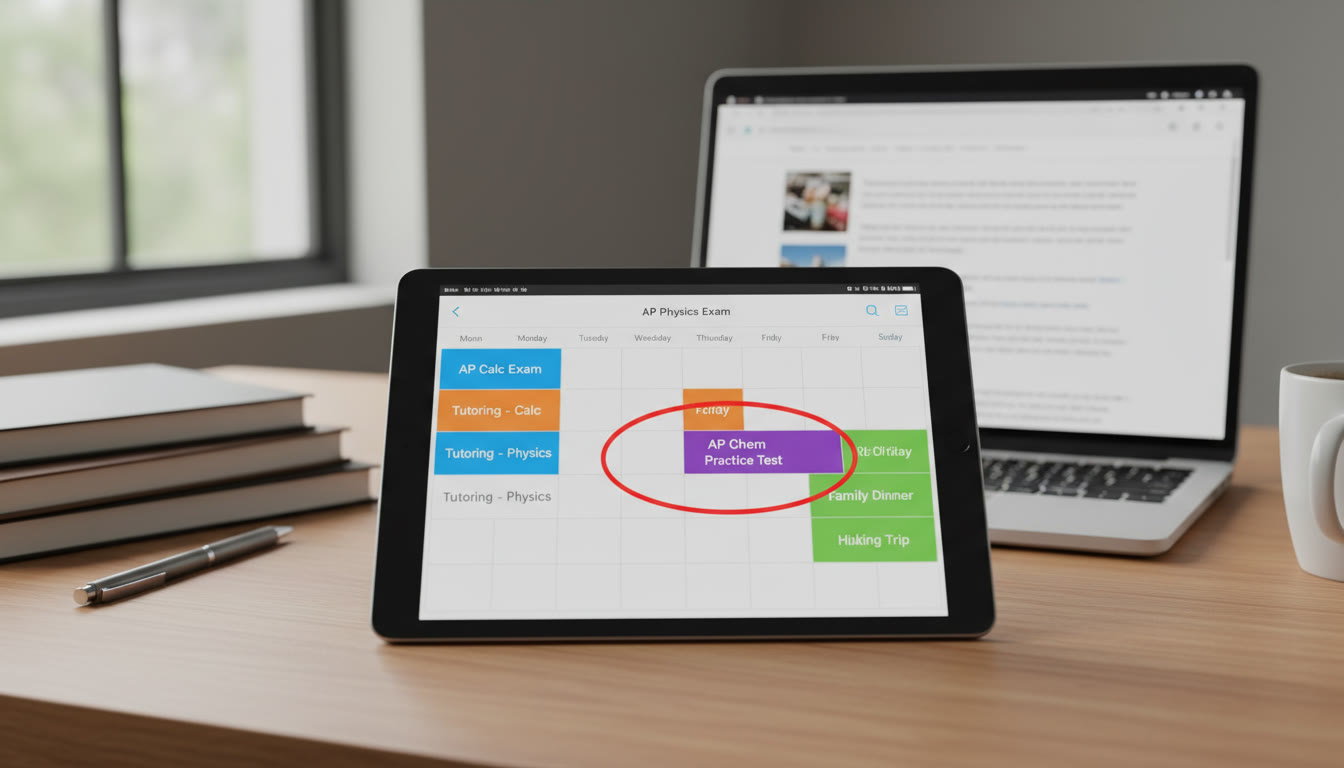
Structure your shared calendar with color-coded categories. For example:
- Red = AP Exam & Test Dates
- Blue = Family Events
- Green = Study Blocks / Tutoring
- Yellow = Jobs / Extracurriculars
Calendar Tags That Actually Help
Create event titles with an agreed format so nothing gets lost at a glance. Use: [Who] – [What] – [Where] – [Time]. For AP exams and practice tests, add the subject and priority level. Example:
- AP Student – Calculus Practice Test – Home – 9:00am
- Family – Grandma’s Visit – House – All Day
- Student – AP Physics Tutoring (Sparkl) – Zoom – 7:00pm
Designing Study Blocks Around Real Life
Effective study blocks are short, intentional, and scheduled with the body and family rhythms in mind. Most teens do best with 25–60 minute focused sessions separated by breaks. But those sessions must co-exist with soccer practice, part-time work, and family dinner.
Weekly Template: Example for a Busy AP Student
Below is a sample weekly calendar that balances AP study with life commitments. It’s flexible: move the blocks earlier if your student is a morning person, or later for night owls. The key is predictability and buffer time around big events.
| Day | Morning | Afternoon | Evening |
|---|---|---|---|
| Monday | Review AP notes (30 min) | Class / Extracurricular | AP Chemistry Practice (45 min) + Family Dinner |
| Tuesday | Flashcard Warmup (15 min) | Lab / Work Shift | AP Tutoring (Sparkl 1-on-1 session) + Chill |
| Wednesday | Practice Problems (40 min) | Study Group | Sports Practice / Light Review |
| Thursday | Mini Mock Quiz (30 min) | Class / Family Errands | Project Work / Portfolio Upload Check |
| Friday | Concept Review (30 min) | Work / Social Time | Rest or Light Study |
| Saturday | Timed Practice Exam (Morning) | Family Time / Chores | Catch-up Study or Free |
| Sunday | Weekly Planning (30 min) + Buffer | Major Assignment Work | Reset & Early Night |
How to Schedule Around High-Stress Periods
Two weeks before a major AP exam should be treated like a mini-season: lower the volume of new commitments and increase calm, high-yield review sessions. That doesn’t mean cancel life, but it does mean being deliberate about where energy goes. Identify three high-impact activities for each subject and schedule them (e.g., practice exams, targeted topic reviews, and problem sets with solutions).
Communicating Calendar Changes Without the Drama
Disruptions happen. The trick is to treat calendar changes as team logistics rather than crises. Use these family rules:
- Alert early: Any change that affects study blocks or exam availability should be shared at least 72 hours in advance if possible.
- Offer alternatives: If a rehearsal overlaps with a practice test, propose a swap or alternate quiet space.
- Daily check-in: A five-minute evening check-in prevents surprises and keeps everyone aligned.
Example Scripts for Tough Conversations
When a parent needs to book travel during exam week, or a teen needs to shift work hours, here are calm, practical phrases:
- “I know your AP Physics exam is on May 14. Can we plan travel for the week after so we won’t add stress?”
- “I’m scheduled to work Saturday morning, can we swap my shift so I can take the Saturday practice test?”
- “If we can’t move the game, can you take the 9:00 am practice and I’ll handle dinner tonight?”
Using Data to Make Smarter Calendar Choices
Not everything on the calendar is equally important. Use a simple priority matrix to decide what stays, what shifts, and what goes. Ask: Is this time block high-impact for the AP goal, family relationship, or required obligation?
Sample Priority Matrix
| Priority | Example Items | Action |
|---|---|---|
| High | AP Exam, Final Portfolio Deadline, College Visit | Protect these times. Shift other activities around them. |
| Medium | Weekly Tutoring, Team Practice | Coordinate logistics; create buffer time before/after. |
| Low | Social Events, Optional Workshops | Reschedule if they conflict with high priorities. |
Mixing Tutoring and Family Support Effectively
Tutoring is most effective when it is predictable and integrated into the calendar. If your student uses personalized tutoring like Sparkl’s 1-on-1 sessions, schedule them as regular weekly green blocks. That way parents know when to avoid scheduling appointments, and students treat tutoring like an essential appointment instead of an optional add-on.
Sparkl’s tailored study plans, expert tutors, and AI-driven insights shine when they complement a family rhythm. For instance, if a tutor identifies a persistent weak topic, families can reserve an extra practice block on the shared calendar for focused work and reduce extracurricular pressure for that week.
Best Practices for Scheduling Tutoring
- Set a consistent weekly time so sessions become part of the routine.
- Keep a short buffer (15–30 minutes) before and after for travel, quick review, or decompression.
- Use tutors’ feedback to adjust the calendar: if a subject needs more time, redistribute low-priority activities temporarily.
Exam Week Playbook: Calm, Clear, and Connected
Two weeks out, your family calendar should move from general planning to fine-tuned operations. Reduce variable commitments and increase predictability. Keep evenings quiet the night before exams and verify logistics: how to get to the testing center, what materials are allowed, and any accommodations needed.
Exam Week Checklist
- Confirm test start times and locations (double-check time zone and travel time).
- Pack the night before: approved calculator, photo ID, water, and a light snack.
- Plan nutrition and sleep: regular meals, avoidance of heavy late-night screens, and wind-down rituals.
- Assign household responsibilities so the student can focus (e.g., parents handle dinner shifts).
- Keep communications calm: no last-minute content cramming; focus on confidence-building conversation.
Templates You Can Drop Into Any Calendar
Copy these event templates into your shared calendar. The goal is clarity and minimal friction.
- Event Title: “AP Bio – Practice Exam (Timed) – Student Name” — Color: Green — Reminder: 24 hours + 1 hour.
- Event Title: “Family Quiet Night – Exam Prep Support” — Color: Blue — All day — Note: No loud activities after 8pm.
- Event Title: “Sparkl Tutoring – AP Calculus (1-on-1)” — Color: Green — Zoom link in description — Reminder: 1 hour.
Make It Visual
Use repeating events for weekly study routines and single events for high-stakes items. Visual cues reduce decision fatigue: dots for practice tests, stars for exam days, and small emoji if your calendar supports them to signal mood or energy level.
When Things Go Wrong: Recovery Strategies
Missed a practice test? Unexpected move? Illness? Treat the calendar as adaptive, not punitive. Here’s a three-step recovery approach:
- Assess: How much did you lose? One missed 50-minute session is recoverable; a missed mock exam close to test day is more serious.
- Prioritize: Move high-impact activities into the next 72 hours (targeted review, practice exams).
- Communicate: Let tutors, teachers, and family members know so everyone can help redistribute support.
Sparkl’s tutors and AI-driven insights can accelerate recovery by pinpointing missed concepts and recommending condensed practice plans — useful when time is short and stakes are high.
Keeping Balance: Mental Health and Sustainable Habits
Calendars are not only for scheduling study; they should protect wellbeing. Schedule daily micro-breaks, weekly social time, and at least one full day of rest each week when possible. This may feel counterintuitive, but rest improves retention and mood, and prevents burnout.
Small Rituals, Big Returns
- Morning check-in: 5 minutes to prioritize three study goals for the day.
- Post-study transition: 10 minutes of light movement or journaling to mark the end of intense focus.
- Family signal: a short phrase or gesture that means “I need quiet focus” so boundaries are respected without awkward conversations.
Measuring Success Beyond the Score
Aligning AP and life isn’t solely about hitting a numeric score. Success includes developing time-management muscle, reducing friction in the home, and preserving relationships while achieving academic goals. Use both qualitative and quantitative metrics:
- Quantitative: Number of completed practice exams, consistent sleep hours, percent of planned study blocks completed.
- Qualitative: Family calm, student confidence, and fewer last-minute schedule crises.
Final Notes: Calendar as a Family Superpower
A thoughtfully synced family calendar is more than a list of appointments. It’s a shared commitment to priorities, a buffer against surprise stressors, and a tool that allows students to pursue AP excellence while living a full life. Start small — one shared calendar, one weekly planning meeting, and one predictable tutoring session — and build from there.
When families pair those habits with targeted supports like Sparkl’s personalized tutoring, which offers tailored study plans, expert tutors, and AI-driven insights, students can focus their effort where it matters most without sacrificing family time. That combination — predictable routines plus smart help — is often the difference between burnout and breakthrough.
Ready-Made Action Steps (Start Today)
- Create a shared family calendar and invite all household members.
- Schedule a weekly 15-minute planning meeting each Sunday evening.
- Block one predictable weekly tutoring slot (consider a service like Sparkl for consistent 1-on-1 guidance).
- Protect two hours per week for full-length, timed practice tests three weeks out from any AP exam.
- Establish an “exam week quiet” policy for the family — simple routines that help the student rest and focus.
Parting Thought
AP prep doesn’t have to be an isolated sprint. When families sync calendars intentionally, students gain more than time — they gain steady momentum, emotional support, and the freedom to be both a student and a person. Make the calendar an ally, not an adversary. With thoughtful planning, shared responsibility, and the right tutoring support, AP season can become a season of growth rather than just pressure.
Take one small step this week: add your student’s next practice test to a shared calendar and mark it with a color that means “protected.” That tiny act can shift the tone of the whole season.


























No Comments
Leave a comment Cancel