
Why This Calendar Matters: The Collision Problem, Plain and Simple
If you’re juggling ICSE/ISC timelines and Advanced Placement (AP) exams, you already know there’s a delicate choreography to get right. Both systems offer enormous academic opportunity — board credibility on one hand and college-level credit on the other — but their calendars don’t always play nicely together. A late spring surge of AP exams plus end-of-year board practicals, project submissions, and final theory papers can create a stressful overlap unless you plan intentionally.
This guide is for students and parents who want a calm, practical, and realistic way to avoid collisions. Think of it as a friendly road map: we’ll compare the calendars, show where common conflicts arise, share actionable planning strategies, provide sample schedules, and offer study tactics to keep energy and confidence high. Along the way you’ll see how tailored support — such as Sparkl’s personalized tutoring, 1-on-1 guidance, and AI-informed study plans — can plug gaps and keep the whole plan running smoothly.
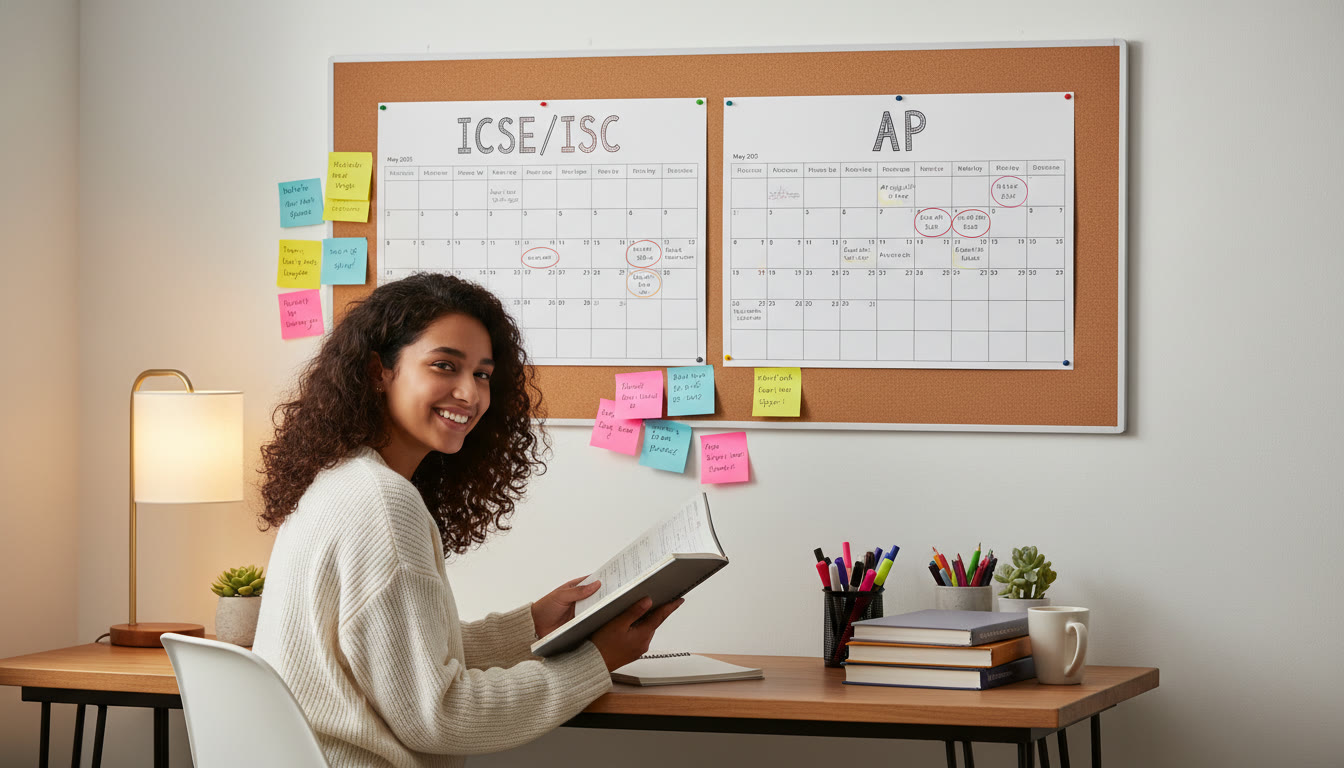
Big Picture: When Do These Exams Happen?
Before you plan, you need accurate anchors. AP exams are administered nationally (and internationally) in early-to-mid May — typically across two consecutive weeks — with specific subjects assigned to particular days and times. ICSE and ISC board exams generally occur in March–April for theory papers, with variations by year and occasional changes imposed by local education authorities. Practical and project deadlines for ICSE/ISC may occur earlier or around the same period, depending on the subject.
Because AP exams are fixed into those May weeks, the most common collision happens when board practicals, project submissions, or last-minute revision camps fall in late April through mid-May. That clustering squeezes students who are trying to prepare for high-stakes board exams and AP tests simultaneously.
Typical Timeline Summary
- AP Exams: Early to mid-May, scheduled across two weeks, with morning and afternoon start windows.
- ICSE/ISC Theory Exams: Often March–April, but some boards or subjects may extend activities into late April or early May.
- Practical Exams & Project Deadlines: Variable; frequently scheduled in April or early May.
- AP Digital Portfolio Submissions (for AP Art and AP Seminar/Research, CSP, etc.): Deadlines are often late April to early May.
Where Collisions Happen — The Usual Suspects
Understanding the typical hotspots helps you prioritize in advance. Here are the most frequent trouble zones:
- Late April project or portfolio due dates overlapping AP digital-submission deadlines.
- Board practical exams scheduled during the second week of AP testing.
- Revision camps and mock exams in late April that drain study time meant for AP test formats.
- Travel or logistics for board exams that cause students to miss AP sessions or feel exhausted on exam day.
How to Build a Collision-Free Annual Calendar
Start with the data you can verify: official AP exam schedule for the coming year and your school or board-issued ICSE/ISC schedule. Once you have those anchors, use this step-by-step approach to build a robust, flexible plan.
Step 1 — Gather Official Dates and Deadlines
- Note the two AP exam weeks and specific exam days for subjects you’re taking.
- Collect ICSE/ISC exam timetables including theory, practicals, and internal assessment submission dates.
- Mark any grade-level meetings, college deadlines, or extracurricular commitments that can’t shift.
Step 2 — Create a Master Calendar with Clear Color Coding
Use a large wall calendar or a digital calendar app. Color code: AP (blue), ICSE/ISC (green), Deadlines/Portfolios (red), Tutoring Sessions (purple), and Buffer Days (orange).
Step 3 — Identify Conflicts and Apply the Priority Test
For each conflict, ask five quick questions: Which exam has a fixed date? Which is irreversible? Which covers material that is cumulative and harder to cram? This helps you decide when to request accommodations — for instance, shifting a board practical earlier in coordination with school authorities or planning late-testing for AP (if eligible and offered by your school).
Step 4 — Build a Weekly Rhythm with Micro-Blocks
Block study time into micro-sessions: 50–90 minute deep-focus blocks for subject mastery and 20–30 minute review blocks for active recall. Reserve the last 10 days before each major exam block for targeted review and sleep-first routines.
Sample Annual Comparison Table
| Month | AP Timeline | ICSE/ISC Timeline | Action Items |
|---|---|---|---|
| January–February | Coursework and AP Classroom practice; register for AP if required | Final internal assessments; mock practical scheduling | Finalize AP subject list; request time-off or early scheduling for practicals if possible |
| March | Regular in-class AP instruction; begin focused topic reviews | Theory exams often begin; intensive board revision | Protect high-energy mornings for your most demanding exam prep |
| April | AP digital portfolio deadlines (some AP courses); final AP topic review | Practical exams and project submission windows; final board prep | Create a blended revision timetable; allocate buffer days around fixed deadlines |
| May (Weeks 1–2) | AP Exams — two-week administration window | Some board follow-ups or delayed practicals may occur | Confirm logistics with AP coordinator; plan rest and light review days |
| June–July | AP Score actions and college applications | Results and administrative tasks | Review outcomes, request scorings, and update college lists |
Practical Strategies to Avoid Collisions
A plan is only as good as its execution. Here are practical strategies families have found helpful.
1. Communicate Early and Often
- Talk to your ICSE/ISC school coordinator and AP coordinator before the semester begins about potential overlaps.
- Ask whether practicals or submission dates are flexible — many schools can rearrange within a limited window if they know ahead of time.
2. Request Official Adjustments When Necessary
When dates collide, official requests to shift practicals or to be scheduled for late AP testing (where available) can solve the puzzle. Your school’s AP coordinator and board exam authorities often have formal processes for this — start early.
3. Use Buffer Zones
Create intentional buffer days around every fixed deadline. If an AP exam is on May 11, avoid scheduling a major ICSE practical on May 9–12. Those buffers protect against illness, travel delays, and emotional fatigue.
4. Prioritize Sleep and Recovery
It’s tempting to stack study with all-nighters — don’t. Research and experience show that consistent sleep improves recall, attention, and exam performance. In high-stress windows, protect at least 7–8 hours nightly and use short naps strategically.
5. Embrace Cross-Training Study
When two subjects fight for the same time slot, look for overlap in study skills. Essay writing for English AP can boost English board paper scores; data interpretation skills are useful for both AP Statistics and board science practicals. Plan sessions that give double value.
Weekly Micro-Schedule Examples
Here are two micro-schedules — one for a student with heavy board focus, another for an AP-intensive student — that illustrate how to blend priorities.
Micro-Schedule A — Board-Heavy Week (6-day study rhythm)
- 6:30–7:30 AM: Light review (flashcards, quick formulas)
- 8:00–12:00 PM: School / Board exam blocks or classes
- 2:00–4:00 PM: Board practical/project work
- 5:30–7:00 PM: AP focused deep study (alternate days for each AP subject)
- 8:00–9:00 PM: Review and planning; wind-down routine
Micro-Schedule B — AP-Intensive Week (balanced with board prep)
- 7:00–8:30 AM: AP problem set / timed section practice
- 9:00–12:00 PM: School / ICSE/ISC study blocks
- 2:00–3:30 PM: AP Classroom assignments or mock exam sections
- 4:00–6:00 PM: Board revision / practical rehearsal on alternate days
- 8:30–9:30 PM: Reflection and light review
Exam Week Playbook: What To Do 14, 7, and 1 Day Out
Use these checkpoints as mini-milestones so nothing sneaks up on you.
14 Days Out
- Create a prioritized topic list for every exam you’ll take in the next 30 days.
- Schedule daily focused review blocks and two mock test sessions for AP timing practice.
7 Days Out
- Begin tapering new content. Switch to consolidation, problem sets, and practice under timed conditions.
- Confirm logistics: exam locations, ID, transport, and any accommodations for conflicting schedules.
1 Day Out
- Light, confidence-building review only; no cramming.
- Prepare exam kit (admit cards, pens, calculators if allowed) and plan a healthy sleep and nutrition routine.
When to Ask for Help — and What to Ask For
Asking for help is strategic, not a sign of weakness. Here are the moments when outside support pays off most:
- If you find a timetable overlap you cannot resolve locally, ask your school coordinators about official procedures for rescheduling practicals or accessing late AP testing.
- If content gaps make juggling two curricula impossible, consider short-term expert help: targeted 1-on-1 tutoring for weak topics, portfolio coaching for AP art or research, or time-management coaching to overhaul your calendar.
Personalized tutoring — for example, Sparkl’s 1-on-1 guidance and tailored study plans — can be extremely helpful here. A short, focused tutoring sprint to shore up a weak topic or to get an AP rubric walkthrough can transform a week of frantic work into a calm, productive stretch.
Sample Two-Month Ramp for a Student Taking AP and ICSE/ISC Practical
Below is an example of how a student might ramp intensity in the eight weeks before exams. Tailor the sequence to your personal weak points and schedule constraints.
- Weeks 8–6: Build core coverage for both syllabi. Identify three priority topics per course.
- Weeks 5–4: Increase timed practice for AP sections and practical rehearsal for boards; complete digital portfolio drafts if required.
- Weeks 3–2: Full mocks—one AP-format mock each week and a board practical rehearsal under exam conditions.
- Week 1: Taper content intake; focus on light review, formula sheets, and sleep hygiene.
Tools and Techniques That Actually Help
The right techniques beat hours spent. Use evidence-based methods: active recall, spaced repetition, interleaved practice, and practice tests under timed conditions. Couple those with logistical tools: a master calendar, a shared family planner, and a recovery plan for when things slip.
Active Recall and Spaced Review
Prioritize flashcards, closed-book problem solving, and teaching concepts to a peer or parent. Schedule review sessions with increasing intervals to lock information into long-term memory.
Simulate Exam Conditions
Timings, breaks, allowed calculator policies — practice under the exact conditions you’ll face. This reduces anxiety and improves pacing on exam day.
How Parents Can Help Without Steering the Ship
Parents play a critical support role. Your job is to provide structure and emotional steadiness, not to micromanage content. Here are a few high-impact ways to help:
- Help create and maintain the master calendar.
- Coordinate with school officials when official schedule shifts are needed.
- Ensure healthy meals, transportation, and quiet study spaces during exam windows.
- Encourage consistent sleep and reward realistic milestones (completed mocks, portfolios submitted).
When Personalized Tutoring Makes Sense
Personalized tutoring is not only for students who are behind. It’s also an efficient way to optimize performance in a compressed timeline. For collision situations, tutors can:
- Help triage priority topics so you study the right material at the right time.
- Provide focused strategy sessions for AP exam formats (timed essays, multiple-choice strategies) and board practical execution.
- Deliver flexible, just-in-time support: a two-week sprint ahead of portfolio deadlines, or sessions scheduled around your master calendar.
Services such as Sparkl offer personalized tutoring with AI-driven insights and tailored study plans that can fill specific gaps quickly and efficiently while tracking progress, making them ideal when time and stakes are both high.
Common Myths and Realities
- Myth: You can perfectly cram both curricula simultaneously. Reality: Certain subjects require spaced practice; a cram strategy often backfires on retention.
- Myth: Asking for schedule adjustments is impossible. Reality: Early, formal requests frequently succeed — schools want students to perform their best.
- Myth: Tutoring is only for struggling students. Reality: High-performers use targeted tutoring to refine strategy and save time.
Final Checklist: Two Months Before Exam Weeks
- Confirm official AP exam dates and ICSE/ISC dates and mark them on the master calendar.
- Identify any conflicts and communicate them to coordinators now.
- Book any required tutoring or portfolio coaching sessions and schedule them around buffer days.
- Create a daily micro-schedule and do one full mock in simulated conditions each week.
- Plan sleep, nutrition, and light exercise to maintain energy and resilience.
Parting Thoughts: Calm, Prepared, and Confident
Collisions between ICSE/ISC and AP calendars are solvable with information, communication, and a dose of flexibility. The key ingredients are early planning, consistent rhythms, and smart, targeted help when you need it. Whether that help comes from teachers, school coordinators, or personalized tutoring, the goal is the same: preserve your wellbeing while making the most of both academic tracks.
Remember: this is a marathon, not a sprint. Build your calendar so it supports steady progress, gives you room to breathe, and protects your most powerful asset — clear thinking. And if you find your schedule tightening, a short, focused run with an expert tutor or a tailored plan from a service like Sparkl can turn last-minute chaos into calm confidence.

Quick Resources to Start With (Your Local Actions)
- Request the official AP subject schedule from your AP coordinator and write down the exact days for the AP tests you’re taking.
- Obtain the ICSE/ISC practical and theory calendar from your school and flag immovable items.
- Map both calendars side-by-side and color code immediately.
- Contact your school’s AP coordinator or board exam coordinator within two weeks of identifying a conflict to ask about solutions.
Need a Hand Getting Started?
If you’d like, take this guide and create a personalized master calendar this weekend. If you prefer one-on-one help to triage conflicts, prioritize topics, and set a two-month sprint plan, consider scheduling targeted tutoring sessions. Short, focused interventions — especially those that combine expert tutoring with adaptive study plans — can be the difference between frazzled and focused.
Good planning, calm habits, and the right help will get you across the finish line with confidence. You’ve got this.




















No Comments
Leave a comment Cancel