
Why AP and MCAT Timing Matters (And Why You Should Care Now)
Planning when to take Advanced Placement (AP) exams and the Medical College Admission Test (MCAT) isn’t just about picking dates on a calendar. It’s a strategic decision that affects course choices, college applications, freshman-year credit, and—if you’re aiming for medical school—how you sequence prerequisite learning and application cycles. Students and parents who treat these tests as part of a thoughtful roadmap (not last-minute checkboxes) sleep better, get stronger results, and make choices that open more doors.

Big-picture tradeoffs to keep in mind
- Depth vs. timing: Taking an AP course early can boost your transcript, but taking it too early might leave gaps in depth when you take the MCAT years later.
- College credit vs. MCAT readiness: Earning AP credit in high school can let you skip introductory college classes—freeing time for research, clinical experience, or advanced science classes that strengthen MCAT preparation.
- Application cycles: When you take the MCAT determines which medical school application cycle you can realistically enter.
- Stress and sustainability: Jamming AP exams and MCAT prep into the same short window often undermines both. Staggering intense study periods reduces burnout.
Understand the typical timelines: AP in high school, MCAT after coursework
AP exams are scheduled by the College Board and administered in May each year. Most students take AP classes during junior and senior years, sometimes earlier. The MCAT, however, is typically taken after you’ve completed most of your undergraduate prerequisites—often after sophomore year through the first half of your senior year of college, depending on your pace and application goals.
How AP exams fit into a long-term pre-med plan
Many students take AP Biology, AP Chemistry, AP Physics, or AP Calculus in high school. Strong AP scores can allow you to place out of certain college introductory courses, which can be a major advantage—if used wisely. Instead of repeating intro classes, you can enroll in higher-level courses (like biochemistry, genetics, or organic chemistry), research, or medically relevant electives that strengthen your MCAT foundation.
Sample timelines: Scenarios and what they mean
Below are three realistic student scenarios with recommended AP and MCAT timing. Use these as templates—adjust based on your school policies, course availability, personal strengths, and college plans.
| Scenario | High School AP Strategy | Undergraduate Path | MCAT Timing | Pros |
|---|---|---|---|---|
| Early AP Focus (Strong HS Record) | Take AP Bio, Chem, Calc in Junior year; AP Stats/AP Physics as Senior | Place out of intro classes; take upper-level bio/chem in freshman/sophomore year | MCAT in spring or summer after sophomore year or fall of junior year | More time for research/clinical experience; earlier application option |
| Balanced Pace (Most Common) | AP Bio/Chem split across junior and senior years; AP Calc if strong | Take intro college science freshman year; upper-level courses sophomore/junior | MCAT in spring/summer of junior year | Mature content knowledge; solid time for MCAT prep while maintaining GPA |
| Conservative Route (Late MCAT) | Focus AP on humanities and math; take fewer science APs | Complete prerequisites later (sophomore/junior); take gap-year MCAT | MCAT during gap year or senior year (after finishing prerequisites) | Less rush, more time for MCAT mastery and extracurricular depth |
How to pick which scenario fits you
- Assess your high school course load and AP success. Did you get strong scores (4–5)? That suggests you can safely place out and move into higher-level college courses sooner.
- Talk to your college’s advising office early. Different schools have different policies for AP credit and placement.
- Consider your extracurricular timeline: research, shadowing, and leadership experiences often take months to develop; plan AP and MCAT timing to leave room for them.
Concrete semester-by-semester plan (example for a student aiming to apply after junior year)
This example assumes the student starts college in Fall Year 1 and wants to take the MCAT in May/June of Year 3 to apply that cycle. It includes how AP credit can shift class choices.
| Semester | Academic Focus | Action Items |
|---|---|---|
| Fall, Year 1 | Intro Bio/Chem (or place out if AP accepted) | Enroll in labs; begin volunteering/club involvement |
| Spring, Year 1 | Intro Physics/Math; continue labs | Seek research assistant opportunities; build clinical exposure |
| Fall, Year 2 | Organic Chemistry or higher-level bio | Start MCAT content review (light), continue research |
| Spring, Year 2 | Biochemistry; upper-level biology | Plan full MCAT study period for Year 3; practice exams |
| Fall, Year 3 | Advanced electives; finalize extracurriculars | Begin intensive MCAT prep 3–4 months before test date |
| Spring, Year 3 | Finish academic term; MCAT test (May/June) | Submit primary application summer; letters of recommendation ready |
Practical planning tips to optimize both AP and MCAT outcomes
1. Use AP credit strategically
Not all AP credit is equal. Some schools award credit, some use AP scores for placement only, and some accept neither. Before deciding to skip introductory courses, check two things: (1) your target college’s AP policy, and (2) whether skipping an intro course will remove access to a structured lab or recitation that strengthens conceptual skills needed for the MCAT. Sometimes repeating an intro course in college, even after earning AP credit, gives you a stronger foundation for advanced courses.
2. Space out heavy test periods
Avoid taking multiple high-stakes exams in overlapping time windows. AP exams cluster in May; the MCAT can be year-round but many students prefer spring/summer. Try not to schedule a full MCAT study blitz immediately after an AP-laden senior spring—fatigue accumulates.
3. Align coursework to MCAT competencies
The MCAT tests critical thinking and scientific reasoning across biology, chemistry, physics, psychology, and social sciences. If AP scores free up schedule space, prioritize college courses like biochemistry, physiology, or statistics that directly strengthen MCAT readiness.
4. Build diversified study strategies
- AP prep is content-heavy and often benefits from targeted review and timed practice exams.
- MCAT prep requires sustained conceptual integration, passage-based reasoning, and stamina—practice with full-length tests is essential.
- Blend content review with application: use AP class notes for MCAT foundations, then layer on MCAT-style passages and critical analysis.
Study time estimates and how to budget your calendar
Everyone’s learning speed is different, but here are general estimates you can adapt. These assume a student balancing coursework and extracurriculars.
| Goal | Estimated Prep Time | Recommended Timeline |
|---|---|---|
| AP Exam (single subject) | 30–80 hours (depending on background) | Start 8–12 weeks before exam for targeted review; longer for weaker foundations |
| MCAT (full prep) | 300–700 hours (most students report 3–6 months of focused prep) | 3–6 months of consistent study, 6–12 months if balancing heavy course loads |
| Integrative prep (AP + future MCAT preparation) | Staggered: AP review now; spaced MCAT content refresh later | Use AP spring for focused exam prep; plan MCAT content mastery in later semesters |
Putting these numbers into practice
If you’re in a senior year with two AP exams in May and expect to start MCAT study the next semester, give yourself a buffer of at least 6–8 weeks between the end of AP testing and the start of your full MCAT prep. That allows rest, targeted review of weak foundational topics, and a structured start to MCAT study without immediate burnout.
Study routines, weekly plans, and real-world habits that work
Consistency beats cramming. Successful students build modular study habits that translate across AP and MCAT work: short daily content review, weekly practice questions, and periodic full-length exams. Here’s a weekly model you can adapt.
- Daily (30–90 minutes): Active recall and flashcards for core facts; 10–20 MCAT-style passages if in MCAT phase.
- Weekly (3–6 hours): Focused content block on a single subject; once per week practice set with review.
- Monthly: Take a timed practice exam (AP timed sections or MCAT full-length) and analyze mistakes in a dedicated review notebook.
- Health habit: Sleep, nutrition, and movement matter. Schedule breaks, walkouts, and realistic sleep times—cognitive performance depends on rest.
How parents can support—without adding pressure
Parents play a crucial role as planners, emotional anchors, and resource-finders. Here’s how to help constructively:
- Encourage planning conversations early—help map out a multi-year academic plan, not just a single test.
- Provide logistical support: calendars, quiet study spaces, and budget planning for test fees and prep programs.
- Ask probing questions that focus on goals and values: Are you taking APs for challenge, college credit, or both?
- Offer emotional support and perspective—remind students that timing is flexible and there are multiple successful paths.
When personalized help makes the difference
Many students benefit from tailored guidance—especially when balancing multiple APs and long-range MCAT planning. Personalized tutoring can help with targeted content gaps, pacing, and test-taking strategies. For example, Sparkl’s personalized tutoring offers 1-on-1 guidance, tailored study plans, expert tutors, and AI-driven insights that identify weaknesses and streamline study time. A coach who understands both AP nuances and MCAT competencies can help sequence courses to maximize both college credit and MCAT preparation.
How to pick the right tutoring approach
- Look for tutors who have recent and relevant experience: former pre-med students, instructors who’ve guided students through MCAT timelines, or AP teachers who understand placement issues.
- Choose a program that personalizes study plans. Cookie-cutter schedules rarely account for course loads and extracurricular demands.
- Check for measurable goals and progress tracking—weekly milestones, practice exam score improvements, and adaptive lesson plans.
Common mistakes students make—and how to avoid them
- Assuming AP credit is always beneficial: Verify the college policy; sometimes taking the college course provides a stronger foundation for the MCAT.
- Underestimating MCAT time: The MCAT rewards depth and endurance. Most students need months, not weeks, of serious prep.
- Stacking tests: Trying to study for multiple APs and the MCAT simultaneously usually dilutes returns. Stagger your peak study periods.
- Ignoring practice exams: Timed practice and review are the fastest way to improve test performance, both for APs and the MCAT.
Real student vignette: How planning changed an application
Consider Maya, who took AP Biology and AP Chemistry in high school and scored 5s. She used those credits to place out of intro classes and in her freshman year enrolled in biochemistry and genetics. Because she had this space, she started research in a faculty lab during sophomore year. By the time she began MCAT prep in spring of her junior year, Maya was comfortable with advanced concepts, had strong letters of recommendation from research mentors, and scored competitively on the MCAT. Her deliberate use of AP credit created space for higher-level experiences that strengthened her medical school application.
Mapping your next 12–24 months: a checklist
Use this checklist to convert strategy into action. Ticking off these items will keep you ahead of deadlines and reduce testing stress.
- Check the AP exam schedule for the upcoming year and mark dates on your family calendar.
- Confirm your school’s AP credit and placement policy before assuming you’ll receive college credit.
- Map undergraduate prerequisite timing for the MCAT and identify an ideal test month (spring/summer often preferred).
- Allocate 3–6 months of focused MCAT study time and plan a buffer after any AP-heavy semesters.
- Arrange letters of recommendation early for medical school—professors and research supervisors like advance notice.
- Assess whether personalized tutoring or a structured prep program fits your needs and schedule; consider trial sessions.
Final thoughts: Plan flexibly, aim strategically
The ideal AP and MCAT timeline depends on who you are as a learner, what colleges you’re targeting, and how you want to balance academics with meaningful experiences. There’s no one-size-fits-all schedule. The most successful students plan with intention—using APs to build foundations and leverage college credit when it truly accelerates their learning—and then schedule the MCAT when knowledge, confidence, and life logistics align.
If you’re feeling uncertain about sequencing or want a plan tailored to your courses and goals, consider a short consultation with a tutor who understands both sides of the equation. Personalized programs like Sparkl’s tutoring platform emphasize 1-on-1 guidance, tailored study plans, and data-driven insights—helping students convert the calendar into clear, achievable milestones without unnecessary stress.
One last practical tip
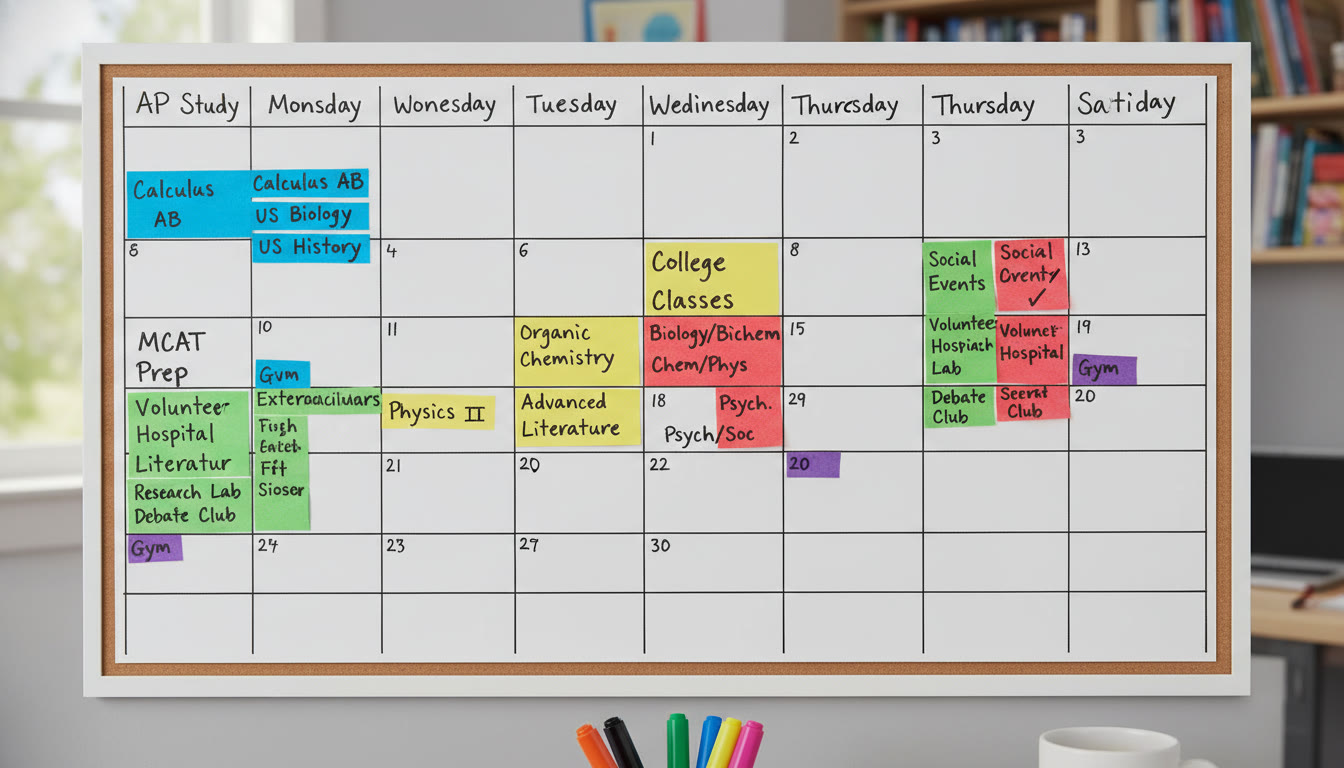
Write your target dates—AP exam weeks and your ideal MCAT month—on a big wall calendar. Backward plan from those dates in weekly chunks: content blocks, practice tests, and rest weeks. Seeing the plan reduces anxiety and makes each study session feel purposeful.
Resources to keep on your radar (what to check each year)
- Annual AP exam schedule and any changes to the College Board’s digital testing policies.
- Your prospective colleges’ AP credit policies, which may change year to year.
- Medical school application timelines (AMCAS and others) and typical MCAT windows for competitive cycles.
- Practice-test release dates and any updates to MCAT content emphasis from the testing authority.
Planning well gives you options. It lets you choose depth over haste, experiences over box-checking, and confidence over panic. With a thoughtful timeline, realistic practice, and occasional personalized support—like 1-on-1 tutoring and adaptive study plans—you can make AP exams and the MCAT powerful stepping stones toward top colleges and medical school. Breathe, plan, and act: you’ve got this.



























No Comments
Leave a comment Cancel