
Why Citations Matter (Even When You’re in a Hurry)
Imagine you’ve written an elegant paragraph for your AP Research or AP English paper: insightful, well-structured, and persuasive. Now imagine a red pen across the page and a note: “Cite your sources.” Ugh. Citations can feel like the homework tax on good ideas, but they’re actually the backbone of academic credibility. They show you’ve engaged with conversation in your field, give credit where credit’s due, and protect you from accidental plagiarism — which matters on AP exams and in college admissions reading.
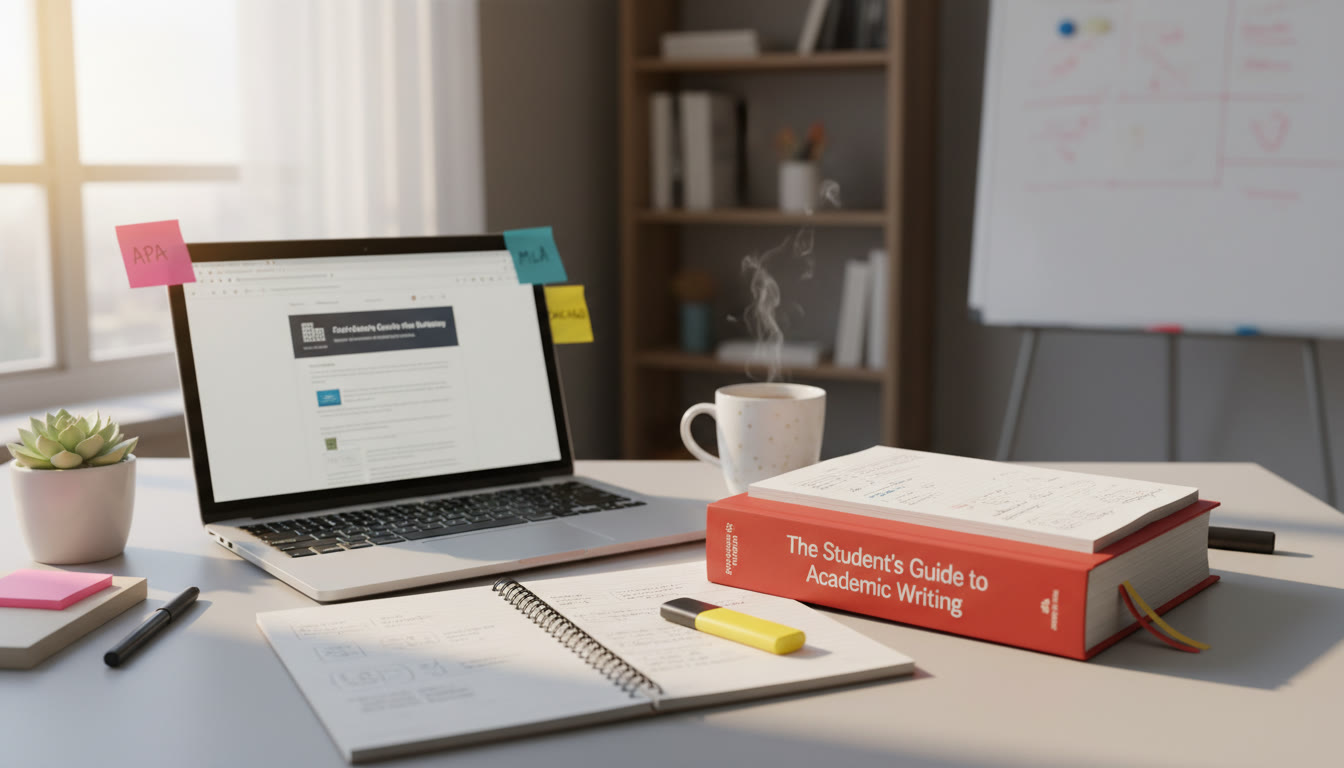
Quick Overview: When to Use APA, MLA, or Chicago
Different classes and exam prompts prefer different styles. Here’s a fast cheat to decide:
- APA (American Psychological Association) — commonly used in social sciences (psychology, sociology, some education research). Focuses on author-date citations in-text.
- MLA (Modern Language Association) — typical for literature, language, and some humanities. Uses author-page in-text citations and emphasizes the text’s location within a source.
- Chicago (Notes and Bibliography or Author-Date) — flexible: humanities often use notes/bibliography (footnotes or endnotes), while sciences sometimes prefer author-date similar to APA.
For AP classes: AP English and AP Literature typically expect MLA-style familiarity; AP Research and many AP History projects can accept Chicago or APA depending on instructor preference. If you’re unsure, check the prompt or ask your teacher — and when time’s tight, have shortcuts memorized.
Core Concepts That Apply to All Styles
1. Crediting the Author
Always put the author first in your references. In-text, you may shorten this to the last name (for example: Smith, 2020 or Smith 45), but the reference list should give the full bibliographic information so readers can find the source.
2. Give Enough Info
A good citation answers: who wrote it, when, what is it, and where to find it. Missing one of those pieces makes it hard for graders to verify your work.
3. Keep It Consistent
Pick a style for the whole paper. Switching mid-paper signals carelessness to scorers who expect tidy academic writing on AP assessments.
Handy Shortcuts: In-Text and Reference Cheats
Below are compact, memorize-able shortcuts you can use under timed conditions like AP exams or quick class assignments.
APA Shortcuts (Author-Date)
- In-text parenthetical: (LastName, Year). Example: (Johnson, 2019).
- When quoting, add page if available: (Johnson, 2019, p. 23).
- Reference list core order: Author Last, F. M. (Year). Title. Publisher. DOI/URL (if applicable).
- Book shortcut example: Smith, A. B. (2018). Thinking Socially. Open Press.
- Article shortcut example: Lee, C. (2020). Memory and learning. Journal of Learning, 12(3), 45–60. Shortcuts (Author-Page)
- In-text: (LastName Page). Example: (Garcia 112).
- No year in parenthetical; put the year in the Works Cited entry if needed.
- Works Cited core order: Author Last, First M. Title. Publisher, Year. Medium (if required).
- Book example: Garcia, Elena. Voices in Time. Blue River Press, 2016.
- Article example: Patel, Nita. “Reading Remains.” Modern Review, vol. 24, no. 2, 2019, pp. 34–47.
Chicago Shortcuts (Notes & Bibliography)
- Footnote first mention: Firstname Lastname, Title (City: Publisher, Year), page.
- Shortened note later: Lastname, Short Title, page.
- Bibliography core order: Lastname, Firstname. Title. City: Publisher, Year.
- Book example (note): 1. Maya Alvarez, Mapping Memory (New York: Sun Press, 2015), 22.
- Use Chicago’s author-date system if instructor prefers it — then it looks very close to APA.
One-Page Cheatsheet Table
Element APA (Quick) MLA (Quick) Chicago (Notes) In-text (Last, Year) or Last (Year) (Last Page) Footnote number (superscript) Book entry Last, F. M. (Year). Title. Publisher. Last, First M. Title. Publisher, Year. Last, First. Title. City: Publisher, Year. Journal article Last, F. (Year). Title. Journal, vol(issue), pages. DOI Last, First M. “Title.” Journal, vol., no., Year, pages. Last, First. “Title.” Journal volume (Year): pages. (Note for first) When to use Social sciences; emphasis on date Humanities; emphasis on page History/humanities; detailed sourcing via notes Practical Tips for AP Exams and Classroom Essays
Time-Saving Tactics for Timed Work
- Memorize the three-line citation pattern for a book and for a journal article in your preferred style — that covers most cases.
- When quoting short passages on AP exams, include an in-text shortcut: Author (Year) or (Author Page) depending on style, and then a short reference at the end of the response if space allows.
- Use consistent abbreviations: Vol., No., p., pp. — but only where the style allows. When in doubt, keep it simple and consistent.
Formatting Fast Checks
- Alphabetize your reference list by authors’ last names.
- Hanging indent is common: second and subsequent lines of a reference are indented. If you can’t format it in a timed setting, at least keep entries separate and ordered correctly.
- If a source has no author, start with the title (put it in italics for books or in quotes for articles in the final reference list).
Common Pitfalls and How to Avoid Them
1. Missing Page Numbers for Direct Quotes
If you quote, try to supply a page number. For online sources without pages, use paragraph numbers (para. 4) or a section title if the style allows. On AP exams, indicating a short locator (e.g., para. 3) demonstrates good form even if it’s not perfect.
2. Overlooking Multiple Authors
Two authors: always list both in the in-text citation (APA: Smith & Doe, 2021; MLA: Smith and Doe 45). Three or more: APA uses et al. after the first author; MLA usually lists all authors up to two, then et al. for three or more depending on edition.
3. Citing Websites Properly
Web sources often lack traditional pagination. In that case, include the author (or organization), year (if known), title, and URL in your reference list. For AP classroom work, showing author and title is often sufficient; for an AP Research paper, be thorough.
Examples: Real-World Citation Scenarios for AP Projects
Scenario 1: AP Research Paper Using APA
Topic: The influence of sleep on memory consolidation.
- In-text: (Nguyen, 2017) or Nguyen (2017) found that…
- Reference: Nguyen, L. T. (2017). Sleep and memory consolidation. Sleep Science Review, 11(2), 101–118. 2: AP English Paper Using MLA
Quoting a passage from a novel:
- In-text: (Walker 128)
- Works Cited: Walker, Toni. The Long Afternoon. Blue Sky Books, 2012.
Scenario 3: AP History Project Using Chicago Notes
Referencing a primary source found in an archive:
- Footnote: 1. John R. Ames, “Letter to E. Carter,” January 2, 1865, John R. Ames Papers, Box 3, Manuscript Collection, City Archives.
- Bibliography: Ames, John R. Letter to E. Carter. January 2, 1865. John R. Ames Papers, Box 3, Manuscript Collection, City Archives.
Build a Personal Citation System for Efficiency
When you’re juggling multiple sources, build a short-hand you can rely on while drafting, then convert to full citations later. Example workflow:
- Draft: Use a bracket shorthand inline: [Smith2019-book], [Lee2020-article].
- Save sources: Keep a one-line note for each source (Author | Year | Title | URL/Publisher).
- Finalize: Before submission, expand each one-line note to a full citation in your chosen style.
This approach keeps the creative flow during writing and moves the mechanical work to a shorter editing step.
How to Practice Citations Without Getting Bored
- Turn it into a timed drill: Give yourself 10 minutes to format five citations correctly.
- Create flashcards for common citation patterns: Book, journal, website, chapter.
- Peer-review swap: Exchange reference lists with a classmate and check each other for consistency.
- Use a small rubric: check author, year, title capitalization, publisher, and locator (pages/DOI/URL).
Technology That Helps — Wisely
Reference managers and citation generators can save time, but don’t rely on them blindly. Automated outputs often need human proofreading for punctuation, capitalization, and whether the style edition matches the generator’s default. For students preparing for AP and college work, a balanced approach works best: use tools for speed, but memorize the core patterns so you can spot and correct errors.
Where Personalized Help Fits In
If you want tailored guidance, one-on-one tutoring can accelerate mastery. Sparkl’s personalized tutoring, for example, offers focused help on citation formats, feedback on your drafts, and tailored study plans to improve both writing and referencing skills. A tutor can walk you through the subtle differences between author-date citations and footnote systems, help you practice under timed conditions, and give targeted corrections that a quick online generator won’t provide.
Checklist: Final Proofread Before Submission
- Are all in-text citations matched in the reference list or bibliography?
- Is the formatting consistent across all entries (hanging indents, punctuation)?
- Have you used the correct style requested by the teacher or exam prompt?
- Are page numbers included for direct quotes where possible?
- Did you double-check special cases (no author, multiple authors, corporate authors)?
Mini Practice Set (Do These in 10 Minutes)
Below are three quick prompts. Try to write the in-text citation and the full reference entry in your chosen style. Time yourself and then check your answers against the cheat table above.
- Book by one author, published 2014, titled “Social Patterns,” author Maya Torres, publisher Riverbend.
- Journal article by A. Brown and S. Le, 2019, “Urban Memory,” Journal of City Studies, vol. 8, no. 1, pages 12–28, DOI 10.1234/jcs.2019.001.
- Online article with no author titled “Climate Choices,” published 2022 by the Institute for Future Cities (no page numbers).
Answers (Quick Reference)
(Use the style you practiced — APA, MLA, or Chicago — and compare your answers to the patterns above.)
Final Thoughts: Make Citations Your Academic Superpower
Citations might seem like a set of rules and dots, but once mastered they let your work stand in conversation with others confidently and honestly. For AP students, this skill is doubly useful: it improves short-term exam performance and builds a habit that colleges expect. Keep a cheat-table in your notebook, practice the one-page patterns, and use tools and tutoring where helpful. If you ever feel stuck, a focused session with a tutor — such as Sparkl’s personalized tutoring — can turn confusion into clarity fast, refine your drafts, and prepare you to write with authority under timed conditions.
With a handful of shortcuts and a little practice, APA, MLA, and Chicago will feel less like obstacles and more like tools you use confidently. Treat your references as part of the craft of writing — precise, generous, and polished — and you’ll give your AP work the finish it deserves.
Good luck — cite smart, write boldly, and let your ideas be heard.


























No Comments
Leave a comment Cancel