
Why This Choice Matters: Calculator or No-Calc — It’s Not Just About Buttons
If you’re preparing for AP Physics C — Mechanics or Electricity & Magnetism — you’ve probably asked yourself: when should I reach for my calculator, and when should I resist the urge? The answer isn’t binary. It’s strategic. The real test is less about whether your calculator works and more about whether your thinking works.
In this blog we’ll walk through a friendly, practical approach to choosing calculator vs no-calculator tactics. You’ll get concrete examples, time-saving tips, and a study plan you can start using today. And when you need extra help, Sparkl’s personalized tutoring—1-on-1 guidance, tailored study plans, expert tutors, and AI-driven insights—can give you that extra edge without breaking the natural flow of your preparation.
Big Picture: When Calculators Help and When They Don’t
Let’s start with an intuitive map:
- Use the calculator when: you need numerical precision, solving messy algebraic equations, evaluating trigonometric values for non-special angles, or checking arithmetic in multi-step problems.
- Don’t rely on the calculator when: the problem tests conceptual reasoning, scaling, limits, or simple algebra that’s faster done symbolically or with a few clever approximations.
AP Physics C rewards clean reasoning and correct units. A calculator can speed you up, but it can also hide algebraic mistakes or distract you with needless decimals. The trick: use it as a servant, not a crutch.
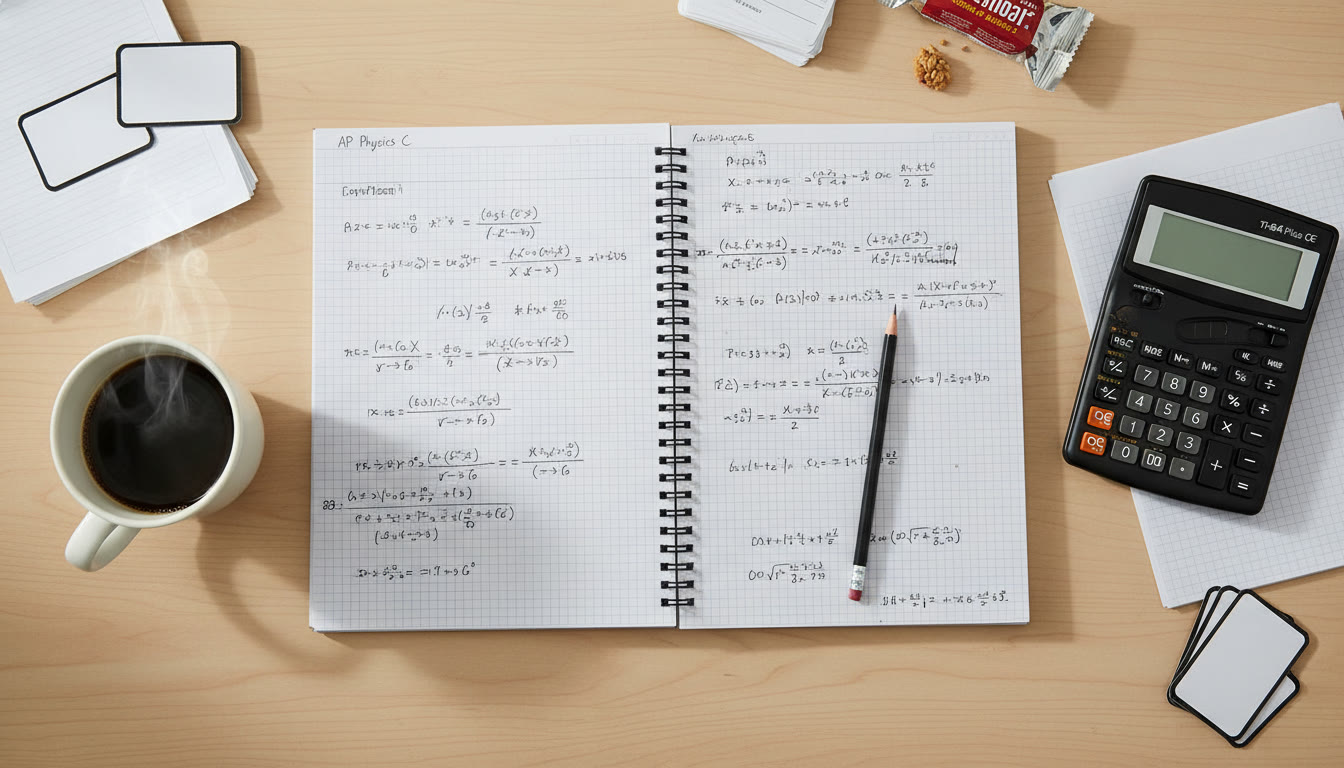
Calculator Section vs No-Calc Section — Practical Differences
Most practice materials and exams mix problems that are calculator-friendly and problems that intentionally reward symbolic manipulation. Here’s how each approach usually aligns with question types:
- Calculator-friendly questions: numerical integrals, multi-step arithmetic involving big or awkward numbers, checking numeric answers, and iterative root-finding (e.g., Newton’s method) in problem-solving contexts.
- No-calculator-friendly questions: proofs, dimensional analysis, limits, recognizing special triangle trig values (30°, 45°, 60°), algebraic simplifications, and conceptual reasoning that’s independent of decimal precision.
Mindset Shift: Speed vs Understanding
Working without a calculator forces you to think symbolically and often reveals simplifications that make problems faster. Working with one can keep you moving when the algebra is dense. Both are valuable skills. Your exam performance improves when you switch between them intentionally rather than reflexively.
Concrete Tactics: Calculator-First, Then Check Without — and Vice Versa
Below are tactical patterns you can adopt during practice and the exam.
Tactic A — Calculator For Crunch, Symbolic For Insight
- Start by setting up the problem symbolically (i.e., write equations with variables and units).
- Try to simplify algebraically: cancel common factors, factor expressions, and nondimensionalize where possible.
- Only plug in numbers at the final step. This reduces the chance of arithmetic errors and gives you an algebra-based check if your numeric answer looks off.
Tactic B — Estimate First, Calculate Later
- Quickly estimate the order of magnitude (e.g., is the answer ~10^-3, ~1, or ~10^3?).
- If your calculator output is wildly different from the estimate, pause and re-check assumptions.
- Use approximations (small-angle sin θ ≈ θ in radians, binomial approximations, etc.) to sanity-check results before wasting time on precise arithmetic.
Tactic C — Reserve Your Calculator for Repetitive or Awkward Arithmetic
- Problems with multiple messy numeric steps (long sums, repeated multiplications, or large factorial-looking products) are perfect for calculators.
- When repeating numerical experiments or table-filling in practice, rely on the calculator to build speed, then practice replicating those results symbolically to deepen understanding.
Worked Examples — Apply the Tactics
Examples cement strategy. Walk through these in your practice sessions—first without a calculator, then with one, and compare time and error rates.
Example 1 — Kinematics (Calculator Not Required If You Think Symbolically)
Problem gist: A particle moves with position x(t) = 5t^2 – 3t + 2. Find when velocity equals zero and determine displacement between t = 0 and t = 2.
- Velocity v(t) = dx/dt = 10t – 3. Solve 10t – 3 = 0 → t = 3/10 s. No calculator needed.
- Displacement from 0 to 2: Δx = x(2) – x(0) = (5*4 – 3*2 + 2) – 2 = (20 – 6 + 2) – 2 = 14. Clear, symbolic math is fastest.
This shows how derivative thinking and simple algebra trump crunching numbers.
Example 2 — Electric Potential from a Line Charge (Calculator Helpful for Integrals)
Problem gist: Compute the potential at a point due to a finite line charge; symbolic setup uses an integral that can often be solved analytically, but the final numeric evaluation may be messy.
- Set up V = k ∫ (λ / r) dl. Solve integral symbolically to a closed form first.
- After simplification, plug in numbers for k, λ, distances, and use a calculator to get an accurate numeric value. Here, the calculator reduces arithmetic strain while the symbolic step ensures conceptual correctness.
Table: When to Use Calculator vs When to Use No-Calc (Quick Reference)
| Problem Feature | Calculator Preferred | No-Calculator Preferred |
|---|---|---|
| Messy numeric evaluation | Yes | No |
| Symbolic simplification possible | No | Yes |
| Check units/dimensional analysis | No | Yes |
| Multiple trigonometric evaluations for special angles | No (mental values are faster) | Yes |
| Iterative numerical root finding | Yes | No |
| Sanity checks and order-of-magnitude estimates | No | Yes |
Practice Routine: Build Both Skill Sets
To truly master both calculator and no-calculator styles, split your practice intentionally:
- Day A: No-calculator day. Solve 6–8 problems entirely by hand, focusing on algebraic manipulation and approximations.
- Day B: Calculator day. Solve 6–8 problems that require numeric evaluations, integrals, or iterative methods, using the calculator strategically.
- Day C: Mixed session. Time yourself and practice switching approaches mid-problem (symbolic setup, numeric check).
Incorporate timed practice to simulate exam pressure. Track how long you spend on each problem type and which errors occur most often—arithmetic, algebra, conceptual slip, or misreading units.
Common Pitfalls and How to Avoid Them
- Over-trusting the calculator: Don’t accept an answer just because the calculator gave you a number. Always perform a quick unit check and magnitude estimate.
- Too many decimal places: Keep 2–4 significant figures for intermediate steps unless the problem demands greater precision. Rounding too early or too aggressively can both cause trouble.
- Poor equation setup: Most mistakes happen before the calculator’s involved. Spend time on a clean diagram, define variables, and ensure sign conventions are correct.
- Ignoring special angle knowledge: Trig values for 30°, 45°, and 60° are free points. Memorize and use them without your calculator when possible.
Time Management: Where Seconds Add Up
A calculator saves time on repetitive arithmetic but can slow you down if you use it for every tiny step. Use a hybrid approach:
- Allocate an average time per problem based on marks: more points = more time. Don’t spend 10 minutes on a 1-point algebraic simplification when a smart symbolic step would take 1–2 minutes.
- When a numeric result takes longer than expected on the calculator, stop and ask: is there a symbolic simplification that makes this trivial?
How to Use Practice Tests to Train the Switch
Practice tests are where the strategy becomes automatic:
- After finishing a full practice section, review each problem and mark whether your primary time was spent on conceptual setup, algebra, or numeric evaluation.
- For problems where the calculator was used: could an algebraic approach have saved time or reduced errors?
- For problems solved without the calculator: did you lose time doing arithmetic manually that a calculator could have solved faster? Note and practice those cases.
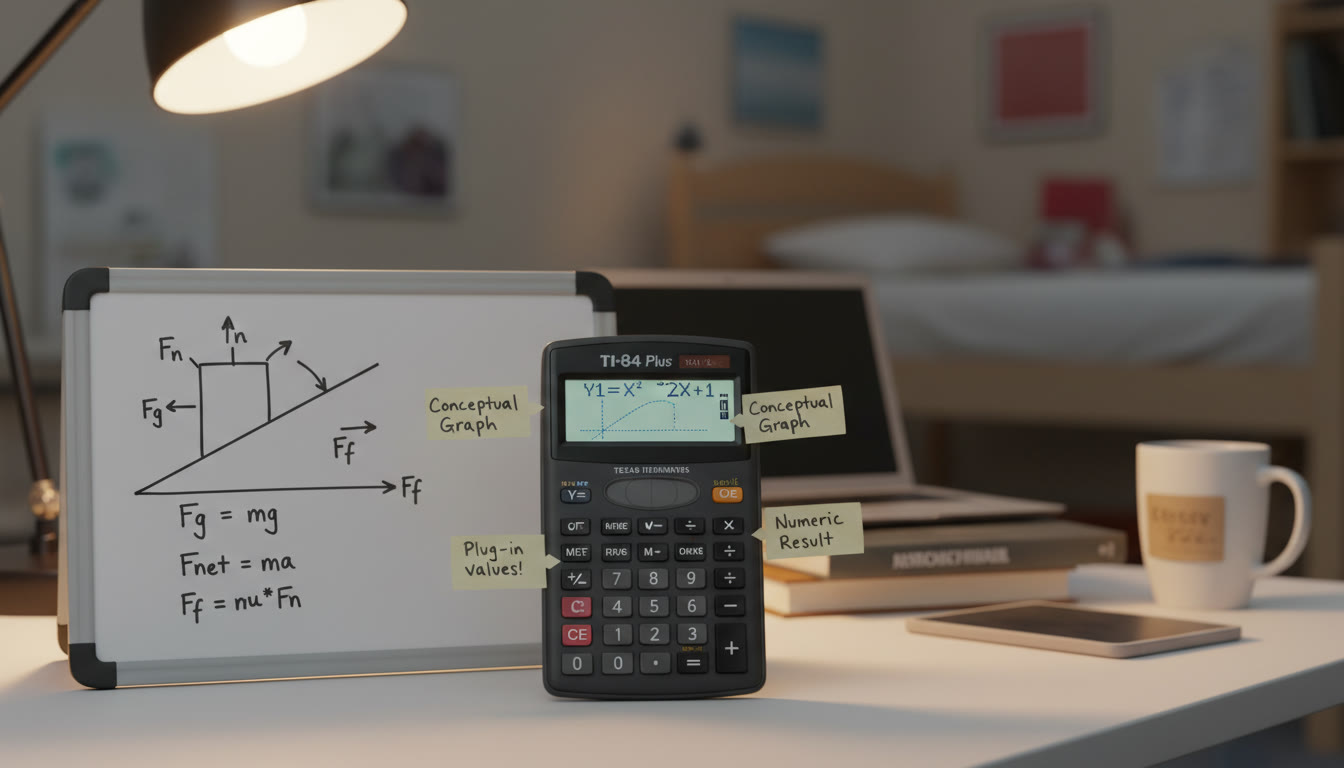
How Personalized Tutoring Helps: Sparkl in the Loop
Studying strategically is easier with someone who can spot the small, repeating mistakes that cost points. That’s where Sparkl’s personalized tutoring becomes valuable. A skilled tutor can:
- Identify whether you lose points from algebraic carelessness, arithmetic, or conceptual gaps.
- Create a tailored study plan that alternates no-calculator and calculator practice based on your specific weaknesses.
- Provide focused 1-on-1 sessions to practice symbolic manipulations until they become fast and reliable, and to teach efficient calculator workflows when necessary.
AI-driven insights in a program like Sparkl can also analyze your practice-test results to highlight patterns—e.g., consistent algebra slips on rotational dynamics or frequent unit-mismatches in E&M problems—and adapt sessions accordingly.
Checklist for Exam Day: Calculator-Ready and No-Calc Confident
Before you walk into the exam room, use this short checklist:
- Calculator: Fully charged or fresh batteries, reset memory if needed, familiarize with scientific and engineering notation, have basic functions memorized (store/retrieve, parentheses, trig in rad/deg).
- Tools: Pencils with good erasers, a ruler, protractor if allowed/practical in practice sessions.
- Mental: Practice a 60-second estimation routine for sanity checks (order of magnitude, unit consistency, sign sanity).
- Strategy: Start symbolically, estimate, then calculate. If stuck, switch: try numeric approximation to get a foothold, then return to symbolic clean-up.
Sample Two-Week Study Plan (Focused, Balanced)
This compact plan emphasizes both calculator fluency and symbolic strength. Adjust intensity based on your timeline.
- Days 1–3: Core mechanics review (no-calculator): derivatives, integrals, energy methods, rotational kinematics. Timed problems with emphasis on symbolic manipulation.
- Days 4–6: Calculator focus: numeric integrals, iterative problem-solving, and circuit numeric analysis for E&M. Practice spreadsheets or calculator programs for repetitive computations.
- Day 7: Mixed practice test. Simulate exam conditions and note time per question type.
- Days 8–10: Address weak areas identified in Day 7—targeted tutoring sessions if necessary.
- Days 11–13: Combined sessions (alternating problems, mixed sets), include at least one full timed practice test.
- Day 14: Light review, memorize key formulas and special trig values, and run through the exam-day checklist.
Final Thoughts — Make the Choice Work for You
There isn’t a universal rule like “never use a calculator” or “always use it.” The smart test taker learns both languages: algebra-first thinking for clarity and calculators for efficiency. With intentional practice, you’ll instinctively know which approach will save time and reduce errors.
If you want to accelerate that intuition, consider targeted 1-on-1 help. Sparkl-style tutoring—tailored study plans, expert tutors, and AI-driven feedback—can speed up the process by focusing on the exact habits that cost you points, whether that’s sloppy algebra, poor unit tracking, or inefficient calculator workflows.
Study smart, alternate deliberately, and make both calculator and no-calculator tactics part of your toolkit. With practice, you’ll find that the test becomes less about panic and more about showing what you already know.
Quick Reference: Top 10 Actionable Tips
- Always set up problems symbolically first; plug numbers in last.
- Memorize trig and special triangle values for quick no-calc responses.
- Estimate order of magnitude before trusting a numerical result.
- Use the calculator for repetitive or awkward arithmetic, not for every step.
- Practice both no-calculator and calculator days on purpose.
- Perform unit checks as a habit—units often reveal hidden mistakes.
- Keep intermediate answers to 2–4 significant figures unless otherwise required.
- Use symbolic simplification to catch algebraic cancellations and avoid wasted computation.
- Simulate test timing and pressure; identify where the calculator truly saves time for you.
- Get targeted feedback—personalized tutoring can pinpoint recurring errors and provide efficient fixes.
Good luck—treat each problem as a small experiment in thinking clearly. With a strategy for when to use the calculator and when to rely on clean symbolic work, you’ll turn both approaches into exam-winning tools.
Ready to sharpen specific habits? Try a focused session to diagnose your common slip-ups—just an hour of targeted practice can reveal huge gains.
























No Comments
Leave a comment Cancel