
Introduction — A Different Kind of Mastery
If you’re preparing for AP Physics or any Collegeboard-backed exam, you’ve probably stared at a dense formula sheet and wondered whether your time would be better spent trying to memorize every symbol, sign, and subscript. The short answer: don’t try. The smarter answer: know how formulas work, when to use them, and how to manipulate them. This post is a friendly, practical guide to turning formula sheets from intimidating lists of symbols into trusted tools that amplify your problem-solving, not substitute for it.
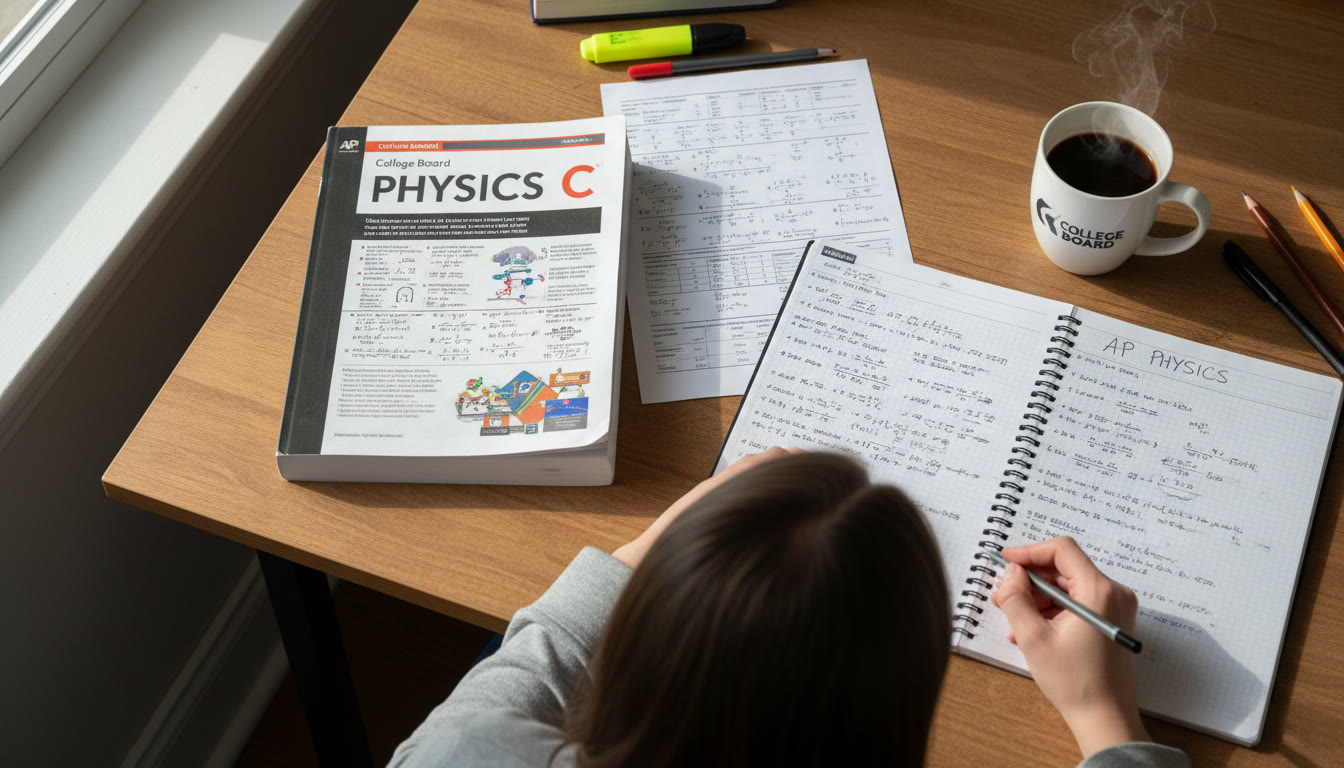
Why Formula Sheets Aren’t Cheat Sheets
Formula sheets are shorthand — a compact map of relationships you’ll use in exam problems. They’re not a substitute for understanding. Think of a formula sheet like a recipe index. The recipe names and core instructions are there, but if you don’t know why certain steps are taken or how ingredients interact, you won’t confidently adapt when a recipe needs tweaking.
On an AP Physics exam, the difference between a correct approach and a wasted formula lookup is often the ability to:
- Read the problem correctly (what is asked? what’s given?).
- Choose the right physical model (kinematics, energy, momentum, circuits, etc.).
- Translate words into equations and check units.
What to Know (Not Memorize)
There are three categories of knowledge that turn formulas into tools. Memorize the essential relationships where doing so removes friction, but prioritize deep familiarity instead of rote recall.
1. Core Relationships and Their Meaning
Learn the fundamental laws and the intuition behind them. For example:
- Newton’s Second Law (F = ma): Not just a symbol — it relates net force to acceleration and sets up free-body diagrams.
- Conservation Laws (energy, momentum): These are strategies for solving problems where forces or accelerations are messy. Ask: is the system isolated? Are external impulses present?
- Wave and Optics Basics (v = fλ, Snell’s Law): Understand how changing one variable affects others.
If you understand the physics behind these equations, the algebra becomes much easier and you’re less likely to misapply a formula.
2. How to Rearrange and Combine Formulas
Too often students memorize formulas as static objects. Instead, learn patterns of manipulation:
- Isolate the variable you need — practice solving for different variables from the same formula.
- Combine equations: e.g., use kinematic equations with Newton’s laws, or energy relations with motion constraints.
- Use substitution to eliminate variables — a common technique for multi-step problems.
Practice turning a formula like E = 1/2 k x^2 into solving for x, or combining momentum p = mv with kinetic energy KE = 1/2 mv^2 to analyze collisions.
3. Units and Dimensional Reasoning
Units are your built-in error checker. Treat them like a second language. If a result has incompatible units, something in your algebra is wrong. Develop the habit of quick dimensional checks:
- Energy must be in joules (kg·m^2/s^2). If your algebra gives meters, re-check.
- Velocity should be m/s, acceleration m/s^2, force in newtons (kg·m/s^2).
- Use dimensional analysis to derive plausible formula forms when you forget the exact constant.
What to Memorize (Sparingly)
Memorization still has a place. The goal is to minimize unnecessary pauses during an exam so you can focus on reasoning. Memorize:
- Common constants and units (g ~ 9.8 m/s^2, Coulomb’s constant k, value of e when needed, conversions like 1 km = 1000 m).
- Basic kinematic equations and what each requires (constant acceleration assumptions, etc.).
- Vector decomposition rules (sin/cos for components) and common trig identities you’ll use often.
- Standard forms of conservation statements (total momentum conserved in isolated systems; mechanical energy conserved when non-conservative forces are negligible).
But avoid memorizing exotic derived formulae you can reproduce with reasoning — it’s more exam-efficient to derive them quickly than to memorize a long list of seldom-used expressions.
How to Study the Formula Sheet Effectively
Studying a formula sheet is different from studying a textbook chapter. Your aim is to connect each formula to a conceptual anchor and a pool of worked examples.
1. Build a Two-Column Page
Create a study page with two columns: left column lists the formula, right column explains when to use it in plain language and sketches a 1–2 step derivation or justification. Example:
- Left: T = 2π√(L/g)
- Right: Small-angle pendulum period when amplitude is small; derived from small-angle approximation and SHM equations.
2. Active Derivation Practice
Set a timer for 10–15 minutes and reproduce derivations from the sheet without looking. If you can re-derive the relation cleanly, you’ve internalized the path from physics to formula — and you’ll be able to adapt it in novel contexts.
3. Connect Each Formula to an Example
For each formula, write a short problem where it’s the natural next step. Solve it slowly once, then again under timed conditions. This conditions your brain to recognize problem patterns quickly on exam day.
Exam-Day Strategies: Use the Sheet Like a Pro
On exam day, the formula sheet is a partner, not a crutch. Use these strategies to work with it efficiently:
1. Quick Scan First
At the start of the exam, briefly scan the formula sheet. This gives you a mental map of what’s provided explicitly and what you must derive. It helps especially when you’re deciding whether a conservation or kinematic approach is faster.
2. Annotate Lightly (If Allowed)
If the rules permit light annotation (check AP instructions), use shorthand marks: underline a formula you’ll use often, circle constants you’ll need, or write a quick note like “use conservation” next to a relevant equation. These visual cues save time during the test.
3. Dimensional Quick-Checks
After an algebraic manipulation, glance at units to confirm plausibility. This habit catches sign errors and missing factors early.
4. Always Ask: Is This Isolated?
Before using conservation laws, verify the system is isolated or that externals don’t exchange the conserved quantity. Momentum might be conserved globally but not if an external impulse acts during the event.
Worked Example: From Words to Equations
Problem: A 2 kg block slides down a frictionless incline of height 5 m. What is its speed at the bottom?
Wrong instinct: try to apply kinematics along the incline without knowing the angle or distance.
Right approach: Use mechanical energy conservation (if the surface is frictionless):
- Initial energy = m g h + 0 (starting from rest).
- Final energy = 1/2 m v^2 + 0 (reference height chosen at bottom).
- Set them equal: m g h = 1/2 m v^2 → v = sqrt(2 g h).
Plug numbers: v = sqrt(2 × 9.8 × 5) ≈ sqrt(98) ≈ 9.9 m/s. Notice how we never needed the incline angle or path length; understanding the right conservation principle made the formula choice trivial.
Common Pitfalls and How to Avoid Them
- Forgetting the assumptions: Many formulas require conditions (constant acceleration, small-angle approximations, linear resistances). Always check assumptions before applying.
- Sign errors: Keep a consistent coordinate system, and watch for negative work or displacement signs.
- Over-reliance on the sheet: If a formula is present but you don’t understand the underlying physical principle, you’ll misapply it. Pair formula lookup with quick conceptual checks.
- Neglecting units: Units save lives — use them as a cross-check after every major algebraic step.
Tools to Make Formula Sheets Work for You
There are study habits and tools that will help you extract value from formula sheets quickly.
1. Flash Problem Sets
Create 10–15 minute problem blocks where every problem forces you to reference one or two formulas and justify their use. Rapid practice builds pattern recognition.
2. Concept Maps
Draw concept maps connecting laws to the formulas they produce and to common problem types. A map makes it easier to jump from a textual problem description to the right law.
3. Tutoring and Personalized Plans
If you sometimes feel stuck connecting formulas to problems, tailored one-on-one guidance can accelerate progress. Personalized tutoring provides targeted feedback, helps you build a study plan, and gives practice problems that focus on your weak spots. Sparkl’s personalized tutoring emphasizes 1-on-1 guidance, tailored study plans, expert tutors, and AI-driven insights to pinpoint the exact formulas and concepts you need to focus on — while helping you practice deriving and applying them, not just recalling them.
Practical Formula Sheet: What to Keep at Your Fingertips
Below is a compact, student-friendly table showing common formula categories and a one-line reminder of when to use them. This isn’t a replacement for your exam’s official sheet, but it’s a study aide to organize your thinking.
| Category | Representative Formula(s) | When to Use |
|---|---|---|
| Kinematics | v = v0 + at; x = x0 + v0t + 1/2 at^2 | Constant acceleration motion problems |
| Newton’s Laws | ΣF = ma; friction f = μN | When forces determine acceleration; free-body diagram problems |
| Work and Energy | W = F·d; KE = 1/2 mv^2; PE = mgh | Systems where energy transfer simplifies the solution |
| Momentum | p = mv; Σp conserved | Collision and impulse problems |
| Oscillations | T = 2π√(m/k); ω = √(k/m) | Mass-spring and small-angle pendulum problems |
| Waves and Optics | v = fλ; n1 sinθ1 = n2 sinθ2 | Wave speed problems, refraction, and simple optics |
| Electricity | V = IR; F = k q1 q2 / r^2 | Basic circuit and coulombic force problems |
Practice Ritual: Make It Routine
Develop a weekly ritual that balances concept review, formula manipulation, and timed practice:
- Day 1 — Concept focus: pick a law and re-derive 2–3 related formulas from first principles.
- Day 2 — Application: solve 6–8 targeted problems using those formulas, explain each step aloud or in writing.
- Day 3 — Mixed set: timed 30–45 minute practice drawing on multiple formula categories.
- Weekly recap — Reflect on errors and annotate your personal formula sheet with reminders about common traps.
Consistent practice makes formula selection second nature — so on test day you’re solving problems instead of hunting for the right equation.
How to Make a Personal “Cheat” Sheet (For Study)
Create a compact personal study sheet — not for the exam, but as a study tool. Keep it single-page, highly visual, and honest about what confuses you. Include:
- Two-line derivations for core formulas.
- One-sentence condition notes (e.g., “use this only for small angles”).
- Common rearrangements you use often (e.g., solve for t, solve for distance).
This personal sheet trains you to think in the language of formulas without fostering blind memorization.
Final Exam-Day Checklist
- Scan the formula sheet immediately to orient yourself.
- Choose problems you can solve confidently first — win points early.
- Write units at the end of each numeric answer.
- When in doubt, fall back to conservation laws and dimensional checks — they often narrow possible answers.
- Stay calm and pace yourself: time management beats frantic formula hunting.
Closing Thoughts — Formulas as Conversation
Think of formulas as part of a conversation between you and the physical world. Each equation tells a story about how quantities interact. Your job as a student is to translate the problem into that story, pick the right chapter from the formula sheet, and then write the solution in clear algebra and units.
Don’t fear the formula sheet — partner with it. Spend your study time building conceptual fluency, practicing rearrangements, and learning to check your work with units and limiting cases. And when you need guided practice or a personalized study plan that targets how to use formulas more effectively, one-on-one tutoring like Sparkl’s can offer direct feedback, tailored problems, and AI-driven insights that speed your learning.
Final Encouragement
Physics rewards curiosity and clarity. If you make formulas meaningful rather than memorable, you’ll be equipped to handle unfamiliar problems with confidence — not because you memorized more, but because you understood better. Good luck; you’ve got this.




























No Comments
Leave a comment Cancel