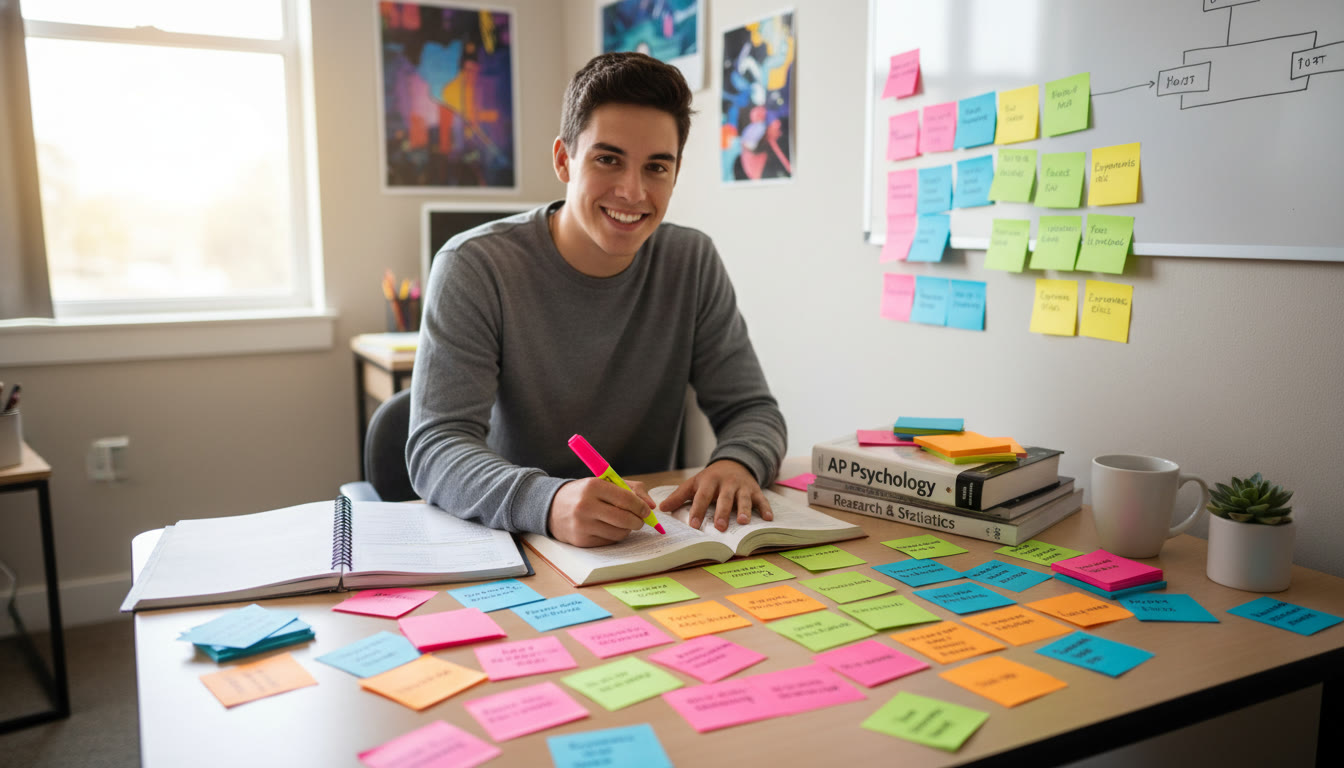

Why Mnemonics Matter for AP Psychology
If you’ve ever sat down with a thick AP Psychology review book and felt your eyes glaze over at the flood of terms—classical conditioning, operant conditioning, autonomic nervous system, or the parts of the neuron—welcome to the club. Psychology is a vocabulary-rich subject. Facts, theorists, and subtle differences trip many students up during the exam. That’s where mnemonics, or memory aids, step in: they transform dry lists into memorable stories, images, or rhythms your brain prefers to keep.
This post is written for real students—busy, ambitious, sometimes stressed—who want practical, friendly, and research-informed mnemonic strategies that actually stick. You’ll get concrete examples tailored to AP Psychology topics, a sample study plan, a table summarizing quick reference mnemonics, and suggestions for how to blend these techniques into a study routine. Along the way I’ll note how Sparkl’s personalized tutoring can complement these strategies with 1-on-1 guidance, tailored study plans, and AI-driven insights to track what sticks and what needs reinforcement.
How Memory Works: A Quick, Friendly Primer
Before we bake mnemonics into your toolkit, let’s quickly peek under the hood. Memory is often described as three stages: encoding (taking information in), storage (keeping it), and retrieval (bringing it back when you need it). Mnemonics help at the encoding and retrieval stages by giving your brain unusual, organized cues rather than relying on raw repetition.
A few memory-friendly principles to keep in mind:
- Distinctiveness: Your brain remembers unusual things better—use odd images or silly sentences.
- Meaningful organization: Group related items into a story or structure—this helps you reconstruct lists on the exam.
- Multisensory cues: Combining visual, auditory, and kinesthetic cues strengthens memory.
- Spaced retrieval: Testing yourself across days beats cramming—this is essential for long-term retention.
Five Mnemonic Types That Work for Psych
Not all mnemonics are created equal. Below are five types that consistently help students learning AP Psychology content. For each type, I’ll give examples tied to common AP topics.
1. Acronyms and Acrostics
Acronyms compress a list into a word; acrostics make a sentence where each first letter cues a term. They’re simple and fast to use.
Example (Big Five Personality Traits):
- Acronym: OCEAN — Openness, Conscientiousness, Extraversion, Agreeableness, Neuroticism.
- Acrostic for Memory: “Old Cats Eat All Nosh” — the silliness helps it stick.
2. The Story Method
Turn a list into a narrative—people remember stories better than isolated facts. Stories can be absurd; the stranger, the better.
Example (Stages of Memory: Encoding, Storage, Retrieval): “Eddie (Encoding) stored his suitcase (Storage) and then retrieved it from the lost and found (Retrieval).” The story format gives you a logical sequence you can reconstruct.
3. Peg Systems and Number-Rhyme Associations
Use a fixed set of ‘pegs’ (mental hooks) to hang content on. If you need to remember ordered items, peg systems are gold.
Number-rhyme pegs: 1—Gun, 2—Shoe, 3—Tree, 4—Door, 5—Hive. To remember the four lobes of the cortex in order, you could attach each lobe to a peg image and imagine the interaction in a vivid scene.
4. Method of Loci (Memory Palace)
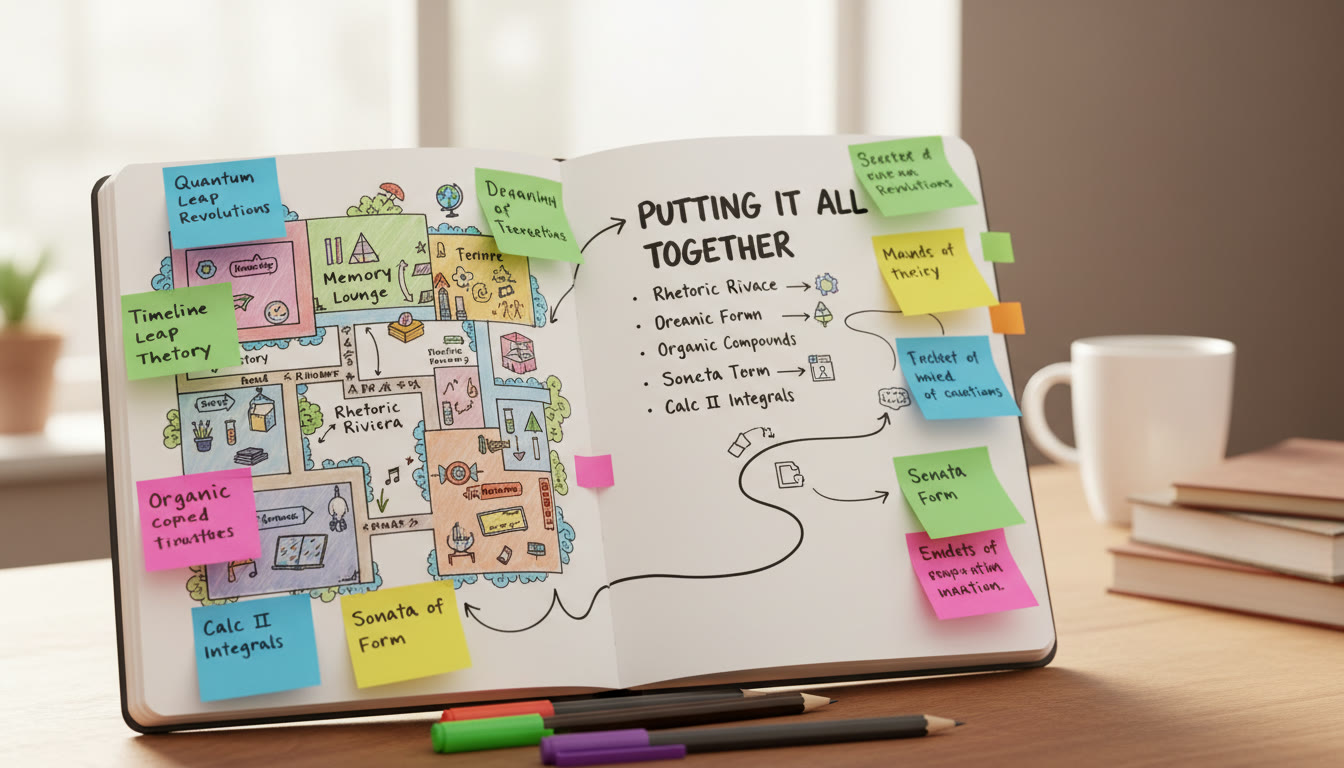
This ancient technique places items along a familiar mental route—ideal for complex lists like neurotransmitters and their functions. Walk your mental house and place each item in a room; when you need them, walk through again.
Example: In your kitchen you picture serotonin cooking a steady stew (mood regulation), while in the hallway dopamine rings a doorbell party (reward).
5. Chunking and Hierarchical Organization
Break long lists into meaningful chunks, or build hierarchies (category → subcategory). This mirrors how many topics are structured in AP Psychology—e.g., biological bases, sensation/perception, learning, cognition.
Example: Instead of memorizing 12 therapies, chunk them into categories: Psychodynamic, Behavioral, Cognitive, Humanistic, Biomedical, Group/Family. Focus on why each cluster exists and a key feature for each therapy inside the chunk.
Mnemonics That Map to AP Psychology Topics
Below are high-impact, ready-to-use mnemonics tied to AP Psychology’s big areas. Use them as-is or adapt them—the best mnemonics become yours when personalized.
1. Research Methods
- META: Manipulate, Experimental, Testable, Analyze — a quick trigger to remind you what makes a study experimental and valid.
- Operational Definitions: “Define It, Measure It, Repeat It” — a mini-rhythm to remember why operationalization matters.
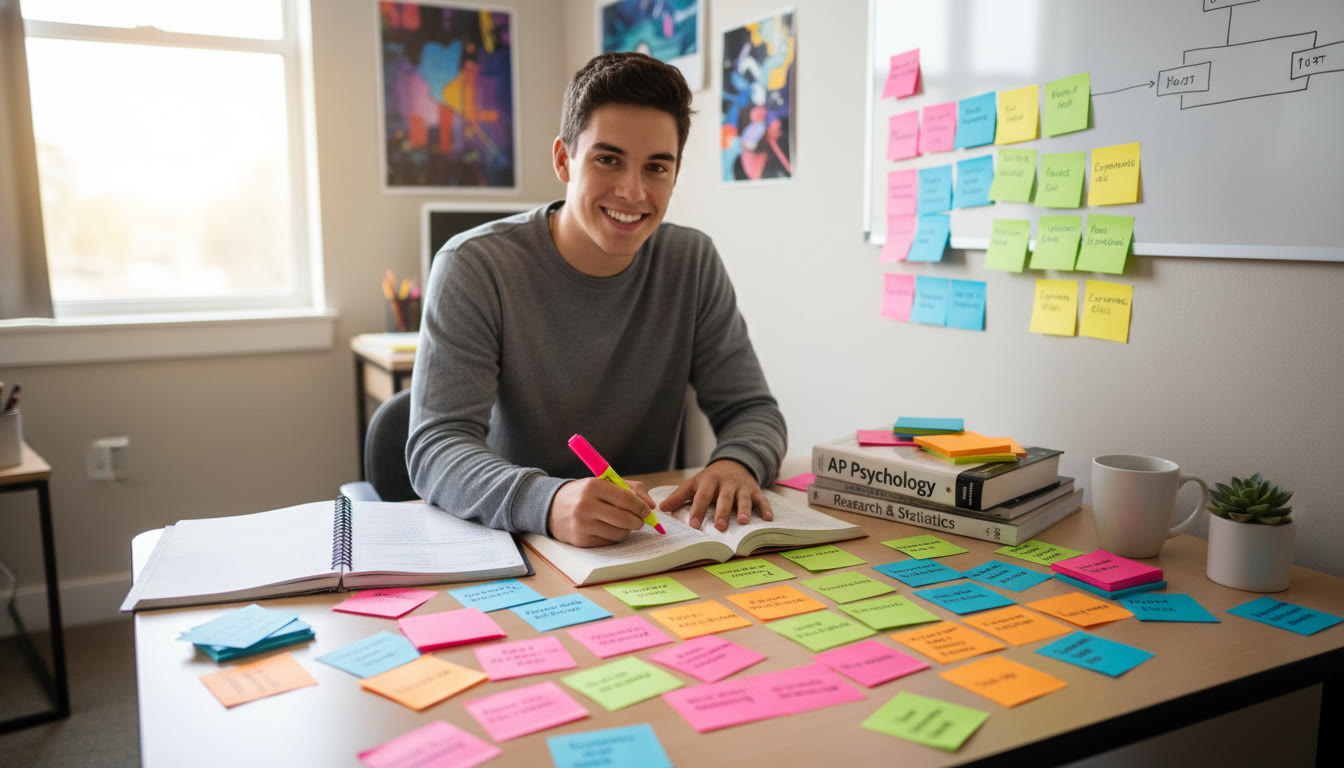
2. Learning and Conditioning
- Classical Conditioning (Pavlov): “NS + US → CR” remembered as “Neutral Sandwich plus Unpleasant Sauce makes a Conditioned Reaction” — silly food imagery makes cause-effect easier to pull up.
- Operant Conditioning Schedules: Use the phrase: “VR = Very Random, FR = Fixed Reward, VI = Very Irregular, FI = Fixed Interval.” Pair each with a quick example: VR slot machine, FR weekly allowance, VI surprise quizzes, FI weekly paycheck.
3. Biological Bases
- Neurotransmitters Quick Cue: “SAD GEMS” — Serotonin (S), Acetylcholine (A), Dopamine (D), GABA (G), Endorphins (E), Melatonin (M), Serotonin/Sleep — tweak as you like. Pair with one-word functions: Mood, Memory, Reward, Inhibition, Pain, Sleep.
- Brain Lobes: “FPOT” (Front, Parietal, Occipital, Temporal) → “Front Porch Opens Today.” Attach one-word functions: Frontal—planning; Parietal—sensory; Occipital—vision; Temporal—hearing/memory.
4. Developmental Psychology
- Piaget’s Stages: “SPCF” — Sensorimotor, Preoperational, Concrete Operational, Formal Operational. Sentence: “Sam Plays Candy Frequently.” Each stage pairs with a hallmark: object permanence, symbolic play, concrete logic, abstract thought.
- Erikson’s Identity Stages (adolescence focus): Remember the core teens conflict as “Identity vs. Role Confusion” with the mental image of a teen trying on different hats—literal hats for roles.
5. Social Psychology
- Conformity vs. Obedience: “Peers Choose, Authorities Command” — a crisp, binary mnemonic to keep differences straight.
- Attribution Biases: “FAE” (Fundamental Attribution Error) → picture someone slipping on a banana and you immediately think “clumsy,” not “maybe the floor was wet.”
Practical Study Plan: Use Mnemonics Without Burning Out
Here’s a compact, realistic three-week plan to integrate mnemonics with active practice and spaced retrieval. Tweak timing based on your exam date.
| Week | Focus | Daily Actions | Mnemonics Use |
|---|---|---|---|
| 1 | Foundations (Research, Memory, Learning) |
|
Create acronyms and story mnemonics for core lists. |
| 2 | Biological + Developmental |
|
Build a small memory palace and peg lists. |
| 3 | Social, Therapies, Full Review |
|
Use acrostics to rapidly recall therapies, biases, and stages. |
How to Create Your Own High-Impact Mnemonic (Step-by-Step)
Personalized mnemonics outperform generic ones because they tap your own experiences, images, and emotions. Follow these steps to craft a memorable cue:
- Pick the chunk: Choose 4–8 items you struggle with—not a huge list.
- Decide the type: Acronym, story, peg, or memory palace—match the complexity to the task.
- Make it vivid: Use strong sensory detail, emotion, or humor. More unusual = more memorable.
- Lock the order: If sequence matters (e.g., stages), use pegs or loci to anchor positions.
- Test immediately: Try to recall without looking; tweak the mnemonic if recall fails more than once.
- Schedule reviews: Quick recall sessions at 1 day, 3 days, 1 week, and 2 weeks help cement long-term memory.
Examples—Personalized Mnemonics That Students Love
Below are real-style examples you can remix. Personalize names, places, and objects to your life for maximum effect.
Example 1: Visual Story for the Stages of Sleep
Create an image: A child in bed (N1 drift), then turning over in light sleep (N2 with sleep spindles—imagine tiny helmets popping on), then deep ocean diving (N3 slow waves), then a whirlwind dance party (REM dreaming). The odd helmet and dance party make the phases distinct and retrievable.
Example 2: Peg for Attachment Styles
Pegs 1–4: 1—Sun, 2—Shoe, 3—Tree, 4—Door. Attach secure to the sun (warm and reliable), avoidant to the shoe (keeps distance), anxious to the tree (clingy vines), disorganized to the door (open but unpredictable). Visualizing these helps during FRQs about parental attachment.
Common Pitfalls and How to Avoid Them
- Pitfall: Mnemonics that are too long or complex. Fix: Keep each mnemonic focused—one per concept.
- Pitfall: Relying only on mnemonics without understanding. Fix: Pair the mnemonic with a one-sentence explanation in your own words.
- Pitfall: No spaced review. Fix: Use a simple scheduler or an app and test yourself instead of passive re-reading.
How to Use Mnemonics on Test Day
On exam day, you don’t want to invent new tricks. Use a handful of pre-memorized cues to prime sections of your brain. For instance, before the multiple-choice section, spend 30 seconds mentally walking through your memory palace to ‘warm up’ recall pathways. Keep this calm and confident—mnemonics are cues, not crutches.
Also, use mnemonic rehearsals when you hit a mental blank: take a breath, imagine the anchor image, and let the rest unfold.
Measuring What Sticks: A Simple Tracking Table
To make your study efficient, track which mnemonics are reliable and which need reworking. Here’s a simple table you can reproduce on paper or a note app.
| Concept | Mnemonic | Recall Accuracy (1–5) | Action |
|---|---|---|---|
| Operant Schedules | VR/FR/VI/FI word cue | 3 | Make a vivid image tying each schedule to a specific object. |
| Piaget Stages | SPCF phrase | 5 | Keep and practice weekly. |
How Personalized Tutoring (Like Sparkl) Fits In
Mnemonics are powerful, but pairing them with tailored feedback accelerates mastery. That’s where personalized tutoring helps. A good 1-on-1 tutor can:
- Help you craft mnemonics that align with your own memories and experiences (which stick better).
- Build a study plan that spaces reviews optimally and integrates content practice with FRQs and MCQs.
- Use AI-driven insights to flag mnemonics that aren’t working and suggest alternatives—so your study time is efficient, not wasted.
If you use a service like Sparkl, expect tutors to model mnemonics, test recall with targeted questions, and adjust tactics based on your weekly progress—especially helpful in the weeks before the AP exam when precision matters.
Putting It All Together: A Short Practice Session Example
Here’s what a focused 40-minute session could look like:
- 0–5 min: Quick warm-up recall of 5 previously-learned mnemonics.
- 5–20 min: Learn a new chunk (e.g., neurotransmitters), craft a memory palace, and lock it with vivid details.
- 20–30 min: Apply the new mnemonic to 5 practice questions—write short answers to test depth.
- 30–35 min: Immediate self-testing without notes—rate recall accuracy.
- 35–40 min: Schedule the next reviews at 1 day, 3 days, and 1 week; tweak any weak mnemonics.
Final Tips: Make Mnemonics a Lifelong Tool, Not a Shortcut
Mnemonics should be more than exam hacks—they’re a bridge to deeper understanding. When you pair a mnemonic with genuine comprehension, you’ll perform better on AP-style FRQs where synthesis and explanation matter, not just recall. A few final tips:
- Customize: Use names, places, and objects meaningful to you.
- Keep it short: If it takes longer to recall the mnemonic than the fact, simplify it.
- Use retrieval practice: The act of trying to remember strengthens memory more than re-reading.
- Review smartly: Space reviews and interleave topics instead of studying one topic exhaustively.
Parting Encouragement
AP Psychology rewards curiosity as much as memory. Mnemonics make the course less intimidating and more playful—turn terms into stories, weird images, and rhythms. If you pair these techniques with targeted practice, periodic assessments, and occasional 1-on-1 guidance—like the personalized tutoring Sparkl offers—you’ll not only remember what you need for test day but also understand the concepts at a deeper level.
Start small: pick three topics this week, build mnemonics for each, test yourself after 24 hours, and tweak. Over a few weeks your mental toolkit will grow, and those once-daunting lists will feel like old friends you can call back whenever the exam asks.
Good luck—study smart, stay curious, and let memory be your ally.


























No Comments
Leave a comment Cancel