
Why AP Courses Matter for a Public Health Track
Thinking about public health? Whether you’re dreaming of epidemiology, health policy, community outreach, health communications, or biomedical research, the AP classes you take in high school can do more than look good on an application. They build the knowledge, habits, and problem-solving skills colleges want. They show admissions officers that you’re curious about population health and ready for college-level thinking. And, when chosen thoughtfully, APs give you a head start on college coursework in biology, statistics, chemistry, and the social sciences that underpin public health.

A quick reality check
Not every AP is equally useful for public health, and you don’t need to cram every science AP into your schedule. What matters more is a logical mix: life science to understand disease and biology, statistics to interpret data, social-science APs to understand human behavior and systems, and select lab sciences to build a rigorous foundation. Balance depth with sustainability—college admissions teams prefer sustained excellence over being stretched too thin.
Core AP Courses That Straightaway Support Public Health
Here are the APs that should be high on your list if you’re committed to a public health pathway.
AP Biology
Why it fits: Biology is foundational to understanding pathogens, human physiology, genetics, and ecology—topics central to many public health problems. AP Biology teaches you how organisms work, how diseases spread at the cellular and organismal levels, and how ecosystems and human health interact.
- Skills built: experimental design, data interpretation, scientific writing.
- Real-world ties: immunology basics, disease vectors, microbial interactions.
AP Statistics
Why it fits: Public health is data-driven. Interpreting surveys, analyzing trends, and understanding uncertainty are core skills. AP Statistics trains you to analyze data properly—an essential tool in epidemiology, health services research, and program evaluation.
- Skills built: sampling, inference, probability, regression basics.
- Real-world ties: reading studies, evaluating interventions, spotting misleading graphs.
AP Chemistry
Why it fits: You might not use lab titrations every day in public health practice, but chemistry teaches you to think about molecular interactions, toxicology, and environmental contaminants. For students interested in environmental health or biochemistry-heavy paths, AP Chemistry is especially useful.
- Skills built: quantitative reasoning, lab techniques, chemical thinking.
- Real-world ties: pollutant behavior, pharmaceutical basics, water safety.
AP Environmental Science
Why it fits: Environment and health are tightly linked. AP Environmental Science covers ecosystems, pollution, resource management, climate impacts, and human health consequences—an excellent match for future environmental health or policy-focused public health students.
- Skills built: systems thinking, environmental data analysis, solution design.
- Real-world ties: air and water quality, vector ecology, disaster public health.
Complementary APs That Strengthen a Public Health Profile
These APs aren’t mandatory, but they deepen your understanding of society, behavior, and research methods—areas public health draws on heavily.
AP Psychology
Why it fits: Health is about people as much as pathogens. AP Psychology introduces cognitive and social processes, mental health, behavior change, and research methods—useful for health communications, community interventions, and mental health policy.
- Skills built: understanding behavior, designing human-centered interventions.
- Real-world ties: behavior-change campaigns, health disparities, mental health response.
AP Human Geography
Why it fits: Human Geography explores population patterns, urbanization, migration, and spatial relationships—core elements when you analyze disease spread, access to care, or the social determinants of health.
- Skills built: spatial reasoning, demographic analysis, policy context.
- Real-world ties: mapping disease hotspots, planning community resources, understanding migration-driven health needs.
AP Research / AP Seminar (AP Capstone)
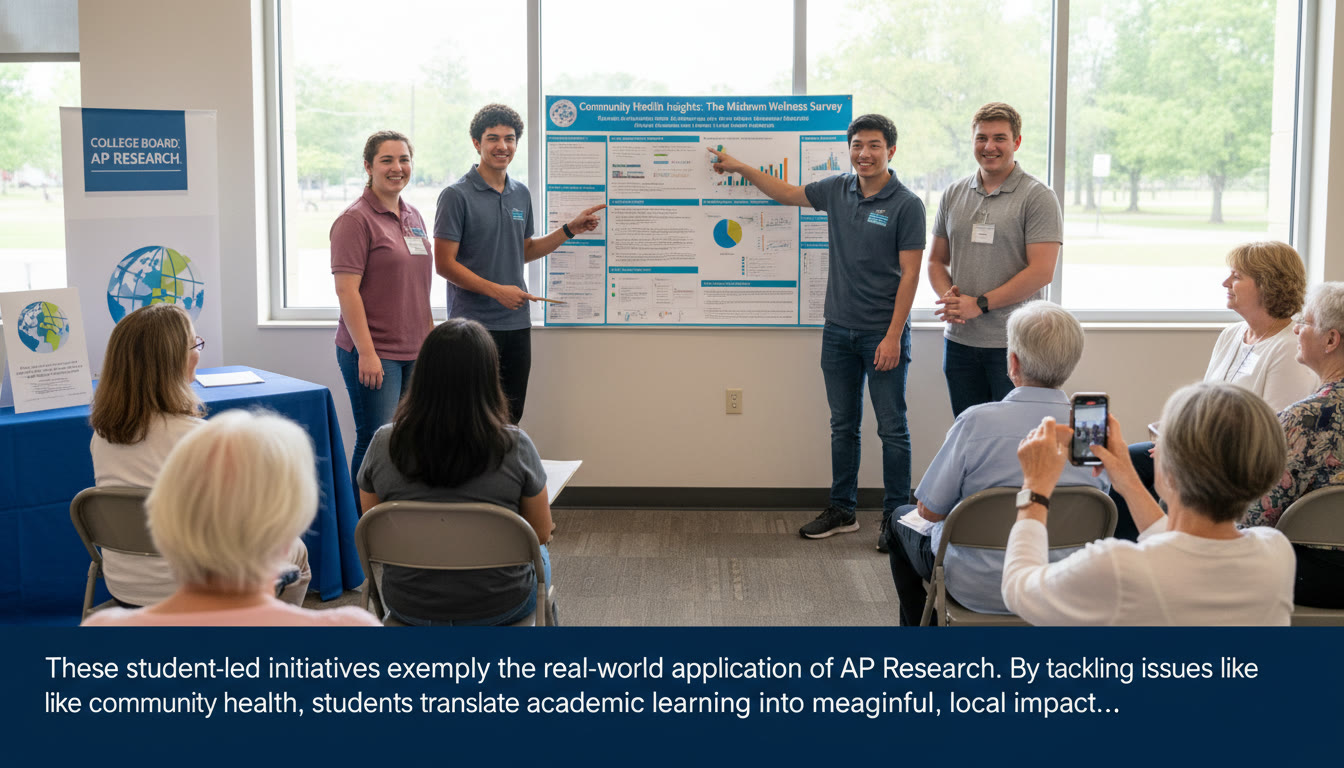
Why it fits: AP Seminar and AP Research (the Capstone sequence) teach you how to investigate complex topics, craft evidence-based arguments, and present findings. Public health thrives on rigorous research—these APs let you plan, execute, and communicate a real research project, which looks fantastic on an application.
- Skills built: literature review, hypothesis testing, long-form communication.
- Real-world ties: independent public health projects, community assessments, policy briefs.
How to Build a sensible AP Plan Across High School
Rather than listing every AP, let’s walk through a realistic, sustainable plan from freshman to senior year that balances rigor with wellbeing. You don’t need to follow this exactly—use it as a template and adapt to your school offerings and personal strengths.
Year-by-year AP roadmap
| Year | Focus | Suggested APs | Why this makes sense |
|---|---|---|---|
| 9th Grade | Explore and build foundation | AP Human Geography (if available) | Accessible intro to social science thinking; great first AP. |
| 10th Grade | Begin science and math rigor | AP Biology or AP Environmental Science; AP Statistics (if offered) | Start core sciences; statistics early helps with research literacy. |
| 11th Grade | Deepen science and quantitative skills | AP Chemistry (if pursuing lab sciences), AP Statistics (if not yet taken) | Junior year is a strong time for heavier science and math rigor. |
| 12th Grade | Research and synthesis | AP Research / AP Seminar, AP Psychology, elective AP | Capstone projects and psychology strengthen communication and human-focused understanding. |
This roadmap balances foundational science, quantitative training, and social science perspectives. Schools and offerings vary, so consult with your guidance counselor to map AP availability and prerequisites.
How Colleges View APs for Public Health Majors
Admissions committees look for academic momentum, relevance, and mastery. A transcript with biology, statistics, and at least one lab science signals sincere interest and preparedness. Capstone or research experience shows initiative and the ability to handle college-level projects. Grades and rigor matter more than the sheer number of APs.
What really helps in admissions and later coursework
- Strong performance in a focused set of relevant APs (e.g., Biology + Statistics + Environmental Science).
- Research or community health experience to pair with academics (internships, volunteer work, local public health projects).
- Clear narrative in your application: why public health, how your AP choices and extracurriculars prepared you, and what you hope to do next.
Examples: Tailored AP Combinations for Different Public Health Interests
Public health is broad. Here are tailored AP mixes for common sub-paths—use them as inspiration, not rules.
1) Epidemiology and Biostatistics
- AP Biology
- AP Statistics
- AP Chemistry (helpful)
- AP Research or AP Seminar
Why: You’ll need strong biology knowledge plus the statistical tools to analyze disease patterns and research data. Research experience or a Capstone project focused on local disease surveillance is a powerful supplement.
2) Environmental and Occupational Health
- AP Environmental Science
- AP Chemistry
- AP Biology
- AP Human Geography (for spatial/contextual skills)
Why: This mix grounds you in ecosystems, pollutants chemistry, and the ways human systems intersect with environmental hazards.
3) Health Policy and Administration
- AP Human Geography
- AP Statistics
- AP Psychology (behavioral health perspective)
- AP Research
Why: Policy-readiness comes from understanding populations, data, and human behavior. Capstone projects can let you simulate policy evaluations.
4) Community Health and Health Education
- AP Psychology
- AP Human Geography
- AP Environmental Science
- AP Seminar / Research
Why: Community health is human-centered. These APs help you understand community dynamics, behavior change, and practical intervention design.
Practical Tips for Success: Studying Smart, Staying Balanced
APs are a marathon. Keep these practical, human tips in mind:
- Start with foundational courses early. If your school offers AP Human Geography or AP Environmental Science to freshmen or sophomores, they’re great stepping stones.
- Take statistics early or parallel to sciences—data literacy is invaluable and enhances every other AP you take.
- Use summers wisely: read public health case studies, volunteer locally, or complete an independent project that can later become a research topic.
- Quality over quantity. Colleges value depth—sustained high performance in a focused set of APs is stronger than superficial exposure to many.
- Pair AP classes with hands-on experience: local health departments, clinics, environmental monitoring projects, or community organizations provide context and inspiration.
- Be realistic with workload: a heavy AP schedule is only helpful if you can maintain grades, extracurricular involvement, and mental health.
How to Use AP Scores Once You’re in College
AP credit policies vary by school and major. Some institutions grant course credit, others give placement out of introductory classes, and some use AP to satisfy general education requirements. For public health majors, AP Stats or AP Biology can sometimes place you out of introductory courses, freeing room in your schedule for advanced electives like epidemiology, health policy, or fieldwork.
Plan with advisors
Once admitted, talk to academic advisors about how to apply AP credits so they align with your long-term goals. If your goal is research or graduate school later on, you might choose to skip credit and take the college course for a deeper foundation or to build relationships with faculty.
Real-World Example: Turning an AP Project Into a College Story
Meet Maya (an illustrative example). In 11th grade she took AP Biology, AP Statistics, and AP Environmental Science. For AP Research, she designed a small study surveying local awareness of mosquito-borne illnesses. She analyzed her data using statistical methods from AP Statistics and presented findings to the town council, proposing targeted public outreach for high-risk neighborhoods. In applications, Maya wrote about how these AP classes built the skills to design and communicate a public health solution—something admissions readers found concrete and compelling.
How Personalized Tutoring Can Help—A Practical Note
Some students thrive with independent study; others benefit enormously from targeted guidance. Personalized tutoring can help you build a study plan that balances AP choices, seniors’ workloads, and application strategy. Sparkl’s personalized tutoring, for instance, offers 1-on-1 guidance, tailored study plans, expert tutors, and AI-driven insights that can help you identify weak spots, optimize exam timing, and turn a classroom project into a compelling research narrative—only where it fits naturally into your learning goals.
Study Strategies That Work for APs in Public Health Tracks
Here are evidence-based study strategies that actually make the difference:
- Active recall and spaced repetition for memorization-heavy topics (e.g., disease mechanisms, biochemical pathways).
- Practice with real data for AP Statistics—don’t just practice formulas; interpret output and critique data collection.
- Connect concepts across APs: link ecology from Environmental Science to disease patterns in Biology; use psychology to interpret survey responses in research projects.
- Write short policy briefs or one-page summaries after major topics—this improves synthesis and communication, a crucial public health skill.
- Form study groups that emphasize teaching: explaining a concept to peers is one of the best ways to learn it.
Common Pitfalls and How to Avoid Them
Students aiming for public health sometimes fall into predictable traps. Here’s how to sidestep them:
- Pitfall: Taking every available AP to impress colleges. Better: choose a meaningful, coherent set and excel in it.
- Pitfall: Ignoring statistics because it feels “just math.” Statistics is the language of public health—invest in it early.
- Pitfall: Isolating academics from experience. Combine AP coursework with volunteering or internships to ground your learning.
- Pitfall: Thinking AP credit replaces all college learning. Some advanced courses benefit from repeating core material at the college level to deepen understanding and build faculty connections.
Putting It All Together: A Personal Checklist
Use this checklist to shape your AP plan and extracurriculars through high school.
- Have I taken or planned: AP Biology, AP Statistics, and at least one lab or environmental AP?
- Do I have a Capstone, research, or community project related to health?
- Am I balancing rigor and mental health—sustainable workload, not burnout?
- Have I explored opportunities to volunteer or intern with public health organizations?
- Do my teachers, counselors, or a personalized tutor (if using one) know my public health goals so they can help craft recommendations and course plans?
Final Thoughts: Make APs Part of a Larger Story
AP choices are pieces of a broader narrative about who you are as a student and future public health practitioner. Colleges don’t just want transcripts; they want to see curiosity, judgment, and a capacity to turn learning into impact. Choose APs that build knowledge, reinforce the skills you’ll use in college, and connect naturally to community or research experiences. When combined thoughtfully, AP coursework, hands-on experiences, and focused storytelling create a powerful application and, more importantly, prepare you to tackle the pressing health challenges we face today.
And remember: you don’t have to figure all of this out alone. Whether you work with a counselor, a teacher, or a personalized tutor from a service like Sparkl—who can offer tailored study plans, expert tutors, and AI-informed insights—what matters is finding the guidance that helps you thrive academically and personally. Take it step by step, follow what energizes you, and let your AP choices be the foundation for a meaningful public health journey.
Quick resources to ask for from your school
When you meet your counselor or teachers, ask for these things to help plan your path:
- A list of AP offerings and recommended prerequisites at your school.
- Examples of past AP Research projects or Capstone theses.
- Contacts for local public health organizations or university labs that take high school volunteers or interns.
- Guidance on AP credit and placement policies for colleges you’re targeting—this helps you decide whether to take a college course later or accept AP credit.
Closing encouragement
If public health calls to you, your high school years are a fantastic time to start building the blend of science, statistics, and social insight that the field needs. Thoughtfully chosen APs will give you tools and credibility—but your curiosity, empathy, and persistence will be what truly shapes your path. Keep exploring, keep asking questions, and don’t be afraid to reach out for help when you need it. The world of public health needs creative, disciplined, and compassionate people—maybe that’s you.





























No Comments
Leave a comment Cancel