
Science “Sure Points” Checklist (Before Every Test)
Take a breath. You’ve studied, practiced, and solved problems until concepts started to click — now it’s about showing that knowledge on test day. Whether you’re facing AP Biology, AP Chemistry, AP Physics, or another science AP, this checklist is your final, confidence-boosting ritual. It’s practical, human, and written for the student who wants one clean, reliable routine before every exam.
Why a pre-test checklist matters
Checklists aren’t about magic — they’re about avoiding little mistakes that cost big marks. In science exams those little mistakes can be: using the wrong unit, forgetting to label axes, misreading a graph, or losing time because your calculator died. A short, deliberate checklist helps you arrive calm, sharp, and ready to focus on reasoning instead of logistics.
Think of this as an exam warm-up routine. Athletes stretch and visualize; musicians run scales; you’ll follow steps that align your mind, materials, and strategy. The payoff? Fewer avoidable slips and more clear-headed problem solving.
How to use this checklist
- Print or memorize it. Keep a concise version on a 3 x 5 card for quick last-minute review.
- Go through items in the morning and again right before you enter the exam room.
- Customize it to your exam: some items matter more for labs or for calculator-heavy sections.
Morning-of: physical and logistical prep
Your morning sets the tone. Use these simple moves to avoid rush-induced mistakes.
- Get enough fuel and rest: Aim for good sleep the night before. Eat a balanced breakfast — protein and complex carbs — to keep energy steady.
- Hydrate: Bring a sealed water bottle (check testing center rules). Hydration helps thinking and focus.
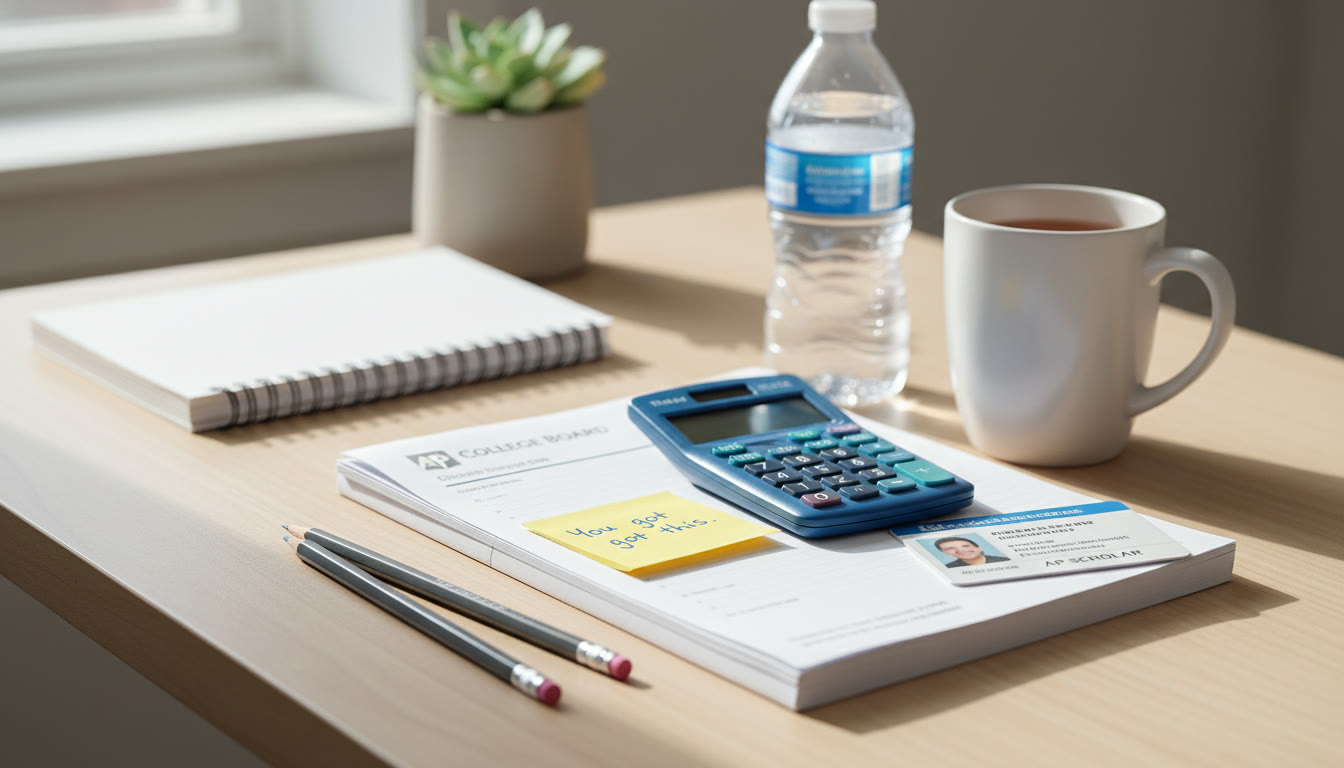
- Pack a test-day kit: Include your admission ticket or photo ID, two #2 pencils (or mechanical pencils with extra lead if allowed), eraser, approved calculator(s), backup batteries, and a watch (airplane mode or non-smart).
- Dress in layers: Testing rooms can be unpredictable. A light sweater helps you stay comfortable without interrupting concentration.
- Check travel time: Plan to arrive 20–30 minutes early. A slow start shakes confidence more than a tricky question ever will.
Quick kit checklist
| Item | Why it matters | Action |
|---|---|---|
| Photo ID / Admission Ticket | Needed for entry | Confirm before leaving home |
| Pencils / Eraser | For sections requiring pencil responses | Bring spares |
| Approved Calculator(s) | Essential for many science sections | Test batteries and settings; pack a backup |
| Watch (non-smart) | Time management | Set to local time; don’t rely on phone |
| Water | Keeps you alert | Sealed bottle; sip during breaks |
Calculator and tech rules — don’t get tripped up
Calculator policies can vary by subject and by year, and the College Board provides the official rules. As a general rule for AP science exams:
- Use only approved handheld calculators or the testing platform’s built-in calculator if available. Bring a handheld calculator you’ve practiced with; unfamiliarity wastes time.
- Bring up to two calculators if you like redundancy, but only approved models are allowed. Proctors may check models before testing begins.
- Remove any smartwatch or wearable tech and keep personal devices powered off and out of reach.
Practical tip: the morning of the test, switch your calculator on, run a quick calculation, and confirm mode settings (degrees vs radians, statistical modes off/on, etc.). If you rely on a graphing calculator, make sure memory or data won’t accidentally display prohibited materials.
Checklist for the first 15 minutes in the exam room
These first minutes are gold. Use them to orient, not to panic.
- Scan the entire test: If allowed, flip through to see structure and difficulty. This helps with pacing decisions.
- Read instructions carefully: Tiny phrases like “show your reasoning” or “give units” are easy to miss but cost points.
- Mark easier questions first: On multiple-choice sections, answer the quickest confident ones. Build momentum and secure points early.
- Allocate time: Note the number of questions and total time, then carve it into manageable blocks. Keep a small buffer for review.
Science-specific pre-answer checks
These are the habits that separate correct answers from careless errors.
- Units: Always write units with numeric answers. If a question asks for energy in joules and you write calories, you risk losing points even if numerical value matches after conversion.
- Sig figs and rounding: Follow the question’s guidance. When in doubt, keep an extra significant figure in intermediate steps and round at the end.
- Axes and graphs: Label axes and include units. If you sketch a graph for a free-response question, small, accurate annotations earn clarity points.
- State assumptions: If you approximate or assume negligible friction, state it. Small sentences like “assuming negligible air resistance” demonstrate scientific thinking and can preserve partial credit.
- Show core steps: Even if the final answer is right, exam graders award partial credit for correct reasoning. Two or three tidy steps are worth the extra time.
Example: a clean free-response approach
Imagine a physics FRQ asking for the speed of an object after falling a certain distance.
- Write down knowns: initial velocity = 0, distance = d, g = 9.8 m/s^2.
- State the formula you’ll use (e.g., v^2 = v0^2 + 2gd).
- Plug numbers and solve showing algebraic steps.
- Give final answer with units and appropriate sig figs.
This structure helps graders follow your reasoning and captures partial credit if arithmetic slips occur.
Time management strategies that actually work
Time is your constant test partner. Use it strategically.
- Two-pass approach: First pass — answer all easy questions you’re sure about. Second pass — focus on medium-difficulty problems. Third pass — tackle the toughest items and use remaining time to check work.
- Set mini-deadlines: If a section is 60 minutes for 40 questions, aim to finish the first 20 in 30 minutes. These micro-targets keep you on pace without constant clock-checking.
- Don’t fight a stuck problem too long: If you’re not making progress in 3–5 minutes on a single free-response item, move on and return later with fresh eyes.
- Use answer-elimination: For multiple-choice, cross out the clearly wrong answers first, then make an educated guess if necessary.
Last-minute review routine (final 10–15 minutes)
If you finish early, use your time wisely. A relaxed last pass beats frantic scanning.
- Check units and labels: Quick scans often reveal a missing “m/s” or mislabeled axis.
- Recalculate suspicious arithmetic: If an answer feels off by an order of magnitude, redo the core computation rather than the whole problem.
- Confirm multiple-choice marks: Make sure circles are filled correctly and match your intended answer.
- Look for overlooked parts: Some free-response problems have multiple parts — double-check you answered each subpart.

Stress-management micro-tools
Anxiety is normal. Use two-minute tools to re-center without losing mental clarity.
- Box breathing: Inhale 4 counts, hold 4, exhale 4, hold 4 — three cycles. Simple and effective.
- Progressive attention: Focus on your feet, then calves, then hands — a quick body scan to ground yourself.
- Positive cue: Have a short phrase like “Clear work, clear mind.” Repeat once or twice to reset after a tough question.
When lab-style or practical knowledge appears
Many AP science exams test experimental reasoning: interpreting graphs, identifying controls, or explaining sources of error. For these questions:
- Identify variables: name independent, dependent, and controlled variables explicitly.
- Note trends before numbers: describe the shape of the graph — linear, exponential, plateau — then quantify.
- Discuss plausible errors: state a specific experimental limitation and how it would skew results (for example, measurement resolution causing systematic underestimation).
Short rubric-minded checklist for experiment questions
- Did I identify variables? (Yes / No)
- Did I state a clear trend and connect it to underlying theory? (Yes / No)
- Did I propose a specific, realistic source of error and direction of effect? (Yes / No)
Personalized help and smart study signals
If you find yourself repeating the same kinds of errors — mislabeling units, shaky algebra, or unclear explanations — targeted, personalized help speeds improvement. Sparkl’s personalized tutoring can fit naturally here: short 1-on-1 sessions to shore up weak spots, tailored study plans that focus on your pattern of mistakes, expert tutors who show you how to structure free-response answers, and AI-driven insights that highlight which practice problems will move your score the most.
Personalized help is especially useful close to test day for polishing presentation habits and pacing strategies that are hard to fix alone.
Post-test immediate actions (within 24 hours)
Your brain consolidates learning best when you reflect. After the exam:
- Make a quick note of what surprised you or what felt unexpectedly easy. This helps refine your study plan.
- Don’t over-analyze every question. If something truly bothered you and you want feedback, save a brief list of specific items to review with a tutor or in your next study session.
- Reward yourself. Even small rituals — favorite snack, short walk, or hanging out with friends — help reset motivation for the next stretch.
One-week practice checklist (for the final week)
Use a focused routine in the last seven days leading up to the exam. Keep it high quality, not high volume.
| Day | Main Focus | Example Activity |
|---|---|---|
| 7–6 days | Content gaps | Targeted reviews on weak units and flashcards for vocabulary |
| 5–4 days | Practice problems | Timed sections from past exams or practice sets |
| 3–2 days | Full timed sections | Simulate test conditions for one or two sections |
| 1 day | Light review and rest | Quick concept summaries, organizer cards, and sleep |
Sample 10-minute checklist to memorize
Memorize this tiny routine and run it like a mental ritual the morning of the test:
- Pocket card: ID, admission ticket, pencils, calculator, watch, water.
- Battery test: calculator on, mode check.
- Mental check: breathe twice, visualize first question going smoothly.
- Timing plan: note total time and target marks per block.
- Confidence cue: repeat a short positive phrase and start.
Final words — confidence over perfection
Great exam days aren’t about perfect recall; they’re about composed thinking. Use this checklist to remove friction from the day — logistics, timing, and presentation — so your brain can do what you’ve trained it to do: analyze, reason, and communicate clearly. When you tidy the small things, you free cognitive energy for insight.
And remember: targeted support like Sparkl’s personalized tutoring can be the nudge that turns repeated small errors into reliable habits. One focused session on free-response structure or on calculator habits often returns far more than the time invested.
You’ve prepared. Now give the exam your best structure, your clearest reasoning, and your calmest self. Go in with a checklist, work the plan, and leave confident that you did everything you could to show what you know.
Good luck — and breathe. You’ve got this.


























No Comments
Leave a comment Cancel