

Why building concepts early gives you the competitive edge
Start here: building concepts early is not about studying more hours—it’s about studying smarter. For a CBSE student aiming at competitive exams, the advantage of early conceptual clarity is simple and lasting: when fundamentals are solid, problems that once felt intimidating become puzzles you know how to solve. Concepts act like keys that open many locked doors—one principle often applies to several chapters or question types, saving time and reducing stress when exam season tightens.

Why ‘early’ changes the game
Early means giving your brain time to absorb, revisit, and connect ideas across subjects instead of cramming facts the night before a test. It lets you space practice, interleave topics, and really test your intuition with varied problems. For CBSE students juggling school assessments and competitive preparation, early concept work reduces the clash between board priorities and entrance exam patterns—because conceptually sound answers perform well across formats.
Understand the roadmap: use the CBSE syllabus as your GPS
Think of the CBSE syllabus as a roadmap, not a shopping list. Each chapter contains a handful of core concepts; identify them early and treat the rest—formulas, exceptions, and problem types—as extensions of those cores. Map topics by concept clusters rather than by chapter names: for example, in physics, ‘conservation’ threads across mechanics and thermodynamics; in chemistry, ‘reaction mechanisms’ recur in organic and inorganic contexts. That perspective turns many small tasks into a few meaningful drills.
How to convert the syllabus into concept clusters
- Scan the syllabus: note recurring keywords across units.
- List 5–8 core concepts per subject that explain most problems.
- Create one-line definitions and a 3-problem checklist for each concept (easy, medium, hard).
- Use that checklist to prioritize study time and mock practice.
Daily, weekly, and monthly habits that build deep understanding
Concept-building is a habit game. Small, consistent actions beat occasional marathon sessions. Structure your weeks so that active learning is the default: short focused study blocks, deliberate practice, and quick daily reviews that lock ideas into long-term memory.
Sample micro-routine (daily)
- 45–60 minute focused study block on a single concept (no multitasking).
- 10–15 minute active recall: close the notes and write the concept from memory.
- 30 minutes of problem practice applying that concept (mix easy and medium difficulty).
- 5–10 minute reflection: note misunderstandings and plan next steps.
Set milestones: a simple table to guide your first two months
Below is a compact milestone table you can adapt. Use it to measure concept coverage and practice targets rather than just hours spent.
| Period | Primary Goal | Concept Focus | Practice Target | Assessment |
|---|---|---|---|---|
| Weeks 1–2 | Foundation mapping | List core concepts for 3–4 chapters per subject | 10–12 targeted problems per concept | Short checkpoint quiz (self-marked) |
| Weeks 3–4 | Apply and connect | Interleave concepts across chapters | 20 mixed problems per week + 1 timed section | Teacher review or peer check |
| Weeks 5–8 | Consolidate & time management | Full-topic synthesis (derivations, mechanism chaining) | 2 full-length sectional tests + focused revision | Detailed solution audit and correction log |
Active techniques that turn facts into usable knowledge
Active learning is the bridge from reading to solving. A few techniques make the difference between passive familiarity and true mastery.
Try these consistently
- Feynman-style explanation: Teach the concept to an imaginary student in plain language. If you stumble, you found a gap.
- Spaced repetition: Revisit core concepts after increasing intervals—1 day, 4 days, 10 days—so retrieval gets easier.
- Interleaving: Mix different types of problems in a session instead of doing lots of one type; this improves problem recognition.
- Worked-to-own: Study worked solutions, then immediately redo the problem without looking at steps.
- Concept maps: Draw links between concepts across subjects to see recurring principles.
Subject-specific tips that keep concept work practical
- Mathematics: Understand why a method works—not just how. Re-derive formulas from first principles for at least one example each week.
- Physics: Convert word problems to free-body sketches or energy-flow diagrams; use units to sanity-check results.
- Chemistry: Group reactions by mechanism and practice writing stepwise electron-flow or structural logic.
- Biology: Use flow diagrams to connect systems and processes rather than memorizing isolated facts.
Full-length mock practice: the rehearsal that reveals gaps
Full-length mock practice is not a punishment—it’s a diagnostic rehearsal. Schedule sectional tests and full-length papers at regular intervals. Treat each mock like data: time taken per question, accuracy, pattern of mistakes, and stress points. After every mock, spend as much time reviewing mistakes as you did taking the test.
A clear post-mock checklist
- Mark every question as concept-weak, careless error, or time-pressure error.
- For concept-weak items, write a 2–3 line note on what to study and include two practice problems to fix it.
- For careless errors, track the trigger (rushing, misreading, arithmetic) and set a corrective habit.
- For time-pressure errors, simulate pacing strategies in the next mock.
Design your revision cycle around mastery, not memorization
A good revision cycle repeats a focused block of study, targeted practice, a mock, and a reflective review. That loop trains your memory and sharpens your test intuition. Keep a correction log where every mistake becomes a short lesson; over time that log becomes the best review resource you own.
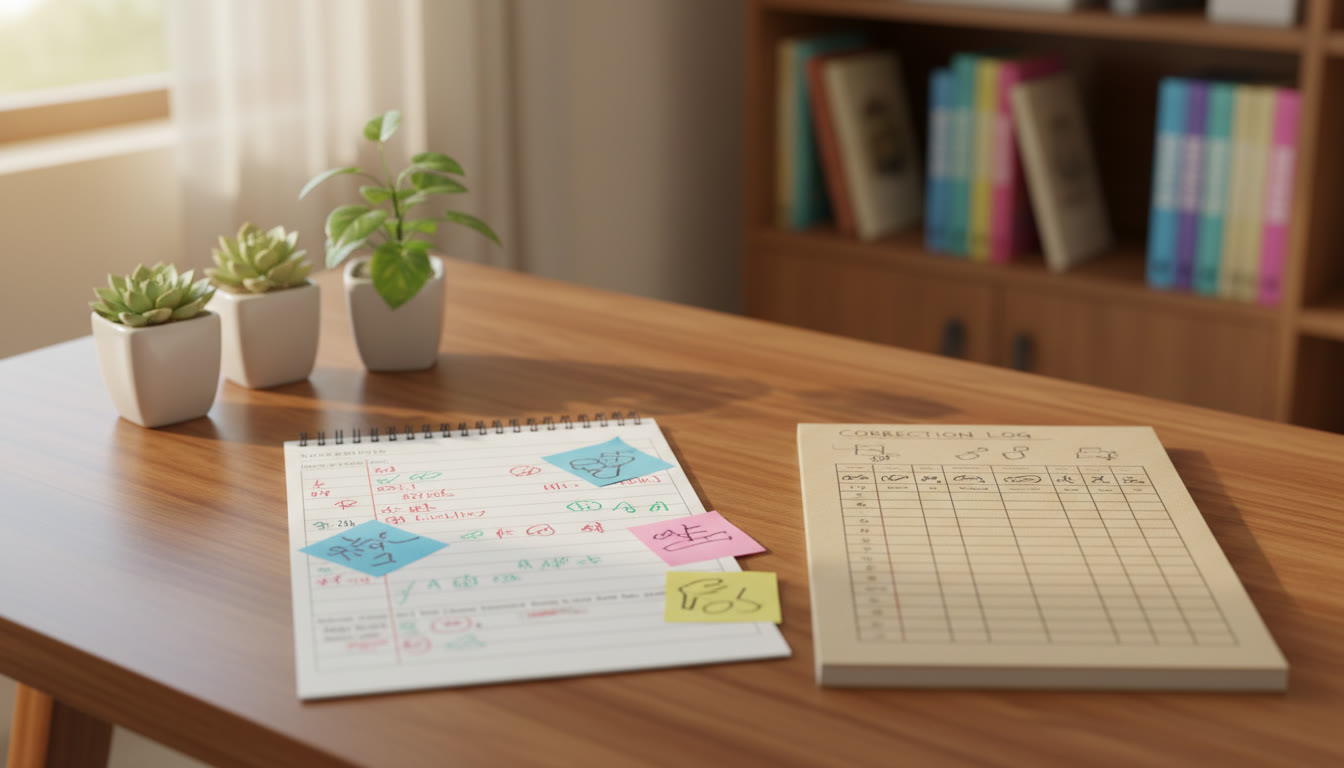
How to use a correction log
- Record the question (short description), mistake type, correct approach, and two follow-up problems.
- Tag entries by concept so you can filter and revise weak areas quickly.
- Review your log weekly and before each mock—this turns errors into learning fuel.
When personalized help fits naturally: targeted tutoring and study plans
Many students benefit from focused one-on-one time when a specific concept keeps recurring as a weakness. Personalized tutoring helps isolate those gaps, sets tailored study plans, and gives corrective feedback—especially on problem-solving approach, examination technique, and pacing. Sparkl‘s tailored study plans and 1-on-1 guidance can be plugged into your schedule when you need targeted acceleration or when self-study plateaus. The value lies in precise feedback loops and strategies that match your learning rhythm.
What to expect from quality personalized sessions
- Short diagnosis to identify root causes (misconception vs. practice deficit).
- A plan that aligns with the CBSE syllabus and your mock schedule.
- Actionable homework that closes the loop between lesson and test performance.
- Periodic adjustments based on mock outcomes and your energy levels.
Practical checklist: daily and weekly to-dos for concept growth
- Daily: one focused concept block + active recall + quick problems (90–120 minutes total).
- Weekly: 1–2 mixed concept sessions + one timed sectional test + review of correction log.
- Monthly: one full-length mock + deep audit and updated milestone table.
- Ongoing: maintain sleep, nutrition, and short physical breaks—thinking clarity matters as much as time spent.
Common pitfalls and how to avoid them
Students who work on concepts early still sometimes stall because of a few common traps. Recognize these early:
- Rote over reason: Don’t memorize procedures without understanding why they work. When a new problem appears, ask “Why would this approach work?”
- Practice without feedback: Random problem practice is less effective than focused practice with review—always check your solutions and note corrections.
- Neglecting connections: Isolating chapters prevents you from seeing transferable ideas—use concept maps frequently.
- Ignoring time management: Conceptual clarity won’t help if pacing collapses in exam conditions—use timed mocks to train speed and stamina.
Simple metrics to track your progress
Use straightforward, measurable indicators so you know when to adjust the plan:
- Accuracy per concept (%) on practice sets.
- Average time taken per question type (minutes).
- Number of concept-weak items appearing in mocks over time.
- Retention check: correctly recall core idea unaided after 1 week and again after 2–3 weeks.
Example: turning metrics into action
If accuracy on “kinematics vectors” is 60% and time per vector problem is 12 minutes, plan two focused sessions on vector decomposition and relative motion, then retest with three timed problems. If accuracy rises and time drops, you know the intervention worked.
Stitching schoolwork and competitive prep without burnout
Balance is not about equal hours; it’s about prioritized hours. Use school time to strengthen board topics and choose small windows—before or after school, or on weekends—for competitive problem exposure. Alternate heavy conceptual weeks with consolidation and lighter, skill-focused weeks to sustain momentum and avoid burnout.
Tips to stay consistent
- Protect one uninterrupted study block each day for deep concept work.
- Use school assignments as practice opportunities—apply the same active techniques when you do them.
- Keep weekends for synthesis: concept maps, mixed problem sets, and longer mocks.
Final checklist before every exam cycle
- Have a concept checklist for each subject—review it weekly.
- Maintain a correction log and revisit it before mocks.
- Schedule regular full-length mock practice and treat the results as data for the next plan.
- Use targeted help when progress stalls; short, focused tutoring sessions can convert weeks of struggle into measurable gains.
Building concepts early is a long-game strategy that pays off in clarity, confidence, and adaptability. By turning the syllabus into a map, using active study techniques, measuring progress with simple metrics, and rehearsing under exam conditions, you convert scattered effort into steady mastery. Whether you study alone, with peers, or with targeted one-on-one support, prioritize understanding over memorization, practice with feedback, and steady, measurable improvement. This approach makes the CBSE journey and competitive preparation mutually reinforcing: solid school performance strengthens competitive readiness, and concept-driven competitive practice deepens school learning. End of article.

























No Comments
Leave a comment Cancel