

Why a research-driven CAS profile matters (even without publications)
When universities, scholarship committees, or school coordinators look at your IB profile, they’re rarely only counting bylines; they’re looking for evidence that you can ask a question, design an approach, collect and interpret data, and reflect honestly on what you learned. A research-driven CAS portfolio shows intellectual curiosity, sustained effort, and a habit of mind that crosses subjects and contexts—qualities that matter as much as any publication.
Think of research as a toolkit rather than a trophy. Publications are one outcome of research, but they are not the only way to show research maturity. For IB DP students, especially those balancing CAS, TOK, and the Extended Essay, demonstrating rigour, transparency, ethics and impact through well-documented projects is just as persuasive—and far more practical.

Understanding how research maps to CAS and your IB profile
What CAS really looks for
CAS isn’t a checklist of outcomes to tick off perfunctorily; it’s a learning journey. When you embed research practices into CAS activities, you’re not only satisfying requirements—you’re building an academic narrative: defining a problem, planning interventions, collecting evidence, acting ethically, and reflecting on learning. Admissions readers care about the depth of that learning—not the presence of peer-reviewed articles.
Research skills that translate directly to your portfolio
Key research skills are portable across CAS strands (Creativity, Activity, Service): question formulation, literature/precedent review, methods selection, data collection, basic analysis, evidence curation, ethical practice and reflective writing. Presenting these skills clearly in your portfolio shows maturity. The rest of this article walks through how to develop and present those skills in ways that are credible and compelling.
How to design research-driven CAS projects step by step
1. Start with a sharp, manageable question
Good research begins with a good question. Make it specific, feasible within your time and resources, and aligned to CAS goals. Rather than “help the environment,” try “What low-cost interventions reduce cafeteria food waste by at least 20% over eight weeks?” or “Does a weekly peer-mentoring session improve Year 9 students’ confidence in algebra problem solving?” Specificity makes your planning measurable—and measurable makes your portfolio persuasive.
2. Co-design scope and ethics
Once you have a question, sketch a simple study design: who, what, when, where, how and why. Identify stakeholders and ethical considerations—consent for surveys, privacy for photos, safety for physical activities. Co-design with community partners when possible; service-oriented research is strongest when it answers a real need.
3. Make a plan that maps to CAS learning outcomes
Show explicitly in your documentation how project stages meet CAS learning outcomes: initiative and planning, collaboration, perseverance, new skills, and engagement with global and local issues. Don’t bury this mapping—make it easy to find in your evidence folder.
Documenting rigorously: what to collect and how to present it
Build a research log that tells the story of your inquiry
Every research activity should generate artifacts. Keep a time-stamped log (digital or physical) with short entries for decisions, setbacks, and breakthroughs. That log is often the clearest evidence of sustained engagement—more convincing than a polished final product alone.
| Stage | Record Type | Example Artifacts | How it Supports CAS/Portfolio |
|---|---|---|---|
| Planning | Research question, timeline, risk assessment | Project brief, Gantt chart, consent templates | Shows initiative, planning and ethical awareness |
| Data collection | Notes, raw data, photos, recordings | CSV files, audio clips, photos with timestamps | Demonstrates method and persistent activity |
| Analysis | Summaries, charts, code snippets | Graphs, spreadsheets, annotated transcripts | Shows critical thinking and evidence-based conclusions |
| Dissemination | Presentations, workshops, posters | Slides, video clips, attendance sheets | Shows impact and communication skills |
| Reflection | Structured reflections, plans for next steps | CAS reflections, teacher feedback, peer reviews | Connects experience to learning outcomes |
Practical tips for evidence
- Use dated photos and screenshots; include short captions that explain what is shown and why it matters.
- Keep raw data files—don’t overwrite or delete them; they prove authenticity.
- Collect short witness statements from community partners or teachers that mention specific contributions and dates.
- Keep reflective entries weekly: what you did, what changed, what you learned, and next steps.
Turning projects into replicable micro-studies
Keep scope lean and methods sound
If you can’t commit to a full-scale study, design a micro-study: one focused variable, short timeframe, simple measurement. Micro-studies are powerful in a CAS portfolio because they show methodology and follow-through without requiring journal publication.
Example micro-study format
- Question: Clear and measurable.
- Hypothesis: A tentative prediction.
- Method: Step-by-step so someone else could reproduce it.
- Results: Quantitative where possible; otherwise clearly coded qualitative data.
- Reflection: Limitations, surprises and next steps.
Interdisciplinary leverage: tie research to EE, TOK and subjects
Multiply your impact by coordinating work
When a CAS research activity overlaps with an Extended Essay topic or a TOK question, you gain efficiency and build a cohesive academic profile. For instance, a service project that tracks local biodiversity can yield observations for an EE in Biology and spark TOK discussions about empirical evidence and models.
Community-based action research: service that documents change
Design projects that benefit and measure
Service research must show benefit to others. Partner with a local organization, agree on measurable goals, and co-create evaluation criteria. Evidence could include pre/post surveys, attendance logs, qualitative interviews, and policy recommendations. This kind of documented impact carries weight.
Presenting your work—outputs that carry weight without publications
Ways to disseminate and validate your findings
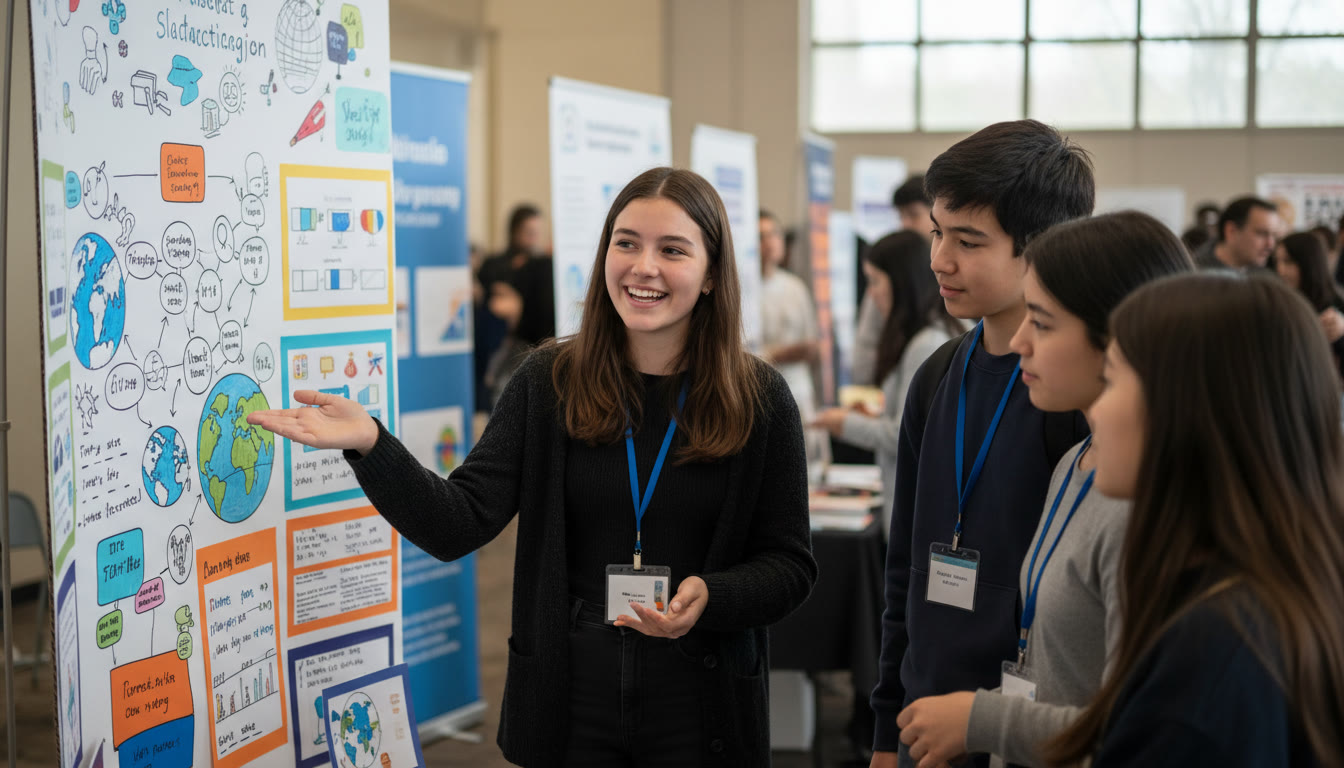
- School research fairs or poster sessions with an attendance log.
- Workshops or lessons you lead—participant feedback is evidence.
- Digital exhibits: narrated slideshows, short documentary videos, or podcasts hosted in your school portfolio.
- Policy briefs or recommendations presented to a community stakeholder with a response or minutes.
- Peer-review within your school: have subject teachers or mentors evaluate your methodology and add signed comments.
For students who want structured support putting a project together, Sparkl‘s personalized tutoring can help with research design, statistical basics and tailored study plans, offering 1-on-1 guidance so your methods and evidence are tight and presentable.
Making your profile credible: transparency, reproducibility and validation
Show your method, don’t just describe the result
Admissions and coordinators value transparency. Include short appendices or “how-to” notes so others can see precisely how you collected and analyzed data. Explain your sample size, measurement tools, calibration, and limitations. That level of honesty builds credibility.
External validation without journals
Collect external validation in these forms: mentor endorsements, community partner letters, participant feedback surveys, workshop attendance numbers, or awards at school-level competitions. These are tangible signals that others recognize your contribution.
Practical toolkit: templates, timelines and artifacts
Sample 12-week timeline (adjust to cycle)
| Weeks | Milestone | Deliverable |
|---|---|---|
| 1–2 | Define question & stakeholders | Project brief, consent forms |
| 3–4 | Design method & pilot | Pilot data, adjusted protocol |
| 5–7 | Main data collection | Raw datasets, logs |
| 8–9 | Analysis & stakeholder check-in | Charts, summary notes |
| 10–11 | Prepare dissemination materials | Poster, slide deck, workshop plan |
| 12 | Share results & reflect | Reflection entries, partner feedback |
Key artifacts to include in your portfolio and how to present them
- Project brief — one page: clear question, timeline, partners.
- Research log — weekly entries with dates and short summaries.
- Data folder — raw files plus a README explaining variables.
- Analysis summary — key findings in plain language and a short visual (chart or table).
- Reflection — explicit links to CAS outcomes and learning.
- External validation — signed emails, photos with partners, feedback forms.
Common pitfalls and how to avoid them
- Overambitious scope: Narrow your question to what you can reliably measure.
- Poor documentation: Daily or weekly logs trump vague end-of-project summaries.
- Neglecting ethics: Always document consent and privacy steps for human participants.
- Weak reflection: Explain not just what you did, but what changed in your thinking or skills.
- Isolated work: Seek feedback from teachers and community partners early and often.
How mentors and targeted support accelerate learning
Good mentorship shortens the feedback loop. A tutor or mentor can help you tighten your research question, test your instruments, and interpret results. If you choose external support, use it selectively—for methodology review, data analysis and polishing your reflection rather than doing the intellectual heavy lifting for you. When seeking help, request concrete deliverables: a method critique, a statistical check, or a rehearsal of a presentation.
For structured coaching that focuses on research fundamentals and presentation, Sparkl‘s personalized tutoring offers targeted 1-on-1 sessions, tailored study plans and guidance on turning raw findings into portfolio-ready artifacts.
Reflection frameworks that make learning visible
A simple reflection scaffold
Use a short, repeatable reflection scaffold each week so your growth is traceable:
- Describe: What did you do this week?
- Analyze: What patterns or data emerged?
- Evaluate: What worked, what didn’t, and why?
- Plan: What will you change next?
Consistent use of this scaffold turns a series of activities into a clear narrative of development—precisely the story IB assessors and admission readers want to see.
Final checklist: what a strong research-driven CAS profile includes
- A clear, concise project brief for each activity.
- A dated research log showing sustained engagement.
- Raw data and a short README explaining it.
- At least one dissemination artifact (poster, workshop, or video) with evidence of audience.
- External validation in at least one form: partner letter, teacher endorsement or participant feedback.
- Weekly reflections linked to CAS learning outcomes and future steps.
- Ethics and consent documentation where relevant.
Building a research-driven profile is less about chasing publications and more about building a credible, evidence-rich narrative of inquiry. When methods are transparent, impact is documented, and reflection is honest, your CAS portfolio becomes a powerful testament to both your intellect and your character. This level of preparation equips you for subject essays, TOK exploration and the kinds of independent scholarship expected of DP learners.
Thoughtful design, consistent documentation and purposeful reflection: these are the pillars of a research-driven CAS profile that stands out without a single publication.



























No Comments
Leave a comment Cancel