

Why a one-page CAS & activities summary matters — tell a clearer story, faster
You’ve lived the messy, rewarding reality of CAS: late-night rehearsal logs, community project planning meetings, service trips, coaching sessions, art exhibitions and those small moments of learning that never made it into a polished CV. Counsellors see hundreds of student records. A one-page CAS + activities summary lets you turn several months (or years) of work into a single, carefully curated snapshot that highlights growth, impact and authenticity.
This isn’t about reducing everything to a checklist. It’s about giving counsellors the narrative they need to write recommendations, place emphasis on the most meaningful experiences, and understand how your CAS work supports your broader IB profile. When done well, a one-page summary becomes a bridge: it connects the messy details you remember to the big-picture outcomes school staff and university readers need to understand.

What counsellors actually look for
Imagine a busy counsellor opening your one-page CAS summary between meetings. They want to quickly answer three questions: What did you do? Why did it matter? What did you learn? The clearer and more honest your answers, the easier it is for them to advocate for you.
Clarity: a clean headline and priorities
Start with a simple headline or profile statement (one sentence). Counsellors use this to set the tone of a reference. A focused opening line—e.g., “Student focused on service-learning with leadership in sustainability projects and a strong record of collaborative arts initiatives”—helps them position you at a glance.
Evidence: concrete metrics and artifacts
Numbers help. Total hours, number of participants you led, funds raised, or measurable outcomes are quick signals of commitment and impact. Counsellors aren’t asking for exhaustive proof on a one-page sheet, but they need to know you kept records and can point to supporting artifacts.
Reflection: concise, honest learning
Reflection is the heart of CAS. Counsellors will prefer short, thoughtful learning statements tied to specific activities over long, generic descriptions. Use tight reflection sentences that show metacognition—what you learned, how you changed, and how you’ll apply those lessons.
Structuring your one-page CAS + activities summary
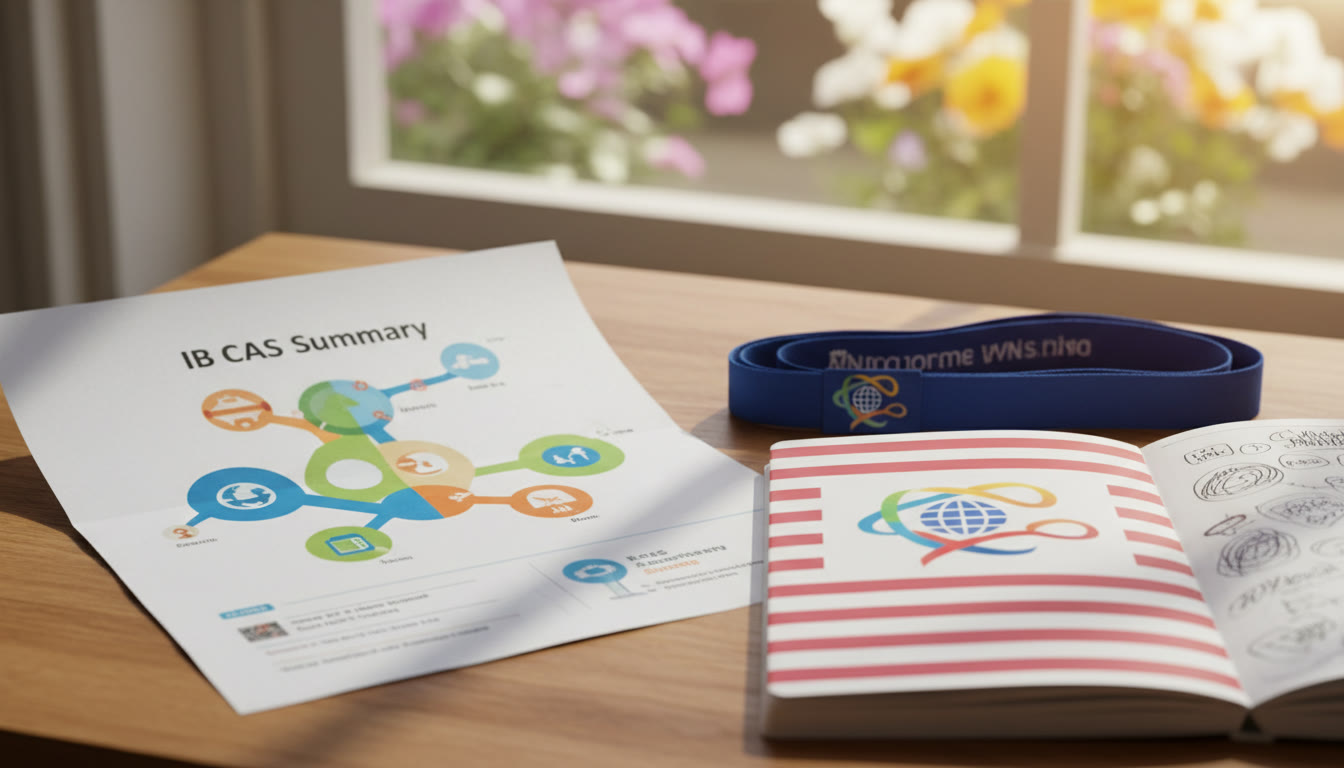
The golden rule: prioritise readability. Use headings, short bullets, and a small table to show the activity mix. Your page should guide the reader from overview to specifics in thirty seconds.
Top section: Snapshot and profile
- Name & cohort: Your full name and the programme label (IB DP).
- One-line CAS profile: A single sentence summarising themes (leadership, service-learning, creative expression, global issues).
- Totals summary: Total verified CAS hours (or a statement of ongoing reflection), number of sustained projects, and balance across Creativity, Activity, Service if applicable.
Middle section: The activity table (the core)
A concise table lets counsellors scan categories, your role, and evidence quickly. Keep columns focused and limit rows to the most meaningful 6–10 entries.
| Activity | Role / Responsibility | CAS Category | Time / Dates | Key Learning Outcome(s) |
|---|---|---|---|---|
| Community garden project | Co-leader: planning, volunteer coordination | Service / Activity | 60 hours / ongoing | Initiation, collaboration, ethical awareness |
| School musical (set design) | Lead designer; team manager | Creativity | 40 hours / term project | Perseverance, planning, new skills |
| Peer tutoring in maths | Tutor (weekly) | Activity | 45 hours / weekly | Collaboration, communication, personal growth |
| Charity fundraiser | Campaign lead | Service | 20 hours / 2-week campaign | Leadership, global engagement, measurable impact |
Note: tailor this table to your reality. If you have many short-term activities, summarise them under a single heading with grouped metrics (e.g., “Multiple community outreach events — 10 events, 50 hours — see portfolio”).
Bottom section: Key reflections and evidence map
Use three short reflection bullets (one-sentence each) that connect to the items above. Immediately below, list how counsellors can access evidence—portfolio page, document titles, or key attachments. Keep links or file names short: counsellors should not have to hunt.
Sample reflection language — concise, honest, and evaluative
Reflection sentences should be specific, show learning, and suggest future application. Here are starter templates you can adapt:
- “Leading the community garden taught me project-management routines I had never used: I now create basic risk assessments and weekly volunteer rosters.”
- “Working on set design pushed me to accept iterative feedback and to translate abstract ideas into practical constraints.”
- “Weekly tutoring strengthened my ability to explain concepts and improved my patience with different learning paces.”
Short, concrete language makes reflections memorable. Avoid vague phrases like “I learned teamwork” without explaining how or why.
Quantify impact without sounding like a fundraiser
Numbers are persuasive when used responsibly. Instead of blanket phrases such as “helped many people,” be specific where possible:
- “Designed a rota for 20 volunteers that reduced setup time by 30%.”
- “Tutored 8 students for an average of 2 hours weekly; class average improved by 12 percentage points in mock exams.”
- “Raised £2,400 for the local food bank through a student-led campaign that reached 500 community members online.”
When exact numbers are not available, use ranges (e.g., “~40 hours”, “dozens of participants”)—this is honest and still useful.
Mapping activities to CAS learning outcomes
Counsellors want to see that your activities are purposeful. Map each activity to learning outcomes to show intentionality. Common learning outcomes to reference include identifying strengths, taking on challenges, initiating projects, demonstrating perseverance, working collaboratively, engaging with global issues, and considering the ethics of choices and actions. You don’t need to attach every outcome to every activity—pick the most relevant one or two.
How to show the mapping simply
- In your table, use a short phrase under the “Key Learning Outcome(s)” column—e.g., “Initiation; Collaboration.”
- In reflections, tie the learning back: “This project developed my planning skills (initiation) and taught me to collaborate across cultural differences.”
Crafting the evidence map
Everyone loves a good story; counsellors love proof. The evidence map is a one-line directory that tells them where to find photos, reflections, or project reports. Keep it tight.
- “Portfolio: ‘Garden Project’ folder — photo set (3), risk assessment PDF, volunteer roster, final reflection.”
- “Document: ‘Fundraiser Report’ — summary of outreach, donor list, bank receipt (PDF).”
Label files clearly so that a counsellor opening a folder can immediately identify the right document. Use a consistent naming scheme: Lastname_Firstname_ActivityName_FileType (e.g., Lee_Alex_Garden_Roster.pdf).
Design & formatting: make it scannable
Design choices influence readability. Counsellors appreciate predictable formatting: a short title, bold headers, one consistent font family, and clear bullet points. Keep the one-page summary printable as a single A4 or US Letter PDF.
Practical tips
- Use at most two font sizes: one for headings and one for body text.
- Limit dense paragraphs; aim for no more than three short sentences per paragraph in the main body.
- Use bold to highlight roles or evidence items; leave reflection text in plain italics or regular text so it doesn’t scream for attention.
- Keep margins balanced; don’t squeeze too much into the page—white space helps scanning.
Export to PDF with embedded fonts and a clear file name: Lastname_Firstname_CAS_Summary.pdf
Digital organisation and verification
Digital organisation is as important as writing. Use a single folder or a dedicated page in your student portfolio to collect evidence. If your school uses a platform for verification, keep copies in your private folder as backup and indicate verified items in your one-page summary.
Verification checklist example
- Has a supervisor signed or commented on the activity? Note yes/no and include a contact or document name.
- Are photos time-stamped or linked to an album? Add album names or file names.
- Is there a final reflection file for sustained projects? Point to the file name.
When to ask for help—and how to use tutoring meaningfully
Putting together your one-page CAS summary is a learned skill. If you’re unsure about how to phrase impact statements, quantify outcomes, or tighten reflections, it’s appropriate to seek support. For example, Sparkl‘s personalized tutoring can help you translate raw activity notes into crisp, counsellor-friendly language through 1-on-1 guidance, tailored study plans and expert tutor feedback, while also leveraging AI-driven insights to organise evidence and sharpen reflections.
Use external help to refine clarity and coherence, not to invent accomplishments. Authenticity matters more than perfectly polished rhetoric; tutors should help you find your voice, not write for you. If you choose to work with a tutor, make sure the final content is an honest reflection of your learning.
Examples: before and after a tight edit
Seeing transformation helps. Here are two short examples showing how to compress and clarify content for a one-page summary.
Before (too long)
“I worked on a project where we started a community garden with a group of students and other community members. We did a lot of planning meetings, contacted local partners, and had to figure out where to get soil and tools. I learned things about leadership and teamwork.”
After (one-page friendly)
“Co-led a community garden (60 hours). Coordinated volunteers and partnered with a local food bank to redistribute produce, reducing food waste and increasing community engagement. Learning: improved project planning and volunteer management; developed risk-assessment practice.”
The “after” is succinct, measurable, and ties directly to learning.
Quick templates and a final checklist
Here is a compact template you can adapt to your style. Keep it at the top of your one-page summary as a quick snapshot:
- Snapshot: Name | IB DP | CAS profile sentence
- Totals: Verified hours • Sustained projects • C/A/S balance
- Top activities (table): 6–8 rows with Activity, Role, Category, Time, Outcomes
- Key reflections: 3 x one-sentence takeaways
- Evidence map: named file locations and verification notes
Final checklist before you hand it in
- Is the page single-spaced and one readable PDF?
- Are roles and times accurate and honest?
- Are there 3 short reflections that show growth?
- Can a counsellor find supporting files in under 60 seconds?
- Have you asked a trusted teacher or a mentor to glance at clarity (not content creation)?
Closing academic note
A one-page CAS + activities summary is an exercise in clarity: it documents what you did, signals why it mattered, and shows how you learned. By selecting your most meaningful experiences, quantifying impact where possible, mapping activities to learning outcomes, and presenting evidence in a tidy, accessible way, you give counsellors the material they need to represent your CAS journey with accuracy and academic insight.
















No Comments
Leave a comment Cancel