

IB DP Final 90 Days: How to Stop Forgetting What You Studied
You’ve put in months—or even a couple of years—of steady work. Now the finish line is close enough to taste, and the last thing you want is to walk into exams feeling like everything you learned evaporated overnight. The good news: forgetting isn’t a moral failing or proof you weren’t working hard. It’s a normal brain process that responds extremely well to specific, repeatable strategies. In the next 90 days you can transform brittle recall into dependable performance by restructuring how you review, practice, and rest.

Start with a calm assessment (Day 1)
Before you rewrite any plan, do one clear, honest check-in: which topics feel solid, which barely stick, and which you can explain aloud? Spend a focused two-hour session per subject doing a “retrieval inventory”: close your notes and write down everything you remember, then score yourself. That snapshot becomes your triage list for the 90 days.
Why a retrieval inventory matters
It reveals the difference between recognition (you feel like you know something when you see it) and recall (you can produce it unaided). Exams demand recall. The inventory shows where to apply heavy retrieval practice and where to use lighter spaced review.
Why memory fails at exam time (and what to do about it)
There are three common reasons students feel blank under pressure: shallow encoding, interference, and retrieval failure. Each problem has a matching solution:
- Shallow encoding → deeper processing (summarise, teach, make connections).
- Interference → interleaved practice (mix topics to reduce confusion).
- Retrieval failure → active recall and practice under exam conditions.
Science-backed principles to keep front of mind
These are the high-leverage moves to use consistently across subjects:
- Active recall: Test yourself before you reread. Closed-book quizzes beat rereading every time.
- Spaced repetition: Return to material with increasing intervals to move memories into long-term storage.
- Interleaving: Mix related topics so you learn to choose the right method under uncertainty.
- Elaboration: Explain ideas in your own words, with examples and consequences.
- Dual coding: Combine words and visuals—diagrams, timelines, or concept maps.
- Sleep and recovery: Consolidation happens when you sleep; timing study around restful sleep multiplies retention.
Design a realistic 90-day roadmap
Break the 90 days into three roughly equal phases: Stabilize, Consolidate, and Polish. Each phase has different goals and rhythms, and the table below gives a compact, practical view you can adapt to your subjects and internal deadlines.
| Days left | Phase focus | Weekly targets | Daily time (typical) |
|---|---|---|---|
| 90–61 | Stabilize: shore up foundations | Core notes clarified; retrieval inventory completed; IAs on track | 2–4 hours focused |
| 60–31 | Consolidate: deeper retrieval and problem practice | Weekly mixed-topic tests; past-paper practice; timed responses | 3–5 hours focused |
| 30–1 | Polish: exam technique and last-pass memory cues | Timed full papers, quick-fact recall, exam logistics checked | 2–6 hours focused (with smart rest) |
How to assign time across subjects
Not all subjects need equal time. Use the retrieval inventory to weight hours: weaker subjects get more sessions; stronger subjects get short, high-quality retrieval sessions. Keep at least one mixed-subject session each week to practice switching mindsets.
Daily and weekly rhythms that prevent forgetting
Your brain likes patterns. Build a weekly rhythm with four elements: a guided review block, a heavy retrieval block, a mixed-practice block, and deliberate rest. Here’s a sample day you can tune to your own energy:
- Morning (or first study block): Active recall from yesterday’s topics (30–60 minutes).
- Midday: Focused subject deep work—past paper question, IA drafting, or problem sets (60–90 minutes).
- Afternoon: Lighter creative consolidation—mind maps, flashcards, teaching a friend (30–60 minutes).
- Evening: Low-stakes review and plan next day; prioritise sleep quality.
Session structure that beats passive marathon study
Use cycles like 45/10 or the classic Pomodoro (25/5) for focus. Each focused block should end with 5–10 minutes of retrieval: close notes and write a quick self-quiz or summary. The small act of producing knowledge is the glue that keeps it.
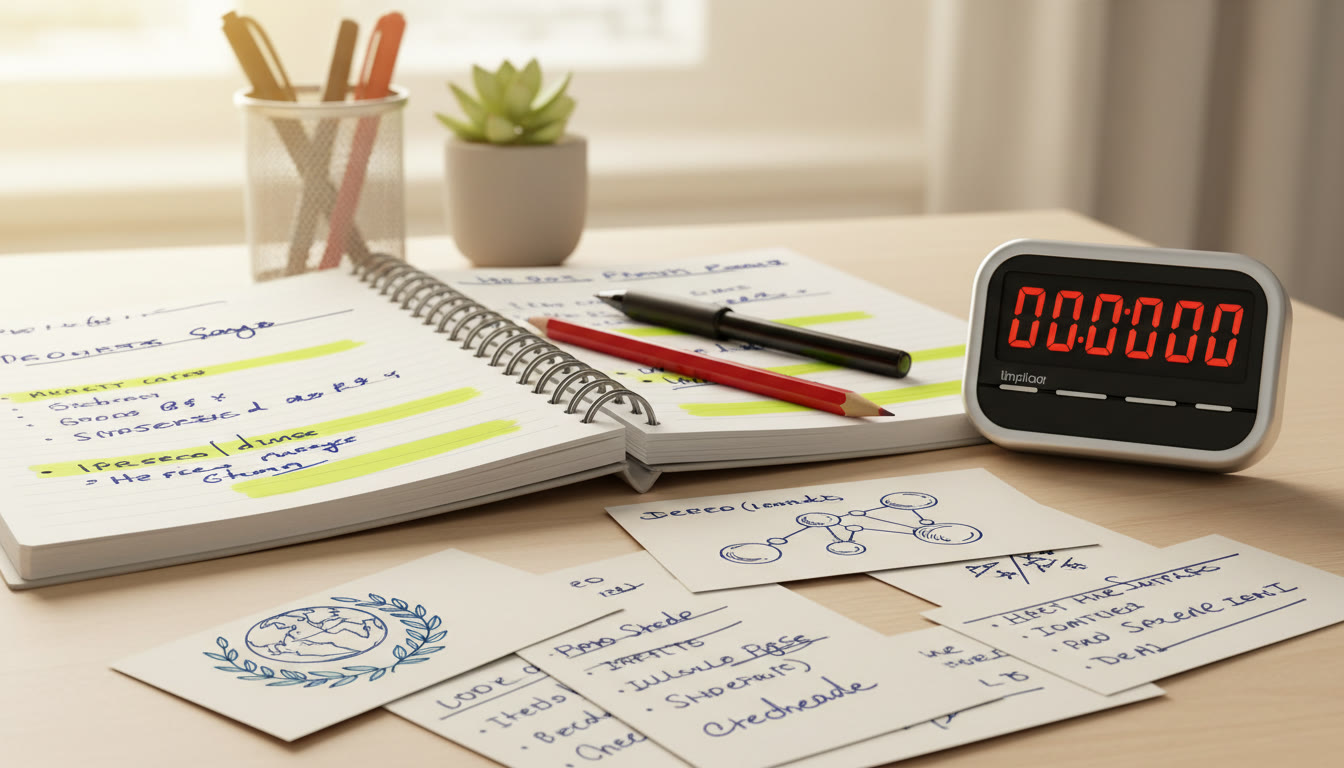
Concrete tools: flashcards, concept maps, and timed papers
Tools are only useful when they support the principles above. Here’s how to use them wisely:
- Flashcards: Keep them short and specific. One fact or question per card. Use spaced review—focus more on the cards you get wrong.
- Concept maps: Perfect for linking major IB ideas (e.g., linking TOK concepts to subject knowledge). Redraw them from memory.
- Past papers: Simulate exam conditions regularly. Build from short, timed questions to full timed papers in the final phase.
Subject-specific breaks on forgetting
The same memory strategies apply across subjects, but small adaptations make them far more effective:
- Sciences: Practice drawing and explaining diagrams, label them from memory, and do lots of problem sets under timed conditions.
- Mathematics: Work on varied questions to force method selection; interleave algebra, calculus, and statistics practice.
- Humanities: Use retrieval through short essay outlines, linked timelines, and practice past paper paragraphs.
- Languages: Active production matters most: speak or write short answers and correct them, rather than just reading texts.
Internal Assessments and Extended Essay: triage and timeboxing
IA and EE tasks are often the largest sources of last-minute stress. If they still need work, carve out fixed weekly blocks and make incremental goals (e.g., evidence collection, draft sections, supervisor feedback). Timeboxing reduces the cognitive load and leaves more reliable memory energy for subject recall.
Mastering past papers without burning out
Past papers are practice, not punishment. Use them to surface weak areas and then move immediately into targeted review. A productive cycle looks like this: timed paper → mark with markscheme → note error patterns → 2–3 targeted retrieval sessions on weak spots.
How to mark and learn from mistakes
When you check answers, don’t just correct: annotate your margin notes with the exact trigger that caused the mistake (e.g., “misread command term,” “forgot formula,” “weak time management”). Those triggers become your micro-goals for the next review round.
Practical weekly checklist for the final 90 days
- One full timed paper per subject every 7–10 days in the consolidate phase; increase to one full paper every 4–7 days in the polish phase.
- Three to five short (20–40 minute) active-recall sessions per subject each week.
- One mixed-subject transfer session per week where you switch topics every 20–30 minutes.
- Regular sleep target and at least two short movement breaks daily.
Managing exam anxiety and memory under pressure
Stress doesn’t just feel bad—it narrows attention and interferes with retrieval. Include short mental-rehearsal practices: a brief breathing routine before a timed paper, and a one-minute “cue-list” you read at the desk to anchor focus (three facts, one formula, one structural phrase for an essay).
Simple pre-exam mental checklist
- Breathe for 60 seconds to slow your heart and steady attention.
- Scan the paper quickly to plan time allocation.
- Start with one question you can complete confidently to build momentum.
How to use targeted help effectively
There is enormous value in short, targeted guidance when you’re trying to turn fragile knowledge into stable recall. If you bring focused questions—past-paper errors, IA feedback, or a concept you can’t explain—one-on-one support can speed up the learning loop. Sparkl‘s personalized tutoring offers 1-on-1 guidance, tailored study plans, expert tutors, and AI-driven insights that help you identify exactly where retrieval breaks down and how to fix it efficiently.
Micro-habits that compound
Tiny, consistent actions beat occasional marathon sessions. These micro-habits are easy to integrate and high-return:
- Write a one-minute summary after every study session.
- Use a two-card flashcard routine each morning: one active card for a weak fact, one for a strong fact.
- At the end of each day, note the single most confusing point and review it the next morning.
Sample 7-day rotation for one subject
Rotate the focus each day to balance depth and spaced review.
| Day | Activity | Goal |
|---|---|---|
| 1 | Retrieval inventory & flashcard review | Identify 5 weak subtopics |
| 2 | Targeted practice problems | Fix method errors |
| 3 | Mixed past-paper question | Timed recall |
| 4 | Concept mapping / dual coding | Deep connections |
| 5 | Teach-back or explain aloud | Strengthen articulation |
| 6 | Full timed practice (short) | Exam technique |
| 7 | Rest/light review & planning | Consolidate gains |
When to push and when to rest
There are days when heavy lifting is necessary—especially after a reality-check mock—but the most productive strategy is alternating intensity. If you finish a hard, full paper, follow it with a light day of re-explaining and sleeping well. Sleep is not optional in the final weeks; it is part of the study plan.
Common pitfalls and how to avoid them
- Rereading without testing: Replace one reread with one closed-book quiz.
- All cram, no spacing: Break cram sessions into short, distributed bursts across days.
- Perfectionism: Mistakes are data. Mark them, fix the pattern, move on.
- Comparing timelines: Tailor your plan to your inventory, not to someone else’s tracker.
Bringing it together: a practical checklist for each study session
- Start with a 2–5 minute recall test of yesterday’s material.
- Work one focused 30–60 minute block on a prioritized item.
- End with a written 3-question self-quiz and note corrections.
- Schedule the next review: make the interval explicit (e.g., review again in 2 days, then 6 days).
How tutoring, feedback, and AI insights fit in
High-quality, short tutoring sessions amplify the loop of testing, error diagnosis, and corrective practice. When you use external help, bring the right inputs: a past-paper question you missed, a one-paragraph explanation you couldn’t produce, or a list of repeated mistakes. Tools with intelligent feedback can highlight patterns you didn’t notice—where you confuse terms, struggle with command words, or make calculation slips—and point you to a focused plan. For targeted help in the final phase, consider structured support that pairs expert guidance with personalized schedules; this can free up time and reduce wasted effort.
One practical way to integrate this kind of support is to book short 30–45 minute sessions around weak spots, then follow up with a three-day micro-review to lock in the fix.
Final practical notes
Keep a visible, simple checklist on your desk. At the end of each week, compare your actual progress with the plan and adjust: more test papers, fewer hours on topics that already show stable recall. Remember that small, consistent retrieval beats last-minute marathons.
In these final 90 days the right combination of active recall, spaced and interleaved practice, calibrated past-paper work, rest, and targeted feedback will turn fragile knowledge into reliable recall for exam day.















No Comments
Leave a comment Cancel