

IB DP Germany Admissions: Strategy for Heidelberg University — Science & Research Fit
If you’re an IB Diploma student dreaming of Heidelberg — one of Europe’s most research-intensive universities — you’re thinking in the right direction. Heidelberg’s reputation for deep scientific inquiry means admissions committees aren’t just looking at points; they’re looking for evidence you can contribute to a lab, think like a researcher, and thrive in a rigorous academic culture. This guide walks you through an IB-specific strategy: subject choices, grade targets, how to use your Extended Essay and Internal Assessments to demonstrate research fit, language and application logistics for Germany, and how to shape an application that feels authentically you.

Why aim for Heidelberg? A quick, human take
Heidelberg is not just another name on a transcript. It’s a university where labs are often led by internationally visible researchers, where cross-disciplinary collaborations are common, and where undergraduate education is closely tied to active scholarship. For a student who wants to do more than attend lectures — someone who wants to design experiments, interpret primary data, and perhaps continue into a research degree — Heidelberg offers fertile ground. But that also means your application needs to show more than numerical ability: it should tell a story of scientific curiosity, hands-on experience, and intellectual readiness.
How the IB Diploma gives you an edge — if you use it well
The IB DP is uniquely positioned to show both breadth and depth. HL subjects demonstrate depth in the fields that matter to you (chemistry, biology, physics, mathematics); the Extended Essay (EE) gives you a chance to show independent research skills; and CAS projects can underpin sustained commitment or leadership in scientific settings. But having the diploma alone isn’t a magic ticket: how you structure those pieces determines whether your application reads like a research candidate’s or like a well-rounded student’s.
Picking subjects: build a science-forward portfolio
When choosing your IB subjects for Heidelberg science programs, think like a researcher and like an admissions reader at the same time. Practical advice that consistently helps:
- Make two science or math HLs your foundation. Common pairs are Chemistry HL + Biology HL for life sciences, or Physics HL + Mathematics HL (Analysis & Approaches) for physics, engineering-adjacent or data-heavy pathways.
- Don’t overload with three HLs in unrelated areas. Depth matters; two HLs aligned to your intended field plus a complementary HL (e.g., a language or another science) is a stronger signal than scattered excellence.
- Use SLs to support your narrative: an SL in a language shows communication ability, while SL in computer science can show technical versatility.
- Choose TOK and EE topics that reinforce your science story. An EE in a subject closely related to your intended major (for example, an experiment-based biology EE) is especially powerful.
Grades & targets: realistic, strategic benchmarks
Universities read IB scores in context. Aiming high is important, but equally important is setting subject-specific targets. For competitive research-fit applications to Heidelberg science programs, think in terms of excellence in relevant HLs and consistent performance across the rest of the diploma.
| Component | Target IB Performance (evergreen guidance) | Why it matters | Actionable tip |
|---|---|---|---|
| Relevant HLs (two) | Consistently 6–7 in HLs aligned with your major | Shows mastery of subject content and readiness for degree-level work | Prioritize HL revision plans; seek lab internships to connect theory and practice |
| Other HL/SL subjects | 5–7 (aim for minimal variance) | Demonstrates well-rounded ability and academic reliability | Use mock exams to identify and close small gaps early |
| Extended Essay (EE) | High mark; clear methodology and analysis | Direct evidence of research thinking and independent project delivery | Pick an EE topic with measurable outcomes and strong supervisor support |
| CAS & extracurriculars | Sustained, evidence-based involvement | Shows perseverance, practical skills, and curiosity outside exams | Record measurable outcomes (e.g., lab hours, poster presentations) |
Extended Essay, IAs and TOK — your research portfolio
The EE is your single best asset for showing research fit. Treat it as a mini thesis: define a clear question, adopt an explicit method, analyze data thoughtfully, and discuss limitations. Internal Assessments (IAs) across science subjects are secondary evidence — collate strong IAs into a portfolio that you can reference in motivation letters or interviews. Use TOK reflections to show meta-awareness: how do you evaluate evidence? How do you deal with uncertainty? Those intellectual habits are exactly what research supervisors at Heidelberg value.
How to communicate research experience
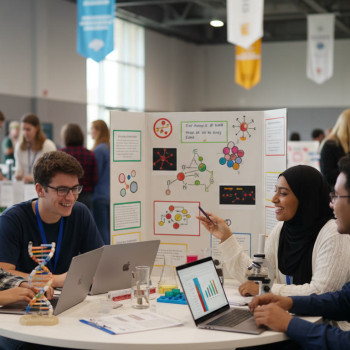
Admissions readers are busy; make it easy for them to see your preparation. When you list lab experience or a science fair project, quantify: what was your role, what methods did you learn, what were the outcomes? If you present a poster at a regional fair, say so. If your EE led to a measurable result or a novel analysis, describe the methodology briefly. A concise paragraph in your application that ties a specific experience to the skills you developed — experimental design, statistical analysis, scientific writing — will go further than a long list of club names.
Language & application logistics for Germany and Heidelberg
Language plays a practical role in admissions. Many Heidelberg programs, especially at undergraduate level, are taught in German or expect some German competency; but there are also programs and research tracks with instruction in English. Typical steps for international IB students:
- Confirm the language of instruction for your chosen program and the university’s exact language requirements. An English-taught program will still often request proof of English proficiency unless you can demonstrate that your IB language and instruction satisfy their conditions.
- If you plan to study in German, prepare for recognized German language certificates (for example, DSH or TestDaF) or check if the university accepts IB language qualifications in place of a test.
- Check whether Heidelberg requires centralized application services, direct portal submission, or any faculty-specific procedures. Some German universities use third-party pre-check services for international credentials; others manage admissions directly.

Context from other systems — what to learn from international differences
It’s useful to compare Germany’s processes against other popular destinations so you can plan your IB DP track with flexibility.
- UK (UCAS) — The admissions format has shifted to structured reflection: three focused questions covering Motivation, Preparedness, and Other Experiences. If you’re applying to the UK and Germany, write reflections that are transferable: concise, evidence-based, and focused on academic fit.
- Switzerland (EPFL) — Admissions there have recently emphasized selective caps for international bachelor’s intake; for example, EPFL has announced a competitive cap of 3,000 international bachelor students in a recent update, and selection is rank-based rather than guaranteed by score alone. If you’re comparing Heidelberg versus Swiss options, remember selection at some Swiss schools can be explicitly quota-driven.
- Canada — Scholarship language differs: look for Automatic Entrance Scholarships (grade-based, awarded on the basis of admitted grades) versus Major Application Awards (which are nomination- or application-based, often valuing leadership or specific experiences). When applying across systems, prepare both academic transcripts and evidence of leadership/impact.
- Netherlands — For numerus fixus engineering programs (for instance at technical universities), a much earlier deadline often applies; many of these programs use a January 15th cutoff for applications, well before general deadlines. If you’re keeping options open, plan early so you don’t miss these windows.
- Singapore — Offers for IB students at major Singaporean universities frequently arrive later in the cycle (often mid-year), which can create a timing gap compared to early US/UK offers; be mindful of deposit and acceptance timing if you’re juggling multiple offers.
Presenting your case for Heidelberg specifically
Heidelberg values a clear research fit. Instead of vague statements, give precise connections: name a lab or a professor whose research resonates with you (if you have a genuine match), describe a technique you want to learn, or explain how a local internship influenced your academic question. Even if you don’t know a specific supervisor, referring to the department’s research themes and linking those themes to your EE or past experiments signals that you’ve done your homework.
Practical checklist for applications (evergreen)
- Verify language and admission requirements on the program page; note whether documents need translation or certified copies.
- Align two HLs with your intended major and keep a third HL as a strategic complement.
- Choose an EE topic that creates a strong evidence trail for research interest; seek a supervisor who understands the university’s expectations.
- Build a concise research portfolio of IAs, lab reports, posters, and supervisor letters that you can reference in applications or interviews.
- Plan for any required language tests and collect certificates early.
- If you have non-academic research experience (lab work, internships), document methods, outcomes, and specific skills learned.
Sample action-plan timeline (flexible and evergreen)
| Phase | Focus | Student action |
|---|---|---|
| Year 1 of DP (early) | Subject selection & discovery | Decide HLs, explore EE topics, start small laboratory tasks or summer research if possible |
| Year 1–2 (middle) | Portfolio building | Complete strong IAs, attend science fairs, draft EE, secure reference from a teacher who can speak to research abilities |
| Final year of DP (application phase) | Finalize application materials | Refine motivation paragraphs, translate/verify documents, prepare language tests and interview talking points |
The role of tutoring, mentoring and focused coaching
Many successful applicants pair strong self-study with targeted support. Personalized tutoring can help you convert raw ability into exam-ready performance and credible application narratives. For example, one-on-one guidance can sharpen your EE methodology, tighten lab write-ups for IAs, and help you rehearse interview answers framed around scientific reasoning. For students who value structured accountability and expert feedback, tailored tutoring often accelerates progress.
When external help is appropriate, look for tutoring that offers:
- Subject-specific expertise and familiarity with IB assessment criteria
- Support for research writing and data analysis
- Guidance on building an application narrative that ties academic evidence to research ambitions
For students interested in those kinds of focused supports, Sparkl‘s tailored tutoring can be useful for 1-on-1 guidance, creating a study plan that matches your HLs, and providing coach feedback on your EE and application materials.
Putting it together: a short example narrative
Imagine an applicant who wants Molecular Biology at Heidelberg. She takes Biology HL and Chemistry HL, with Mathematics HL (Analysis & Approaches) as a strong complementary HL. Her EE is an experimental study on bacterial resistance patterns supervised in her school lab; her Biology IA investigates a local ecological dataset; she completed a summer internship in a university lab where she learned PCR basics and data plotting. In the application, she references the methods she’s mastered, links those methods to a department research theme, and quantifies her lab hours and outcomes. That concrete, method-focused narrative is precisely the kind of profile that aligns with Heidelberg’s research culture.
What to avoid
- Vague statements of interest without concrete evidence. Say what you did, how you did it, and what you learned.
- Overloading on activities with no measurable substance. A long list of clubs is less persuasive than a few deep, outcome-oriented projects.
- Assuming the same strategy works everywhere. Admissions processes differ — keep your application tailored to Germany/Heidelberg while keeping other routes open.
Final academic note
To make your Heidelberg application competitive as an IB student, align two HLs with your intended science field, produce an Extended Essay and IA evidence that demonstrate research capability, meet language requirements for the program you choose, and present a clear, quantified narrative of the skills and methods you’ve learned. When those pieces come together, your application will read less like a list of achievements and more like the beginning of a research trajectory.


























No Comments
Leave a comment Cancel