

Panel interviews: why they feel like a rapid-fire test — and how you can make them feel manageable
Panel interviews are a rite of passage for many IB Diploma Programme students applying to competitive universities. The room feels small, the voices multiply, and questions can arrive from several directions at once. That jumble of voices is not a trap — it’s an opportunity. Panels are designed to see how you think in real time: how you prioritize, how you keep composure, and how your IB learning (TOK explorations, Extended Essay research, CAS reflections) lives inside your answers. With a few practical habits, a simple mental structure, and sound rehearsal, you can transform that pressure into a calm performance that highlights your best thinking.

Understand the panel’s aim and read the room
Before you try to master rapid questions, remember why panels exist. Different interviewers have different goals: an academic interviewer may push on subject knowledge, an admissions officer might gauge fit and motivation, and an alum or faculty member could be listening for intellectual curiosity and resilience. Your job is to be helpful to all of them at once — clear, honest, and concise — and to let your IB work offer evidence of your thinking.
Who’s likely to be on the panel and what they want
- Admissions officer: clarity about motivation, fit with the program, and how you’ll contribute to campus life.
- Subject tutor or department representative: subject depth, analytical habits, and potential for advanced study.
- Faculty or external interviewer: critical thinking, openness to feedback, and intellectual curiosity (TOK-related probing may appear here).
- Occasional alumni or current students: practical, lived perspectives and follow-up on extracurricular interests or CAS projects.
Common question types you’ll see from a panel
- Motivation questions: “Why this course? Why this university?”
- Academic fit: “Tell us about a key idea from your subject and how you explored it.”
- IB-specific probes: “How did your Extended Essay change the way you approach research?” or “What TOK insight surprised you?”
- Personal qualities: “Describe a challenge and how you responded.”
- Rapid follow-ups and hypotheticals: designed to test how you reframe or prioritize under pressure.
Prepare like you’re preparing for a conversation, not a script
Preparation matters less when it becomes rote and more when it becomes reliable muscle memory. Build short, evidence-rich stories from your IB experience that you can adapt on the fly: one about an Analytical success in Physics IA, one about a challenge during a CAS project, and one about a surprise TOK insight. Each story should have a clear point (what you learned) and a short example (what you did).
Practical pre-interview checklist
- Summarize your Extended Essay, IA, and TOK reflection into one-paragraph bullet points you can speak aloud in 30–60 seconds.
- Prepare one concise CAS story that shows initiative, reflection, and impact.
- Practice redistributing attention: get comfortable making eye contact with multiple people while keeping your thought thread intact.
- Run panel mock interviews with peers, teachers, or an experienced tutor.
How guided practice can sharpen your focus
Working with a tutor or coach who simulates a multi-person panel accelerates progress because it exposes habits you won’t notice alone: looking only at one interviewer, over-explaining in response to a subject-specific prompt, or failing to redirect when two questions arrive at once. Many students pair self-practice with targeted coaching to build both content and presence. For those who want structured support, Sparkl‘s personalized tutoring — 1-on-1 guidance, tailored study plans, expert tutors and AI-driven insights — can provide practice that mirrors live panels and feedback that helps you improve between sessions.
Answer architecture: a simple structure you can use under pressure
When multiple questions come at once, a reliable answer shape is your anchor. Use this compact structure: Point → Evidence → Reflection → Short Bridge. It gives you a clear beginning, a concrete middle, a reflective finish, and a one-line transition that invites the next question.
What that looks like in practice
- Point: one clear sentence answering the question.
- Evidence: a quick example from IB work (EE, IA, CAS, or coursework).
- Reflection: what you learned or how your thinking changed.
- Bridge: a short sentence that opens to further detail or invites the next question.
When questions pile up: strategies to manage the moment
Panels can feel like an orchestrated barrage. The good news is that the panel isn’t trying to trick you; they’re testing flexibility. Here are tactics that let you keep control while staying courteous.
Short buys: phrases that buy you time and signal composure
- “That’s an interesting point — may I answer briefly and come back to the other part?”
- “Could I clarify which part you’d like me to focus on first?”
- “I’ll answer the main point in one sentence, then outline an example.”
How to triage multiple questions
Triage with a simple rule: answer the question that best demonstrates your academic fit first, then the affective/character question. If two questions are equal, answer the shorter, more concrete one first to show crisp thinking, then expand on the reflective question.
Sample scripts — use them as templates, not scripts to memorize
When an interviewer asks several quick questions, you can use these short, polite frames to stay in control without shutting anyone down.
- Interruption: “If I may finish this thought in one sentence, then I’ll answer your point.”
- Overlap: “That’s closely related — I’ll link the two: [one-sentence link], then address your specific query.”
- Unclear question: “Do you mean the theoretical side or the practical result?”
Tables to guide practice and timing
Use the table below to practice short, timed answers and to make a habit of structuring responses. The timings are guidelines you can adjust by subject and context.
| Question Type | Immediate Goal | Practice Timeframe |
|---|---|---|
| Motivation (Why this course?) | One-sentence thesis + 30–45s example | Practice 60s answers; tighten to 30–45s |
| Technical / Subject | Concise explanation + brief evidence (IA/EE) | Practice 90s deep-dive; 45s summary |
| Reflection (CAS, TOK) | State insight + impact on you | Practice reflective 60–90s speaks |
Practical rehearsal plan: a timeline that keeps momentum
Break preparation into deliberate blocks so you steadily build confidence. Below is a compact, adaptable plan that focuses on content, structure, and simulated exposure.
| Stage | Focus | Key Actions |
|---|---|---|
| Weeks out: knowledge and content | Summaries of EE/IA/TOK and CAS stories | Create one-paragraph summaries; write 3 evidence-rich stories |
| Mid-phase: structure and timing | Shape answers using P-E-R-B (Point, Evidence, Reflection, Bridge) | Practice with timers; record and listen back |
| Late-phase: panels and pressure | Simulate multi-interviewer dynamics | Run mock panels; refine eye contact and brief buys |
| Final days: polish and calm | Rest, light rehearsal, logistics | Review short notes, practice breathing, confirm arrival details |
How to answer one of the classic IB panel prompts
Below is a template you can adapt. Read it, then write your version with your details.
| Prompt | 60–90s Outline |
|---|---|
| “Tell us about your Extended Essay and what it taught you.” |
|
Body language, distribution of attention, and voice
Small, deliberate changes in posture and voice give panelists confidence in you. Breathe. Keep your shoulders relaxed. If the panel is three people, distribute your eye contact in short cycles — look at each person for a sentence or two. Use a slightly slower pace than your inner panic wants. Pausing for a breath before answering will make your words land and signals composure.
Simple micro-skills to practice every day
- Two-second pause before you start to speak to collect and frame your thought.
- One-sentence lead: start with a one-line thesis to orient listeners.
- One reflective close: end with 10–15 seconds that contextualize the example.
Handling the hardest moments: being honest without losing ground
If you genuinely don’t know an answer, or you’re asked a question that’s outside your experience, honesty plus a thoughtful pivot is your strongest tool. Admit the gap and then show how you would approach learning the answer or relate a similar example from your IB work.
Scripts for gaps in knowledge
- Honest + process: “I haven’t looked at that specific case, but here’s how I would begin to investigate…”
- Pivotal link: “I don’t have that exact example, but in my IA I tackled a similar challenge by…”
- Reflective curiosity: “That question makes me think about X — I’d be excited to explore it further because…”
Quick-reference cheat sheet: lines and rhythms to rehearse
These are lines to practice until they feel natural; they aren’t scripts to be repeated word-for-word but anchors that buy you time and structure.
- Opening lead: “In short, my main point is…”
- Brief buy: “May I answer the first part briefly and then return to your second point?”
- Transition: “That connects to my Extended Essay because…”
- Close: “In that experience I learned X, which I think is relevant because…”
Practice drills you can do alone or with others
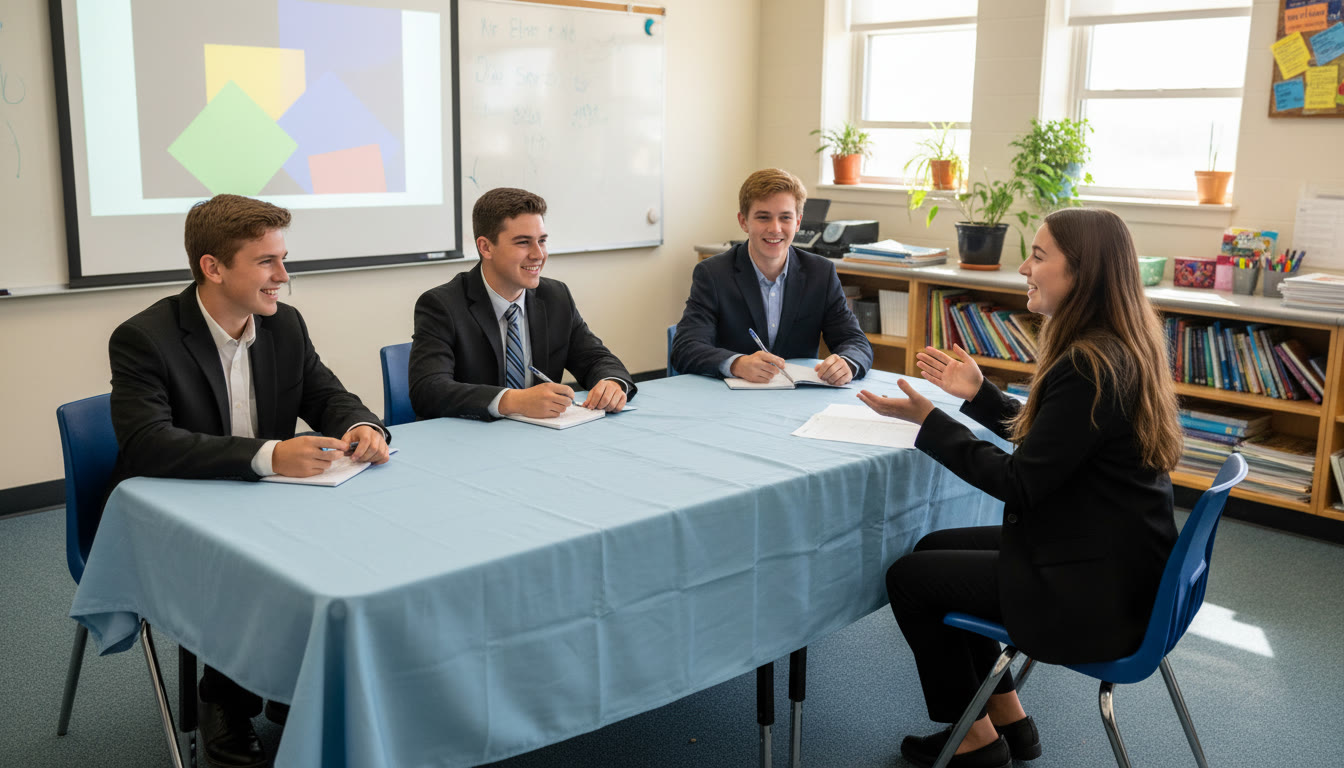
One of the most effective drills is the three-interviewer simulation: get two friends or teachers to play the panel and have them ask six questions in rapid succession, then allow you to answer for two minutes. Afterwards, get focused feedback on clarity, pacing, and whether you answered the highest-priority question first.
Common traps and how to avoid them
- Trap: Over-preparing to the point of sounding rehearsed. Fix: Practice flexibility; deliberately vary your wording.
- Trap: Rambling answers that don’t answer the question. Fix: Use the Point → Evidence → Reflection → Bridge shape.
- Trap: Ignoring the panel dynamic and speaking only to one person. Fix: Cycle eye contact and invite follow-ups.
- Trap: Defensive tone when challenged. Fix: Treat pushback as curiosity; thank the interviewer for probing and respond calmly.
When to bring evidence from your IB work, and how much to share
Panelists love concrete evidence, but they don’t want a long technical lecture. Choose one concise piece of evidence (a key data point, a textual insight from your EE, or a clear CAS outcome), explain it in plain language, and tie it to what you learned. The aim is clarity and intellectual humility, not exhaustive coverage.
Final day and day-of rituals to keep nerves in check
On the day, keep rituals simple: a short review of your one-paragraph summaries, a few minutes of breathing and posture practice, and a tiny warm-up conversation with a friend so your voice feels natural. Treat the interview as a conversation about your learning rather than a performance to be judged. That shift in perspective reduces pressure instantly.
Closing thought: turn the panel’s questions into a map of your thinking
Panel interviews reward students who listen, prioritize, and then answer with clarity and reflection. If you practice concise structures (Point, Evidence, Reflection, Bridge), rehearse under simulated pressure, distribute attention across the panel, and use calm buys when multiple questions arrive at once, you’ll show not just what you know but how you think. With disciplined rehearsal and steady composure, panel interviews will become an opportunity to let your IB experiences — your TOK insights, Extended Essay learning, and CAS reflections — speak for you.
End of article.






















No Comments
Leave a comment Cancel