

DP1 Month 7 — Your Mock Season Roadmap
Okay — deep breath. Month 7 of DP1 is often the moment when mock season moves from an idea to a calendar entry on your phone. The good news? Mocks are your rehearsal. They are not a final judgment; they are a spotlight that shows what’s working, what’s not, and where you can improve before the real exams. This blog walks you through a clear, humane, practical month-long plan: study rhythms, subject-specific tactics, exam technique, admin checklists, and the wellbeing routines that keep energy and focus consistent.

Why mocks matter — beyond the grade
Mistakes first, marks second. Mocks give you three things you can’t get from regular homework alone:
- Real exam rhythm: timed practice, pacing, and learning how to allocate your time across questions.
- Curriculum clarity: which syllabus topics need more study, which command terms keep tripping you up, and which assessment criteria you misunderstand.
- Feedback gold: teacher and peer feedback after a full paper is richer than comments on piecemeal homework.
Approach mocks as a diagnostic tool: extract information, then adjust the plan. If you treat them like a sink-or-swim test, you’ll miss the real value.
Month 7 in one sentence
Run a rehearsal that mimics exam conditions, record the results, and convert those results into a targeted four-week action plan that improves knowledge, exam technique, and exam stamina.
The 4-week mock sprint (what to do each week)
This is a compact, high-impact sequence you can adapt to your timetable. The table below lays out a weekly focus and simple deliverables. Aim for consistency (quality study of 2–4 focused hours daily is far better than erratic marathon sessions).
| Week | Primary Focus | Daily Time | Key Tasks | Deliverable |
|---|---|---|---|---|
| Week 1 — Baseline | Take full-length mock papers under timed conditions | 2–4 hrs (including warm-up) | One full paper per subject; simulate exam rules; note time used | Completed papers + raw score log |
| Week 2 — Mark & Diagnose | Mark papers against rubrics and compile error logs | 1.5–3 hrs | Self-mark then review with teacher/peer; extract top 3 weaknesses per subject | Error log + targeted weakness list |
| Week 3 — Intensify & Practice | Target weak areas with micro-lessons and past-question practice | 3–4 hrs | Active recall, past paper questions on weak topics, teacher consultations | Mini-mastery checklist for each weak topic |
| Week 4 — Simulation & Review | Run second round of timed papers and polish technique | 2–4 hrs | One timed paper per subject focused on previous weak spots; final review | Updated scores and a post-mock action plan |
How to time your day during the sprint
- Morning (best for hard thinking): 60–90 minutes on a heavyweight subject (maths, sciences, or analysis).
- Late morning/afternoon: 45–60 minutes of targeted practice (problem sets or revision cards).
- Evening: 30–45 minutes of lighter review (flashcards, TOK notes, reading for languages).
Subject-specific strategies (bite-sized, practical)
IB subjects differ in style. The trick is matching study technique to assessment style.
Sciences (Physics, Chemistry, Biology)
- Practice calculations and show all steps: examiners award method marks even if the final answer is off.
- Use past paper practical-style questions to prepare for labs and internal assessments — write clear aim, method, and sources of error.
- Create two-column notes: left = concept, right = 2 exam-style questions that test it.
Mathematics (Analysis & Approaches / Applications & Interpretation)
- Prioritize technique drills for recurring question types (derivatives, integrals, statistics formulas).
- Timed practice on shorter questions to build speed, then longer structured problems for depth.
- Mark using extended rubrics: if you lose marks due to poor notation, fix notation habits immediately.
Individuals & Societies (History, Economics, Geography)
- Practice planning essays under time pressure: 5–10 minute outline, then write. That outline habit saves time and prevents drift.
- Memorize high-quality evidence/examples you can adapt to several questions.
- For data response papers, practice quick interpretation and decide a stance within the first 5–10 minutes.
Languages (A & B)
- For Language A, practice paper 1 and paper 2 structures and ensure quotations are integrated smoothly.
- For Language B, prioritize oral fluency with short, timed speaking drills and build a bank of topics for written tasks.
- Vocabulary recovery: use application-based practice (write a paragraph using new words) rather than passive lists.
Arts and Electives
- Portfolio-based subjects: build a revision checklist for technique, process journals, and curatorial statements.
- Practical exams: practice under timed, setup-limited conditions to mirror exam constraints.
TOK, EE and Internal Assessments
- EE and IAs rarely finish overnight. Use Month 7 to schedule concrete checkpoints with supervisors: clear question, methodology, and a draft plan.
- TOK: practice linking real-life examples to knowledge questions. Use recent mock essays to hone clarity and structure.
Exam technique — how to win the marks you deserve
- Command terms: know the difference between “compare,” “discuss,” “evaluate.” Write a one-line plan that matches the command term before you write the answer.
- Time allocation: quickly divide available time by marks. If a question is 20 marks and you have 60 minutes, aim for around 20 minutes with review time at the end.
- Answers that show thinking: brief scaffolding, clear steps, and a concise conclusion earn clarity points.
- Label diagrams and units clearly. Small details like units can cost marks unnecessarily.
- Review habit: earmark the final 5–10 minutes of each paper to scan for lost marks, incomplete answers, or misread questions.
Mock logistics & practical checklist
Before exam day, triple-check these items — small slips cost time and focus.
- Stationery pack: pens (black/blue), spare pencils, eraser, ruler, protractor, approved calculator with fresh batteries, spare batteries.
- Exam materials: permitted formula booklets, dictionaries (if allowed), student ID.
- Know the rules: closed-book vs open-book; calculator policies; time and location of each paper; sign-in and supervision rules.
- Simulate conditions: sit a full timed paper at least once before the mock week so the real mock feels familiar.
Mental prep, stamina and wellbeing
Mock season is as much about stamina as it is about knowledge. A consistent routine beats irregular marathons.
- Sleep priority: treat the night before a mock like an exam night — aim for 7–9 hours of consistent sleep.
- Nutrition: regular meals with protein and complex carbs; avoid heavy sugar spikes on test mornings.
- Micro-recovery: 5–10 minute breaks after 45–50 minutes of focused work to reset concentration.
- Mindset ritual: a 2-minute breathing or focus routine before starting a paper reduces anxiety and sharpens concentration.
Marking practice — make feedback actionable
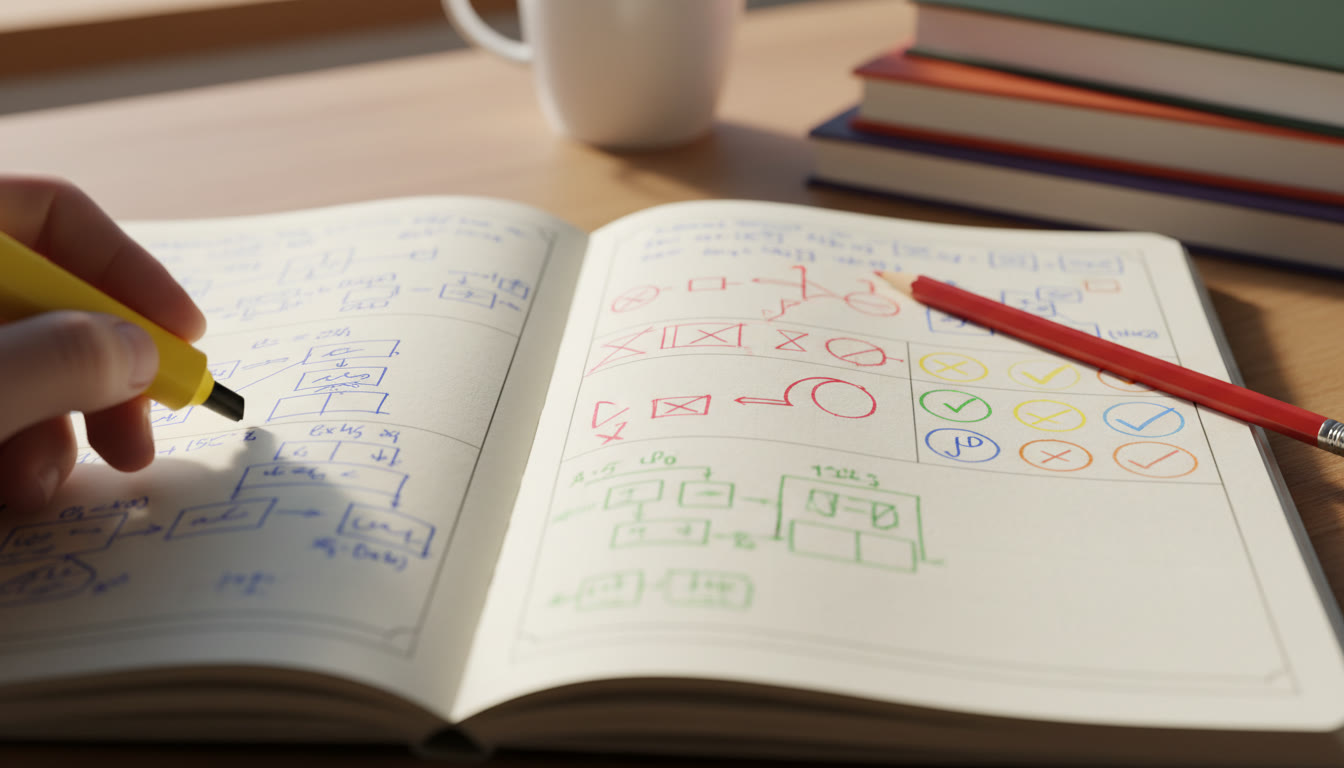
Use a simple triage system when you get marks back:
- Red items: big gaps — conceptual misunderstandings or repeated errors (fix with targeted study sessions).
- Amber items: technique or structure issues (practice 2–3 questions focusing on structure).
- Green items: things you can maintain with light review (flashcards, occasional practice).
Create an error log with three columns: Mistake — Why it happened — Fix. Review the log weekly and re-test yourself on logged items in simulation conditions.
When focused support helps: teachers, groups and Sparkl
Some weaknesses respond best to targeted coaching. Discuss these with your teachers first — they know your syllabus and assessment trends. If you need extra, structured help, platforms like Sparkl offer one-on-one guidance, tailored study plans, and expert tutors who can pinpoint exam technique and conceptual gaps. Sparkl‘s approach often combines human feedback with AI-driven insights to track progress and suggest focused practice, which can be particularly helpful for students who want a measurable improvement in a short window.
Sample day-by-day checklist for a student juggling six subjects
Below is a compact weekly pattern that balances revision, practice, and wellbeing. Adjust hours to match your course load and energy levels.
| Day | Morning | Afternoon | Evening |
|---|---|---|---|
| Monday | Timed paper — Subject A (1 paper) | Mark & error log for Subject A | Vocabulary / light review |
| Tuesday | Targeted practice — Subject B weak topic | Homework / teacher question | Group study (45 mins) |
| Wednesday | Timed paper — Subject C | Consultation with teacher | Restful activity: walk or hobby |
| Thursday | Problem drills — Subject D | Practice essay outline | Flashcards + sleep hygiene |
| Friday | Timed paper — Subject E | Mark & quick fix session | Light reading for Language |
| Saturday | Project work: EE/IA checkpoints | Creative rest / exercise | Peer review session |
| Sunday | Review error log & prepare plan | Meal prep + downtime | Early bed |
After your mocks — turn data into growth
Mocks are only useful if you do something with the results. Here’s a short process you can run right after marks are back:
- Collect your raw scores and compare them against your personal target bands rather than class averages.
- Identify the top three recurring mistakes across all subjects — those are your priority.
- Make a two-week micro-plan: daily targeted practice for those top mistakes plus weekly mini-simulations to test improvement.
- Book quick follow-ups with teachers to confirm you understood the feedback.
Common pitfalls and how to avoid them
- Over-correcting: Don’t try to overhaul your entire study system overnight. Fix one habit at a time.
- Ignoring mark schemes: Familiarize yourself with IB-style rubrics; examiners award what’s written against the criterion.
- Studying in isolation: Teach a concept to a friend or tutor — if you can explain it, you understand it.
- Burnout spiral: If you notice energy dropping, scale back and focus on high-impact edits: exam technique and common errors.
Tools that actually help during the sprint
- Past papers and mark schemes — practise, mark, and compare.
- Timed question banks — to build speed.
- Error logs and a small set of flashcards for fast recovery work.
- Teacher feedback slots — schedule short meetings and bring focused questions.
Final academic note
Mock season in DP1 Month 7 is a structured rehearsal: run authentic, timed papers; mark honestly; extract recurring gaps; and convert those gaps into a targeted action plan that you test and refine. The cycle of simulate → diagnose → practice → re-simulate is the clearest path to steady, reliable improvement in both knowledge and exam technique.
























No Comments
Leave a comment Cancel