

IB DP Pathways: Design & Architecture Pathway in IB DP—Portfolio, subjects, and planning
If you’re reading this while sketching in the margins of a notebook or hovering over a tiny cardboard massing model, welcome. The IB Diploma Programme gives you an unusually flexible platform to explore design and architecture—if you plan it with your future study and career goals in mind. This post is written for DP students who want practical steps: choosing subjects that open doors, building a portfolio that actually tells your story, and making counselling decisions that align school choices with university expectations for design and architecture courses in the upcoming entry cycle.

I’ll speak plainly about what admissions panels tend to look for, how your DP assessments (EE, TOK, CAS) can strengthen your case, and how to structure a portfolio that shows process—because process matters more than polished final pieces. Along the way I’ll point out the study and coaching supports that can help you refine technique and presentation, including how Sparkl‘s personalized tutoring can fit into that plan when you need targeted feedback or a tailored study schedule.
Is the architecture/design pathway right for you?
Passion, habits, and the kind of thinking you’ll enjoy
Architecture and design are about more than beautiful drawings. They are careers that blend spatial imagination, technical competence, and human-centered thinking. Ask yourself honestly: do you love making iterative sketches until an idea becomes clearer? Are you curious about materials, light, circulation and how people move through space? Do you enjoy both the conceptual (what should this space mean?) and the practical (how will this roof actually keep water out)? If yes, this pathway is a fit.
There are also closely related options—industrial/product design, interior architecture, landscape architecture, and urban design—that overlap in skills and portfolio expectations. Early on, treat your DP as an opportunity to sample different scales and methods so you can refine your focus before applications.
Picking IB subjects that strengthen your application
Core considerations
Universities and foundation studios look for a combination of demonstrable visual/technical skills and academic rigour. In the DP, that mix is achieved by pairing studio-type subjects (Visual Arts or Design Technology) with analytical courses (Mathematics, Physics, Geography or History). Choosing the right levels (HL/SL) helps too—some programmes value HL Mathematics for its analytical training; others prize a strong Visual Arts background.
Subject strengths: what each brings to the table
| Subject | How it supports design/architecture | Typical level to consider |
|---|---|---|
| Mathematics (Analysis & Approaches) | Builds geometric reasoning, calculus and precision—valuable for structural concepts and form-finding. | HL recommended for architecture-focused applicants |
| Design Technology | Teaches design process, materials, technical drawing and prototyping—directly portfolio-relevant. | HL or SL depending on school offerings |
| Visual Arts | Develops observational skill, composition and visual communication; excellent for an art-based portfolio. | HL builds a deeper body of work but SL can still be effective with supplementary projects |
| Physics/Chemistry | Useful for material behaviour, structural thinking and environmental systems—helps with technical essays. | SL or HL depending on intended emphasis |
| Geography | Strong for urban, environmental and site-analysis themes in portfolio projects and essays. | SL often sufficient; HL for deeper theory and fieldwork |
| History / Economics | History helps with architectural history and context. Economics supports understanding of development and urban policy. | SL or HL depending on interests |
| Language A | Clear writing and critical thinking help with the Extended Essay and articulation of design intent. | Choose the best language to write well in; HL adds depth |
Remember: not every student will take every recommended subject. The strongest applications are coherent. If you’re aiming for architecture, a combination like Mathematics (AA), Visual Arts or Design Technology, and a human-environment subject (Geography or History) tells a clear story. If product design is your goal, pair Visual Arts or Design Technology with a focus on rapid prototyping and perhaps IT-related skills.
Building a portfolio that actually persuades
Process, not perfection
Admissions reviewers want to see how you think. A polished final image is nice—but without pages that show your exploration, iterations, failed experiments and subsequent refinements, the portfolio feels shallow. Think of your portfolio as a compact narrative: problem → exploration → evolution → resolved idea. Each project should include a few process pages and at least one resolved outcome.
Essential portfolio components
- Site analysis and context pages: quick sketches, photographs, diagrams showing an understanding of place.
- Concept development: annotated sketches, thumbnails, precedents and quick models that show idea generation.
- Technical work: scaled drawings, sections, plans, exploded axonometrics or CAD screenshots where relevant.
- Physical/digital prototypes: photos of models, materials, and any 3D prints or fabricated pieces.
- Annotated final presentations: show the idea, the intended user, and decisions about materials and structure.
- Process documentation: evidence of iteration—what you tried, what you learned, what you changed.
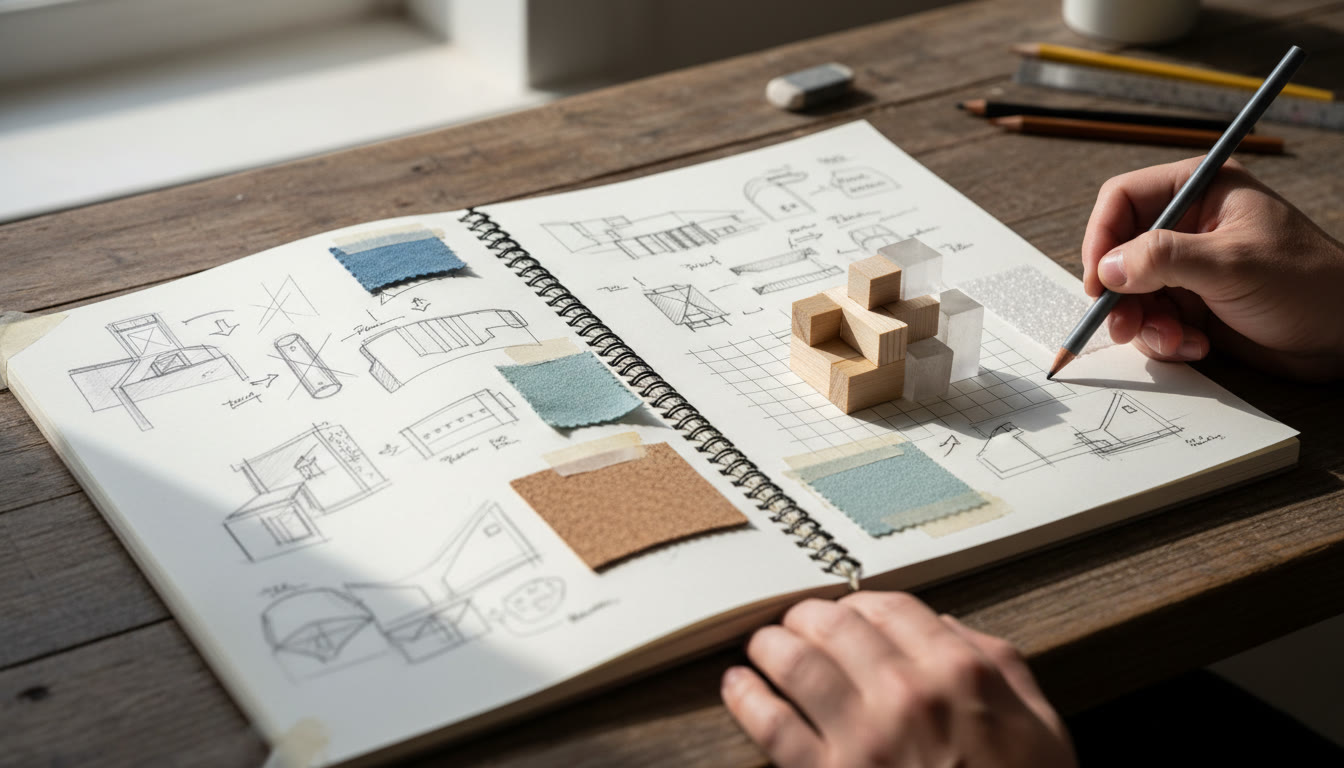
Quality over quantity: 12–20 well-presented pages beats 50 rushed slides. Use consistent typography and crop images tightly; legible labels and short captions transform a pretty image into evidence of thinking. When possible, include scale references on model photographs and use consistent image resolution across pages.
How the DP’s EE, TOK and CAS can boost your application
Use the Extended Essay to add depth
The EE is a golden opportunity to demonstrate academic curiosity around a design-related question. Good EE topics often combine theory and case study: for example, investigating how a particular material has shaped construction practices in a region, or examining the social effects of a particular style of housing. The best essays pair clear research methods with fieldwork—surveys, interviews, or small-scale site analysis—and place the argument in a wider academic conversation.
CAS projects that speak to design
CAS can be more than volunteering credits. A community design-build, a participatory workshop with local residents, or a small adaptive-reuse project for a school shows leadership and social responsibility. Document everything: initial brief, participatory methods, prototypes, and reflections. This is exactly the material that helps interviewers see you as a reflective designer.
TOK: connecting knowledge to practice
In your TOK reflections you can examine how different ways of knowing (perception, reason, imagination) influence design decisions. That intellectual thread can be woven into interview answers and portfolio captions to demonstrate that your design work is anchored in critical thought.
Practical timeline and planning
When to start and what to do when
- Before DP begins: keep a sketchbook habit—daily quick sketches, 10–20 pages a month. Try short projects that take a day or a weekend.
- Early DP: explore widely—model making, photography, digital drawing, basic CAD. Use class projects to test portfolio ideas.
- Mid-DP: curate and edit. Start arranging work into a coherent sequence and ask for feedback from teachers and peers.
- Final months: refine layout, make high-quality photos/scans, write concise captions, and produce a final PDF sized to the application requirements of your target schools.
Check university and foundation programme deadlines for the upcoming entry cycle early—some portfolios must be uploaded months before final offers, and some schools ask for extra materials or interviews. Work backward from those deadlines and build milestones into your calendar.
Working with your counselor and making strategic choices
Questions to ask in counselling meetings
- Does the school support portfolio development with workshops or a dedicated teacher? How much one-on-one guidance is available?
- Which DP subjects have helped past applicants succeed in architecture or design admissions?
- Can the Extended Essay be supervised by a teacher with a design background?
- What are the internal deadlines for predicted grades, references, and portfolio reviews?
A good counselor will help you align your subject choices to your strengths and the expectations of the programmes you’re targeting. If you need additional critique or technical skills outside school hours, targeted support—such as one-to-one coaching or focused portfolio tutoring—can be very effective. For example, Sparkl‘s tutors offer tailored study plans and portfolio feedback that many students use to tighten their submissions and manage exam preparation at the same time.
Common portfolio mistakes and how to avoid them
- Showing only final images — always include process.
- Poor sequencing — tell a story with clear beginnings and ends for each project.
- Too much text or too little context — captions should be concise, explaining intent and decisions.
- Low-quality photography — invest time in good lighting and clear shots of models.
- Incoherent subject choices — avoid picking subjects at random; build a narrative around your interests.
Real student pathways: small case sketches
Case 1 — The Spatial Thinker
One student focused on architecture, pairing HL Mathematics (AA), Visual Arts and Geography. Their portfolio emphasized site-based projects, large-scale models and an EE that explored adaptive reuse strategies in a dense urban neighborhood. Admissions reviewers responded to the coherence between mathematical rigour, contextual analysis and visual communication.
Case 2 — The Product Designer
Another student loved objects and interfaces, took Design Technology, HL Physics and Standard Level Visual Arts, and produced a portfolio full of iterative prototypes, user testing notes and CAD renderings. Their CAS project involved designing and building a public bench with recycled materials, which became a strong talking point in interviews.
Last-minute checklist before uploading your portfolio
- Confirm the format, maximum file size and naming conventions for each target programme.
- Check spelling and captions; put the project title, date and brief intent on each page.
- Ensure image resolution is clear but file size remains within limits; compress where necessary without losing legibility.
- Have a trusted reviewer (teacher, mentor, or tutor) check for clarity and narrative flow.
- Keep an editable master file; many schools request changes or ask for originals during interviews.
Putting it together: a strategic summary
The most persuasive application will tie subject choices, EE and CAS experiences, and a portfolio to a consistent narrative about who you are as a maker and thinker. Use your DP time to experiment widely, document every step, and refine a few strong projects that show how you approach design problems. Invest in clarity: clear captions, well-lit photos of models, and a logical sequence will make your work easier to assess.
Targeted tutoring can be a smart supplement when your school timetable is full. A focused tutor or mentor helps with technical skills, critique cycles and deadline planning so you can balance internal assessments and portfolio development. If you decide to seek that kind of support, look for help that emphasizes iterative feedback and concrete deliverables—short, actionable sessions that move a project forward are more effective than general advice.
Final thought
Choosing an IB DP route toward design or architecture is a long-form project: select subjects that build complementary skills, use EE and CAS for meaningful depth, document process carefully in a portfolio, and plan deadlines with your counselor so academic demands and creative work support one another. Thoughtful, consistent preparation during the Diploma Programme will give you the strongest possible foundation for architecture and design pathways in higher education.

























No Comments
Leave a comment Cancel