

Why tightening matters (and why so many IB essays balloon)
It’s easy to let a personal statement swell. You’re juggling Extended Essay notes, CAS reflections, TOK threads and a long list of activities — each feels worthy of inclusion. Add the natural urge to impress admissions officers, and suddenly a concise idea becomes a sprawling chronology. The trick isn’t to shave words until the soul of your story is gone; it’s to tighten with intent so that every sentence pulls its weight.

This guide gives you a clear, humane workflow for trimming a long IB DP personal statement without losing the meaning that makes it yours. You’ll find high-impact editing techniques, concrete before/after rewrites, a realistic timeline you can adopt around application windows, and quick advice for activity lists and interviews. The goal is to preserve voice and evidence while cutting the noise.
Start here: Find the single thread that matters
The thesis test
Every strong personal statement has one main thread — a central idea the reader remembers. That could be intellectual curiosity, resilience, a leadership arc, a community commitment, or an interdisciplinary passion that links CAS, EE and classroom learning. Before you delete a paragraph, ask: does this support my central thread? If the answer is no, it goes.
- Write a one-sentence “thesis” that sums your essay’s main claim.
- Label each paragraph with its purpose in the margin (e.g., context, conflict, action, impact).
- Remove or merge any paragraph that doesn’t advance the thesis or provide essential evidence.
Macro edits: preserve structure, cut detours
Map the story arc
Think of your statement as a short story with a clear beginning, middle and end. The beginning sets context quickly; the middle shows decisively how you changed or acted; the end explains the consequence and links to future plans. Macro editing focuses on re-ordering and reshaping whole paragraphs so each plays a precise role.
- Condense background: two crisp sentences, not a paragraph of backstory.
- Keep one defining moment or scene rather than many small incidents that dilute impact.
- Group related achievements into a single, evidence-rich sentence instead of scattering them across the essay.
Micro edits: the art of words that do work
Trim words, not tone
Micro editing is where you cut filler and pick stronger verbs. Replace weak phrases with crisp alternatives. Small changes add up fast: dropping unnecessary adverbs, swapping passive for active voice, and removing hedging words will tighten prose without flattening personality.
- Remove filler: very, really, quite, obviously, in order to.
- Shorten phrases: “due to the fact that” → “because”; “I was able to” → “I” or “I could”.
- Prefer specific verbs: “made a change” → “revamped” or “streamlined”.
Before / After: a concrete example
Original (bloated)
When I first joined the environmental club, I really did not understand how much work would be involved in planning a community clean-up day, and I tried to do everything myself because I felt that if I didn’t, no one else would take responsibility for the project, which made me very tired and frustrated, but eventually I learned to delegate and that helped the event to be more successful than I had expected.
Edited (tightened, same meaning)
Joining the environmental club taught me to delegate. Initially I tried to organize a community clean-up alone and quickly became exhausted. Sharing tasks with teammates made the event more efficient and ultimately more successful.
Notes: The edited version keeps the lesson (learning to delegate), preserves the arc (— struggle → change → result), and saves words by removing repetition and filler.
Table: Practical editing techniques and their payoff
| Technique | How to apply | Estimated words saved |
|---|---|---|
| Cut redundant clauses | Remove restatements of the same idea within a paragraph | 20–50 |
| Replace long phrases | Swap “in spite of the fact that” for “although” | 5–15 |
| Active voice | Make the subject perform the action to shorten the sentence | 3–10 per sentence |
| Combine related details | Turn multiple weak sentences into one strong, evidence-packed sentence | 15–40 |
Concrete editing workflow you can use
Pass 1: The 5-minute thesis check
Write your one-sentence thesis at the top. Read your essay and cross out any sentence that does not support that thesis. This moves you quickly from length to purpose and often removes whole paragraphs.
Pass 2: Macro reorder (30–60 minutes)
- Number your paragraphs; experiment with moving one paragraph earlier or later to tighten the narrative arc.
- Merge paragraphs that repeat context or evidence.
- If you have multiple examples proving the same point, keep the strongest one and compress others into a single line of proof.
Pass 3: Sentence-level pruning (30–60 minutes)
Look for wordy constructions and rephrase. Read each sentence aloud: if you stumble, it probably needs cutting or reworking. Replace nominalizations (“made a decision”) with verbs (“decided”).
Pass 4: Final polish and tone check (45–90 minutes)
- Scan for filler words and eliminate them.
- Ensure your voice is consistent and authentic; small colloquial touches are fine, but avoid overly casual slang.
- Read aloud one last time or use a text-to-speech tool to catch rhythm problems.
Two image ideas to break up the work
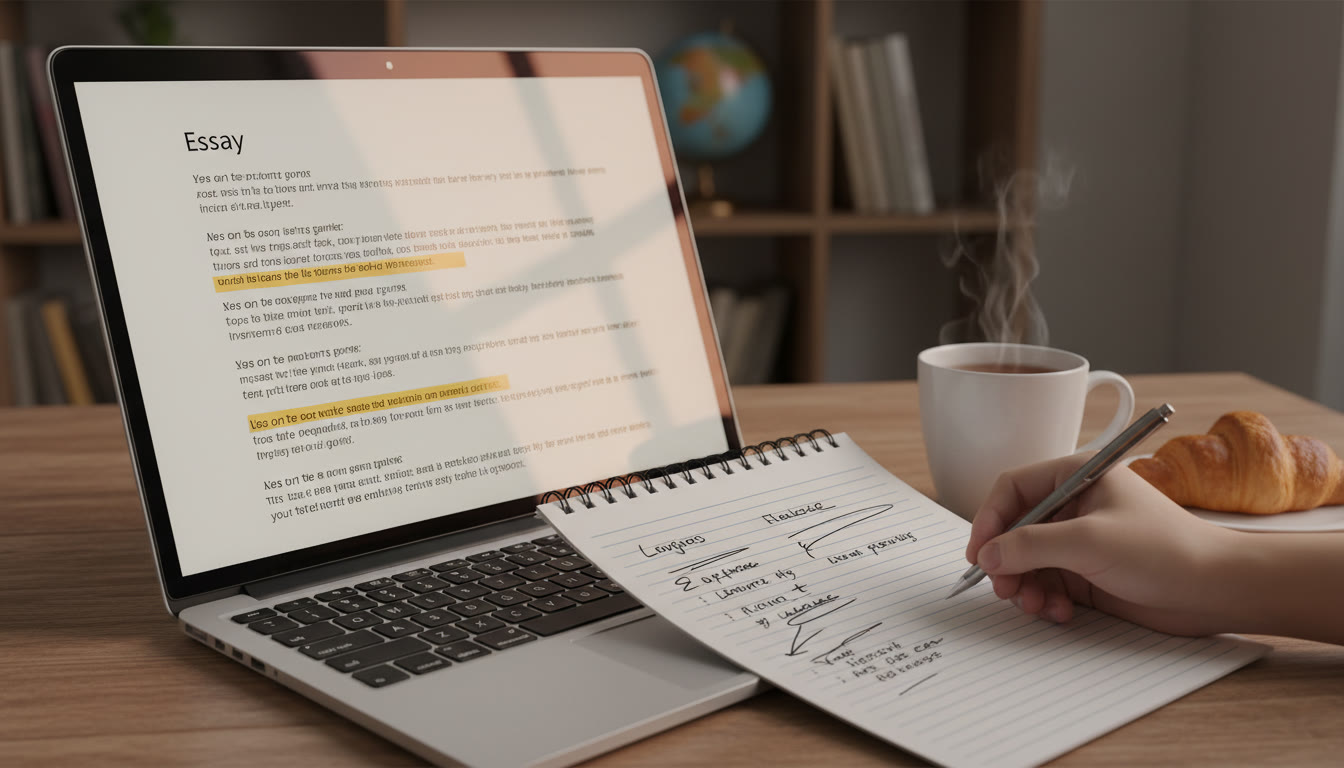
Visual checkpoints can help your editing practice: printed drafts, color-coded pens, and a simple checklist placed beside you keep focus sharp.
Shortening activity statements and CAS entries
Write for impact, not inventory
Application activity sections reward clarity. Admissions officers scan quickly, so each entry should answer three things in one tight line: role, action, and impact. Think of a micro-story that fits a single sentence.
- Format: Role + Action + Outcome (timeframe if space permits).
- Example: “Peer tutor: ran weekly math clinics; redesigned exercises that improved classmates’ exam confidence.”
- Group similar activities under one header when possible (e.g., “Community service: coordinated monthly beach clean-ups and recycling drives”).
Interview preparation: concise stories that carry weight
Prepare 3 two-minute anecdotes
Interviews reward clarity and specificity. Prepare three brief stories linked to your central thread: an academic struggle, a leadership moment, and a clear example of personal growth. Practice them so the core message fits a minute or two without unnecessary preamble.
- Use the STAR framework: Situation, Task, Action, Result — keep the Result explicit.
- Anticipate follow-ups by summarizing any metrics or concrete outcomes in one line.
Timelines and milestones (an adaptable schedule)
Different students have different calendars, but a simple, repeatable rhythm helps you avoid last-minute word-scraping that undermines meaning. Below is a flexible week-based plan you can shift closer or further from your deadlines.
| Weeks before deadline | Focus | Deliverable |
|---|---|---|
| 8–6 | Brainstorm & first draft | Thesis sentence + full draft |
| 6–4 | Macro edits & peer feedback | Second draft with tightened structure |
| 4–2 | Micro edits & proofreading | Near-final draft; activity statements polished |
| 2–1 | Formatting & final read-aloud | Final proofread and submission-ready files |
Tools and feedback: who and what to involve
Edit with a small, trusted loop. One teacher who knows your work, one peer who reads sympathetically, and a final fresh set of eyes for typos. If you need structured support, many students pair brief coaching sessions with independent practice so feedback is targeted and time-efficient. For example, some choose to work with Sparkl for focused 1-on-1 guidance on structure and clarity, and others use Sparkl‘s tailored study plans to schedule revision cycles alongside IB deadlines.
Common pitfalls that really erode meaning
- Overloading with lists: A page of activities with no narrative thread feels like a CV, not a personal statement.
- Trying to impress with vocabulary instead of specifics: flashy words rarely substitute for a clear example.
- Apologetic language: “I may not have had the opportunity…” weakens. State what you did and what you learned.
- Treating the essay like a laundry list: admissions remember choices and insights more than volume.
Real-world examples of powerful trimming
Example: compressing multiple small events into one strong line
Instead of: “I volunteered at the library, helped with a fundraiser, led a study group and organized the sports awards,” try: “Organized and led extracurricular initiatives—library volunteering, peer tutoring and a school fundraiser—that broadened access to academic resources and secured funds for equipment.” The second version groups similar activities, emphasizes leadership and clarifies impact.
Polish for voice: keep the human detail
Tightening shouldn’t erase the sensory or emotional detail that makes a statement memorable. Keep one small, specific image: a single line where you show rather than tell. That detail anchors the essay and makes the narrative feel lived-in even after you’ve cut the rest of the fat.
Last-minute checks before you click submit
- Does each paragraph connect to the thesis? If not, cut or rewrite.
- Have you removed obvious filler? (scan for the common culprits listed earlier)
- Read aloud for rhythm and voice; pause where commas feel forced or sentences run on.
- Confirm activity entries match interview stories—consistency builds credibility.
Keeping perspective: quality over quantity
Admissions officers read for authenticity and clarity. A concise essay that reveals depth, shows growth and maps to your future aims will always outshine a long essay filled with peripheral details. Tightening is not loss; it is refinement. Treat cutting as an act of clarity: you are choosing what matters most about your experience and presenting it with confidence.
Final takeaways
Start by naming your thesis, perform macro then micro edits, practice aloud, and follow a simple timeline so revision doesn’t become a sprint. Use activity lines to show action plus impact, and keep three concise stories ready for interviews. Structured feedback and a few targeted coaching sessions can accelerate progress, but the core work is yours: deciding what to keep and why. When every sentence earns its place, your personality and achievements will come through sharper and truer.
The end.




















No Comments
Leave a comment Cancel