

IB DP Subject Mastery for Students With Heavy Extracurriculars
Balancing demanding IB Diploma courses with intense extracurricular commitments can feel like juggling flaming batons: it looks impressive when it works, and exhausting when it doesn’t. If you’re in practice rooms at dawn, on the field after school, or splitting weekends between rehearsals and competitions, the challenge isn’t that you don’t care — it’s that every minute matters. This article is for you: a clear, human guide to turning limited study time into consistent progress toward top grades.
We’ll walk through how to audit where you are, build a sustainable study architecture, make the most of micro-study windows, tackle subject-specific strategies that actually move marks, and integrate Internal Assessments and the Extended Essay without late-night panic. Along the way you’ll find realistic examples, a sample weekly plan, and tips on when tailored one-on-one support can be a game-changer — including how Sparkl‘s personalized tutoring can fit naturally into this approach.

Start with an honest audit: know your energy, time, and assessment map
Begin by mapping three things for the current cycle: your weekly hours, your energy curve, and the assessment landscape. The audit is simple but revealing.
- Weekly hours: Log a typical week for one or two weeks — classes, practice, commuting, chores. Be realistic.
- Energy curve: Identify when you are most alert. Morning person? Night owl? Match harder tasks to higher-energy slots.
- Assessment map: List internal deadlines, major tests, and the weight of each assessment (e.g., final paper vs. IA vs. orals). This tells you where to focus scarce high-quality time.
Once you see the actual numbers (not the aspirational ones), prioritizing becomes a practical, calm exercise rather than a stress spiral.
Quick checklist for the audit
- Record all fixed time commitments for two weeks.
- Highlight 4–6 highest-stakes assessment points across your subjects.
- Note energy peaks and troughs, and two unavoidable weekly time-wasters to reduce.
Design a study architecture that plays to your schedule
When time is tight, architecture matters more than sheer hours. Build a structure you can sustain, one that treats study as a set of optimized habits.
- Block scheduling: Use 25–60 minute blocks. Short, focused blocks beat vague long hours. If you have a 45-minute gap between commitments, make it a high-value session.
- Priority windows: Schedule your most difficult subject into your best energy slot twice a week; rotate the remaining subjects into other good windows.
- Weekly deep-focus session: Reserve one 2–3 hour block for practice papers or extended writing on the weekend where possible.
- Micro-review pockets: Carry 10–15 minute cards or a phone app for flash recall on commutes or between rehearsals.
Quality beats quantity: thirty minutes of uninterrupted, active study that targets a single skill will often produce more marks than three distracted hours.
How to protect study windows without burning out
- Treat them as non-negotiable appointments — put them in your calendar.
- Pair study with an accountability ritual: a quick message to a study buddy or a short checklist ticked at the end of each block.
- Be flexible: if practice runs late, move a block rather than skipping it entirely.
Sample weekly plan: realistic time allocation for a heavy-extracurricular student
The table below represents one model for a student with 12–15 hours of extracurricular commitments per week. Adjust the numbers by subject weight and personal deadlines.
| Activity | Hours/week (example) | Focus | When to schedule |
|---|---|---|---|
| Higher Level (HL) subject 1 | 6–8 | Past paper practice; problem sets; mark scheme alignment | Best energy windows, 2–3 short blocks + 1 extended |
| Higher Level (HL) subject 2 | 5–7 | Concept mapping; application questions; IA progress | Alternate days + weekend deep session |
| Standard Level (SL) subjects (combined) | 6–8 | Consolidation of core ideas; exam command terms | Short daily reviews; two longer revisions per week |
| Internal Assessments / Extended Essay | 3–5 | Research milestones, drafts, supervisor meetings | Evenly spaced mini-deadlines |
| Extracurriculars | 12–15 | Practices, rehearsals, travel | Fixed; plan study around these |
| Rest, sleep, wellness | Minimum 35–45 hours (sleep) | Non-negotiable for peak performance | Every night, consistent schedule |
This is a template, not a rule. The key is balancing concentrated work on high-stakes items and daily maintenance of other subjects so nothing surprises you near major assessments.
Micro-study strategies that give maximum return
When your day only has short study pockets, you need techniques that squeeze big gains out of small windows.
- Active recall: Close the notes and write or say what you remember. Then check. This is the most efficient way to transfer knowledge from short-term to durable memory.
- Spaced repetition: Schedule quick reviews of concepts at increasing intervals — this turns brief sessions into long-term retention.
- One-skill focus: Each block targets a single skill (e.g., calculus past paper question, source analysis, unseen poem technique).
- Past-paper micro-sessions: Set a 30-minute single-question challenge: plan, answer, and scan the mark scheme for 10 minutes.
- Feynman pass: Teach the concept out loud in simple language for five minutes; if you stumble, identify the weak point and close the gap.
Using technology without getting sidetracked
Use apps for spaced repetition and quick quizzes, and use website blockers during deep blocks. If you use AI-driven insights or analytics as part of support, keep them focused on identifying gaps and tailoring practice, not passive consumption.
Subject-specific tactics that translate into marks
IB is wide: each subject rewards slightly different strategies. Below are targeted approaches that respect limited study time.
Mathematics (HL & SL)
- Master core techniques first — a secure method on common question types yields consistent marks.
- Do timed question sets: 3–5 high-quality problems at a stretch rather than 20 rushed ones.
- Create categorized mistake logs: algebra slip, sign error, misreading — review these weekly.
Sciences (Physics, Chemistry, Biology)
- Link theory to practical examples: turn lab observations or training metrics into concept checks.
- Practice data analysis and command-term questions; these are efficient ways to score with structured responses.
- For IAs, set small, frequent milestones and discuss methods with your supervisor; iterative feedback saves rework.
Language A and Literature
- Turn reading into active work: annotate with a focus question in mind (character motive, technique, tone).
- Practice concise thesis-driven paragraphs under timed conditions to build speed and clarity.
Language B
- Daily 10–15 minute active speaking or writing practice beats fewer long sessions.
- Use recorded practice for oral work; listen back for recurring errors and correct them one at a time.
Individuals and Societies (History, Economics, Geography)
- Build answer skeletons for common question types and practice adapting them to new prompts.
- Connect case study facts to theoretical frameworks so you can deploy evidence efficiently in exam conditions.
Arts and Performance (Visual Arts, Music, Theatre)
- Align practice schedules with assessment rubrics: performance rehearsal should map to assessment criteria.
- Document progress continually — a visual or audio log saves time when compiling portfolios or reflections.
Across subjects, the unifying idea is deliberate practice: define a narrow goal, practice it with feedback, and repeat.
Internal Assessments and Extended Essay: integrate them early
IA and EE don’t start the week before their deadlines. For students with heavy extracurriculars, the trick is to break them into micro-milestones that fit between rehearsals and practices.
- Define your research question and a short bibliography early; set two small weekly tasks (e.g., read one source, write 300 words).
- Use travel and downtime for passive research: audio notes, shortlisted sources, or annotated images.
- Reserve supervisor meeting time as fixed calendar items; a 20-minute focused check-in beats a chaotic hour-long scramble.
If targeted, expert feedback is what speeds progress. For students who need tailored one-on-one help, Sparkl‘s tutors can create focused milestones and suggest evidence-based improvements for drafts and methodologies.
Exam technique: make practice papers work harder
Past papers are a goldmine — but only if you practice them with purpose.
- Practice with the mark scheme immediately after writing, not days later; this trains you to target the examiner’s expectations.
- Time single-question drills to improve pacing for similar items in the exam.
- Track question types that cost you time or marks and convert them into weekly micro-goals.
- Simulate exam conditions for a full paper once every three to four weeks to build endurance.
Collaboration, delegation, and using support intelligently
Extracurricular involvement often brings teamwork skills that can be repurposed for academics. Use them.
- Study partners: Brief, focused sessions with a teammate can consolidate knowledge — one explains, the other questions.
- Task delegation: If you lead a club, delegate administrative tasks before big assessment windows.
- Expert coaching: Targeted tutoring for problem areas (e.g., essay structure or IA methodology) can accelerate returns. When you need efficient, tailored support that respects your schedule, Sparkl‘s approach — with one-on-one guidance, tailored study plans, expert tutors, and AI-driven insights — is designed to slot into busy routines.
Wellbeing: the non-negotiable part of mastery
Top grades aren’t possible on tired brains. Sleep, nutrition, and recovery are part of the plan, not optional extras.
- Protect consistent sleep: performance drops when sleep is irregular, even if total hours sometimes equal out.
- Short active recovery — a 10-minute walk or breathing routine — refreshes focus between blocks.
- Plan one full day off per week where you avoid academic tasks and recharge creatively.
Small adjustments that yield big results
Here are practical levers to tweak immediately:
- Swap a passive review session for an active question session.
- Change one long, unfocused evening into three targeted micro-blocks across the week.
- Convert commute time into retrieval practice rather than passive scrolling.
Real-world vignette: how a busy student rearranged priorities
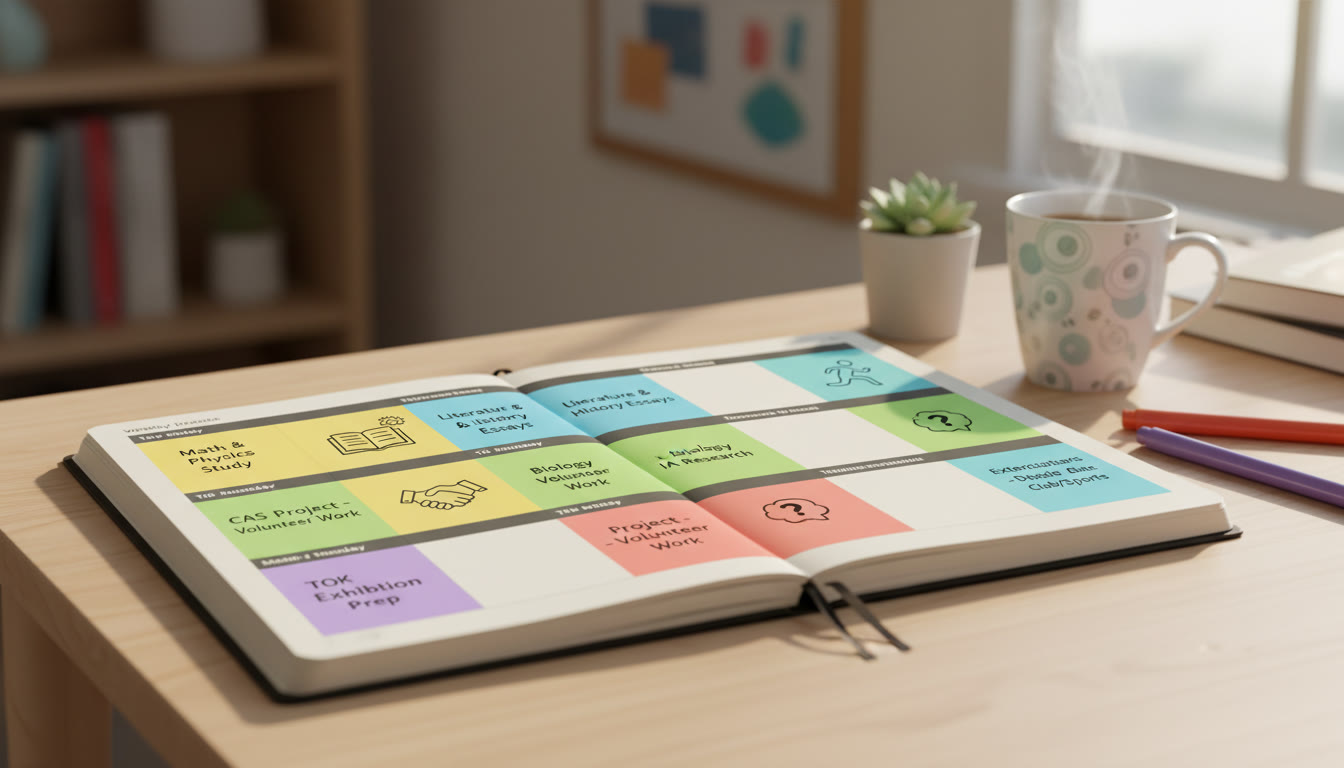
Imagine a student who trains 12 hours a week for a sport and carries two HL subjects and three SL subjects. They had been trying to do long night study sessions and burning out. After an audit they moved their toughest subject to morning blocks twice a week, turned commuting time into 10–15 minute flashcard checks, and scheduled one focused weekend 2.5-hour deep session for past papers. Within a few cycles their pace and accuracy improved and stress decreased. Small changes, consistency, and a focus on high-leverage practice were the differentiators.
When to consider extra help and what to expect
Extra help is not a shortcut; it’s an efficiency tool. Consider one-on-one tutoring when:
- You have consistent gaps despite sustained effort.
- An IA or EE requires methodological input beyond your current skillset.
- Time constraints mean you need a study plan designed around a packed schedule.
Good tutors do three things well: they diagnose precisely, set small measurable milestones, and provide feedback that reduces rework. For students with clashing commitments, personalized options that respect routines and provide flexible session timing are often the most effective.
Putting it all together: a simple weekly routine
Here’s a compact routine you can adapt:
- Monday: Two focused 45-minute blocks for HL subject 1; 15 minutes of language practice before bed.
- Tuesday: Short morning problem set; rehearsal after school; commute flash review.
- Wednesday: 25–40 minute active recall session; IA mini-task (300 words or data check).
- Thursday: Past-paper single-question timed drill; review with mark scheme.
- Friday: Light consolidation; rest early to prepare for weekend deep session.
- Saturday: 2–3 hour deep block (rotate subjects each week), plus one supervised IA/EE milestone.
- Sunday: Active recovery and a short planning session (30 minutes) for the upcoming week.
Small, consistent practice beats occasional marathon sessions, especially when extracurriculars consume large time blocks.
Final academic note
Mastering IB DP subjects while maintaining heavy extracurricular involvement is achievable through a realistic audit, prioritized scheduling, focused micro-practice, and strategic use of tailored support where needed. By aligning study with assessment goals, protecting high‑quality study windows, and keeping wellbeing non-negotiable, progress becomes measurable and sustainable.

























No Comments
Leave a comment Cancel