

IB DP Subject Mastery: The “Spaced Repetition” System Tailored for IB DP
If you’re juggling Higher Level essays, lab reports, language vocab and the quiet dread of exam season, here’s a friendly truth: memorizing the night before rarely builds mastery. Spaced repetition doesn’t promise miracle learning overnight — it promises something better: consistent, predictable retention that turns yesterday’s confusion into tomorrow’s confident answer. This guide walks you through a version of spaced repetition designed for the IB Diploma Programme’s particular mix of content, skills and assessments.

Why spaced repetition works for IB students
Memory science in plain English
Spaced repetition leans on two simple facts about how memory behaves. First, our brains forget fast if a piece of information isn’t revisited (that’s the forgetting curve). Second, every time we successfully retrieve an idea, we strengthen the pathways that let us recall it later. So instead of repeating everything continuously, we re-encounter items at expanding intervals — which is both time-efficient and powerful for long-term retention.
Why the IB DP needs a tailored approach
The IB DP mixes concept-heavy subjects, skills-based subjects, and high-stakes assessments like internal assessments (IAs) and extended essays. That variety means one-size-fits-all revision won’t cut it. You’ll use spaced repetition differently for: formula-based problem solving (maths and physics), layered narrative and argument (history, TOK, literature), language acquisition (vocab, structures, oral fluency), and practical skills (labs, art portfolios). This guide gives practical tweaks so the method supports each subject’s demands.
Designing your spaced repetition system for the DP
Step 1 — Begin with outcomes, not hours
Write clear, subject-level learning outcomes: what must you be able to do by the end of a unit? For maths that may be “set up and solve a kinematics differential equation”; for literature it might be “write an argument comparing two poems with textual evidence.” Outcomes keep your cards and review sessions tightly focused.
Step 2 — Chunk knowledge into smart prompts
Think in prompts, not whole chapters. A prompt is one piece of retrieval practice: a definition, a single proof step, a conceptual “why” question, or a short past-paper question. Quality prompts are short, clear and targeted. For essay-based subjects create argument or counter-argument prompts; for sciences use cause–effect or mechanism prompts; for languages pair vocabulary with a short sentence in context.
Step 3 — Choose a cadence that fits IB rhythms
IB timetables have steady teaching blocks and intense assessment bursts. Your spaced schedule should match that rhythm: denser early in a unit (to lock fundamentals) and then strategically spaced refreshers that intensify before mocks and exams.
| Review | Approx. Interval (from initial study) | Primary focus | Suggested session length |
|---|---|---|---|
| Initial study | Day 0 | Understand and create prompts | 30–60 min |
| Review 1 | 1 day | Active recall of basics | 10–20 min |
| Review 2 | 3 days | Apply basics to a new problem | 15–25 min |
| Review 3 | 7 days | Deeper application and explanation | 20–30 min |
| Review 4 | 14 days | Mix with related concepts (interleaving) | 25–35 min |
| Review 5 | 30 days | Long-form practice | 30–60 min |
| Maintenance | Monthly or before key assessments | Weak spots and exam technique | Varies |
This table is a starting template: lengthen intervals for items you recall easily, shorten them for persistent trouble spots. Higher Level (HL) topics often need more frequent, deeper application than Standard Level (SL) basics.
Subject-specific spaced repetition strategies
Mathematics (AA / AI and problem-based subjects)
Maths is mastery by practice. Your cards should not only ask for definitions but present problems with partial steps removed — a “fill-in-the-step” style that forces you to reconstruct reasoning. Use sets of near-identical problems with one variable changed to build flexible procedure recall. Interleave topics (calculus, algebra, statistics) rather than blocking all calculus then all algebra; your brain learns to choose the right tool when prompted.
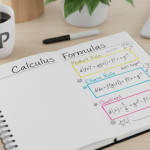
- Card types: worked problem (question + steps to reproduce), trick-spotter (what’s wrong with this solution?), core formula recall.
- Practice tip: annotate a solved problem and then hide alternate steps for later retrieval.
Sciences (Biology, Chemistry, Physics)
For sciences, separate conceptual cards (explain this mechanism) from application cards (predict the result of a changed experiment). For experimental technique and IA preparation, create process-cards: “What are the main sources of systematic error in a titration?” and practice answering them aloud. Diagrams and labeled steps are golden — convert diagrams into sequenced prompts.
- Card types: explain, apply, diagram-label, error-analysis.
- IA tip: use spaced repetition to revisit feedback and corrections — every revision should tackle both content errors and procedural habits.
Languages (A and B)
Vocabulary needs both recall and usable context. Pair a word with a short sentence you write yourself rather than an isolated translation. For language A literature, create cards for quote–context pairs and for essay scaffolds: opening lines, thematic comparisons, and a concise line of analysis you must reproduce.
- Card types: vocab-in-context, translation challenge, quote + analysis, oral prompt.
- Exam tip: practice oral responses and then schedule quick voice-review sessions to prime fluency.
History, Economics, ESS and essay-heavy subjects
These subjects reward argument scaffolding. Create cards that force you to outline a short paragraph from a prompt: claim, evidence, linking sentence, counterargument. Timelines and cause–effect chains can be broken into many small prompts. Use comparison cards that ask you to list three similarities and three differences between two case studies — that rehearse analysis, not just facts.
TOK, CAS, IAs and extended writing
Spaced repetition supports process as well as facts. For TOK, make cards that prompt a real-life example and its corresponding knowledge question. For IAs and the extended essay, schedule review cards for supervisor feedback points so you revisit revisions, data interpretation and citation style multiple times before submission.
Practical timetables and daily routines
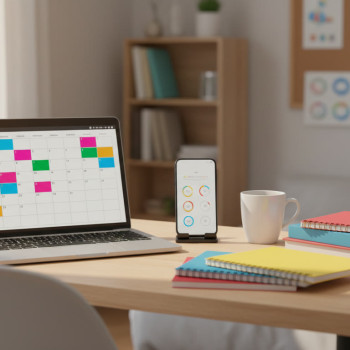
Spaced repetition needs regular short sessions more than a few marathon cramming days. Here’s a practical daily routine that fits disciplined IB life without burning you out:
- Morning — 20 minutes: new vocab or quick recall (low cognitive load to wake the brain).
- School day — short micro-reviews between lessons (5–10 minutes) for consolidation.
- Afternoon — 30–60 minutes: focused learning or first pass of new content.
- Evening — 20–40 minutes: scheduled spaced-repetition reviews (the table cadence above).
- Weekend — 60–120 minutes: mixed practice tests and deeper interleaved review.
Use the Pomodoro method for focused blocks: 25 minutes concentrated study, 5 minutes quick flashcard review, repeat. That alternating rhythm keeps practicing retrieval while avoiding fatigue.
How to measure progress and adapt the system
Retention is the metric that matters. Track not just hours studied but how often you recall correctly on the first try. Keep a simple log or a “quality of recall” score with four bands: easy, correct with hesitation, partial recall, fail. Adjust intervals like this:
- Easy on-the-spot recall: move the item two steps forward in the schedule.
- Hesitant but correct: keep the next interval unchanged.
- Partial or incorrect: bring the item back to a shorter interval and break it into smaller prompts.
For HL subjects, add a second metric: application fluency. If you can recall a concept but cannot apply it in an unseen question, make application-focused cards and shorten the next interval.
Integrating spaced repetition with exam practice
Use past-paper prompts as review items
Convert short past-paper tasks into spaced items. For example, a 10-mark question becomes a card that asks for the skeleton of the answer (key arguments, evidence points, and timing for paragraphing). Over time you’ll build a bank of exam-style retrieval items that doubles as a mock paper library.
Train to the mark scheme
Create cards that paraphrase mark-scheme descriptors and practice applying them to short answers. This helps you write precisely for the points examiners award — and trains your time use during timed practice.
Common pitfalls and how to avoid them
- Overloading your queue: limit new cards per day. Quality beats quantity.
- Rote flashcards for complex skills: break essays and experiments into process-cards rather than single-fact cards.
- Ignoring application: if you can recite facts but fail in problem-solving, convert cards into applied prompts.
- Not revising feedback: schedule explicit review cards based on teacher comments or IA supervisor notes.
Tools and small hacks that make a big difference
You don’t need sophisticated software to start, but choose a consistent tool and stick with it. Whether paper cards in a box, a spreadsheet, or a spaced-revision app, make sure each prompt is searchable, tagged by topic, and dated so you can track intervals. If you ever want guided set-up — personalized study plans, one-to-one guidance, or help shaping card banks to IB assessment criteria — consider Sparkl’s tailored approach to tutoring and study design.

Case study — turning shaky recall into confident mastery
Imagine a student who struggles in HL Biology with retention of metabolic pathways and IA technique. They start by converting every pathway into small prompts: key enzymes, rate-limiting steps, and clinical implications. For the IA, every supervisor comment becomes a card: “What was your control and why?” and “List three sources of systematic error and how you corrected them.” Using the spacing table above, the student schedules fast initial repetition for the IA process and slightly longer intervals for pathways. Two months later, weak areas are reduced to frequent small prompts while stronger areas move into monthly maintenance. Mock exam scores reflect a clearer ability to explain mechanisms and apply knowledge to novel scenarios.
Final checklist: getting started this week
- Write three clear learning outcomes for each subject you’re focusing on.
- Create 10–15 high-quality prompts for each outcome (start small).
- Set your initial schedule using the table above and commit to brief daily reviews.
- Log quality of recall and adjust intervals after each session.
- Convert one past-paper question into a review card every few days to build exam fluency.
Spaced repetition isn’t a magic pill; it’s a plan that rewards consistent, thoughtful practice. When you break big IB tasks into small, retrievable prompts and schedule them intelligently, you spend less time re-reading and more time building durable understanding. That is the difference between temporary cramming and subject mastery.
This guide is designed to help IB students blend memory science with the specific demands of the Diploma Programme and to build a revision rhythm that supports both depth and exam readiness.



















No Comments
Leave a comment Cancel