
Why Class 11 Is the Game-Changer for JEE Aspirants
Class 11 is the season where foundations are laid, curiosities are sparked, and the nervous excitement of competitive exams begins to feel real. If you treat this year as a hurried warm-up, you’ll be playing catch-up during the tougher months that follow. If you treat it as the base layer of everything to come, every concept you master now will multiply your speed and accuracy later.
This article is written to feel like a conversation with a senior friend who’s been through the loop: practical, honest, and focused on what actually helps—not a list of unrealistic to-dos. You’ll get subject-wise tactics, a weekly plan you can adapt, smart mock-test advice (including how to run and analyze a full 3-hour mock under exam-like discipline), and ways to use targeted help when you need it.

Understand the Exam Context (What Your Practice Should Mirror)
Train for the environment you will face. Competitive entrance testing emphasizes clear, fast problem recognition and accurate execution. That means practice must simulate the core exam features: multiple-choice and numeric-style questions, timed full-length practice (3-hour sessions), negative marking awareness, and strict discipline with answer entry. Even if the main exam is computer-based, practicing OMR-style answer discipline in pen-and-paper mocks helps reduce silly mistakes and builds time management and focus.
Two practical ground rules to keep in mind: (1) do not assume partial credit for half-worked descriptive answers—JEE-style assessments reward correct final responses and efficient argumentation; (2) practice under pressure. The calm comfort of the classroom is very different from a timed mock: simulate the latter frequently.
Subject-wise Strategy: Build Concepts, Then Intensify Practice
Physics — Think Like Nature, Not Like a Formula Sheet
Physics in Class 11 is about seeing the physical picture first. Ask yourself: what is moving? what forces act? where is energy going? Sketch simple diagrams and label them. Diagrams and derivations are learning tools to clarify thought—use them to internalize relationships, not to write out long exam answers.
- Start each topic with a few conceptual questions: what are the assumptions? what are limiting cases (e.g., small angle, large mass)?
- Derive the key relations yourself—this builds intuition. After that, memorize only the most used forms and boundary conditions.
- Practice layered problems: easy → standard → challenging. Solidify the first two tiers before attempting the third.
Example approach: for projectile motion, make a one-line summary (components separate, motion independent, range symmetry) and then solve 10 problems, each focusing on a different twist: variable launch heights, windless/no-resistance assumptions, max range conditions, and time-of-flight based questions.
Chemistry — Balance the Three Faces
Chemistry in Class 11 is usually divided into Physical, Organic, and Inorganic strands. Treat each with a tailored method:
- Physical Chemistry: Understand the mathematics behind concepts—practice numerical problems and conceptual derivations until you can estimate orders of magnitude quickly.
- Organic Chemistry: Focus on reaction mechanisms and pattern recognition. Learn functional-group behavior, common reaction types, and a handful of reliable reagents.
- Inorganic Chemistry: Build a compact set of notes for periodic trends, common salts, and typical reactions. Frequent recall beats long re-reading.
Make short concept-cards for every acid/base, reaction type, and key law—these are revision gold when tests are near.
Mathematics — Structure Your Thinking, Practice With Purpose
Maths is cumulative. Each chapter builds tools you will use repeatedly. Work on sharpening core problem-solving habits: identify the theorem or trick first, then map the problem to that pattern.
- Learn to create a quick plan for each problem—1 minute to decide strategy, then execute.
- Maintain two folders: one for solved model problems (step-by-step) and one for tricks and shortcuts you discover. Revisit the tricks folder weekly.
- Emphasize clarity in notation; a messy approach costs time and invites errors under pressure.
Time Management: Design a Weekly Plan That Grows with You
Consistency beats cramming. Rather than 12-hour bursts, plan steady daily effort with a longer, exam-style session each week. Here’s a practical split you can adapt to your school demands and energy pattern.
Sample Weekly Schedule (Flexible Template)
| Day | Focus | Primary Goal | Suggested Hours |
|---|---|---|---|
| Monday | Physics + Math | New concept + short problem set | 3–4 |
| Tuesday | Chemistry (Physical) | Numerical practice + concept review | 3–4 |
| Wednesday | Math (Practice) | Problem-solving streak (medium) | 3–4 |
| Thursday | Physics (Applications) | Integrated problems + derivations | 3–4 |
| Friday | Chemistry (Organic/Inorganic) | Reaction patterns + recall | 3–4 |
| Saturday | Mixed practice + weak-topic focus | Targeted practice, error-log work | 5–6 |
| Sunday | Full-length Mock + Review | 3-hour mock (timed) + 1–2 hour analysis | 5–6 |
During school weeks, shift a couple of hours to evenings; during exam prep holidays, increase focused hours but keep sleep and short breaks consistent. Reserve Sundays (or another fixed day) for a 3-hour full-length mock. This is the most reliable gauge of exam readiness.
How to Practice: Quality Over Quantity
Smart practice follows a cycle: learn, apply, analyze, correct, repeat. Don’t just solve questions—inspect why mistakes happened and how to avoid them. Keep an error log with three columns: question reference, mistake type (conceptual/calculation/careless), and corrective action.
- Layer difficulty: warm up on solved examples, then solve moderate questions, then try one or two hard problems.
- Time yourself for sections within the mock: know how long you take on physics numerical vs math proof-style questions.
- Practice question selection: don’t jump endlessly among topics. Block 2–3 hours to focus on one subject for deep practice.
Mock-Test Routine — Make Each Mock a Mini-Project
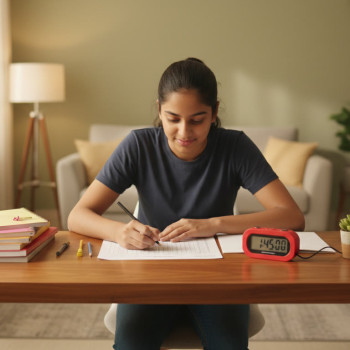
Run your 3-hour mock exactly as the real test would be: timed, quiet, no phones, and with answer marking discipline (if you’re doing paper mocks, simulate OMR filling). After the test, break analysis into phases:
- Phase 1 (First 20 minutes): mark clear mistakes and calculation slips.
- Phase 2 (Next 40–60 minutes): examine wrong answers for conceptual gaps.
- Phase 3: list 3–5 action items—topics to revise, formulae to memorize, and technique improvements.
| Metric | What to Check | Fix |
|---|---|---|
| Accuracy | Percentage correct per subject | Targeted concept revision + 10 similar problems |
| Speed | Time spent per question type | Timed drills and shortcuts practice |
| Careless Errors | Signs of misreading or arithmetic mistakes | Slow down for 10s check per question |
Efficient Revision: Keep It Short, Keep It Sharp
Revision is not a marathon; it’s a sequence of sharp, spaced recalls. Use active recall and spaced repetition rather than long passive rereads:
- Weekly Quick-Revision: 1–2 pages of hand-written notes per topic. These are the pages you’ll re-scan before every mock.
- Flashcards: for reaction mechanisms, key theorems, and tricky formulae. 10–15 minutes daily keeps many details alive.
- Problem Collections: maintain a small set of “representative” problems for each chapter—5–10 that capture the essential variations.
Remember: diagrams and derivations belong in your study notebook as tools to restore intuition quickly; they’re not exam-length answers but mental maps that help you reconstruct solutions under pressure.
When to Consider Personalized Help
Most students cross a threshold where individualized guidance accelerates progress: persistent conceptual gaps, stagnant mock-test scores, or lack of a structured plan that fits your school schedule. That’s the right time to get tailored support—targeted, not generic.
For students who need one-on-one clarity, Sparkl can offer personalized tutoring, tailored study plans, expert tutors, and AI-driven insights to highlight weak spots and suggest focused practice. Some find that a short period of guided study—focused on weak topics and exam strategy—delivers disproportionately large gains.
Common Pitfalls and How to Avoid Them
- Over-reliance on rote notes: If you can’t apply what you’ve written to a new problem, your notes need to be reworked into concept-action items.
- Shallow practice: Doing many problems superficially is worse than doing fewer problems with full analysis. Always spend time with wrong answers.
- Ignoring mock-test analysis: A mock without a review is just practice for speed, not improvement. Convert every wrong answer into a short revision card.
- Comparison paralysis: Avoid comparing your day-by-day progress to others. Measure yourself against your past tests.
Daily Micro-Habits That Move the Needle
- Start study sessions with 5 minutes of focused review of yesterday’s errors.
- Always note one “testable fact” to memorize per session—this creates cumulative knowledge.
- Keep short breaks and maintain sleep; tired brains make careless mistakes that look like ‘lack of aptitude’ but are often just lack of rest.
Mindset: The Long, Honest Trajectory
Class 11 is an investment year. Real progress is incremental—concepts consolidate, speed improves, and error patterns shrink. Hone curiosity: ask why a method works, not just how. Celebrate small wins (a concept you finally understand, five correct answers in a row on a topic), and treat setbacks as data for smarter practice.
Final Checklist Before Any Full-Length Mock
- Clear study area, everything you need at hand (stationery, water, watch).
- Set a strict 3-hour timer and follow the planned sectional time allocation.
- Simulate exam discipline: single sitting, no phones, no long distractions.
- After the test, allocate 1–2 hours immediately for analysis while memory is fresh.
Conclusion
Class 11 JEE preparation is about building a durable conceptual base and marrying it to deliberate practice. Prioritize understanding over memorization, structure weekly plans that include a 3-hour full-length mock, analyze every error with curiosity, and use targeted help when gaps persist. Over time, steady habits—clear notes, timed practice, error logs, and consistent mock-test analysis—compound into the speed, accuracy, and confidence required for success.




















No Comments
Leave a comment Cancel