

Common Mistakes in Accuracy and Speed: The Quiet Marks That Slip Away
Mock tests are the best mirror you’ll get on the road to competitive exams. A well-run 3-hour full-length mock, reflecting MCQ-based testing and the realities of negative marking and OMR discipline, tells you more about the exam you’ll take than a week of untargeted study. But many students treat mocks as a scoreboard instead of a diagnostic tool. That small mistake — confusing score with learning — is the seed of recurring errors in accuracy and speed.
This article walks you through the frequent slip-ups students make during mock tests, why they matter, and how to fix them in repeatable, practical ways. Examples, simple planning templates, and a realistic mock-day routine are included. Where focused guidance helps, consider how Sparkl‘s personalized approaches (1-on-1 guidance, tailored study plans, expert tutors and AI-driven insights) can slot into the practice loop — but the strategies below are ones you can start applying immediately.

Why accuracy and speed must be trained together — not separately
Speed without accuracy is reckless guessing; accuracy without speed is incomplete answering. In MCQ-based testing with negative marking these trade-offs are amplified: one rushed wrong answer can wipe out the value of several correct responses. A strategic mock routine trains both: the automatic, mechanical parts of answering (reading comprehension, marking answers, mental arithmetic) and the higher-level decisions (question selection, when to bail, and when to invest time).
Think of mock practice like athletics: sprinters don’t run 100-meter races at marathon pace, and marathoners don’t sprint every lap. You need drills to build raw pace, separate drills to reduce error under pressure, and then mixed rehearsals that fuse the two. That’s why your mock strategy should blend short, sharp speed drills with longer accuracy-focused reviews.
Top mistakes students make (and why they cost marks)
- Over-speeding on unfamiliar questions — Racing through a question you barely understand invites misreads and wrong choices. The time saved is often less valuable than the expected loss from a wrong answer because of negative marking.
- Random guessing without a fallback plan — Guessing is part of MCQ strategy, but undisciplined guessing is costly. Smart guessing uses elimination and time budgeting.
- Poor OMR or answer-entry discipline — Whether you practice with paper OMR or a computer-based layout, sloppy marking, misaligned bubbles, or forgetting to transfer answers costs marks you already earned.
- Ignoring question selection — Attempting questions in linear order instead of prioritizing high-confidence items wastes high-value time.
- Not analyzing repeated errors — Taking a mock and moving on is the fastest way to repeat the same mistakes. Patterns need tracking: topic clusters, misinterpretations, and time sinks.
- Assuming partial credit for descriptive work — In MCQ exams that follow strict marking rules, long derivations or partial steps don’t fetch partial marks. Treat diagrams and derivations as learning tools, not as a hedge for scoring.
Quick fixes: what to change in your next mock
- Adopt a two-pass approach: Pass 1 — solve only the questions you can do confidently in under 3–4 minutes; Pass 2 — attempt medium-difficulty questions; Reserve the last 25–30 minutes for review and any remaining tough problems.
- Use timed micro-drills: Daily 20–30 minute sessions focused only on short problems (speed sets) and 40–60 minute sessions focusing on accuracy (error elimination).
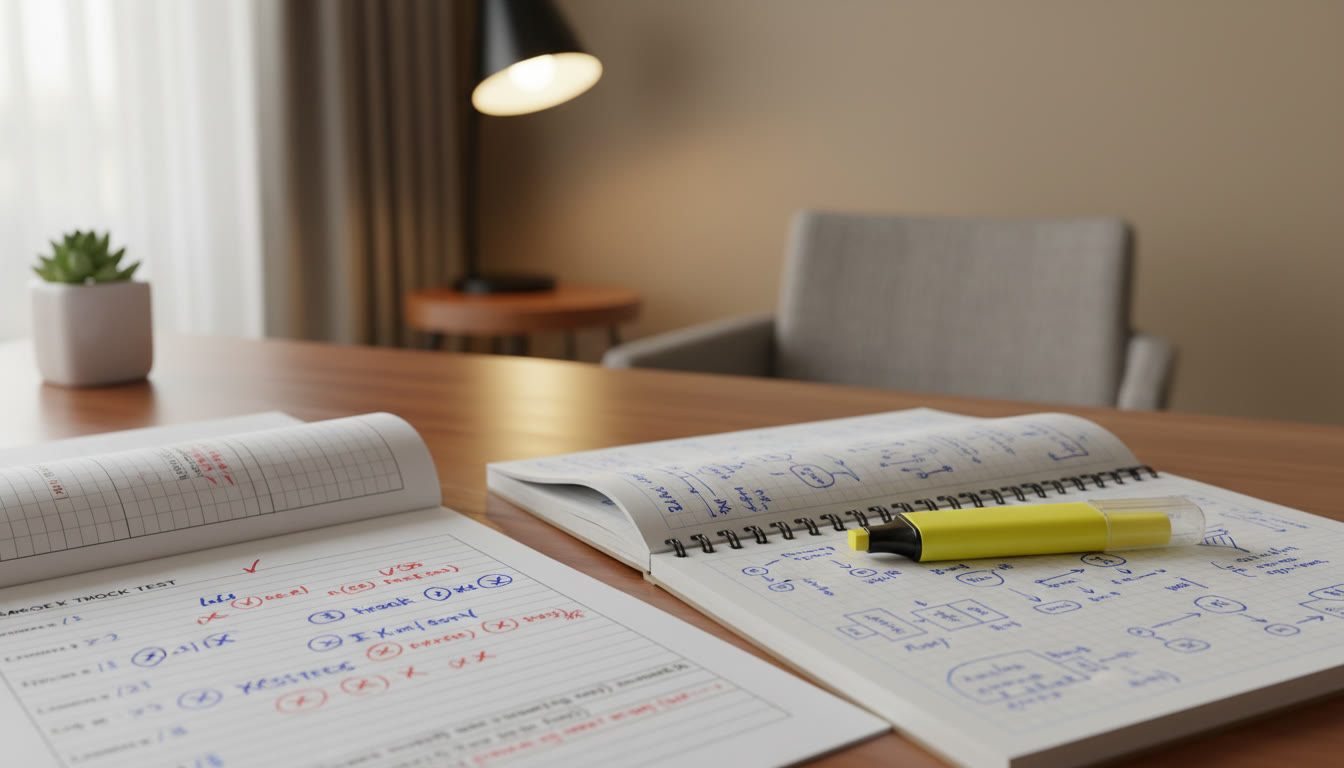
- Use a physical or digital error log: For every wrong or skipped question, note the cause (conceptual gap, careless mistake, misread, time loss) and the fix. Review this log weekly.
- Practice OMR discipline: If your mock requires OMR bubbling, practice filling answers under timed conditions; if it’s computer-based, practice careful clicking and review procedures.
A practical table: common mistakes, impact, and the three-step fix
| Mistake | Immediate Impact | Three-step Fix |
|---|---|---|
| Rushing unfamiliar questions | Wrong answers, negative marks, wasted time | 1) Skip and mark, 2) Return only in second pass, 3) Post-mock: identify knowledge gaps |
| Careless arithmetic/units errors | Loss of easy marks | 1) Slow down final calculation by 30%, 2) Re-check units, 3) Do a quick sanity check |
| Poor time allocation | Unanswered high-scoring questions | 1) Pre-assign minute bands per section, 2) Enforce breakpoints, 3) Log time-per-question pattern |
| Bad marking (OMR/computer) | Lost answers despite correct solutions | 1) Practice transfer routines, 2) Use consistent marking order, 3) Re-check before submission |
Planning the 3-hour full-length mock: a realistic time allocation
A 3-hour mock (180 minutes) can look like a simple 1/3 split by subject — but smarter allocation is skill-driven. Below is a sample template you can adapt to your strengths and the exam’s section format. The goal is to create predictable checkpoints so you can audit your mock in-flight and post-test.
| Phase | Time (minutes) | Focus |
|---|---|---|
| Warm start & high-confidence sweep | 0–40 | Quick wins, easy MCQs across Physics/Chemistry/Biology |
| Focused solving | 40–140 | Attempt medium and some high-difficulty questions with time-boxed efforts |
| Review & smart guessing window | 140–170 | Revisit flagged questions, check calculations, and make elimination-based guesses |
| Final OMR/computer check | 170–180 | Confirm entries, bubble checks, and submit |
Adapt these counts: if Physics is your strongest subject, allocate more early time there; if you’re weaker in Biology, keep a longer accuracy window for that section during the focused solving phase. The critical habit is the checkpoint at around two-thirds time: do a rapid status check, identify unanswered high-value questions you still want to try, and then lock a review window.
Discipline for MCQ + negative marking: rules to live by
- Never guess blindly. Use elimination and odds: if two options are implausible and you can reasonably eliminate them, your expected value increases; if you cannot eliminate options, leave it for the review window.
- Be ruthless with time. If a problem costs more than your pre-set threshold (for example, 6–8 minutes), mark and move on.
- Recognize when derivations are learning tools. A beautifully written multi-step derivation during the exam isn’t a substitute for a correct option — use derivations to verify or rule out choices, not as a consolation for partial marks.
- Practice OMR-style transfers: if your mock has answer-sheet filling, treat the final five minutes as sacred for transfers and checks. If it’s computer-based, confirm your final clicks and review flagged items.
Drills that work: speed, accuracy, and combined rehearsals
Here are drills you can fold into a weekly routine. Consistency matters more than intensity: short daily practices beat long infrequent sessions.
- Speed Sets (5×20 minutes weekly) — Solve twenty short, single-concept MCQs in 20 minutes. Time each set, aim to reduce average time per question, and track accuracy.
- Accuracy Sessions (3×45 minutes weekly) — Take a medium-sized problem set where you must achieve 95% accuracy. Focus on careful reading, units, and intermediate checks.
- Full Mock + Deep Review (1 per week) — After a 3-hour simulated test, spend 90–120 minutes on analysis: error classification, time logs, and correction plan.
- Mini-mocks for pressure (2×30 minutes weekly) — Do a 30-minute mixed-section mini-mock designed to replicate the pressure of a surprise sequence of questions.
How to analyze a mock: a step-by-step audit
After every full mock, don’t just record your score. Run this audit:
- Identify the top 3 types of mistakes (calculation, concept, misread).
- Quantify time lost: how many minutes did you spend on flagged questions that you ultimately left or got wrong?
- List the topics where more than one mistake happened — these become your focused study targets for the week.
- Update your error log: for every wrong answer, write a one-line correction plan and schedule a short revision slot within 48 hours.
- Re-test only the corrected topics in a micro-drill within 7–10 days to ensure the mistake didn’t return.
Sample weekly routine (balanced approach)
This sample shows how to blend learning, speed, and full mocks.
- Monday: Speed sets (Physics + Chemistry), 30 minutes review of error log.
- Tuesday: Accuracy session (Biology/Concepts), topic revision 60 minutes.
- Wednesday: Mini-mock 30 minutes, immediate 20-minute review.
- Thursday: Problem-solving block + derivation practice (90 minutes).
- Friday: Speed sets + OMR practice (45 minutes).
- Saturday: Full 3-hour mock followed by 90-minute analysis.
- Sunday: Light conceptual revision, fix 2 recurring mistakes, rest.
If you have access to one-on-one coaching, personalized study plans can compress this loop because the tutor helps prioritize the highest-gain corrections. For example, Sparkl‘s tutors often recommend swapping certain routine sessions based on an individual’s mock-analysis metrics: that targeted nudge saves hours over a month.
Common psychological traps and how to avoid them
- Score obsession — If every mock is an emotional roller coaster, you won’t learn. Treat score as feedback, not identity. Focus on measurable process gains: fewer silly mistakes, lower average time per question, improved topic completion rates.
- Overconfidence in repeated topics — Repeating the same question types breeds complacency. Introduce variability: mix problem styles and difficulty levels to prevent “pattern blindness.”
- Fixation on high-difficulty questions — A handful of very hard questions can eat your clock. Train the discipline to pass and return.
A practical checklist for mock day
- Pre-test: Warm up with a 10-minute speed set, fueled and hydrated.
- During test: Use the two-pass approach and keep a visible timer with checkmarks for the 40/140/170 minute breakpoints.
- OMR/computer: Every 30–45 minutes do a quick bubble/click sanity check; if paper-based, keep pencil and eraser controlled to avoid smudges.
- Post-test: Do the full analysis ritual within 24–48 hours while the mistakes are still fresh.
Final practical tips and small experiments you can run this week
- Experiment with 3 different pass thresholds: 2 minutes, 4 minutes, 6 minutes per question. See which gives you the best score/accuracy trade-off over three mocks.
- Run one mock with strict no-guessing and one mock with guided elimination-guessing; compare net scores to find your guessing policy.
- Track mental fatigue: schedule your hardest mock when you’re naturally at peak focus, then simulate lower-energy conditions to train resilience.
Parting note: the simple metrics that show real progress
Track these weekly: accuracy on attempted questions, average minutes per attempted question, number of careless mistakes, and the ratio of “skips-to-tries.” Small steady improvements in these metrics are far more predictive of exam success than an occasional high score. Your aim is to convert random gains into predictable performance.
Approach every mock with the mindset of measurement: practice a reliable answer-entry routine, enforce time checkpoints, log and fix recurring mistakes, and mix speed and accuracy drills. These habits turn a 3-hour mock into a compact laboratory for learning and will steadily strengthen both your pace and precision.
Accuracy and speed are skills you build deliberately; treat each mock as structured practice and the margin between you and many other candidates will consistently grow.



















No Comments
Leave a comment Cancel