
Finish Strong: A Practical Rank Improvement Plan for the Last Phase of JEE Preparation
This is the stretch when small, consistent moves earn big rank improvements. You’ve already covered concepts, solved problems, and written practice tests—now the game is about focused revision, mistake correction, and exam-intelligent action. Think of this period as surgical: remove the noise, patch the leaks in your preparation, and rehearse the actual exam experience until your responses become calm, fast, and reliable.

How to use this guide
Read it as a single-session playbook. You’ll get a quick assessment routine, a priority matrix, a replicable weekly template (with a table you can adapt), a mock-test analysis loop, CBT discipline tips for exam entry and navigation, and a compact checklist for the last 30 / 14 / 7 days. There’s also a short note on how personalized one-on-one support and AI-driven insights can fit naturally into this phase for targeted, high-impact gains.
1. Quick assessment: Where do you actually stand?
First, stop guessing. A realistic assessment separates anxiety from action. Spend one focused session—no longer than a morning—doing the following:
- Take a single full-length mock under strict exam conditions (3-hour duration, no phone, no reference material). Treat it as the truth-telling test.
- Classify your score by topic: Which three topics account for most of your lost marks in each subject (Physics, Chemistry, Mathematics)?
- Note time-leaks: How many questions did you spend more than the planned time on? Which question types slow you down (calculation-heavy, conceptual, multi-select)?
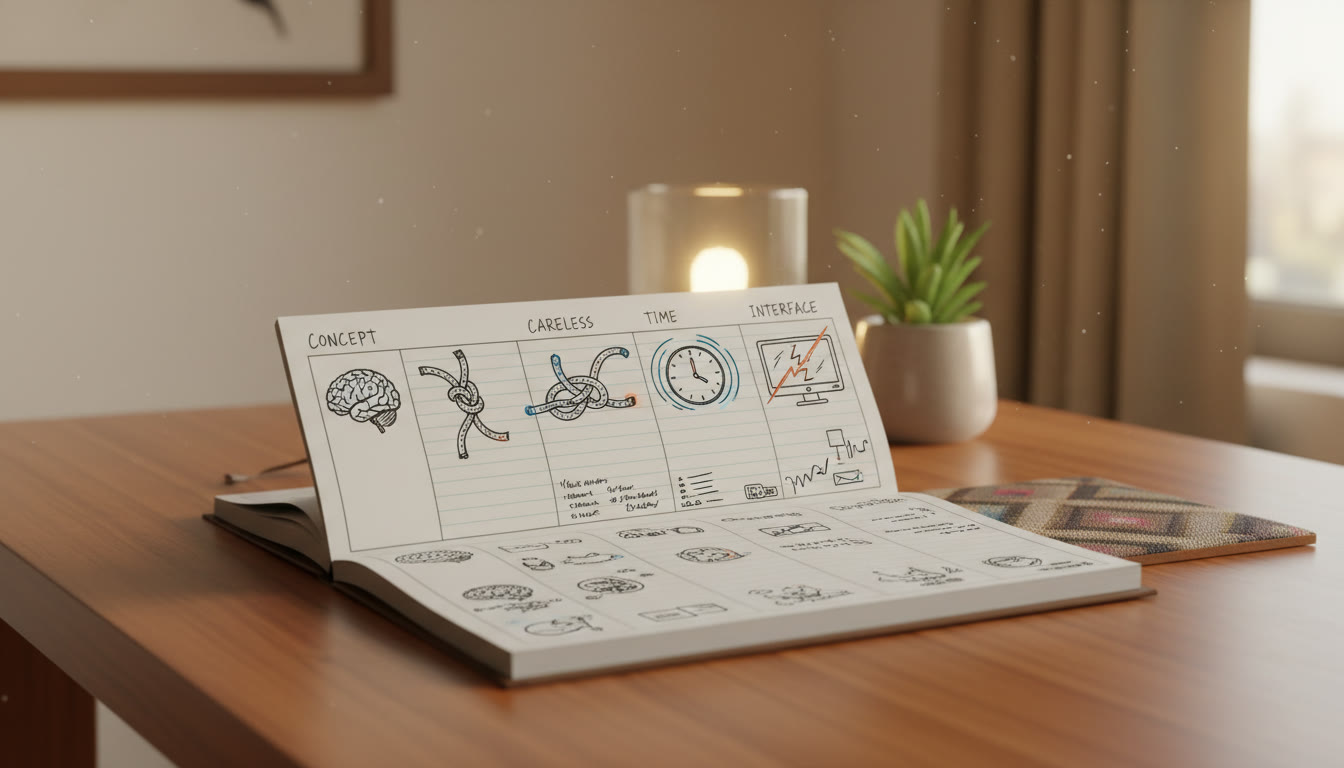
- Inventory careless errors vs. conceptual gaps: Careless errors are the easiest to fix; concept gaps take planned practice.
This short audit creates a precise to-do list instead of a generic “study more” approach.
2. Triage: Prioritize the topics that move your rank needle
With only weeks left, you must allocate effort where the payoff is highest. That means prioritizing:
- High-weight and high-confidence topics: polish them into automatic scoring.
- Medium-weight topics with fixable gaps: target them next through short, focused problem sets.
- Low-yield topics only if they are high-confidence (quick attempts for possible extra marks).
Example prioritization (adapt to your audit):
- Physics: Make sure core mechanics, electricity, and optics problems are exam-ready.
- Chemistry: Strengthen physical calculations and organic reaction logic; keep inorganic recall crisp.
- Mathematics: Lock down calculus and algebra methods that appear in multiple question forms.
When you prioritize, think in terms of marks-per-hour. A topic that gives two reliable marks in 30 minutes is better than a topic that might yield five marks but takes a week to shore up.
3. Weekly template: a flexible, high-impact plan (table)
Below is a compact template you can adapt to the number of weeks left. The table spells out the focus, mock frequency, and main actions for each week. Use it as a scaffold, not a strict timetable—life happens, so the plan must flex but not crumble.
| Week | Main Focus | Mocks & Timing | Daily Actions | Goal |
|---|---|---|---|---|
| Week A (initial audit week) | Full-length mock + error-classification | 1 full mock (3 hours) + 30–45m topic quizzes | Analyze every wrong/slow question; update error log | Clear list of top 6 weaknesses across subjects |
| Week B (intensive repair) | Fix top weaknesses; daily micro-tests | 2 full mocks (including timed sectional practice) | Targeted practice sets + light revision of strong topics | Regain predictable scores on repaired topics |
| Week C (consolidation) | Simulate exam nights and endurance | 2–3 mocks with increasing realism | Polish exam strategies, timer discipline, and physical routine | Stable time management and confidence in exam flow |
| Final Days | Light revision, formula recall, sleep & routine | 1 short mock or sectional rehearsal | Low-stress review, flashcards, error log scan | Sharp mind, no new topics, minimal fatigue |
How to adapt the table
If you have fewer weeks, compress the cycle: more focused mock-analysis loops and stricter selection of topics to repair. If you have more time, add spaced repetition days and extra sectional mocks.
4. Mock-test strategy: make each mock teach you something
Full-length mocks are the highest-leverage activity in this phase—but only if you analyze them properly. Treat mocks like lab experiments: collect data, analyze causes, and run controlled interventions.
- Mock frequency: One realistic full-length mock once every 3–4 days is ideal during the intensive phase. In the consolidation phase increase realism (same start time, same breaks, same seating conditions).
- Timed practice: each mock should be a 3-hour, full-length, single-seat session that mirrors the exam’s objective format and interface behavior.
- Quality of analysis: don’t just note the wrong answers—diagnose why you failed (conceptual gap, silly mistake, misread question, calculation error, time pressure, interface error).
- Quantify improvements: track metrics such as accuracy on attempted questions, time per question bucket, and careless-error rate. Your goal is to reduce careless errors and tighten time control.
Mock analysis loop (a simple process to follow after every test):
- Step 1: Mark each wrong answer with cause code (C = Concept, S = Silly, T = Time, M = Interface/Entry).
- Step 2: For each Concept error, do two focused problems on that micro-topic; for each Silly error, add a 10-minute accuracy drill; for Time errors, simulate the same question under a faster clock.
- Step 3: Update an error-log summary and carry forward only the persistent errors into the next mock cycle.
5. Daily micro-plan: structure your days for momentum
Consistency trumps marathon sessions late in the game. Here’s a sample daily micro-plan (adjust hours to your own stamina):
- Morning (most alert): 2–3 hours on a priority topic—solve 4–6 high-quality problems; no distractions.
- Late morning: 45–60 minutes quick revision of formulas and flashcards for two subjects.
- Afternoon: 1.5–2 hours of targeted problem practice (timed or sectional).
- Evening: Mock-related tasks—analysis of the previous mock, error log updates, and a short revision of corrected concepts (45–60 minutes).
- Night: 30 minutes light review or visualization; keep the last hour before bed screen-free to protect sleep quality.
A daily error log entry is vital: record the problem, the mistake type, the fixed method, and one quick test problem to validate the fix the next day.
6. CBT discipline and answer-entry hygiene
Much of last-phase failure comes from exam-entry mistakes rather than unknown science. Whether the exam is computer-based or uses any other objective interface, these principles hold:
- Familiarize yourself with the test interface: practice marking for review, switching sections, and the specific steps to submit answers in the simulated environment.
- Answer-entry hygiene: before you finalize a question, do a quick read-back to ensure you entered the intended option. Don’t rely on memory—verify the on-screen selection.
- Understand marking schemes and negative marking: avoid wild guessing, use elimination carefully, and place marks only when the expected return outweighs the risk.
- Minimize interface errors: avoid over-clicking, accidental clears, or marking the wrong question. Simulate the real device’s keyboard and mouse behavior during practice.
Note: written workings in your rough sheet are not a substitute for entering the final chosen option correctly. Objective tests reward the recorded answer, not the side calculations.
7. Smart question-selection and time-allocation rules
Having a clear selection policy reduces decision fatigue during the exam:
- First pass: solve all questions you can do quickly and accurately. These are your guaranteed scores.
- Second pass: attack medium-difficulty items where you can apply a known method; mark anything that may need more time.
- Final pass: attempt high-difficulty problems you’ve practiced repeatedly and can solve within an acceptable time bound; don’t waste minutes on one question.
Pro tip: set mini-benchmarks for each mock: for example, aim to finish the first full sweep in X minutes so you reserve ample time for medium and hard problems. Adjust X based on mock experience.
8. Mental conditioning, sleep, and nutrition
Peak performance is physiological as much as intellectual. In the final phase, stress management, sleep, and simple food rules matter:
- Sleep is strategic: prioritize 7–8 hours on exam-like nights; avoid the temptation to “cram” at the cost of rest.
- Nutrition: keep meals regular and avoid heavy, unfamiliar foods before mock/exam days; hydration supports clarity.
- Short, structured breaks inside your study blocks (5–10 minutes every hour) improve retention and reduce careless errors.
- Active relaxation: 15 minutes of light movement or breathing exercises after a mock reduces cortisol and improves recovery.
9. How personalized tutoring and AI-driven insights fit now
When time is limited, personalized interventions can be highly efficient. If you choose targeted external support, look for help that offers:
- One-on-one clarity sessions on persistent conceptual gaps so you don’t waste time on repeated, unfocused practice.
- Tailored study plans that adapt after each mock—short corrective loops that convert weaknesses into reliable attempts.
- Data-driven feedback: use performance analytics to prioritize your next study block rather than relying on intuition alone.
For example, Sparkl‘s model often blends 1-on-1 guidance with compact, test-focused plans and AI summaries of mock-test trends. That kind of support can be useful if you need to convert recurring errors into stable solutions quickly. If you mention conceptual patterns from your error log to a tutor, ask for two short practice problems that test that exact micro-skill rather than a long problem set.
If you refer to Sparkl‘s approach, note that the idea is to use targeted human coaching alongside quick, algorithmic diagnostics to free up hours you would otherwise spend guessing what to fix next.
10. Actionable checklist for last 30 / 14 / 7 days
Print or pin this checklist. It’s short, concrete, and focused on actions that reliably change outcomes.
- Last 30 days: complete at least 6 full-length mocks, update error log after each, and repair the top 6 recurring weaknesses.
- Last 14 days: increase mock realism—same start time, same breaks, and rotate question difficulty; reduce introduction of new topics to near zero.
- Last 7 days: only light practice and revision; review error log flashcards, memorize quick formulas and reaction patterns, and stabilize sleep schedule.
Always keep one sheet for “do-not-forget” items: permitted stationery, exact exam start time, ID details, and a short breathing routine to use before the exam begins.
11. Small examples of micro-drills that yield big results
Micro-drills are 10–25 minute tasks designed to eliminate a single recurring error. A few examples:
- Careless arithmetic: 10 problems with only arithmetic and no concept—do timed repetition until error rate drops to near zero.
- Read-the-question traps: take ten multi-sentence MCQs and practice underlined-keyword extraction (identify exactly what is being asked before solving).
- Interface practice: simulate marking for review and finalizing answers on a mock interface for 15 minutes, repeating entry verification steps.
12. Simple tracking table you can copy into your notebook
| Date | Mock Score | Top 3 Error Causes | Correction Planned | Verification Problem (done?) |
|---|---|---|---|---|
| — | — | — | — | — |
Copy this table into every mock-analysis page. The discipline of filling it is as important as the content.
Closing note — a mindset for the final push
In the last phase, precision beats volume. Replace vague promises to “study more” with micro-goals: repair a single concept, reduce one careless error type, finish the first sweep in a fixed minute window. Practice the real exam conditions repeatedly. Each accurate, timed mock that you analyze deliberately narrows the gap between practice performance and exam performance.
Keep the focus narrow: prioritize high-value topics, correct repeat mistakes with small drills, and maintain exam-entry discipline so technical errors don’t steal marks you deserve. Trust the incremental gains—the cumulative effect of small, deliberate corrections is what changes ranks in the final stretch.























No Comments
Leave a comment Cancel