

How to Choose the Right Books for JEE Main
There are moments in every aspirant’s journey when a neat row of books on a desk suddenly looks like either a treasure trove or a maze. You want clarity: which ones to keep, which ones to skip, how many are too many, and how to turn any book you pick into an instrument that actually raises your score. This guide walks you through that selection with a friendly, practical approach — no fluff, no name-brand lists, just clear principles and tactics you can apply right away.

Begin with the exam reality: what your books must prepare you for
Before buying anything, accept the exam’s basic mechanics and design your book stack around them. JEE Main places a premium on speed, accuracy, and deep conceptual clarity across three subjects: Physics, Chemistry, and Mathematics. The exam is largely multiple-choice or objective-type in nature, uses a fixed time window for a full-length test, follows strict OMR/answer-entry discipline, and applies negative marking for incorrect responses. That means your books should do more than explain theory: they should build the habit of answering correctly under timed conditions.
How that changes what you choose
- Clarity-first: Books that explain core concepts clearly and in progressively deeper layers will convert into quicker problem-solving later.
- Practice-first: Because questions are objective and time-pressured, books must include a large, varied set of problems with answer keys and preferably step-by-step solutions.
- Exam-sim practice: Full-length timed papers and OMR-style practice are essential — your book plan should make space for regular 3-hour test runs.
Books play distinct roles — know which role you need
Think of your library as a toolkit where each tool has a purpose. Don’t buy a dozen hammers if you really need a drill and a level. Here are the typical roles books should play:
- Foundation texts — Clear, chapter-wise explanation of core concepts you’ll encounter on the syllabus.
- Concept-builders — Books that slow you down and push you to understand derivations, physical intuition and proofs.
- Problem banks — Large sets of graded problems for practice with solutions.
- Advanced challenge books — Tough, olympiad-style or deep-reasoning problems you pick up once the basics are firm.
- Mock test series — Full-length papers that mimic the real exam’s timing and OMR behaviour.
- Revision/notes — Concise formula sheets, quick-review guides and topic-wise short notes for last-minute polishing.
Quick checklist to evaluate any book (ten-minute test)
Not every book deserves your time. Give each candidate a fast check before you commit:
- Does it align with the official syllabus topics and their typical depth? If not, move on.
- Are explanations clear enough that you can follow a derivation or argument without external help?
- Are worked examples present and varied in difficulty?
- Does the problem set cover conceptual, application and high-difficulty problems separately?
- Is the answer key accurate and are solutions available (preferably stepwise)?
- Does it help you learn exam strategy — problem selection, time management, and answer-entry discipline?
A one-page decision rule
If a book fails two items on that checklist and it is not free, don’t buy it. If it passes most but lacks ample practice, combine it with a good problem bank instead of searching for another theory book.
Table: What to expect from different book types
| Book Type | Purpose | Key Indicators | How to Use |
|---|---|---|---|
| Foundation Textbook | Build core understanding | Clear language, progressive examples | Read chapter → attempt examples → summarize |
| Concept Builder | Deep understanding and derivations | Detailed proofs, physical discussion | Study selectively where you feel shaky |
| Problem Bank | Practice variety and speed | Large question bank, graded difficulty | Daily problem sets + track mistakes |
| Mock Tests | Time management & exam temperament | Full-length tests with OMR simulation | Weekly timed tests; review thoroughly |
Subject-wise selection strategy (practical, not prescriptive)
Each subject has its own rhythm. Think about the role a book must play for that rhythm rather than hunting for a single ‘best’ title.
Physics
- What physics needs: conceptual clarity plus numerical fluency. Physics questions reward both intuition and accurate calculation.
- Choose books that provide layered explanations — start with simple examples, then move to problems that force you to combine multiple concepts.
- Use diagrams actively: redraw them, annotate forces and fields, and use them as tools to reduce problem complexity.
Chemistry
- Chemistry is three-part: conceptual memorization and pattern recognition in inorganic, mechanistic thinking in organic, and calculation/problem solving in physical chemistry.
- Pick resources that separate these three streams clearly, give practice for reaction mechanisms and include enough numerical problems for physical chemistry.
- For inorganic portions, prefer concise, tabulated summaries and problem practice that tests recall and application.
Mathematics
- Maths rewards structured problem-solving. Choose books that teach techniques first, then offer graded problems that gradually increase in trickiness.
- Look for books with clear step-by-step solutions and alternate solution methods — seeing multiple routes to the same answer builds flexibility.
- Practice is key: a single topic must be drilled until common patterns become second nature.

How many books per subject is ideal?
There’s no universal number, but a safe, focused stack for each subject looks like this:
- One clear foundation text (to learn and revise core concepts).
- One problem-practice book or bank (to build speed and variety).
- Optional one advanced/problem-challenge resource for top-up practice (if you aim for the highest rank or are comfortable with the basics).
So, two to three quality books per subject is usually enough. The trap many students fall into is accumulating dozens of books: more titles often mean more confusion, not more learning.
How to convert any book into a learning machine
Buying a good book is only half the battle. The other half is using it the right way.
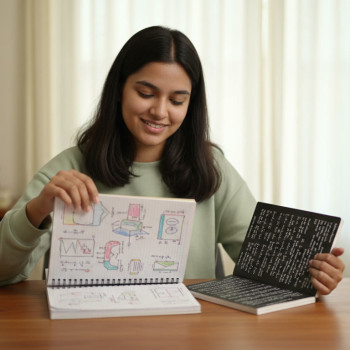
- Active reading: Read with a pen. Write out derivations, recreate annotated diagrams, and explain a concept out loud as if teaching someone.
- Problem-first practice: Attempt solved examples on your own before reading solutions. Force yourself to think for at least 10 minutes per example.
- Spaced practice: Revisit topics after a short and then a longer interval — don’t cram everything in one sitting.
- Error log: Maintain a small notebook where you record every mistake, the reason (silly, concept gap, careless), and a corrective action.
- Timed sets: Convert problem sets into timed mini-tests to build speed under pressure.
Mock tests and OMR discipline
Regular 3-hour full-length mock tests are non-negotiable. Treat them like the real exam: simulate the environment, follow OMR discipline and practice the art of selecting which questions to attempt first. Use your books to build the exact skill sets the mocks expose as weak: if a mock shows poor time allocation in a topic, go back to a problem bank and drill that topic under time pressure.
Integrating books with guided support
Self-study is powerful, but targeted guidance can accelerate learning dramatically when used correctly. One form of guided support is personalized tutoring that helps convert book knowledge into strategy and habits. For example, Sparkl’s personalized tutoring blends one-on-one coaching, tailored study plans, experienced mentors, and AI-driven insights that point to the exact chapters and problem types you should focus on next. Personalized guidance helps when your book stack is right but your progress plateaus: a coach helps you use the existing books more efficiently rather than pushing you to buy more.
Practical examples: how to pick books based on your profile
Scenario A — You have good conceptual grip but lack speed: Pick a solid problem bank with graded practice and a mock-test series. Spend most time converting book problems into timed sets and logging errors.
Scenario B — You have speed but shaky basics: Invest time in a clear foundation text and a concept-builder. Work through derivations and basic examples before jumping to advance-level problems.
Scenario C — You’re starting late: Consolidate with one concise foundation text per subject and an intensive mock-test schedule. Avoid buying many optional books; focus on high-yield topics first and use problem banks for practice under time constraints.
Budget-wise and format choices: physical vs digital
- Physical books are great for annotation; writing in margins helps retention. If you buy physical copies, highlight judiciously and keep a separate error log to avoid defacing practice questions you may need to reuse.
- Digital books and PDFs are searchable and convenient for quick lookups; they pair well with online problem practice and test simulators.
- Whichever format you choose, prioritize a clean, portable set of essentials: foundation text, problem bank and mock tests. You can supplement with digital resources for topic drills.
Mistakes students make when choosing books (and how to avoid them)
- Buying too many books at once. Rule: buy one per role, try it for a month, then decide.
- Confusing book density with usefulness. A thick book can be intimidating without being practical.
- Choosing books because everyone else uses them. Fit matters more than reputation; choose what fits your learning style.
- Using advanced books too early. If basics are shaky, advanced problem books will only frustrate you.
- Ignoring solution quality. If a book’s solutions skip steps, it’s a poor learning resource for weak areas.
Sample weekly schedule that pairs books with practice
| Day | Morning (Concept) | Afternoon (Practice) | Evening (Revision/Test) |
|---|---|---|---|
| Mon/Wed/Fri | One chapter from foundation text (read + note) | Problem bank: 8–12 problems, timed mini-set | Review errors; 20-min revision notes |
| Tue/Thu | Concept-builder: derivation or mechanism practice | Mixed-topic practice (to build switching speed) | Short mock (30–60 mins) on weak topic |
| Sat | Targeted problem drill | Full-length timed mock (3 hours) | Thorough analysis of mock errors |
| Sun | Light revision; formula sheets | Untimed practice or concept consolidation | Rest and short recap notes |
When a tutor or mentor changes the book equation
Books are the raw material; mentors help you convert them into results faster. Personalized support is most valuable when:
- Your book stack is set but progress has plateaued.
- You need discipline and a plan that aligns chapters with mock schedules.
- You want targeted advice on which chapters to prioritize for the upcoming exam cycle.
That’s where a guided approach that pairs one-on-one coaching and tailored study plans can be worth the investment. For many students, Sparkl’s combination of expert mentors and AI-driven insights makes it easier to extract more value from the books already on the shelf.
Final checklist before you click “buy”
- Does this book fill a role on your shelf or duplicate something you already own?
- Can you afford the time to finish the book, not just skim it?
- Does it have graded problems and real exam–style questions?
- Are the solutions complete and trustworthy?
- Will it help you practice under timed conditions and improve OMR discipline?
Concluding guidance
Choosing the right books for JEE Main is less about brand names and more about fit, depth and how you use them. Aim for a compact, purpose-driven library: a foundation text for clarity, a problem bank for speed and variety, a mock series for exam temperament, and — where needed — a challenge resource to push your peak. Use active reading, timed practice, error logging, and regular full-length mocks to turn pages into points. If progress stalls, targeted personalized tutoring can optimize the way you use existing books rather than just adding more shelves. Keep decisions simple, track what improves your scores, and iterate your choices based on measured results.






















No Comments
Leave a comment Cancel