
How to Improve Productivity for JEE Main: Practical Habits That Deliver Results
Prep for JEE Main can feel like you’re carrying a whole library on your shoulders. If productivity feels elusive, you’re not alone — the difference between busy and productive is often small, but it compounds fast. This article walks you through clear, actionable steps to convert effort into measurable progress: smarter daily routines, better mock-test use, targeted revision, and sustainable habits that protect your energy and sharpen your focus.

Start with a productive mindset — what really matters
Productivity for JEE Main isn’t about clocking endless hours; it’s about choosing the right tasks at the right time and executing them well. Replace vague intentions like “study more” with crisp goals like “finish three chapter-wise problem sets in calculus with accuracy above 70%” or “complete one full-length mock under timed conditions and analyze errors for two hours.” Clear goals make your brain prioritize the right work.
- Quality beats quantity: Deep, focused study sessions yield more retention than long, distracted hours.
- Small wins matter: Daily micro-goals build momentum — a solved concept, a corrected mistake, a single formula memorized.
- Progress is measurable: Track accuracy, speed, and topic coverage instead of just hours spent.
Set measurable goals: what to track
Break your targets into three levels: long-term (target percentile/score), mid-term (monthly topic coverage, mock score improvement), and short-term (daily chapter goals). Make each goal measurable and time-bound so you can check it every day. For example: “Finish electrostatics notes and 40 mixed problems by Sunday; maintain 60–70% accuracy on mixed tests.”
Design your study week: balance focus, practice, and recovery
A sustainable weekly plan allocates deep study blocks, problem practice, revision, and at least one full-length mock or simulation. Use the table below as a flexible template — adjust hours to your school schedule and energy levels, but keep the proportions consistent.
| Activity | Suggested hours/week | Purpose |
|---|---|---|
| Core concept study (Physics/Chem/Math) | 12–18 | Build conceptual foundations and class notes |
| Problem practice (chapter-wise) | 10–15 | Apply concepts to typical and tricky problems |
| Revision & flashcards | 4–6 | Active recall and spaced repetition |
| Full-length mock / simulated exam | 3–4 (per mock) | Exam simulation (3-hour practice + analysis) |
| Mock analysis, doubt clearing | 3–6 | Identify error patterns and remedy weak areas |
| Breaks, exercise, sleep maintenance | Variable | Energy recovery and cognitive health |
Daily templates you can adapt
Two quick templates — pick one depending on whether you are school-going or fully dedicated to self-study.
- School + JEE prep: 1 hour morning quick revision (formulas), 1.5–2 hours evening deep study (new concepts), 1.5–2 hours night problem practice; short review before sleep (15–20 mins).
- Dedicated self-study: Morning deep block (2–3 hours: difficult topics), afternoon practice block (2 hours: problem sets), evening revision and mixed questions (2 hours), plus mock/simulation on scheduled days.
Active study techniques that actually stick
Passive reading is convenient but inefficient. Replace it with techniques that force retrieval and application.
- Active recall: After a study block, close your book and write key points, formulas, and derivations from memory. This builds strong retrieval paths.
- Spaced repetition: Revisit weak topics at increasing intervals. Use short daily flashcards and weekly deep reviews.
- Interleaving: Mix problems from different topics in a session (e.g., optics + mechanics) to sharpen discrimination skills.
- Feynman technique: Explain a concept in simple language, as if teaching a peer — this reveals hidden gaps in understanding.
- Problem-first approach: Tackle a representative problem before rereading the theory; struggle productively, then fill conceptual gaps.
Notes, errors, and the power of an error log
Keeping a problem-error log is one of the highest-ROI habits. For every wrong or half-solved problem, log: topic, reason for error (conceptual, careless, calculation, time pressure), corrective action, and date revisited. Review this log weekly and mark patterns — often three topics account for most mistakes.
Mock tests: your most valuable training ground
Mock tests are not just a measurement tool — they’re practice for decision-making under pressure. A focused mock routine should have two parts: realistic simulation and deep analysis.
- Frequency: Early preparation — one full-length mock every 10–14 days; later stages — weekly or twice-weekly. Adjust frequency as your stamina and analysis capacity improve.
- Simulation: Treat each mock as the real thing: 3 hours continuous focus, silence, timed sections, and no phone. Practice the computer-based interface if available so you’re comfortable with navigation and marking for review.
- Post-test analysis: Spend at least as much time analyzing the mock as you spent taking it. Diagnose why mistakes happened and convert insights into action items for the next week.

How to analyze mocks efficiently
Use a consistent rubric for each mock: attempted questions, accuracy, time per question, conceptual errors, calculation mistakes, and questions left to guess. A small table or spreadsheet helps you track these numbers over time and visualize improvement.
| Metric | Why it matters | Target |
|---|---|---|
| Attempt rate | Shows willingness to take on questions | Gradually increase without sacrificing accuracy |
| Accuracy | Primary driver of score | Improve week-over-week |
| Time per question | Helps detect slow sections or calculation delays | Reduce variability and set realistic per-question targets |
| Topic-wise errors | Reveals weak chapters for targeted revision | Reduce repeat errors each month |
Tactics for MCQs and negative marking
In MCQ tests, decisions are as important as calculations. Two guiding principles will help: eliminate and estimate. Eliminate impossible options, then estimate whether a calculated guess is worth the negative mark. If you can confidently eliminate at least two options, the odds favor an educated guess; otherwise, consider marking for review and moving on.
- Read carefully: A small misread of units or limits changes the whole answer. Train your eyes to spot qualifiers (“least,” “closest,” “maximum”).
- Round-trip checking: If a numeric result seems off by an order of magnitude, do a quick sanity check before committing.
- Use mark-for-review wisely: Reserve it for problems worth more time — a temporary bypass helps preserve momentum.
Time management techniques that actually work
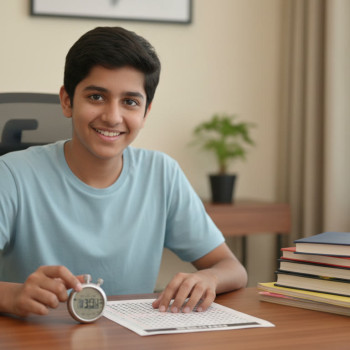
Small rituals improve focus: a short pre-study checklist (water, light, timer), a single-task mindset, and micro-breaks. Consider structured techniques like the Pomodoro method (25–50 minute focused blocks with short breaks). Track how many focused blocks you complete each day rather than raw hours. The aim is replicable focus, not random intensity.
Prioritization frameworks
- Impact vs. Effort: Prioritize topics that will deliver the biggest score gains for reasonable study time — often high-weight chapters and recurring problem types.
- Weakness first: Allocate a guaranteed portion of weekly time to your weakest topics so they improve steadily.
- Polish your strengths: Maintain practice on strong topics so they remain reliable scorers under pressure.
Use tools wisely — tech as a productivity multiplier, not a distraction
Apps for spaced repetition, digital timers, and distraction blockers are helpful. But be strict: limit social apps and set specific time windows for digital research. Keep your practice tests offline or in airplane mode to simulate actual exam conditions.
Personalized tutoring can accelerate gains when used with disciplined practice. For example, Sparkl‘s approach to one-on-one guidance and tailored study plans often pairs well with an independent practice routine: the tutor helps diagnose weak spots and the student executes focused practice. If you use such support, make sure sessions are goal-oriented and include clear homework and measurable outcomes.
Revision strategy: frequency and format
Revision is most effective when it’s active and spaced. Don’t just re-read notes; test yourself. Keep three revision formats:
- Quick recall (daily): 10–20 minute flashcard or formula checks.
- Weekly consolidation: 1–2 hour mixed problem set covering recent topics.
- Monthly deep revision: Retake earlier chapter tests and rework past mock mistakes.
Use a rolling revision calendar: anything learned gets a slot for 1 day, 1 week, 3 weeks, and 2 months later. This simple spaced schedule removes last-minute panic and converts short-term study into long-term mastery.
Health, sleep, and energy management
Peak cognitive performance depends on rest. Aim for consistent sleep (even if it’s 6–8 hours depending on your rhythm), short daily exercise, and nutritious meals. Hydration, regular movement breaks, and avoiding all-night cramming before a mock or exam is crucial — your recall and reasoning skills require steady brain fuel.
- Power naps: 20–30 minutes can restore focus during long study days.
- Movement: Short walks or stretching reduce stress and improve problem-solving.
- Mindset breaks: Schedule non-academic time to recharge — it’s part of a productive plan.
How to recover faster from a bad mock day
Everyone has off days. After a low mock score, resist two urges: quitting and panic-studying. Instead, diagnose one or two root causes (time pressure, careless mistakes, conceptual gaps) and create a focused corrective plan for the coming week. Small, consistent fixes are more effective than frantic, unfocused effort.
Metrics that matter — track what improves your score
Don’t chase vanity metrics like hours alone. Track the few numbers that correlate with score improvement:
| Metric | How to measure |
|---|---|
| Mock score trend | Plot test-by-test to see slope |
| Topic-wise accuracy | Log in an error notebook and revisit weak topics |
| Average time per question | Use timed practice to reduce outliers |
| Repeat errors | Track whether the same mistakes reappear on subsequent tests |
Practical weekly checklist — turn planning into action
- Schedule one timed 3-hour mock under exam conditions.
- Set one weekly concept target per subject (for example: electrostatics, reaction mechanisms, or integration techniques).
- Complete two mixed problem sets and log every wrong answer.
- Do a focused revision session for previously weak topics.
- Sleep and exercise plan for at least three active days this week.
When personalized help makes sense
If you’ve been stuck on the same errors despite disciplined practice, targeted guidance can shorten the loop from error to insight. Sparkl‘s’ strengths — 1-on-1 guidance, tailored study plans, expert tutors, and AI-driven insights — can help convert repeated weaknesses into structured action items. When choosing personalized help, prioritize clarity of goals, measurable milestones, and regular feedback loops that match your study rhythm.
Common pitfalls and quick fixes
- Pitfall: Overdoing new content and neglecting revision. Fix: Reserve 20–30% of weekly time for revision and error log work.
- Pitfall: Endless topic-hopping without depth. Fix: Use problem sets to force depth before moving on.
- Pitfall: Mock-tests without analysis. Fix: Allocate equal or greater time to mock analysis and action planning.
Final academic takeaway
Improving productivity for JEE Main is a system, not a secret. Combine clear, measurable goals with focused study blocks, disciplined mock simulations, and a review loop that converts mistakes into learning. Track the right metrics, protect your sleep and recovery, and prioritize high-impact practice. With consistent application of these principles, your efforts will translate into clearer thinking, faster problem-solving, and steady score gains.




















No Comments
Leave a comment Cancel