
How to Solve Previous Year Questions for JEE Advanced — A Practical, Step-by-Step Guide
Hey — if you’re here it means you want to turn previous year papers into a reliable ladder for improvement. Old questions aren’t just practice material; they’re a mirror that shows how the exam-setter thinks, which topics are repeatedly tested, and where many students lose marks under pressure. Done right, past papers teach timing, sharpen elimination instincts, and build exam temperament.
Why previous year questions are your single best diagnostic tool
Solving previous year questions (PYQs) is different from doing random practice problems. PYQs reveal patterns: which concepts are tested together, typical distractor styles, and the phrasing that hides the intended trick. A few big benefits:
- Alignment: PYQs reflect the current-cycle emphasis across Physics, Chemistry, and Mathematics (PCM).
- Authentic difficulty: You get the actual level of reasoning and calculation the exam expects — not an invented or slightly-easier mock.
- Test temperament: Regularly facing real exam-style questions trains the mental stamina for 3-hour exam blocks and the pressure of negative marking.
- Pattern recognition: Over multiple papers you’ll spot recurring constructs — standard integrals, typical mechanics setups, or chemistry reaction chains — that reward small templates and quick checks.
Know the exam context: question types, timing, and marking mindset
A practical approach begins by understanding the testing environment. The exam is largely objective: multiple-choice formats, integer or numerical response types, and multi-select questions are commonly used. Many question types include negative marking for incorrect choices, so careless guessing reduces expected score. Because the test is taken in timed blocks that mimic a full paper of roughly three hours, simulation should mimic that duration and the time pressure.
Two points to keep in mind:
- Marking schemes vary by question type. Some questions penalize wrong choices, some have no penalty for unanswered items, and some reward partial correctness only in very specific formats — never assume descriptive partial credit where the paper uses objective scoring.
- The test interface is computerized; still, the discipline of clear answer recording (whether you track answers on a separate sheet while you practice or directly on screen) prevents silly transfer mistakes and helps with time splits.
Which previous papers should you solve — and in what order?
Quality beats quantity. Instead of trying to finish every paper at once, follow a progressive sequence that builds confidence and insight.
- Start with recent cycles: they are closest in style and difficulty to the current pattern.
- Mix: alternate paper-wise practice with topic-wise PYQs. For example, practice a full recent paper one week and do a focused set of past questions on mechanics the next week.
- Scale difficulty: begin with papers or sections you can finish in time, then increase the challenge by taking a tougher full-length paper under strict timing.
- Repeat strategically: re-solve the same paper after 7–14 days with only the wrong/uncertain questions visible to test retention.
A step-by-step workflow to solve a previous year question
1) First read — don’t rush to write
Read the question fully once. Underline or mark the key data: what’s being asked, constraints, and special conditions. This first read should take no more than 30–45 seconds for most questions, longer for complicated multi-statement problems.
2) Classify the question (concept & format)
Ask yourself: is this direct recall, standard application, combined concept, or a synthesis problem? Decide whether it’s a quick-solve or a deep-solve candidate. That decision guides how much time you should invest before moving on.
3) Quick strategy sketch (20–60 seconds)
Draft the shortest path in your head or on rough paper: a formula to use, a variable to eliminate, or a diagram to draw. For multi-step math or physics problems, sketch the chain of results needed to get to the final expression.
4) Solve carefully — then check fast
Execute the plan with focused attention. Once you have an answer, do quick sanity checks: dimensional analysis for physics, sign checks in calculus, and limiting cases where possible. If the question has options, use them actively to reverse-check your result or to eliminate impossible answers.
5) Decide to mark or skip
If you’re confident, mark the answer. If your answer relies on a shaky algebraic step or a risky approximation, flag it for review and move on — minimizing time lost in an exam is a skill as valuable as solving accuracy.
During full-length mocks: time splits and answer discipline
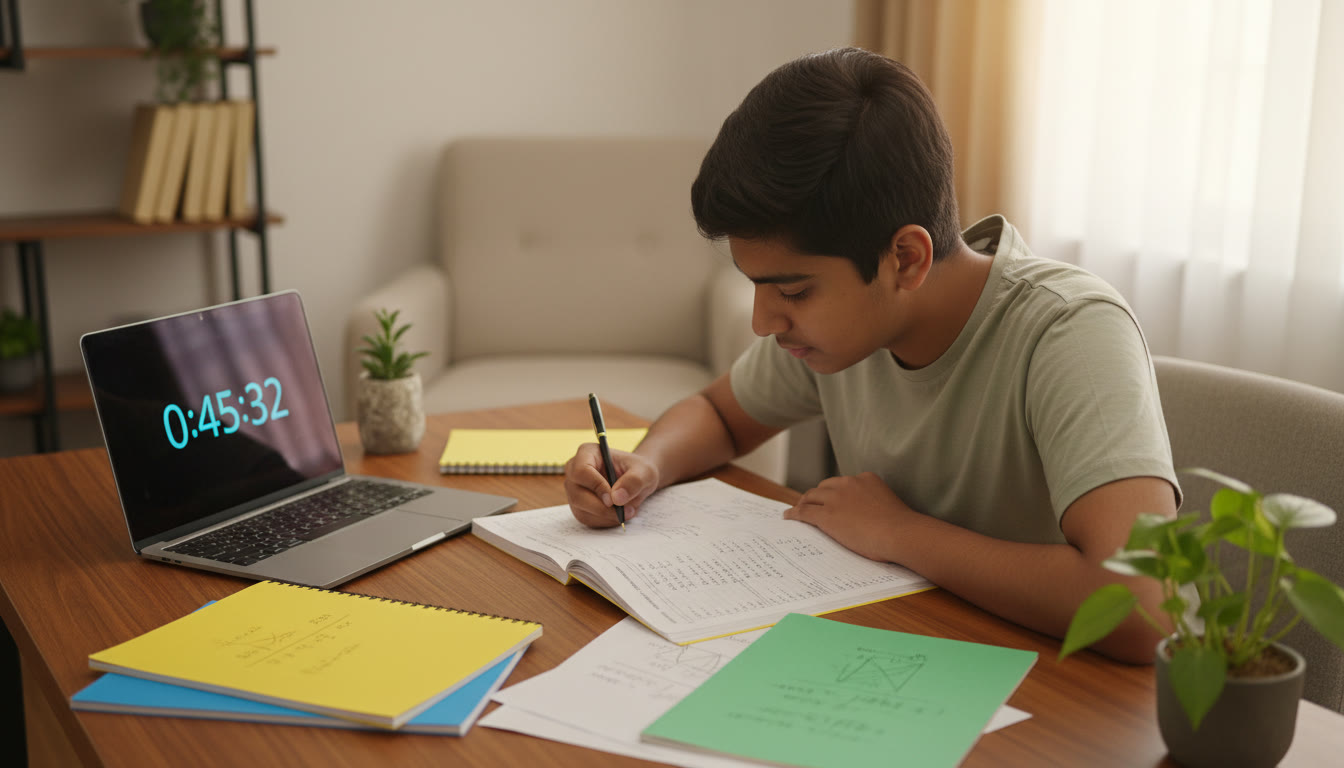
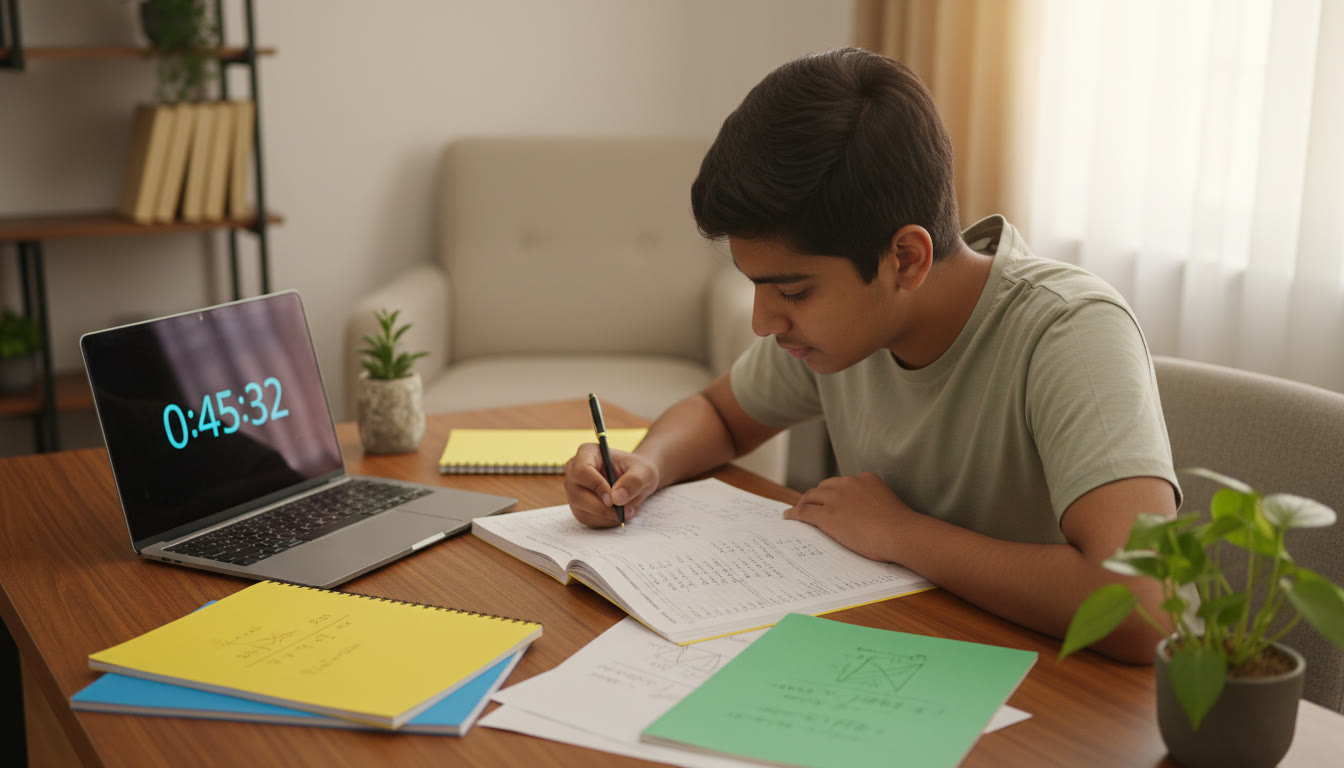
Simulate exam conditions. Use a quiet space, set a three-hour timer, and practice the way the real test asks you to answer. Here are tactical habits to practice:
- First pass: solve the quick 40–50% of questions where an answer is straightforward. Flag the rest.
- Second pass: take on medium difficulty questions; allocate time blocks per section or cluster.
- Final pass: attempt high-difficulty questions, keeping in mind negative marking and emotional fatigue.
- Keep a running time log: note how long each block or question took so you can improve pacing.
Small rules that prevent big losses: keep rough work organized, write down intermediate results clearly (so you can re-check fast), and when in doubt about negative marking, prefer elimination strategies over blind guessing.
After solving: analysis that actually improves scores
How you analyze matters more than how many papers you finish. Turn every solved paper into a corrective plan.
- Immediately log every incorrect answer and every question you flagged. Record the reason: conceptual gap, careless arithmetic, time pressure, misreading, or unfamiliar format.
- Categorize errors and build micro-tasks for each: a 30-minute revision on the concept, 15 minutes of targeted calculations practice, or a shortcut sheet for algebraic manipulations.
- Do not simply correct the final answer. Re-solve the question from scratch after three days without looking at your notes to confirm the fix.
Error type → corrective actions (table)
| Error type | Why it happens | Immediate fix | Practice drill |
|---|---|---|---|
| Conceptual gap | Missing core idea or mistaken theorem use | Review concise theory notes; re-derive key formula | 5 focused questions from PYQs on same concept |
| Careless arithmetic | Rushed steps, sign errors | Rework slowly; use consistent notation | Timed calculation drills (10 Qs × 15 min) |
| Time mismanagement | Poor pacing, spending too long on one question | Practice first-pass/second-pass strategy | Simulated 3-hour mock with enforced time checkpoints |
| Misread question | Skimming or ignoring constraints | Underline constraints before solving | Read-and-summarize drills (3 reps/day) |
How to document your learning
Create a concise error log — one line per question: paper code, question number, error type, corrective action, and the date you plan to re-test that item. This turns random practice into tracked progress.

Sample two-week micro-plan for turning PYQs into mastery
Below is a compact routine you can modify based on how many hours you have each day. The aim is exposure, timed practice, and deliberate correction.
- Week 1: one full timed paper (3 hours) + two focused topic sessions from PYQs + one light revision day.
- Week 2: one full timed paper (3 hours) + two topic-shuffle sessions (mix of weak topics) + error log re-check and a rest/light problem day.
Example daily layout (average 5–6 hours of focused study):
| Day | Activity | Duration | Focus |
|---|---|---|---|
| Monday | Full previous-year paper (timed) | 3 hours | Exam simulation |
| Tuesday | Analyze paper + error log | 1.5 hours | Root-cause fixes |
| Wednesday | Topic practice (PYQs) | 2 hours | Weak topic deep-dive |
| Thursday | Shortcut drills & quick recall | 1.5 hours | Formulas, units, common substitutions |
| Friday | Mini mock (sectional) | 1.5 hours | Speed and accuracy |
| Saturday | Mistake re-test | 1 hour | Retention check |
| Sunday | Light revision or rest | 30–60 min | Concept consolidation |
Common pitfalls and simple countermeasures
- Finishing too many papers without analysis: Stop collecting completed papers. Spend at least as much time analyzing as you did solving.
- Over-relying on memory tricks: PYQs reward pattern recognition, but deep understanding beats tricks on unfamiliar variants.
- Ignoring negative marking: If you can eliminate one or more options reliably, guessing becomes a calculated move; blind guessing is costly.
- Not simulating fatigue: Doing a 3-hour block once a month won’t build stamina. Do shorter intensive blocks regularly and full-length mocks weekly or biweekly nearer to exam windows.
How to approach multi-concept questions
Break them into named sub-goals: identify sub-problem A (apply conservation), sub-problem B (use kinematics), and link them. Label intermediate results so you can verify each stage quickly. This modular approach reduces algebraic errors and makes backtracking far more efficient.
Using guidance without losing ownership
Guided help speeds recovery from plateaus — especially when a pattern of errors repeats despite your best efforts. Personalized tutoring can help isolate subtle misconceptions and suggest the shortest correction path.
For example, consider one-on-one diagnostics that map your frequent error types to a tailored practice plan, or an AI-driven insight that highlights topics where elimination-based strategies will add the most expected score. If you try guided help, keep the focus on translating insights into practice: the tutor’s role is to point out where to push; you still need the deliberate repetitions.
For students who pick guided routes, Sparkl‘s tailored study plans and one-on-one clarity sessions are an example of combining expert human feedback with targeted practice tools. Use such support to speed up the loop from mistake to correction, not to skip doing the corrective repetitions yourself.
Measurement: how to know you’re improving
Improvement is measurable when you track a handful of metrics over time:
- Net correct answers in timed full papers (after penalty adjustments).
- Average time per question across difficulty tiers.
- Error-type frequency (how often conceptual vs arithmetic errors occur).
- Retention score on re-tested corrected questions.
Graph these weekly. If error-type frequency for a given category falls, you’re getting conceptually stronger; if net correct rises without increased time per question, you’re getting faster and smarter.
How to use PYQs to build intuition, not just answers
Don’t treat previous year solutions as final scripts; treat them as conversations with the setter. Ask: Why was this distractor included? What shortcut would the setter expect? Can this problem be generalized into a 2–3 line template for future variants? Convert each solved question into a flashcard: the concept, the one-line trick, and a counterexample that breaks the trick.
Final checklist before a mock or PYQ session
- Clear workspace, countdown timer set for a 3-hour block or for your chosen sectional time.
- Rough sheets and pens ready; a single-sheet summary of formulas allowed for practice (not for exam).
- Flagging method agreed — how many minutes you’ll spend before moving on from a question.
- Error log template ready to populate immediately after the test.
When you consistently follow this loop — realistic simulation, disciplined solving, careful analysis, and focused correction — previous year questions stop being a ritual and become your most efficient path to higher scores.
Solve with intention. Track with honesty. Correct with repetition. End every session with a single, clear corrective task you can finish in less than an hour the next day. That is how past papers turn into present gains.
Concluding academic note
Previous year questions are a structured dataset: treat them like experiments. Pose a hypothesis about why you missed a question, design a short corrective drill to test that hypothesis, and measure the result in the next similar question you attempt. Over time, this scientific approach to practice converts flaky performance into reliable competence in Physics, Chemistry, and Mathematics.






















No Comments
Leave a comment Cancel