

JEE Main PYQ Chemistry Analysis: Decode the Past to Level Up Your Mocks
You’re sitting for a mock test, the clock starts, and that Chemistry paper stares back. Calm. That’s your cue to be methodical, not frantic. Past-year questions (PYQs) are the coach who knows the opponent: they reveal recurring themes, the examiner’s favourite angles, and the sorts of traps that eat marks. This blog is a warm, practical conversation — the kind you’d have with a senior who’s actually sat the same grind — on how to read PYQs, what the patterns mean for mock practice, and how to turn a 3-hour mock into a learning rocket for Chemistry.

Why PYQ Analysis is the Shortcut You Can’t Ignore
PYQs are not just questions — they’re a map. They show which subtopics examiners return to, which question-types reward clean technique, and how time-consuming certain question archetypes are. By studying PYQs you reduce randomness in mock practice: you don’t just do more tests, you do better-targeted tests. That means greater efficiency — the single most valuable currency when the exams are near.
Key Exam Context (Evergreen Essentials)
- Format: Objective-style chemistry in the context of the overall test cycle; expect single-correct multiple choice, numerical-answer questions, and objective formats where accuracy matters.
- Duration: Full-length practice matches the real exam’s three-hour endurance demand — simulate that timing for realistic conditioning.
- Marking: Negative marking applies for many single-correct MCQs. Learn the rules for each question type and avoid assuming partial credit on objective items.
- Answer discipline: Treat every selection with OMR-like care — whether you’re marking on screen or on paper, a disciplined selection habit reduces careless loss of marks.
- Syllabus: Chemistry is part of the foundational trio with Physics and Mathematics. Keep alignment tight: PYQs frequently draw from core class-XII concepts and bring them together in applied settings.
How to Read PYQs: Patterns, Motifs, and What They Mean for Your Mocks
Spot recurring motifs
Scan PYQs for patterns: do numerical questions repeatedly test limiting reagent and concentration conversions? Do organic questions favour mechanisms that hinge on electron-pushing logic rather than obscure named-reactions? Do inorganic questions emphasize oxidation states and simple coordination chemistry facts? Once you spot motifs, convert them into focused mini-syllabus blocks for mock creation.
Learn the examiner’s language
Many exam questions hide their demands in phrasing. Look for trigger terms — words that hint at approximation, assumptions, or which quantity is actually being asked (for example, ‘most stable’, ‘major product’, ‘initial rate’). Train yourself to rephrase each question into a one-line objective before solving: that one-line reduces misreads.
Difficulty vs. Weightage
Past papers show a healthy mix of straightforward recall, moderate application, and a few heavy-calculation items. In a mock, mimic that distribution: include quick-win recall items to build confidence, mid-level application for scoring, and 1–2 high-time-value problems to sharpen stamina and method.
Topic-wise PYQ Analysis and Smart Practice Plans
Physical Chemistry: calculation & concept synergy
Physical Chemistry loves a blend of algebraic clarity and conceptual checkpoints. PYQs here often reward tidy setup: unit checks, mole-count clarity, and careful choice of approximations. Key recurring areas include stoichiometry, chemical equilibria, thermodynamics basics, electrochemistry set-ups, and simple kinetics. In mock tests, label physical-chem questions as ‘fast-to-moderate’ or ‘slow’ based on algebraic load; this labeling will train time allocation sense.
- Strategy: Keep a portable formula-bank (not for exam use — for revision). Practice translating word statements into symbolic form quickly.
- Example focus: A multi-step equilibrium question typically collapses if you set up limiting expressions and check units before algebra.
Organic Chemistry: think intuitively, not just memorise
Rote memory can take you far in some inorganic corners, but organic PYQs prize mechanistic reasoning and pattern recognition. Recognise reaction centers, electron flow, and stability trends. Practise drawing quick resonance and intermediate sketches — these pay off when exam questions shorten steps into a single line.
- Strategy: Build reaction families rather than memorising isolated transformations. A small set of mechanistic templates covers a surprising number of questions.
- Example focus: For a substitution-elimination style question, a checklist—nucleophile strength, leaving group, solvent—often yields the answer faster than long derivations.
Inorganic Chemistry: clarity and recall win
Inorganic is often a scoring zone in PYQs because many questions reward crisp factual recall and simple reasoning. Periodic trends, oxidation states, coordination numbers, and acid-base character frequently appear. The trick: pair memorised facts with quick logic checks (e.g., charge balance and simple electron counts) to avoid silly errors.
- Strategy: Flashcards for ionic radii, common oxidation states, and typical complex geometries. But pair flashcards with short ‘why’ notes — that’s how you convert recall into exam reliability.
Practical Tables for Your Mock Routine
| Topic | Typical PYQ Angle | Mock Prep Strategy | Suggested Focus Time (per week) |
|---|---|---|---|
| Physical Chemistry | Numerical set-ups, equilibrium thinking, unit-check heavy | Timed problem-sets, formula derivation practice, estimated-answer checks | 6–8 hours |
| Organic Chemistry | Reaction mechanisms, product prediction, reagent selection | Mechanism drills, synthesis short-cases, reaction-family flashcards | 6–7 hours |
| Inorganic Chemistry | Recall + short reasoning (oxidation states, periodic trends) | Flashcards with concept-notes, quick electron-count checks | 4–5 hours |
| Integrated/Analytical | Application questions connecting topics | Mixed-section timed practice, cross-topic quizzes | 3–4 hours |
Sample 3-hour Mock Timing Plan (Chemistry-focused)
Below is a sample time split for a full-length mock where you want to allocate time sensibly across subjects while giving Chemistry the attention it needs.
| Section | Minutes | Purpose |
|---|---|---|
| Physics | 60 | Solve straightforward numerical first, then tackle lengthy derivations |
| Chemistry | 50–60 | Start with high-confidence topics (inorganic recall, quick organic tricks) then do calculations |
| Mathematics | 60–65 | Allocate extra for multi-step problems; reserve final minutes for review |
| Buffer / Review | 10–20 | Revisit marked questions, sanity-check quick answers |
After the Mock: A Step-by-Step PYQ-Driven Audit
1) Immediate score & emotional check (within an hour)
Mark the paper and record your raw score. Pause and write down the one feeling you had during the paper (e.g., ‘rushed’, ‘stuck on kinetics’). Recognising emotional states prevents repeat mistakes under the clock.
2) Categorise every wrong/non-attempt (within 24 hours)
For each wrong answer, tag it as one of: conceptual gap, careless error, calculation slip, time-run-out, or misread question. This simple taxonomy converts confusion into a clear list of next-action items.
3) Re-solve the wrong questions the right way
Don’t just read the solution — re-solve it on a blank sheet, aloud if possible. If a conceptual gap is found, write a one-line concept note and link two practice questions targeting that exact same concept for tomorrow’s practice.
4) Build micro-sessions from PYQ clusters
Group wrong or slow PYQs by topic and create a 20–40 minute micro-session: revise the core concept, do two new similar questions under timed conditions, and log what improved. Repeat weekly to turn weak zones into steady scores.
Common Mistakes from PYQs and How to Break Them
- Misreading units or conditions: Habit: underline key quantities and units in the first 10 seconds.
- Skipping sanity checks: Estimate an expected magnitude (e.g., pH range, orders of magnitude for equilibrium constant) before deep algebra.
- Guessing recklessly under negative marking: If you don’t have a 40–60% confidence, leave the question or flag it; blind guessing often erodes score more than it helps.
- Poor time-splitting: Use a soft timer (30-minute blocks) and train to finish the chemistry block with 3–5 minutes to spare for double-checks.
How to Build Mock Papers That Mirror PYQs
A good mock is not simply a random set of old questions. It mimics composition: a mix of direct recall, application, and two endurance questions. Build or choose practice papers where:
- Physical questions require set-up and unit checks;
- Organic questions test reasoning about reaction pathways rather than obscure reagent memory;
- Inorganic questions often reward neat recall paired with a single-step reasoning check.
When constructing tests, include 25–30% quick scoring items, 50–60% moderate application items, and 10–15% high-time-value problems that test endurance and clarity of thought.
Using Personalized Guidance to Decode PYQ Trends (Where It Helps)
Targeted feedback accelerates improvement. If you find your error-log repeating the same conceptual tag, personalised tutoring that focuses on those tags can cut weeks off remedial time. For instance, tailored one-on-one sessions help you convert weak PYQ clusters into practise playlists; AI-driven insights can flag hidden pattern-mistakes (e.g., repeatedly losing time on multi-step equilibrium setups). If you choose guided help, a model that offers 1-on-1 guidance, tailored study plans, expert tutors, and AI-driven insights can slot into your mock cadence without derailing independent practice. Sparkl‘s personalised approach can assist with this kind of micro-targeting while preserving your mock-test autonomy.
Weekly Routine: Turn PYQ Insights into Habit
Here’s a compact weekly cycle that uses PYQ analysis to sharpen performance:
- Day 1: Timed mini-test (30–40 minutes) focusing on one PYQ theme (e.g., titration/equilibrium).
- Day 2: Deep review — re-solve errors, note conceptual gaps, make a 1-page quick-note.
- Day 3: Targeted practice (3 new problems, increasing difficulty).
- Day 4: Rest or light revision (flashcards, organic reaction family sketching).
- Day 5: Full mixed timed set (50–60 minutes chemistry block), simulating exam concentration.
- Day 6: Analysis and correction; add items to error-log and to the next week’s micro-sessions.
- Day 7: Optional recap and a short conceptual drill.
Quick Tools and Habits That Show Up in PYQs
- Always write down units and watch for unit-consistency checks in physical chemistry questions.
- Sketch quick resonance forms and intermediate charges in organic questions — a 10-second sketch clarifies the path.
- For inorganic, maintain a mental checklist: charge balance, typical oxidation states, and simple geometry guess.
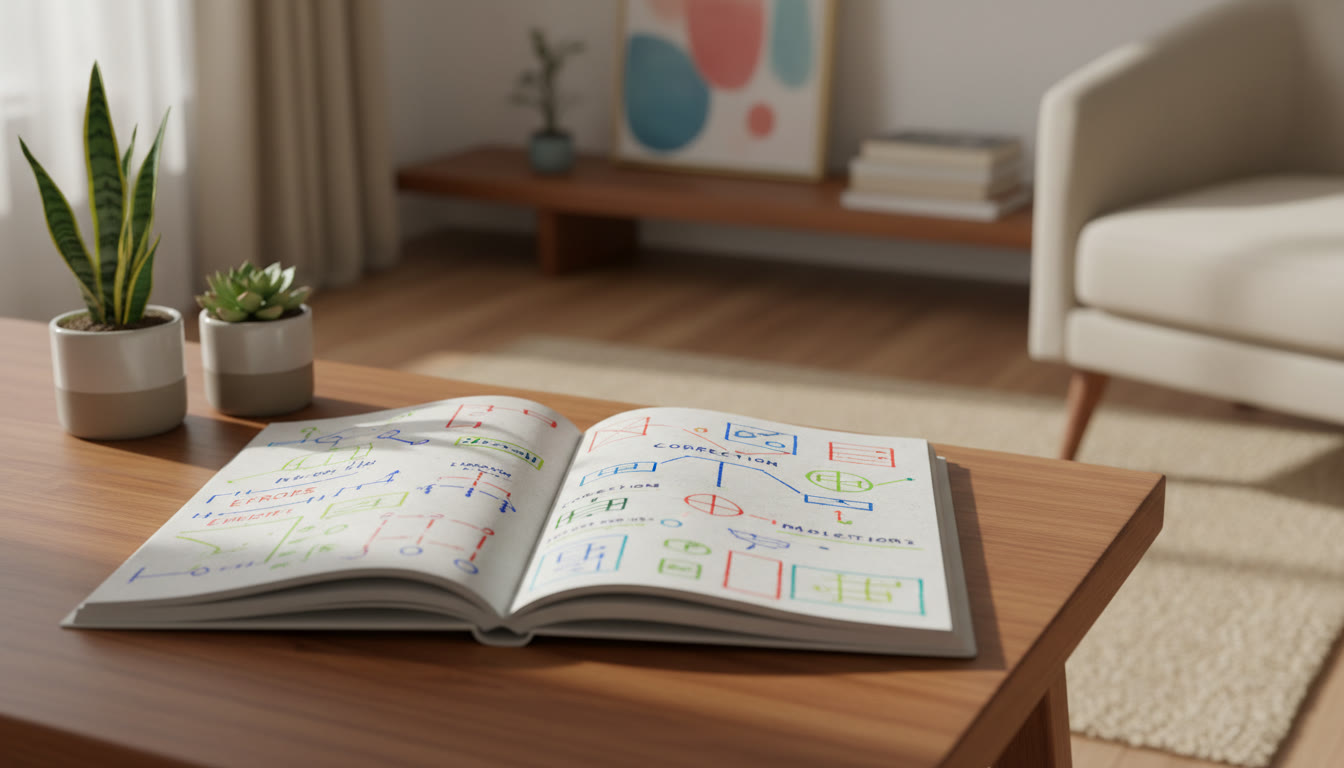
- Maintain an error log with three columns: Mistake, Root Cause, Fix Attempted — update it after every mock.
Final Notes on Mindset and Mock Discipline
Mock tests are practice: treat each one as data, not as destiny. PYQs turn practice into a guided experiment — they show what works and what doesn’t. Keep the process scientific: hypothesise (why you missed the question), test (apply the fix in the next mock), and measure (did the error disappear?). Over time the noise reduces and your score becomes a reliable signal of preparedness.
Practically, good practice is simple: simulate the three-hour rhythm, respect negative marking discipline, split chemistry preparation into physical/organic/inorganic micro-blocks, and run a weekly audit driven by PYQ clusters. Use targeted tutoring or analytics to accelerate fixes when patterns repeat — but keep the final control in your hands through disciplined mock cycles and a tight error-log habit.
Closing thought: PYQs are an invitation to think like the examiner — to prefer clarity over cleverness, consistent set-up over ad-hoc workarounds, and steady accuracy over speed-for-speed’s-sake. Let each mock be a lesson; let each lesson be small and specific; and let your mock routine be the engine that converts those lessons into consistent scores.
End of academic analysis.





















No Comments
Leave a comment Cancel