

JEE Main PYQ Mistakes to Avoid: Turn Past Papers into Precision Practice
Why previous-year questions (PYQs) are a goldmine — and a trap
There’s something irresistible about a stack of PYQs: familiarity, patterns, and the comforting feeling that if you can solve last year’s paper, you’re ready. That feeling is true — but incomplete. PYQs become a goldmine only when you treat them as diagnostic tools, not as a cheat-sheet to be memorized. Left untreated, five harmless habits around PYQs can quietly cost you dozens of marks in mock tests and the real examination.

Start here: the exam realities your mock must respect
- MCQ-based testing demands accuracy under time pressure — practice should replicate that format.
- A full-length mock is a 3-hour simulation — treat it like exam day to train stamina and focus.
- Negative marking exists — guessing without a plan hurts your score growth.
- Simulate answer-marking discipline (OMR-style or device-based) so you don’t lose marks to silly marking errors.
- Align PYQ practice strictly with the syllabus areas in Physics, Chemistry, and Mathematics; use questions to reveal conceptual gaps, not to collect “favorites.”
Big-picture mistakes students make with PYQs (and how to fix them)
1. Treating PYQs like an answer bank
Mistake: Memorizing steps or final answers and moving on. This creates fragile “pattern memory” that collapses the moment a problem is shuffled or reworded.
Fix: Convert every PYQ into a concept-card. After solving, label the question by the underlying concept (for example, ‘conservation of energy — rotational dynamics’) and write a one-line summary of why the chosen approach works.
2. Running mock tests without test-like conditions
Mistake: Doing a “mock” with interruptions, phone notifications, or with open notes. The timing and pressure are missing, so the score is meaningless.
Fix: Schedule a strict 3-hour slot. Turn off notifications. Use a single device or a printed OMR template if practicing offline to recreate marking discipline.
3. Ignoring negative-marking psychology
Mistake: Random guessing, or using a habit of “guess until someone says stop.” Negative marking penalizes thoughtless risk-taking.
Fix: Build a guessing policy: attempt only when you can eliminate at least one or two options or when you have a clear probabilistic advantage. Practice that policy consistently in mocks so it becomes automatic under pressure.
4. Shallow error analysis
Mistake: After a mock, students look at right/wrong but don’t dig into root causes. Result: same mistakes reappear.
Fix: Use an error log (see the table below). Record not just what you missed, but why — concept gap, careless arithmetic, misread question, or time-pressure rush — and assign a corrective drill.
5. Cherry-picking PYQs that feel “easy”
Mistake: Preferring only the attractive or “clean” PYQs that confirm confidence.
Fix: Force balance. Every week, mix 60% new-challenge PYQs with 40% revision of previous weak areas. The more you expose weaknesses, the faster they vanish.
Practical tools: a table to turn mistakes into actions
| Mistake | Why it happens | Quick fix | Practice drill (one example) |
|---|---|---|---|
| Treating PYQs as answer banks | Surface memorization; pattern recognition without concept mapping | Create a 1-line concept card for every PYQ | Solve 10 PYQs, write concept cards, next day explain each out loud in 5 minutes |
| Poor simulation of test conditions | Comfy environment, interruptions, wrong timing | Strict 3-hour mock with no notes, phone off | Weekly full-length mock done under timed rules |
| Bad guessing habits | Emotional impulse to attempt every question | Adopt a mathematically defensible guessing rule | During practice, mark “confident / eliminable / guess” and review outcomes |
| Shallow analysis | Time pressure to move on; discomfort with mistakes | Use an error log with causes and corrective drills | After every mock, spend 60–90 minutes on structured analysis |
How to structure your mock-test routine (actionable week plan)
The goal of a mock-test routine is to create a repeating loop: simulate → analyze → repair → re-test. Here’s a practical weekly cycle you can adapt.
Weekly mock-test cycle (example)
- Day 1: Full-length 3-hour mock (strict simulation).
- Day 2: Deep error analysis (60–90 minutes). Build concept cards and fill the error log.
- Day 3: Targeted concept repair — 2 focused study blocks on the weakest topics.
- Day 4: Short timed sectional practice (45–60 minutes per section) emphasizing weak areas.
- Day 5: Mixed problem set — include 30% PYQs and 70% fresh problems on the repaired concepts.
- Day 6: Light revision and active recall. Do quick quizzes and review notes.
- Day 7: Rest or passive review — short conceptual reading and mentally rehearsing strategies.
Micro-routines inside a mock (what to do during the 3 hours)
- Spend the first 10 minutes skimming the paper and identifying low-effort questions.
- Maintain an on-paper mark system: star for revisit, tick for confident, G for guess.
- Reserve the last 25–30 minutes exclusively for review and checking calculations.
- When stuck for more than 2.5–3 minutes on a question, mark and move on — speed matters.
Subject-specific PYQ pitfalls and how to neutralize them
Physics
Common slip-ups: missing assumptions, unit errors, and skipping diagrams. Fix these by habitually drawing quick free-body or circuit sketches, writing units in every step, and explicitly listing assumptions (ideal frictionless surfaces, point masses, small-angle approximations, etc.). Use PYQs to practice this habit until it costs zero extra time.
Chemistry
Common slip-ups: rote memorization instead of reasoning, misreading reaction conditions, and neglecting state or concentration constraints. Fix this by converting memorized facts into “if-then” chains: if condition X, use mechanism A; otherwise, use pathway B. For organic and physical chemistry, replicate PYQ variations so you learn to reason through novel conditions.
Mathematics
Common slip-ups: algebraic sloppiness, reading the question wrongly, and assuming intermediate steps. Fix by writing every substitution and labeling intermediate results clearly. When a PYQ looks like a plug-and-chug, force yourself to check edge cases and domain restrictions — these are frequent traps.
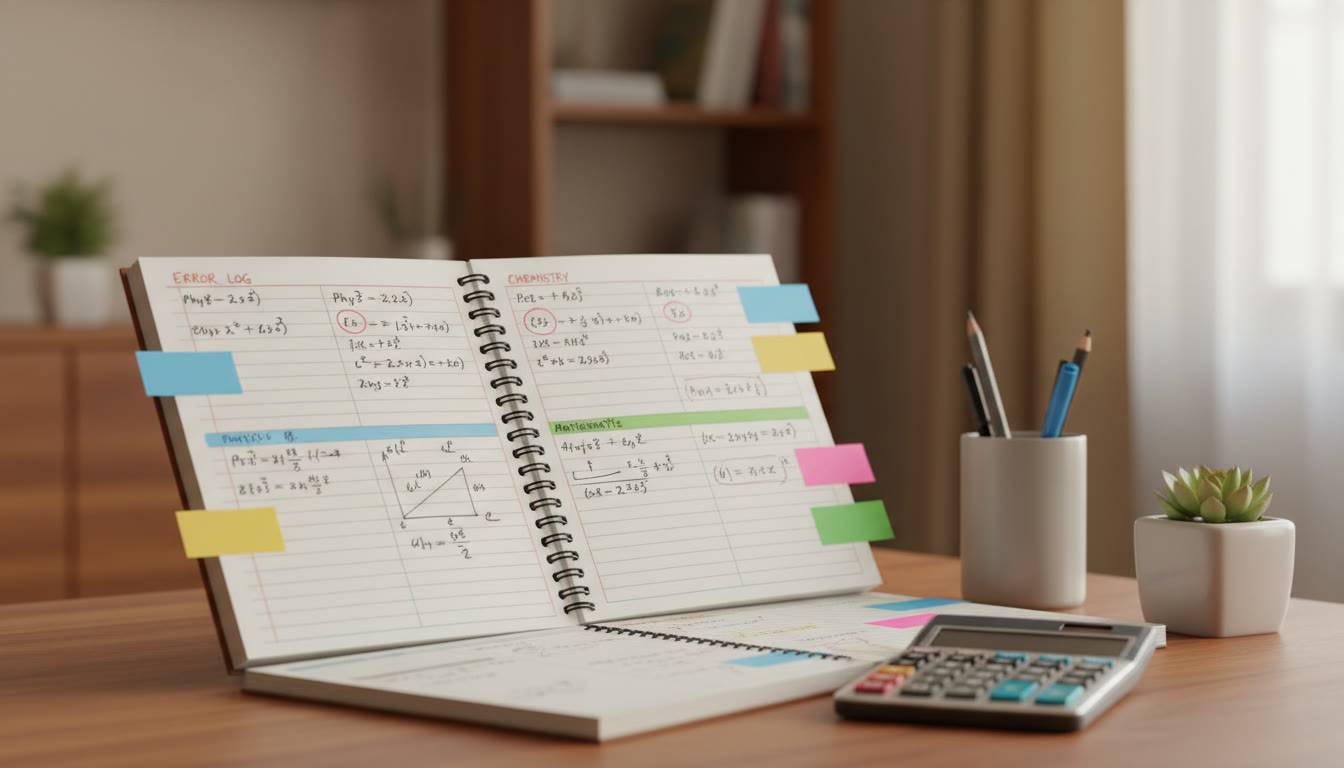
Concrete error-log template (use this after every mock)
| Date | Question No. & Source | Topic | Type of Mistake | Root Cause | Immediate Fix | Drill for next 2 weeks |
|---|---|---|---|---|---|---|
| 2026-XX-XX | Math Q12 (PYQ) | Integration: improper substitution | Concept gap | Did not consider substitution limits | Re-solve including limit adjustments | 10 substitution problems over 4 sessions |
Note: replace the example date row with your actual mock date entries. The key is consistency — the log is only useful when updated every single mock.
How to use PYQs for targeted revision (not just practice)
Map PYQs to syllabus granularity
Don’t keep PYQs in a generic folder. Tag each question with the exact syllabus topic — for example, ‘Electrostatics: potential due to ring’ not just ‘Electrostatics’. That granularity helps when you need to run a pinpointed 48-hour repair cycle before a test.
Vary the angle: reframe PYQs
Take a PYQ and rephrase it: change the parameter values, alter boundary conditions, or convert it from a conceptual item to a numerical one and vice versa. If you can answer the rephrased versions reliably, you own the concept.
Use timed mini-sets for stubborn topics
For any topic that shows repeated mistakes in your error log, create a timed 20–30 minute mini-set of 6–8 problems. Attack this set three times across the week and watch the error type migrate from ‘concept’ to ‘careless’.
How personalized help can fit into this routine
Self-driven correction is powerful, but targeted mentorship speeds the loop. If you reach a plateau — repeating the same error categories despite disciplined analysis — a tailored coach can spot hidden root causes: sub-optimal problem selection, inefficient algorithms, or exam-anxiety triggers. Personalized support like Sparkl can plug into your mock loop by providing one-on-one guidance, tailored study plans, expert tutors, and AI-driven insights that show which micro-skills to attack next. When used sparingly and strategically, that kind of support complements disciplined self-practice; it does not replace your mock-test habits.
Sample drills you can start tonight
- Timed elimination drill: 30 MCQs, 45 minutes. Objective: practice eliminating two options quickly.
- Careless-to-clean drill: Re-solve the last 10 wrong answers from your mock without a timer, writing down the exact thought process for each step.
- One-concept blitz: Choose a recurring weak topic and solve 12 mixed-difficulty PYQs on it over two sessions.
- Review sprint: Spend 25 minutes reviewing your concept cards aloud; teaching aloud cements recall.
Small habits that compound into big improvements
- Keep a tiny notebook for “1-minute fixes” — one-liners you can review on commutes or breaks.
- Color-code your error log: red for concept gaps, orange for procedural errors, green for careless slips.
- After each mock, write down one behavior to change in the next test (for example, “spend 10 fewer minutes on section 2”).
- Use spaced repetition for concept cards — revisit in 2 days, 7 days, 21 days.
When to seek targeted tutoring
Consider focused mentorship if any of the following applies: your mistakes are clustered around a single conceptual area despite repetitive practice; your mock scores oscillate without trend despite steady study hours; your test-day anxiety consistently creates time-sapping behaviors. In these cases, a tutor or a short block of personalized sessions can help refine strategy, diagnose stubborn habits, and rebuild confidence rapidly.
If you choose a guided pathway, look for help that integrates with your mock cycle — not something that simply gives more problems. The best support will analyze your error log, suggest a micro-plan, and coach you through the hardest weeks with measurable milestones.
Putting it all together: a compact 3-week repair plan for recurring PYQ mistakes
- Week 1: Identify and log. Run two full-length mocks; create concept cards and the error log for each wrong answer.
- Week 2: Repair by design. Run targeted drills for the top three recurring concepts and perform two timed mini-sets weekly.
- Week 3: Re-test under stress. Take three strict full-length mocks spaced out with focused repair sessions between them. Measure the reduction in repeated mistakes.
Final checklist before your next mock
- Have you scheduled a strict 3-hour block and cleared distractions?
- Is your guessing policy written and understood?
- Do you have an error-log template ready for immediate post-test use?
- Can you commit 60–90 minutes the day after the mock for deep analysis?
- Have you prepared two targeted drills for the weak topics you expect to surface?
Conclusion
PYQs and mock tests are mirrors — they reflect not just what you know, but how you think under pressure. The difference between repeating the same errors and steadily improving comes down to how you interpret those reflections: shallow score-chasing keeps you stuck; disciplined analysis, targeted drills, and realistic simulation turn past papers into reliable score-builders. Make your mock routine a closed loop of simulate → analyze → repair → re-test, and the mistakes you dread will become the stepping stones you rely on.



























No Comments
Leave a comment Cancel